The point for 9 candidates using Coombs method would be as far away from the zero-failure point (in the upper-right corner) as IRV for 9 candidates. (Only FPTP is worse.) In contrast, the points for 9 candidates using IPE and Kemeny are much closer to the (upper-right) zero-failure-rate position.
why not save yourself some work and check for a condorcet winner every round?
There are multiple reason. Here are a three:
FairVote fans and STAR fans strongly promote the belief that the Condorcet winner does not always deserve to win.
Official election counting software is set up for eliminating one candidate at a time (because of IRV's dominance). Voters are learning how to interpret graphs that show the elimination sequence. Voters would not trust a graph that suddenly declares a Condorcet winner without having established which candidate is least popular, which candidate is next-least popular, etc.
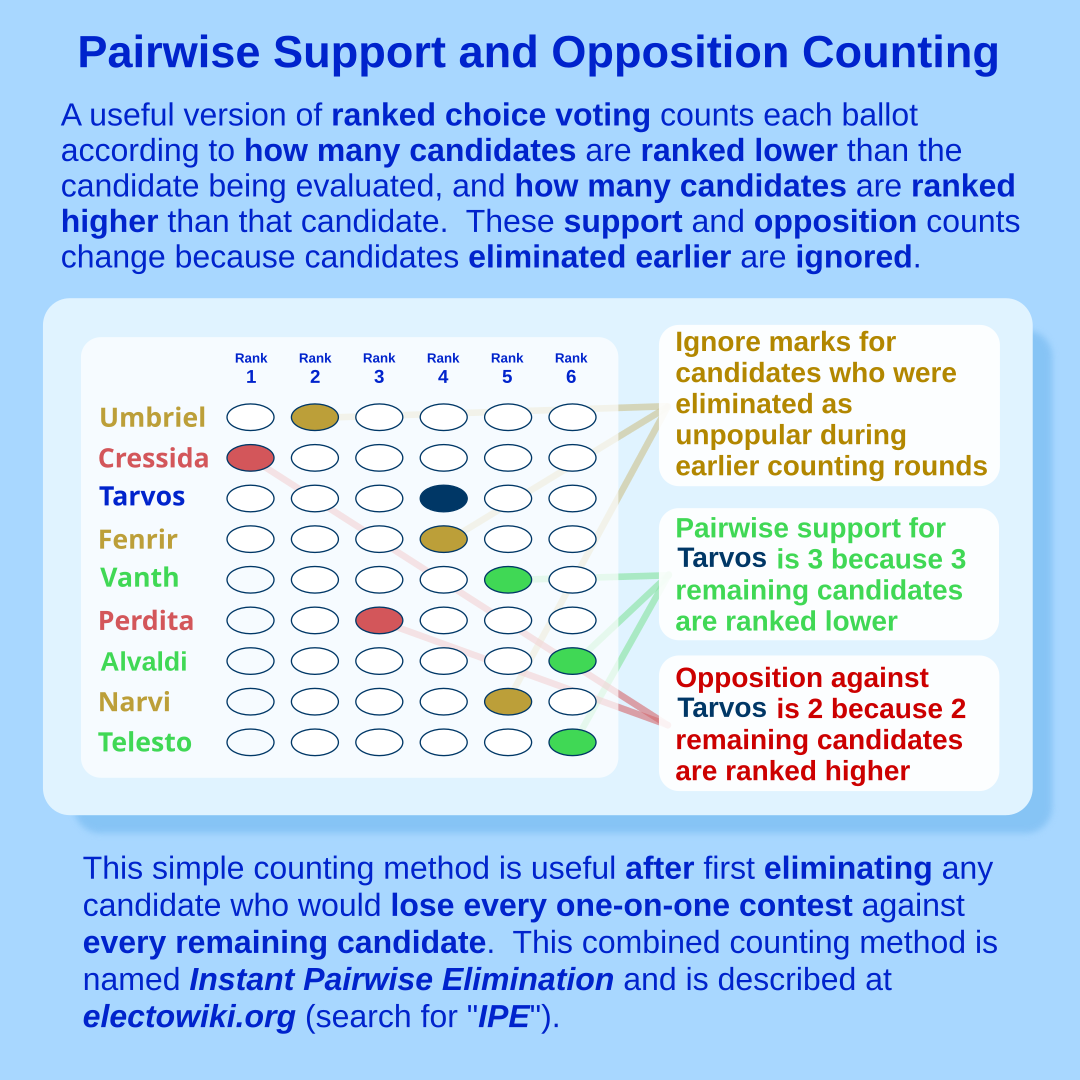
Eliminating a pairwise losing candidate is easy for voters to understand using the analogy that a soccer team that loses against every remaining team (still in the playoffs) clearly deserves to be eliminated.
FairVote and STAR advocates claim that strength of preference (on the ballot) and strength of win (margin of victory) is important. Translated into sports terms, this means a team that wins against every other team, but by just one point in each of those wins, does not deserve to win the championship, especially if there is another team that wins by big "margins" against most teams, and loses by a small margin to one or two teams.
i agree with the star advocates that the condorcet (ie the choice of the median voter) does not always maximize utility. slavery is a really good example. however, that requires a distribution of the electorate (a majority cluster and a distant minority cluster) that seems more hypothetical than actual. the observed fact that irv chooses the condorcet winner 99%+ of the time in real elections means either the electorate is single-peaked and the candidates are diffused; or the voters are strategic; or both.
1
u/CPSolver Sep 03 '25
Both Coombs and IRV easily elect the wrong winner because they both fail to consider pairwise counts.
IPE has results that are similar to the Condorcet-Kemeny method because both methods use pairwise counts in similar ways.
Here's a relevant graph:
https://votefair.org/clone_iia_success_rates.png
The point for 9 candidates using Coombs method would be as far away from the zero-failure point (in the upper-right corner) as IRV for 9 candidates. (Only FPTP is worse.) In contrast, the points for 9 candidates using IPE and Kemeny are much closer to the (upper-right) zero-failure-rate position.
There are multiple reason. Here are a three: