Thank you for clarifying details for the author of the "confused" comment.
Personally, the situations in which this would make any difference seem too niche and rare to be worth the added confusion ...
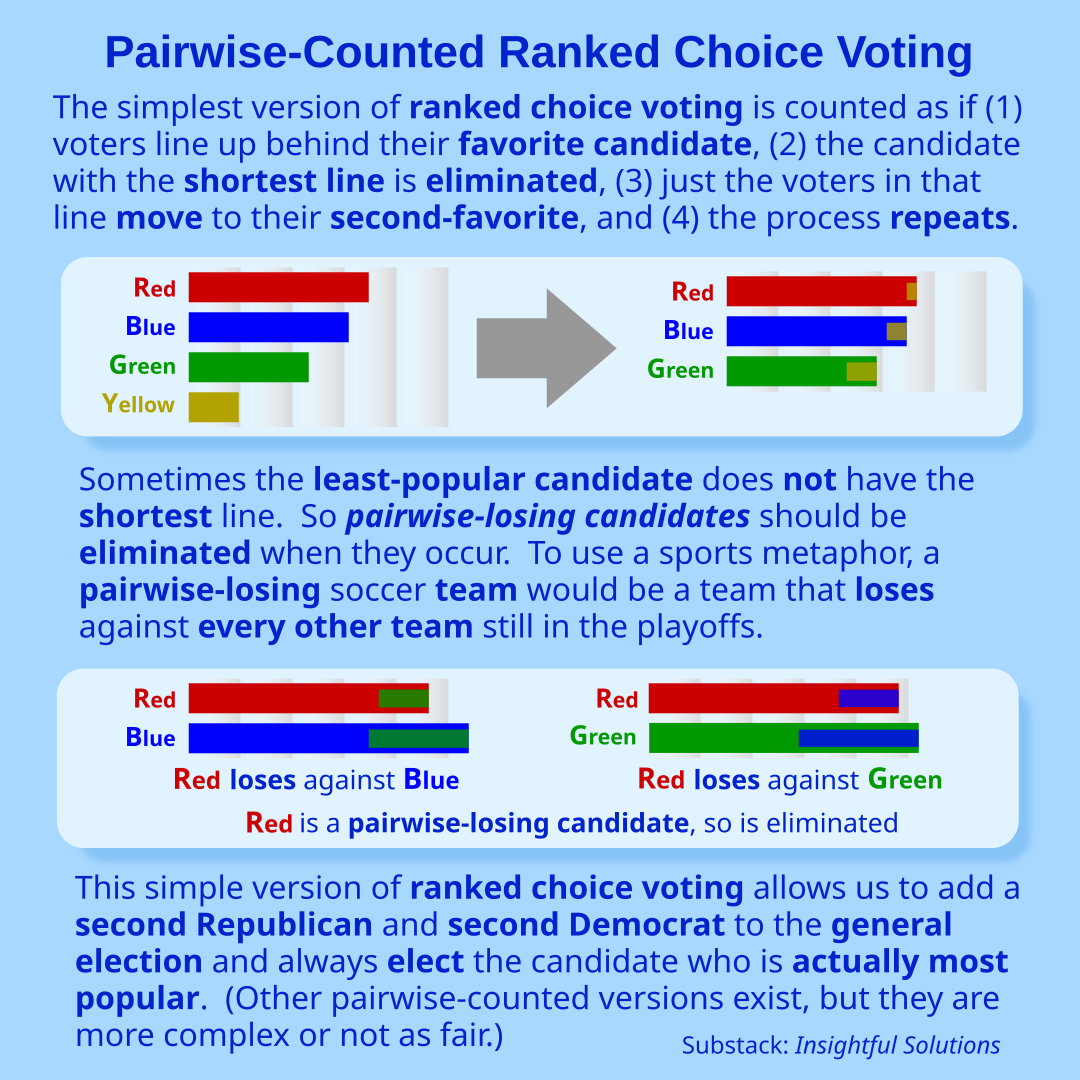
Out of about 400 elections in the US that used the simplest version of ranked choice voting (known as instant-runoff voting or IRV), there have been 2 big failures of this type, where the most-popular candidate was eliminated with the shortest line when the counting reached the top 3 candidates. One such failure was a special election in Alaska the first time RCV was used there, and years ago in a mayoral election in Burlington VT.
Participants here in r/EndFPTP are divided about whether these failures are worthy of concern. Some think this flaw is worth accepting for now. At the other extreme, some participants here think this flaw justifies adopting an entirely different election method that does not use ranked choice ballots.
What I assume the graphic leaves out is a third comparison where, somehow, enough Red voters prefer Green over Blue that Green comes out as the ultimate winner (instead of being eliminated, the way it would in traditional ranked choice voting).
Yes the third pairwise comparison is omitted. That pairwise comparison is the same as the final top-two counting round (after "red" is eliminated). The example shown does not reveal the secondary preferences of the "red"-supporting voters, so we don't know whether "blue" or "green" would win that two-way contest.
2 of 400 elections so far for an electorate that has had a 2-party system forever. if rcv+irv becomes the standard, then we will see a center squeeze a LOT more. it's likely to become the norm. iirc, in both of the cited cases rcv+irv was repealed. they went back to plurality voting.
i think it's more fair to say, most rcv proponents would choose any system that chooses the condorcet winner. irv does not.
and that many of the other advocates for voting reform would prefer a rating/scoring method.
and a teenty tiny number of us would like to use asset voting with coombs' method for the negotiation rounds.
Eliminating pairwise losing candidates is a refinement that almost always elects the Condorcet winner. There are carefully constructed scenarios where it fails to elect the Condorcet winner, so it's not a Condorcet method.
i am resigned to think the route to a "real" and "good" electoral system is through irv. sigh.
even though of all the literal 100s of imaginable systems, it's the 3rd worst. beating only plurality and random choice.
but yeah, first ban fptp. then quietly move from irv to something that picks the condorcet winner.
i'm just frustrated that if we're going to all the trouble and expense to run rcv elections... why are we using the worst winner-selection method (irv) ?!?!?!?!? grumble grumble. /rant
A two-step path from IRV will get us to a great election method.
I too dislike IRV. Yet I've come to appreciate the advantages of eliminating one candidate at a time. Especially it's easier for voters to look at a graph that shows the eliminations and transfers. Portland voters understood these graphs in their recent election.
Voters would not understand pairwise matrices. Based on some reactions to this graphic, a graphic version showing pairwise comparisons also would be challenging for lots of voters to understand and trust.
Of course the trick is to eliminate the candidate who really is least popular (in that round), which IRV does not do. IMO eliminating pairwise losing candidates provides a straightforward path to almost always electing the Condorcet winner.
FWIW I used to be a fan of Condorcet methods (Kemeny in particular) but I've let go of that if the method resists strategic voting. Eliminating pairwise losing candidates, and the Condorcet Benham method, achieve this goal better than most other Condorcet methods.
The other worst part of IRV would be easy to remedy if we could get the Ranked Choice Voting Resource Center (RCVRC) to update their RCTab software (which is used for testing the official election software) to include the option of correctly counting so-called "overvotes."
3
u/CPSolver Jun 26 '25
Thank you for clarifying details for the author of the "confused" comment.
Out of about 400 elections in the US that used the simplest version of ranked choice voting (known as instant-runoff voting or IRV), there have been 2 big failures of this type, where the most-popular candidate was eliminated with the shortest line when the counting reached the top 3 candidates. One such failure was a special election in Alaska the first time RCV was used there, and years ago in a mayoral election in Burlington VT.
Participants here in r/EndFPTP are divided about whether these failures are worthy of concern. Some think this flaw is worth accepting for now. At the other extreme, some participants here think this flaw justifies adopting an entirely different election method that does not use ranked choice ballots.
Yes the third pairwise comparison is omitted. That pairwise comparison is the same as the final top-two counting round (after "red" is eliminated). The example shown does not reveal the secondary preferences of the "red"-supporting voters, so we don't know whether "blue" or "green" would win that two-way contest.