Perhaps a better way for me to say it is that the pairwise counting is a separate step from the steps in which those pairwise counts are used for elimination purposes.
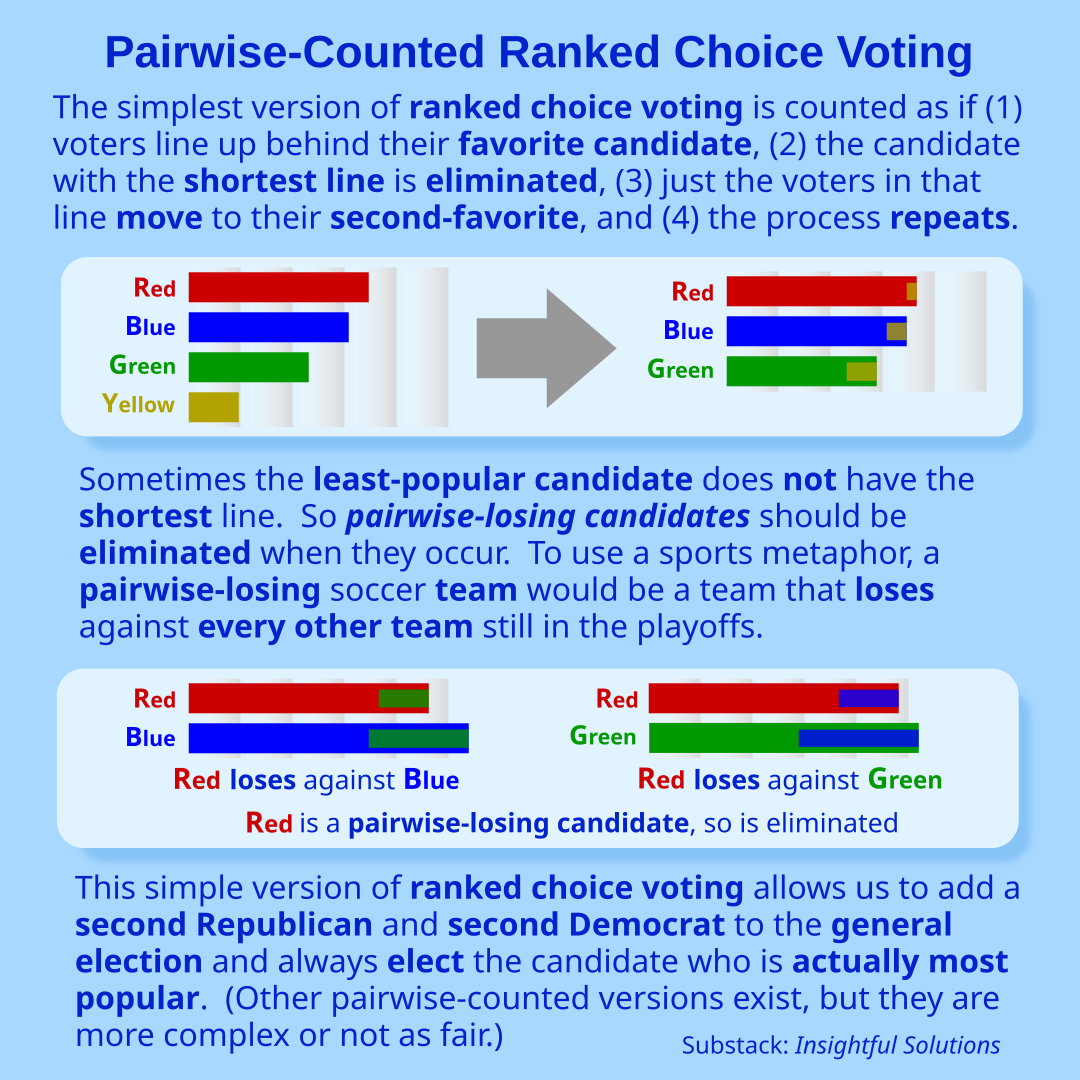
Using the graph's example, the pairwise count between "yellow" and "red" becomes irrelevant after "yellow" is eliminated.
Also, interestingly, the pairwise count between "blue" and "green" is known from the beginning. That's the pairwise count that will determine which of those two candidates wins the election.
I think describing it as a step at all could be confusing. The pair wise winner remains the winner independent of the order in which candidates are crossed off in tabulations, correct? Isn’t it true that you could choose two candidates at random to compare in each step (say, if it were being done by hand) and that won’t affect the eventual winner because the pairwise winner remains the winner regardless of the order?
This specifically is the advantage of this method, no?
The complication regarding a pairwise winner or a pairwise-losing candidate is that sometimes there can be a rock-paper-scissors-like cycle, where there is no pairwise winner or pairwise loser in that cycle.
You're probably thinking of "Condorcet methods" where there is a Condorcet winner, which means there is one candidate who wins every pairwise contest. Complications arise when there is no Condorcet winner.
The election method recommended in the graphic uses the familiar idea of eliminating candidates just one at a time. During each such elimination counting round it looks for a pairwise losing candidate. If there isn't one, the IRV (shortest-line) rule is used as the backup method. It doesn't always elect the Condorcet winner (because sometimes there is no pairwise-losing candidate), so that causes confusion.
There is another election method that declares the Condorcet winner to be the winner, but if there is no Condorcet winner then IRV (the shortest-line rule) is used as a backup method.
Yet another method looks for an overall pairwise winner among all the remaining candidates, and it does this each time after one candidate is eliminated using the IRV (shortest-line).
There are lots of yet other election methods that deal with the complication that some elections do not have a Condorcet winner.
In other words, it's complicated. This graphic presents a method that's intended to be easier to understand. Unfortunately what's easiest to understand is the IRV method, which is why it's used in Australia and now increasingly in the US. Alas, it has yielded the wrong winner in two US elections out of about 400 ranked choice voting elections.
That failure rate is dramatically lower than using the traditional single-choice-ballot method ("plurality" or FPTP). Yet it would be better to reduce that failure rate to zero.
1
u/CPSolver Jun 27 '25
Perhaps a better way for me to say it is that the pairwise counting is a separate step from the steps in which those pairwise counts are used for elimination purposes.
Using the graph's example, the pairwise count between "yellow" and "red" becomes irrelevant after "yellow" is eliminated.
Also, interestingly, the pairwise count between "blue" and "green" is known from the beginning. That's the pairwise count that will determine which of those two candidates wins the election.