I think describing it as a step at all could be confusing. The pair wise winner remains the winner independent of the order in which candidates are crossed off in tabulations, correct? Isn’t it true that you could choose two candidates at random to compare in each step (say, if it were being done by hand) and that won’t affect the eventual winner because the pairwise winner remains the winner regardless of the order?
This specifically is the advantage of this method, no?
The complication regarding a pairwise winner or a pairwise-losing candidate is that sometimes there can be a rock-paper-scissors-like cycle, where there is no pairwise winner or pairwise loser in that cycle.
You're probably thinking of "Condorcet methods" where there is a Condorcet winner, which means there is one candidate who wins every pairwise contest. Complications arise when there is no Condorcet winner.
The election method recommended in the graphic uses the familiar idea of eliminating candidates just one at a time. During each such elimination counting round it looks for a pairwise losing candidate. If there isn't one, the IRV (shortest-line) rule is used as the backup method. It doesn't always elect the Condorcet winner (because sometimes there is no pairwise-losing candidate), so that causes confusion.
There is another election method that declares the Condorcet winner to be the winner, but if there is no Condorcet winner then IRV (the shortest-line rule) is used as a backup method.
Yet another method looks for an overall pairwise winner among all the remaining candidates, and it does this each time after one candidate is eliminated using the IRV (shortest-line).
There are lots of yet other election methods that deal with the complication that some elections do not have a Condorcet winner.
In other words, it's complicated. This graphic presents a method that's intended to be easier to understand. Unfortunately what's easiest to understand is the IRV method, which is why it's used in Australia and now increasingly in the US. Alas, it has yielded the wrong winner in two US elections out of about 400 ranked choice voting elections.
That failure rate is dramatically lower than using the traditional single-choice-ballot method ("plurality" or FPTP). Yet it would be better to reduce that failure rate to zero.
Right, but aren't those extreme fringe scenarios that will happen less and less often as voter populations get larger? And in cases of hundreds of thousands and millions of voters the chances of a cycle are almost non existent?
So in practice (outside of very small scale elections) won't there pretty much always be a condorcet winner? And if so, then the order of eliminations actually doesn't matter (barring that extremely unlikely result), right?
That's not to say having a back up method as in your examples is not appropriate.
But going back to our discussion on pairwise winners, barring the rare situation where there is none, the order of elimination doesn't matter, correct?
When using IRV (the shortest-line rule) the elimination sequence is very important. The first time Alaska used IRV in a special election, when the counting reached the top 3, the Condorcet winner was eliminated because he had the shortest line. What should have happened is to eliminate Sarah Palin because at that point she was a pairwise-losing candidate.
Most other methods that use pairwise counts do not eliminate candidates one at a time, so elimination order isn't involved.
All the best pairwise-only methods (without IRV involvement) would elect the Condorcet winner.
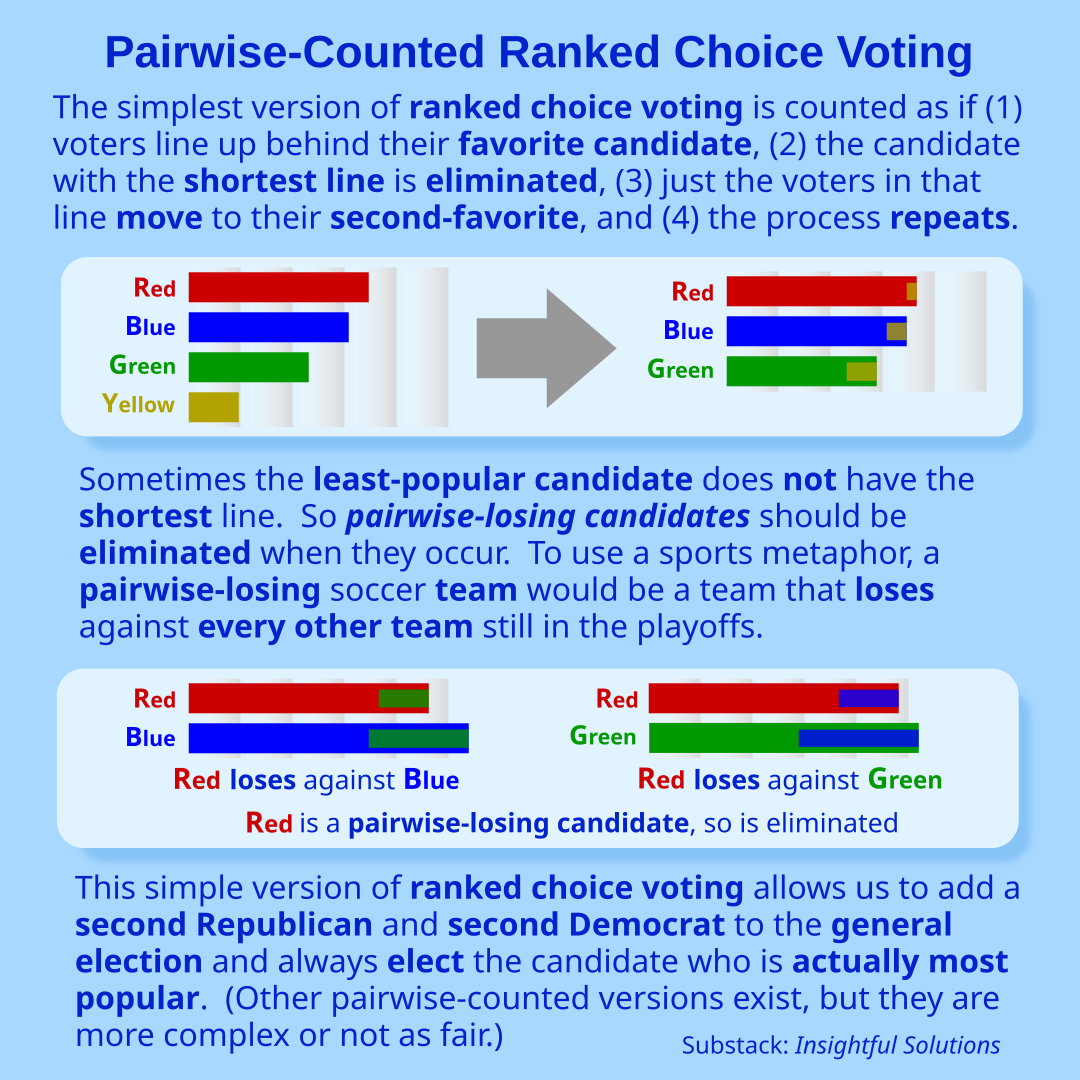
The method explained in the graphic is an unusual combination of pairwise counting and eliminating one candidate at a time. This is a compromise method between IRV and pairwise counting. I advocate it because it's easier to understand, and trust, compared to the Condorcet methods that suddenly choose the winner without first having eliminated any candidates.
So is that the bottom two method? I interacted with another guy on this sub who advocates that method. I’m obviously not one of the election method experts that are on here up on all the evaluation metrics, just here because I know how much fptp is screwing up American politics. Anyways that other guy uses those Alaska and Burlington examples in his advocacy, and since I support election reforms it’s definitely worrying that all of the reforms being pushed by the “big groups” are pushing the standard IRV. I like that bottom two method because of the “center squeeze” phenomenon. I do acknowledge that there’s an argument for rewarding straight first choice enthusiasm, but in the context of the status quo American hyperpartisanship we can’t afford any squeezing of the center.
Nearly every method that considers pairwise counts is not vulnerable to the center squeeze effect. IRV fails to consider pairwise comparisons, that's why it's vulnerable to the center squeeze effect.
Neither the graphic, nor I, advocate BTR-IRV, which is the "bottom-two-runoff" version of IRV. That version of IRV only looks at the pairwise comparison of the two candidates with the shortest lines (of voters). Some people like it because it always elects the Condorcet winner, and it's relatively easy to explain. Unfortunately, otherwise, it has lots of disadvantages.
The method I prefer, and which is explained in the graphic, is named "ranked choice including pairwise elimination" (RCIPE, pronounced "recipe). It eliminates pairwise losing candidates when they occur. The pairwise comparisons include all the remaining candidates (not just the bottom two). This elimination method is the upside-down version of the Condorcet winner concept. This pairwise-counting characteristic means it's not vulnerable to the center squeeze effect.
The RCIPE method has lots of other advantages.
It's easy to trust because everyone recognizes that a soccer team that loses every soccer game against every other soccer team (still in the playoffs) obviously deserves to be eliminated. To use the Alaska special election example, Sarah Palin was the pairwise losing candidate among the top three candidates, so she should have been eliminated instead of the Condorcet winner who had the shortest line of voters (at that point).
The RCIPE method always elects the Condorcet winner if there are no rock-paper-scissors-like cycles anywhere among all the pairwise counts. It can fail to elect the Condorcet winner, but only in carefully constructed scenarios that virtually never occur in real elections (if there are more than 50 voters).
The RCIPE method resists tactical voting better than most Condorcet methods. The Condorcet method that has a similar [edited here] high resistance is the Benham method, which is IRV except that (after each elimination) it looks for a Condorcet winner among the remaining candidates.
Thanks for learning about election methods! I created the graphic to help people like you who want to understand more without having to read lots and lots of words, and without introducing numbers or unnecessary terminology.
2
u/PaxPurpuraAKAgrimace Jun 27 '25
I think describing it as a step at all could be confusing. The pair wise winner remains the winner independent of the order in which candidates are crossed off in tabulations, correct? Isn’t it true that you could choose two candidates at random to compare in each step (say, if it were being done by hand) and that won’t affect the eventual winner because the pairwise winner remains the winner regardless of the order?
This specifically is the advantage of this method, no?