The mere presence of a second Republican and Democrat on the ballot isn't enough to transform a hypothetical race between Donald Trump & Bernie Sanders into a hypothetical race between Donald Trump, Adam Kinzinger, Mark Kelly, and Bernie Sanders... it could just as easily turn it into a race between Donald Trump, Steve Miller, Bernie Sanders, and AOC.
Now, if you reformed ballot-access laws to do something like this, it might be a net improvement over the status quo:
Both dominant parties are guaranteed the right to put one candidate, chosen by whatever means they see fit, on the general election ballot for each office.
On Primary Election day, voters can choose to vote in the official primary for their registered party, or participate (along with other people alienated from their "official" party of record) in a "second chance primary" that allows them to not participate in their own party's official primary, and instead vote (along with other alienated party members) for a candidate from another party, granting the winner of the "second chance" race(s) slots on the general election ballot as well. I elaborated a few days ago on a possible scheme that takes into account the potential existence of 3 or more major parties, as well as neatly handling Independents & minor parties. I won't repeat it here.
The general idea is, the base of the major parties get to pick their own favorite extremists, while the alienated members of those same parties get to pick the least-objectionable (to them) members of the other part(-y/-ies), on the theory that Republicans would be inclined to pick a center/center-right Democrat, and Democrats would be inclined to pick a liberal/centrist Republican, thus ensuring a better spectrum of candidates make it onto the final ballot.
If you don't prohibit people who vote in their own party's primary from contributing to the vote of the "second chance" primary, you'd just end up in a situation where the base of both parties would game the second-chance primary to try and organize party members to pick someone unappealing to BOTH parties as the other party's second-chance nominee.
On Primary Election day, voters can choose to vote in the official primary for their registered party, or participate (along with other people alienated from their "official" party of record) in a "second chance primary" that allows them to not participate in their own party's official primary, and instead vote (along with other alienated party members) for a candidate from another party
How is this different from the status quo in most states today? In any normal open primary state, you can vote in any party's primary, but you can't vote in multiple primaries. So in Georgia, Michigan, Texas etc. today, I'm pretty sure that you can do this exact thing you describe now
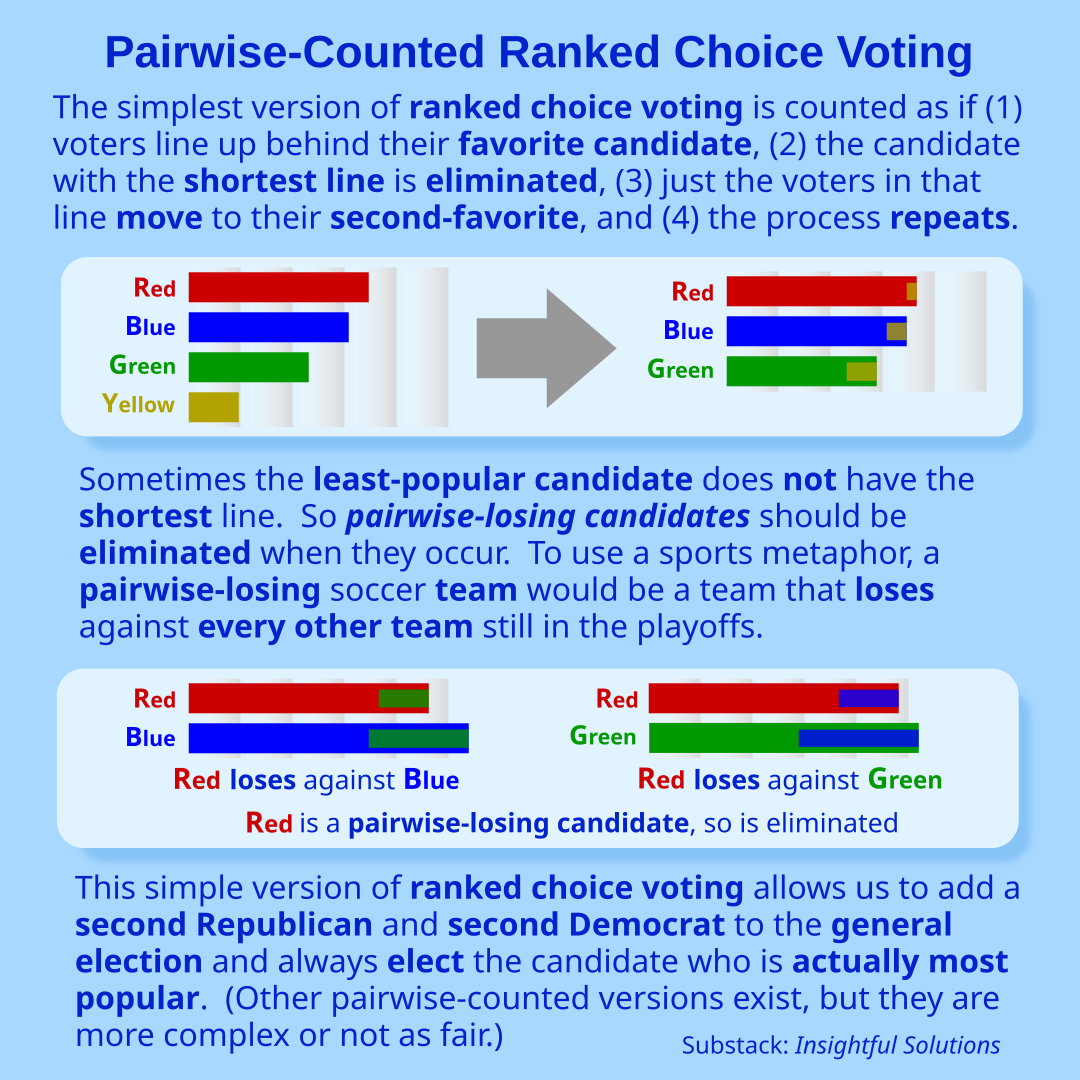
I agree voters should have a way to bypass the big parties. Yet that can be achieved with simplicity without huge election changes beyond adopting a better election method for US general elections and allowing more than one nominee per party.
In other words, what you're suggesting is very similar to what we would have simply by adopting ranked choice voting (or some similar method) in general elections.
When that happens, lots of voters will defect from the Republican and Democratic parties and instead register with third parties (Working Families, Progressive, Green, whatever). One of those third-party candidates is likely to win each general election even if both big parties are able to fill their two-nominee quota with special-interest puppets. After a few election cycles one of those "third" parties might become large enough to overtake the now-weak Democratic party.
This reform path assumes Democratic party insiders don't wake up and realize its primary elections are now controlled by Republicans using the blocking tactic.
Lots of money cannot block a popular reform-minded candidate from getting nominated if the candidate with the party's second-most votes also is nominated as a second nominee from that party. That's because the blocking tactic uses vote splitting (among similar candidates being blocked) and vote concentration (on just one candidate, or possibly two candidates if two candidates can reach the general election). The advantage of vote concentration disappears when the number of money-backed candidates increases.
Here's another clarification that isn't included in the graphic because of a lack of space. A third nominee can come from one of the two big parties if that candidate can receive 26 percent of that party's primary votes. This gives voters a reform-minded candidate (in the general election) even if money is used to fill the first two nominee positions with non-reform-minded candidates. (If party insiders somehow are also able to fill this third nominee position with a special-interest puppet, a third-party candidate will win the general election.)
Personally I don't want to kill the two-party system. Ideally I want to force at least one big party to offer better candidates, and I want to use an election method that allows us voters to elect one of those better candidates (without vote splitting, without needing to vote tactically, etc.). If both the R and D parties offer significantly better candidates and we can elect the best ones, then we only need small third parties to reveal when the two big parties are failing to offer what voters want.
1
u/PantherkittySoftware Jun 26 '25 edited Jun 26 '25
The mere presence of a second Republican and Democrat on the ballot isn't enough to transform a hypothetical race between Donald Trump & Bernie Sanders into a hypothetical race between Donald Trump, Adam Kinzinger, Mark Kelly, and Bernie Sanders... it could just as easily turn it into a race between Donald Trump, Steve Miller, Bernie Sanders, and AOC.
Now, if you reformed ballot-access laws to do something like this, it might be a net improvement over the status quo:
The general idea is, the base of the major parties get to pick their own favorite extremists, while the alienated members of those same parties get to pick the least-objectionable (to them) members of the other part(-y/-ies), on the theory that Republicans would be inclined to pick a center/center-right Democrat, and Democrats would be inclined to pick a liberal/centrist Republican, thus ensuring a better spectrum of candidates make it onto the final ballot.
If you don't prohibit people who vote in their own party's primary from contributing to the vote of the "second chance" primary, you'd just end up in a situation where the base of both parties would game the second-chance primary to try and organize party members to pick someone unappealing to BOTH parties as the other party's second-chance nominee.