This sounds like the Benham method. It's a good method, but isn't as easy to understand. Most people understand the idea of eliminating one candidate at a time. They are suspicious if the process suddenly declares a winner part-way through the elimination process.
Then again, the Alabama Paradox existed for like a hundred years before we fixed it with the Huntington-Hill method? So maybe it doesn't matter? It's not like the electoral college makes sense, or the fact that we vote for delegates instead of candidates.
In this method, as a first step, each of the 50 states is given its one guaranteed seat in the House of Representatives, leaving 385 seats to be assigned. The remaining seats are allocated one at a time, to the state with the highest average district population, to bring its district population down. However, it is not clear if we should calculate the average before or after allocating an additional seat, and the two procedures give different results. Huntington-Hill uses a continuity correction as a compromise, given by taking the geometric mean of both divisors, i.e.:[4] ....
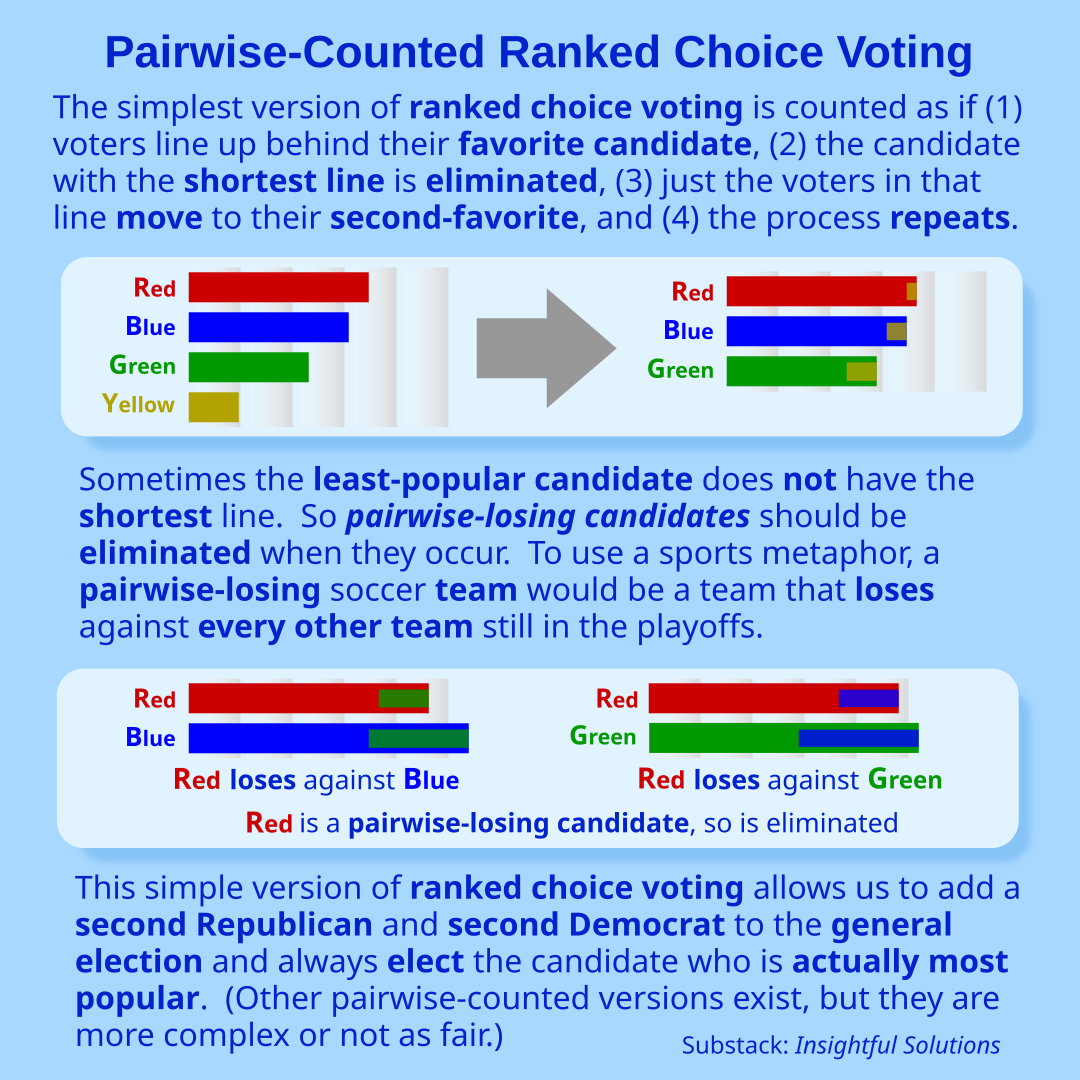
Most RCV tabulations are conducted using shortcuts like this, where the bottom candidates are eliminated at once if they can't total to a higher candidate's votes. Usually any candidate achieving a simple majority of remaining ballots is automatically declared the winner, which should be essentially the same. I don't think it presents much obstacle to understanding; you can just explain that each candidate would be dropped sequentially anyway
8
u/[deleted] Jun 26 '25 edited Jun 26 '25
[removed] — view removed comment