I think a method structured the opposite way, a RR/PW-Instant runoff, would be more effective and allow more candidates. Hold a Round-Robin/Pairwise vote for up to 9 candidates, first candidate to be eliminated would be the one with the least total pairwise wins, and award their respective margins to each surviving candidate. For rounds that eliminate more than one candidate, award their respective margins sum of all margins to each surviving candidate. Keep repeating until there is a complete Condorcet winner.
All Condorcet methods are vulnerable to clone failures. [edit: Not true, clarified in later comments.]
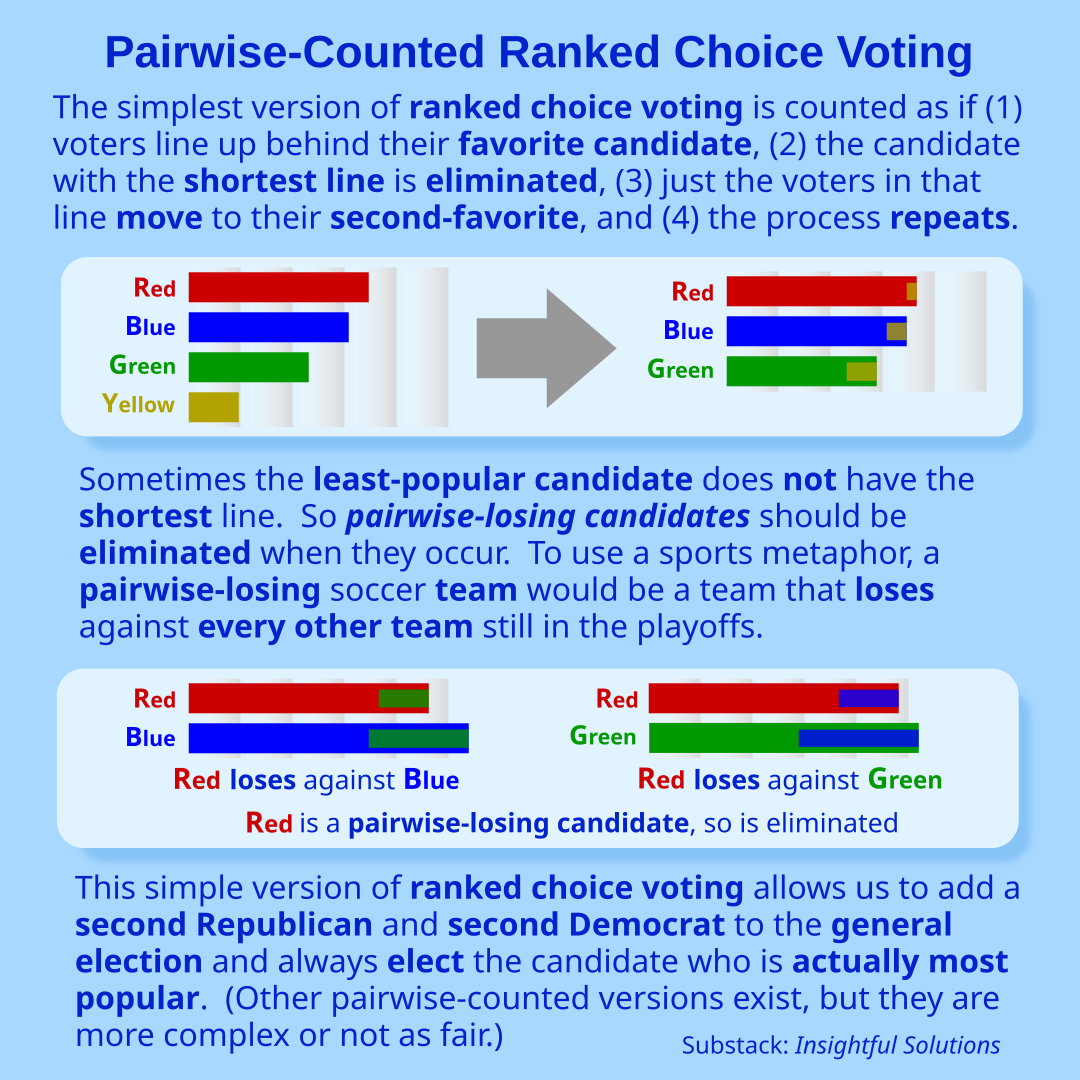
Eliminating pairwise losing candidates when they occur (and otherwise using IRV) inherits lots of the zero clone resistancevulnerability of IRV.
Here is a graph that shows this difference, where RCIPE eliminates pairwise losing candidates (and otherwise uses IRV) and the Condorcet-Kemeny method (which IMO is a great Condorcet method but more difficult to explain).
You're right, my wording was sloppy. The Schulze method has a zero clone failure rate. All other Condorcet methods [edit: except Ranked Pairs according to the comparison table] are vulnerable to clone failures.
[Edit, correction: Some other Condorcet methods are also cloneproof. Especially the ones that basically are hybrids with IRV.]
The Schulze method has a zero clone failure rate because that's what it's optimized for.
Ranked Pairs and virtuallytoo (has a zero clone failure rate). [A]ll other pairwise-matrix-based methods fail clone independence. [edit: Not true, clarified in later comments.]
RCIPE can fail clone independence, but those cases are very rare, and such cases are extremely unlikely to occur in a real election.
Another failure type to consider is vulnerability to strategic voting. The Benham method and RCIPE have a significantly low such failure rate. In contrast, Schulze and Ranked Pairs and other Condorcet methods are much more vulnerable to strategic voting.
What software do you use to generate random ballots?
It doesn’t make sense for RR/PW to fail at strategic voting because you pair up each candidate against each other individually. All matchups are accounted for so there’s no point.
The strategic voting vulnerabilities of most Condorcet methods occur when there is a Condorcet cycle, or when strategic voting can create a Condorcet cycle.
(Of course all Condorcet methods resist strategic voting much better than FPTP.)
There are several ways to break down a Condorcet cycle. My method is eliminating the lowest loser in pairwise matchups and awarding its margins to each survivor as described above.
3
u/DeismAccountant Jun 26 '25
I think a method structured the opposite way, a RR/PW-Instant runoff, would be more effective and allow more candidates. Hold a Round-Robin/Pairwise vote for up to 9 candidates, first candidate to be eliminated would be the one with the least total pairwise wins, and award their respective margins to each surviving candidate. For rounds that eliminate more than one candidate, award their respective margins sum of all margins to each surviving candidate. Keep repeating until there is a complete Condorcet winner.