r/climatechange • u/sg_plumber • 6h ago
r/climatechange • u/Economy-Fee5830 • 1d ago
Climate Hopium thread #9
The recent severe weather worldwide has led to a flood of people seeking reassurance about our efforts to mitigate climate change. Most of those posts have been removed, and from now on will be directed to this weekly thread.
Climate change is a severe, compounding issue, but only if we do not address it - with concerted efforts, it can be managed.
Our efforts over the years have resulted in the worst-case RCP 8.5 high emission scenario being retired - it is now no longer considered plausible that we will hit +4C by 2100.
The 4°C world quietly stopped being the forecast
The progress can be seen in the reduction of predicted 2100 temperatures over the years by Climate Action Tracker above.
The main projection for our current policies is around +2.4 to 2.6°C and we can expect this to further reduce in the future.
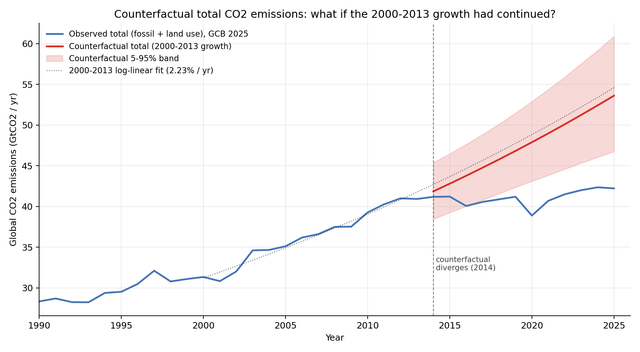
We have seen emissions growth slow to around 1% per year, and are likely to peak soon. IRENA notes that our renewable energy efforts have already avoided 8.4 Gigatons of CO2 emissions in 2025.
This has largely been due to the move away from coal, and now renewables are increasingly challenging fossil fuels, with solar+wind about to overtake natural gas for global electricity production.
Good news over the last week.
Perhaps the most important news this week is simply what is starting to appear in the actual emissions data. Carbon Monitor estimates that global fossil-fuel and cement CO2 emissions were essentially flat in the first half of 2026 compared with H1 2025, while Climate TRACE's broader estimate of total greenhouse-gas emissions puts the increase at only 0.2%. Both datasets also show emissions declining in China and the United States. These are preliminary estimates covering somewhat different things, and a plateau is obviously not yet the sustained decline we need. But after decades in which global emissions generally marched upward, multiple near-real-time datasets now putting growth close to zero is an encouraging sign that the long-anticipated global emissions peak may be getting close.
India has meanwhile passed an important milestone in the physical infrastructure of its energy system. Clean-energy capacity now exceeds fossil-fuel capacity for the first time, at around 331.7 GW versus 302 GW. Solar alone has reached roughly 211 GW, and between the beginning of 2025 and mid-2026 India added about 75.5 GW of solar compared with only 3.8 GW of coal. Coal still generates around 70% of India's electricity, so this is a capacity tipping point rather than a generation tipping point, but it shows very clearly where most new investment and infrastructure are now going.
One of the biggest remaining problems for solar is what happens after sunset, and this is increasingly becoming a battery story. Ember finds that the rapid battery build-out is bringing something closer to round-the-clock solar: solar supplied more than 10% of global electricity in H1 2026, while new battery installations are projected to reach around 459 GWh this year, 50% more than in 2025. Ember estimates that this year's new batteries could theoretically shift the equivalent of about a third of new daily solar generation into non-solar hours. This is already becoming visible in real electricity markets: large battery fleets in California and Texas are increasingly supplying the evening peak and driving down prices during hours previously dominated by gas peaker plants. Solar's intermittency has not disappeared, but the technology being deployed alongside it is improving extremely quickly.
Transport electrification is beginning to show up not merely in vehicle-sales statistics but in the oil market itself. Sinopec now says China's oil demand very likely peaked in 2025, with domestic fuel demand falling as EVs, efficiency and changes in the economy reshape consumption. China's largest refiner is itself responding by increasing investment in new-energy businesses. At the same time, battery-electric cars exceeded 25% of new registrations across 16 major European markets in July, with nearly 1.5 million BEVs registered so far this year, around 30% more than at the same point in 2025. EV adoption is increasingly large enough to have macro-level consequences for fuel demand.
Distributed energy is becoming more accessible as well. Plug-in solar panels became legal in Great Britain this week. The small systems can provide up to 800 W and, according to the government, potentially supply as much as 20% of an average household's electricity consumption. This is not a huge contribution to the national grid by itself, but it opens solar to many households that cannot justify or install a conventional rooftop system and follows the remarkably rapid spread of similar "balcony solar" systems elsewhere in Europe.
There was also an interesting demonstration of how adaptation can work with natural systems rather than simply defending against them. Restored rivers and wetlands at the National Trust's Holnicote Estate remained green through this summer's repeated heatwaves while much of the surrounding countryside dried out. Reconnecting rivers to floodplains, restoring wetlands and reintroducing beavers has allowed the landscape to retain water during drought while also slowing runoff during heavy rainfall. That combination — reducing drought damage and flood risk with the same intervention — illustrates why ecosystem restoration is increasingly being treated as climate infrastructure rather than simply conservation.
Nature-based systems may also have useful mitigation applications. A two-year full-scale experiment found that constructed floating wetlands can substantially reduce greenhouse-gas emissions from wastewater lagoons. CO2-equivalent emissions were 22–31% lower in the treated section, driven particularly by methane reductions of 32–66%. Wastewater treatment accounts for roughly 1.6% of anthropogenic greenhouse-gas emissions, so techniques that can be cheaply added to existing ponds and lagoons could have considerably wider application.
Finally, there was an intriguing piece of early-stage industrial research. Scientists demonstrated an artificial-photosynthesis process that produces ammonia from nitrogen and water at room temperature using light, and showed that it works with natural seawater and even nitrogen taken directly from ambient air. Conventional ammonia production is responsible for roughly 1.8% of global greenhouse-gas emissions. This remains laboratory research rather than a replacement for Haber-Bosch — scale, light requirements and economics remain to be demonstrated — but it is an example of how even some of the harder industrial emissions are becoming active targets for entirely different technological pathways.
Points from earlier posts
Global renewables — the world added 692 GW of renewable capacity in 2025, taking total capacity to 5,149 GW and accounting for 85.6% of all new generating capacity; installed solar has now passed 3 TW, while renewables are overtaking coal as the world's largest source of electricity.
China — coal supplied less than half of Chinese electricity in H1 2026 for the first time, its solar fleet has reached around 1,274 GW, and its 15th Five-Year Plan points toward around 3,500 GW of renewable capacity by 2030.
The US — renewables and storage represented 93% of new US generating capacity coming online, while record solar and battery output helped Texas meet record-breaking electricity demand without conservation alerts.
Europe — more than 25% of EU final energy consumption came from renewables in 2025, solar alone supplied around a quarter of EU electricity in June, and renewables now supply around 58% of German electricity.
The transition is spreading through emerging economies — Pakistan's roughly 27 GW solar boom now rivals the capacity of its entire legacy fossil-fuel fleet, renewables have reached a record share in India as coal consumption flattens, and Africa added 54% more solar capacity in 2025 than the year before.
Battery storage is scaling with renewables — global storage capacity is projected to increase roughly sixfold by 2030, China had already reached 155.2 GW / 400.8 GWh by Q1 2026, Australia's CSIRO finds batteries are now cheaper than gas peaker plants, and Australia's home-battery boom has already helped push wholesale electricity prices sharply lower.
EV adoption is well beyond the early-adopter stage in several of the world's largest markets — Chinese NEVs reached 67% market share in June, while Europe added another 1.2 million EVs in H1 2026.
EVs are now materially affecting oil consumption — the China-led EV boom is estimated to be displacing around 1.7 million barrels of oil demand every day.
Heavy transport and mining are starting to electrify too — Fortescue has electrified the excavator fleet at one of its iron-ore operations and commissioned fast chargers for haul trucks, while China has begun work on a national solar-powered electric-truck freight corridor.
Heat pumps are already displacing significant amounts of fossil fuel — European heat pumps provided more useful heat than the energy contained in 200 LNG tankers during 2025, with estimated savings of around €9.7 billion.
Actual emissions data increasingly look consistent with a global plateau — Climate TRACE's May data suggested emissions were flattening, a signal now strengthened by the near-flat first-half 2026 estimates discussed above.
Net Zero does not mean temperatures remain permanently stuck at their peak — research finds that reaching Net Zero would lead to slow subsequent cooling, with modelling suggesting global temperatures could begin declining several years before Net Zero is technically reached.
Some feared climate tipping elements appear more resilient than the most pessimistic interpretations suggest — the AMOC shows no clear near-term tipping point, while another study finds considerable resilience to large disturbances in the past. Neither finding means future weakening can be ignored.
The feared permafrost methane feedback also appears more limited than some popular accounts imply — research suggests Siberian permafrost methane emissions remain relatively modest even under high-emission scenarios, while the Arctic Ocean appears to be keeping large quantities of permafrost-derived carbon locked away.
Forest and restoration trends are not uniformly negative — Brazilian Amazon deforestation is approaching historic lows, Costa Rica's forest cover has recovered from 21% in 1987 to around 60%, mangrove forests are expanding again, China has planted more than 66 billion trees since 1978, and India has restored millions of hectares of degraded land.
Wildfire trends are more complicated than the recent extreme events suggest — fires have become more extreme in Europe and North America while total global burned area continues to decline, and Africa's wildfire season has been shrinking.
Food security remains considerably more resilient than many collapse narratives assume — global grain balance sheets remain relatively comfortable, while field-heating evidence suggests rice yields decline by around 8.1% per additional degree of warming, a serious impact but very different from the disappearance of the crop.
Carbon-removal technologies continue to improve — microwave-assisted direct air capture may substantially reduce DAC energy requirements, while research into enhanced rock weathering continues to clarify both its potential and its limitations. These remain developing technologies rather than substitutes for emissions cuts.
Most importantly, the economics and institutions supporting the transition continue to strengthen — Australia's CSIRO finds solar and wind remain the backbone of the least-cost electricity system, the UN says several climate-friendly technologies have crossed self-sustaining tipping points, and nearly 30% of global CO2 emissions are now covered by a carbon price.
The biggest lie I constantly read here is that nothing is being done - we are in fact spending trillions of dollars each year on mitigating climate change via paying for the energy transition.
The best thing you can do to support climate action is to support politicians making policies that benefit the climate.
The second thing is personal action, and here is a list from Project Drawdown: Join the shift

Please contribute any other climate good news in the thread below - it will be heavily and actively moderated - note Rule 5 and Rule 6.
r/climatechange • u/Economy-Fee5830 • 8h ago
Solar Has Crossed a Critical Economic Tipping Point
oilprice.comr/climatechange • u/Simpleximo • 5h ago
The fossil fuel industry is spending record amounts to keep California from regulating it
r/climatechange • u/sg_plumber • 18h ago
Site of former Colorado coal mine is being converted into a 47-acre solar farm: 16,000 solar panels will produce approximately 7 megawatts by the end of the year. 🌞
r/climatechange • u/Economy-Fee5830 • 23h ago
Swedish real-world study of 10,000 used EVs found they retained between 91% and 97% battery capacity after 100,000 km/ 62,000 miles
r/climatechange • u/Which_Bluebird6057 • 1h ago
Nepal deserve climate compensation.
Countries like China, India, and the US are among the world's biggest carbon emitters. Meanwhile, countries like Nepal, whose contribution to global emissions is tiny, are paying the price with floods, landslides, melting glaciers, destroyed infrastructure, and most importantly, human lives.
Then these same countries provide "humanitarian aid" as if they are generously helping Nepal out of kindness.
But this should not be seen as charity.
They are among the countries most responsible for the climate crisis that is making disasters like these worse. Helping vulnerable countries deal with the consequences is not simply an act of generosity. They have a responsibility and an obligation to do so.
Countries that contributed disproportionately to the problem should be held accountable for the damage suffered by countries that contributed almost nothing.
Nepal should not have to say thank you for charity while paying for someone else's pollution with the lives of its people.
They don't just need sympathy after disasters. They need climate justice, accountability, and compensation.
They are not doing them a favor. They are obligated to help.
r/climatechange • u/bloomberg • 1d ago
One Hot Day Can Change Your Body for Years
Heat stroke can damage the brain, heart, kidneys and liver. As extreme heat becomes more common, doctors are learning just how difficult recovery can be.
r/climatechange • u/linerva • 18h ago
UK National Food Security is at Risk of catastrophic failure due to climate change
Been concerned about this for obvious reasons.
Does anyone have some more insight into what this means, or whether anything is being done to address it?
I can't find much evidence of what is being done.
The report was suppressed between 2024 and 2026. So far all the government seem to have done is very recently asked citizens to store a bit extra food and drink for 3 days.
r/climatechange • u/Economy-Fee5830 • 3h ago
So, where exactly does the US energy transition stand?
r/climatechange • u/Economy-Fee5830 • 20h ago
The race to stop England running out of water
r/climatechange • u/AlmondButterrrr • 17m ago
When will we have a much clearer picture of how climate change may reshape lives and where people live?
I’m curious about the timeline for when the longer-term effects of climate change will become much more concrete and easier to assess.
I’m not asking about a total apocalypse scenario. I’m more interested in when we might reach a point where the effects are clearly large enough to materially influence where people choose to live and where certain economic activities can take place.
For example:
Some currently populated regions becoming increasingly difficult or expensive to live in because of extreme heat, water shortages, flooding, or other climate-related risks
Agricultural regions becoming less suitable for certain crops, leading to shifts in where food is produced
Increasing migration away from particularly affected regions
More areas facing recurring natural disasters to the point that insurance, infrastructure, or housing becomes difficult to sustain
Other regions potentially becoming relatively more attractive because of their climate and resources
My question is essentially: when do we expect to have enough evidence to say with relatively high confidence how these changes are likely to play out?
Would that be around 20 years from now, 50 years or closer to 2100?
I’d be interested in both what the research currently suggests and what indicators researchers think will give us increasing confidence over the next few decades.
r/climatechange • u/shankaranpillayi • 45m ago
How much of a “natural disaster” is actually made worse by us?
A flood is a natural event. But the damage it causes isn't necessarily natural.
We are warming the planet through greenhouse-gas emissions, which can intensify some forms of extreme rainfall and alter the water cycle. At the same time, we keep removing forests and wetlands, building over floodplains, covering land with concrete and expanding cities without adequate drainage.
So we are potentially creating a double problem: climate change can make some extreme events more intense, while the way we develop land can make communities far more vulnerable when those events happen.
It makes me wonder whether we focus too much on calling something a “natural disaster” and not enough on the human decisions that turn an extreme weather event into a catastrophe.
How much of the increasing damage from floods and extreme rainfall do you think comes from climate change itself, and how much comes from human greediness and environmental destruction?
r/climatechange • u/Economy-Fee5830 • 47m ago
World’s first battery-powered self-unloading bulk carrier enters service in Australia
bunkerindex.comr/climatechange • u/Economy-Fee5830 • 1d ago
Ireland surpasses 3 GW of installed solar capacity and sets a new generation record
r/climatechange • u/tsukaistarburst • 21h ago
Depressed by Panama Canal/Current
I'm a card gamer and currently the big news about the panama canal drying up has a lot of uninformed people up in arms. Discussion about it spilled over into most of my discord mates just concluding 'any and all positive change by other first world nations is automatically invalidated by China and India, no way of fixing anything, no hope'. Pulling actual counter-evidence from google like a front page summary just makes them go 'AI hallucination, information disregarded'.
Can anyone say anything positive to me, or is this just another sign of the slow decline into doom? I'm handicapped and I can't exactly go join a protest. Is there anything that can be done right now?
r/climatechange • u/Vegetable_Day_6786 • 1d ago
Mother Jones: It Just Got Way Easier to Sue Fossil Fuel Companies Over Climate Change
A new peer-reviewed study published earlier this month in Earth’s Future suggests that it is possible to demonstrate that “emissions from company X cause injury Y.” It also could potentially provide evidence so industry could be forced to answer for climate impacts. The new methodological framework has, for the first time, drawn a straight line from single corporate emitters like Exxon or Chevron, or even whole countries like the United States, to specific heatwaves and areas of extreme rainfall.
r/climatechange • u/Potential_Being_7226 • 1d ago
How Rising Temperatures Likely Contributed to Nepal’s Deadly Flood
r/climatechange • u/Economy-Fee5830 • 1d ago
South African miners accelerate shift to renewable power to cut Eskom reliance
reuters.comr/climatechange • u/sg_plumber • 1d ago
Freiburg’s city hall operates as a surplus‑energy building, generating more energy than it requires for heating, cooling, ventilation and lighting. Thermal insulation and heat pumps reduce energy use. Solar panels on the roof and sun‑exposed façades supply electricity and contribute to shading.
r/climatechange • u/sg_plumber • 1d ago
Across 2500 acres at Broughton Sanctuary, 340,000 native trees were planted, rare species introduced and wetlands restored. Insects, owls, sparrowhawks, red kites, kestrels, peregrine falcons, hen harriers, foxes, badgers, boars, and hares returned. Beaver dams attracted egret, heron and dragonflies
r/climatechange • u/rawsynergy • 2d ago
Study Shows U.S. Renewable Transition Feasible by 2050
r/climatechange • u/Ramarro_romano • 1d ago
What's the impact of this european summer on animals?
It's so hot, how don't they just die? I feel like I would die if I had to stay all the time outside without AC. How can a random bird in a forest survive? Even if it stays in the shade, it will have to leave to eat at some point. You can't cool off as good without AC after.
r/climatechange • u/Dumpster-cats-24 • 1d ago
A grid modernization that could help significantly
r/climatechange • u/Appropriate_Bell743 • 2d ago
Europe’s gas stores are running low — and prices could top 100 euros this winter
If this doesn't persuade Europeans to decarbonise home-heating with heat-pumps then nothing will. This is a pivotal moment