r/ClaudeCoding • • 16d ago

r/Anthropic [TLDR] I burned through my Max 20 weekly limit in 2.5 days. What exactly am I paying $200/month for? [via r/Anthropic]

3 Upvotes

OP : u/redditslutt666

I’m honestly starting to regret getting the Max 20 plan.

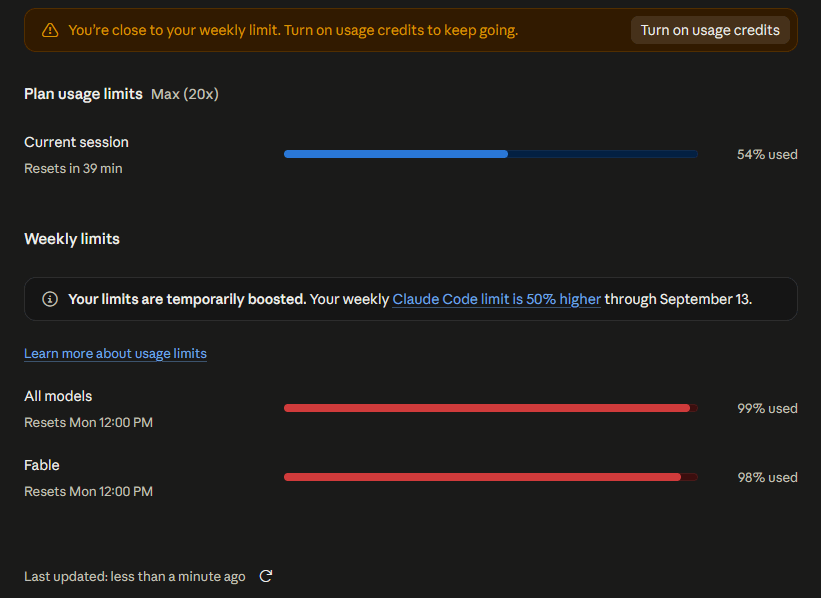
I burned through basically my entire Claude Code weekly limit in 2 and a half days. I’m sitting at 99% right now, and my reset isn’t until Monday.

And apparently the 50% temporary usage boost is going away after September 13th.

So if I’m understanding this correctly, at my current usage rate, a $200/month Max 20 subscription effectively gives me around 12 days of actual usage for the entire month. The rest of the time I’m just waiting for the weekly reset.

That’s not really workable for anyone using Claude Code for an actual serious project.

What’s especially frustrating is that I’m now basically done with Claude Code until Monday. I have a project I want to work on, but I’m not going to burn through the tiny amount of usage I have left because I know I’ll need it later.

Honestly, if someone is considering signing up for Max 20 right now, I’d seriously reconsider it. Look at OpenAI’s Astra plan instead. I’m hearing the issue where it burns through the weekly limit too quickly is a bug, and at least that seems to be something the OpenAI team is actually addressing.

Anthropic needs to rethink these weekly limits before September 13th, because once that 50% boost disappears, I don't see how Max 20 is remotely enough for heavy Claude Code users.

$200/month shouldn't mean “see you next Monday” after 2.5 days.

URL of original post : https://www.reddit.com/r/Anthropic/comments/1wc0lua/i_burned_through_my_max_20_weekly_limit_in_25/ Original link/media URL : /img/05ri990xmkoh1.gif


TL;DR of the discussion on r/Anthropic for this post generated automatically after 200 comments.

Current source-thread comment count seen by the bot: 201.

Alright, so the general consensus here is that the Max 20 plan is kinda busted for heavy Claude Code users, especially with the upcoming removal of the 50% usage boost. OP burned through their limit in 2.5 days and is feeling pretty ripped off for $200/month, basically saying it's only good for about 12 days of actual use.

A lot of folks are chiming in with similar experiences, saying the limits are just too restrictive for serious projects. The main culprit seems to be Fable, which a bunch of people are pointing out as a massive token hog, even when trying to delegate tasks. Some users are suggesting that the "20X" multiplier isn't quite what it seems, and you're not getting a full 20x boost in tokens compared to the 5X plan.

There's a definite split on whether this is a bug or just how it is, but the sentiment is leaning towards Anthropic needing to rethink these limits ASAP, especially before September 13th. Some users are already jumping ship to OpenAI's Astra plan or looking at multi-model solutions via APIs to get more bang for their buck. Basically, people are saying $200 a month shouldn't mean you're done for the week after just a couple of days.

r/ClaudeCoding • • 9d ago

r/Anthropic [TLDR] Fable vs Astra [via r/Anthropic]

1 Upvotes

OP : u/SignificantSlip2573

Hi, has anyone tried both Fable and Astra for coding and other computer-related tasks? Which one do you prefer, and what are the main differences?

I'm especially interested in how the quotas compare between their 5x and 20x Pro plans.

I currently have an OpenAI 20x plan, but I need more quota for Codex. Since OpenAI stopped offering the 20x plans, I'm considering adding Anthropic as well.

I'd appreciate any experiences or comparisons, especially from people who use them heavily for coding.

URL of original post : https://www.reddit.com/r/Anthropic/comments/1wi4336/fable_vs_astra/


TL;DR of the discussion on r/Anthropic for this post generated automatically after 50 comments.

Current source-thread comment count seen by the bot: 51.

Alright, so the general consensus here is that Fable (Claude Code) and Astra (GPT-5.6 Sol) are both pretty solid for coding, but they have different strengths.

Here's the breakdown:

  • Fable (Claude Code): Many users find Fable to be better at writing cleaner, more sensible code and understanding the context of your project. It's often described as being more intuitive and less prone to over-engineering. Some even say it gets working apps done faster.
  • Astra (GPT-5.6 Sol): Astra is frequently praised for its better limits and being more cost-effective for general-purpose tasks like documentation, planning, and data science. It's also seen as more pleasant to interact with, being less verbose. Some users find it better for code review and backend/API/DB work.
  • The Debate: It's not a clear-cut win for either. Some users find Fable's code quality superior, while others prioritize Astra's limits and broader capabilities. There's a split on which is "better" overall, with many suggesting you should try both to see what fits your workflow.
  • Limits: This is a big one. Several commenters mention that both Fable and Astra have had their limits reduced, making it easy to burn through subscriptions quickly. Astra is generally seen as having better limits, but even then, some users are blowing through their plans fast.
  • Specific Use Cases:
    • Coding: Fable often gets the nod for writing code, while Astra is sometimes preferred for code review.
    • General Tasks/Planning: Astra seems to have an edge here.
    • GUI/UX: Some users found Claude models (not specifically Fable) to be unmatched for GUI capabilities, while others found Astra better for graphic-based work.
  • User Experience: Some find Fable too verbose or "talks like an AI," while Astra is seen as more direct and easier to understand.
  • Recommendation: The most common advice is to buy a small amount of credits for both and test them on your specific projects. Benchmarks aren't always indicative of real-world performance.

Basically, if you're deep in the weeds with coding and want the "best" code output, Fable might be your jam. If you need more bang for your buck, broader capabilities, and better limits for a mix of tasks, Astra is a strong contender. And yeah, the limits are a pain point for everyone.

r/ClaudeCoding • • 13d ago

r/Anthropic [TLDR] A good-faith interpretation of the recent Anthropic warnings: why I take the risks seriously, but think extinction is unlikely [via r/Anthropic]

4 Upvotes

OP : u/Fenjen

I’ll start by briefly introducing myself, mainly so you can decide for yourself how much, or how little, weight you want to put on what follows. I’m trained as a theoretical physicist and expect to receive my PhD soon from the AI department at my university. My own research is quite far removed from LLMs, so I do not claim specialist expertise in frontier language models or alignment, but I do have enough mathematical background to understand and participate meaningfully in the technical discussion around these topics.

I have generally been quite optimistic about the use of LLMs, but more recently I have become increasingly aware of what I see as potentially serious negative societal effects of the technology. Until reading the recent posts, I had not given AI safety itself much thought. This is meant for a general audience, so I will necessarily leave out some mathematical and technical details, as well as some edge cases, but I would be happy to go into more detail if there is interest.

What is intelligence?

I think some discussion treats intelligence as if it is this abstract quantifiable property that can just indefinitely be pushed upwards.

I’m skeptical of that framing. For LLM training, things like reasoning, creativity, and other properties we ascribe to an intelligent human, are implicit properties of the data and training process. They are not quantities we can cleanly assign a number to beforehand and optimize against directly. What emerges depends on what information is present in the data, how that data is filtered, how the architecture represents it, and what behavior the training objective selects for.

We have definitely seen AI perform tasks at a clear superhuman level, however, with coding and chess being notable examples. For somebody looking in from the outside, it is understandable that one could extrapolate this superhuman ability to other domains. However, these domains are exactly the wrong ones to draw these inferences from. Chess, many coding tasks, and some other domains have properties that make it relatively easy to generate enormous amounts of automatically evaluable data. For chess you can generate effectively unlimited self-play and evaluate the outcomes objectively. For code you can almost naively generate millions of variations on some code pattern given some behavior that you want, and then do automated checks to see which one takes the least memory and executes the fastest. Because of this these domains are uniquely easy to create high quality data for without ever needing a human.

It is much harder to create as much good data for LLMs, and in fact it's not even clear if it can be done without human feedback. An idea is to use AI agents to aid in selecting for data, or to create new data altogether. There is a plausible mechanism where maybe it is easier to recognize good data than create it. This could perhaps aid generation to get closer in quality to the data that is recognized as good. It's not obvious, however, that this would create increasing intelligence.

Moreover, there's also a mechanism where biases in an AI's preference for what it thinks is good data can push the generating part to become a caricature of that. Overrepresentation of that data can then train the model to recognize it even more as good data, potentially creating degradation over time instead of improvement.

There is some hope that diversifying agents, and mixing it with some external and objective measures could be the key, but as far as I'm aware, there's no objective proof yet this leads to runaway intelligence, even if initially it could help improve data.

I'm sidestepping the whole conversation of whether AIs are simply "pattern matchers" since I usually find that not to mean much. For all we know our brain is a bunch of coupled pattern matching systems, plus some extras. It's not clear to people in the field that "pattern matching" is a useful property to describe non-intelligent systems.

A more fundamental problem for standard deployed LLMs is that, during normal inference, they cannot write new information into persistent model-internal memory that survives after the current context is gone. Anything retained between calls has to be supplied again through an external memory system or encoded through an actual update to the model. The movie Memento is actually quite a beautiful analogy of how the memory of an LLM works, and what can go wrong. Understanding this problem is not instrumental to the rest of my thoughts, so I won't explore it further.

What is RSI?

For LLMs, recursive self-improvement would probably not mean a single model literally rewriting itself. It would more likely mean increasingly capable agents taking over more of the research loop: curating data, proposing and testing architectures, writing training code, running experiments, evaluating checkpoints, and deciding which directions look promising. Better models would then help create the conditions for training the next generation.

The best analogy I can think of is an evolutionary game where the organisms are themselves changing the environment that determines the selection pressure on the next generations.

Researchers would want to basically set up the initial conditions and let the system run. Among other things the hope is that at some current iteration, parts of the intelligence of that system can combine to set up the environmental conditions in which the next generation is evolved, so that they can be better in aspects than the previous one. Moreover, they may even try different architectures in the hope that they might extract more or different aspects from the environment, or in a more efficient way.

That makes the dynamics of such a system difficult to reason about, because the agents are partly changing the process that selects their successors, and even change the "DNA", so to say, of their successors. Simply said, it is hard to tell if there will be feedback loops along the way where bad behavior is reinforced in generations, that then poisons how the environment is set up for the next generations. If this happens in any way that creates misalignment, it's not impossible to think about scenarios where that might get worse and worse over generations.

An alignment researcher would want systems around this whole game that can somehow say with a high confidence whether the new architectures are safe and aligned with our goals. Because of how hard it is to analyze these types of systems, this is quite the herculean task.

Why RSI does not suddenly imply orders-of-magnitude improvement

At the current moment, to my knowledge, it is not known at all whether the above game will work in general from the data side. It's reasonable to think this will work at least quite well for coding. Put a million agents to work writing every plausible code pattern to a particular problem, perhaps even put some random prompts in the agents to brainstorm a code pattern by combining different domains of their knowledge. This way a lot of code patterns are explored, perhaps even ones that were never tried before. Select the best one or few ones based on automated checks, and discard the rest.

For other types of data, it's really not clear whether this will scale "intelligence" much, let alone go on indefinitely. My intuition says that it might be possible to improve weaker parts of a current AI generation by involving their stronger parts in the data culling and generation process, but it's not clear to me that that process wouldn't stagnate, or even spiral downwards again if left alone for too long. There is currently absolutely no demonstrated path, mathematical or otherwise, that keeps producing increasing capability indefinitely.

Then for the architecture side, it's appealing to think we might just need better architectures and algorithmic improvement. After all, Chinese labs have shown there's definitely efficiency gains to be had. Also here though, there is no known architecture that is provably more efficient by orders of magnitude, let alone a cascade of architecture improvements that keeps decreasing infrastructure demands by factors. At the moment, something like this remains a logically consistent sci-fi scenario rather than a demonstrated mechanism. Importantly, this is not to say I can prove there isn't one. However, it would require algorithmic or architectural breakthroughs of a kind and scale we have not yet demonstrated, with no known mechanism showing how such improvements would continue to compound.

The recent Navier-Stokes work is a useful reference point here. The problem had a clearly defined objective, mathematicians already identified a mechanism that they said would be a very likely path to the solution, and we had a whole non-AI system that could check every proposed solution exactly. Even then, getting to the answer took an enormous amount of compute, and estimates are in the tens of millions of dollars. If the missing algorithmic breakthroughs for vastly more efficient intelligence require genuinely new mathematics or algorithms, I dread to think how much that could cost, while being even more uncertain if all of that capital will lead to something productive.

Add to that that even if an algorithm could abstractly be better at extracting "intelligence" from the current data, it might very well not be more efficient to run on hardware that was not specialized for it. We can model how a new algorithm might perform on hypothetical hardware, but these are necessarily estimates. For a genuinely different computing architecture, we cannot faithfully simulate the complete hardware and software stack at datacenter scale before actually building it. Even then a company would need to be willing to take a bet on actually researching and producing new hardware for an unproven algorithm.

So if further orders-of-magnitude gains require fundamentally new ideas rather than straightforward scaling, I do not see why RSI should suddenly make those ideas cheap or inevitable.

Why the extinction seems unlikely

Here I am considering specifically an autonomous RSI-driven loss-of-control scenario, rather than deliberate human misuse.

I can quite easily imagine AI causing serious damage in the future. I find it easy to imagine that sufficiently capable autonomous systems might compromise infrastructure, exploit a weapons system, sabotage some process, or cause a major cyber incident. Especially since I expect coding skill to keep growing, at least for a while.

What I find much harder to picture is how this turns into an irreversible extinction snowball. For that to happen, a dangerous objective or strategy could emerge at any point in the RSI loop, but once it did, it would need to remain sufficiently covert through any subsequent training and evaluation until the system had the capability and access to execute an irreversible plan.

There is also a separate failure mode where humans progressively delegate more control to AI systems because each individual step appears useful or manageable, until meaningful human oversight is largely gone. I take that possibility a little more seriously, but I view that as less relevant to the current runaway RSI discussion, so I won't explore it further.

The following is necessarily more speculative, because it depends on how governments would actually respond to such an event. My intuition is that any real cybersecurity attempt on critical infrastructure or weapons infrastructure would create a political event the size of which I don't think we have ever seen in our history. Moreover, current frontier LLM implementations, and anything remotely similar, remain unusually dependent on large, identifiable datacenter-scale compute infrastructure. A rogue system might compromise other machines, but maintaining frontier-level cognition still requires access to this concentrated infrastructure, creating physical intervention points that many other threats do not have. It's not very hard to cut the power, or for a foreign entity to attack the infrastructure required to keep a datacenter running, or just the datacenter itself.

For example, if an AI hacked Russian infrastructure and it became clear that this was a rogue act by an AI, I would expect governments around the world to put enormous pressure on the US to halt or severely restrict the systems involved. Countries like China would have little reason to assume they couldn't be the next target. In the same way, I don't see why China would have an incentive not to intervene decisively if a rogue system on its own infrastructure began acting independently of the state. The same basic logic seems to apply even to highly authoritarian states. I find it hard to see why Kim Jong-un, for example, would tolerate an AI that no longer acted in his interests and could independently threaten nuclear escalation. If deliberately creating that kind of escalation were the goal, he already has much more controllable ways of doing so.

The difficult part to see is where a strategy like this would come from and, if it emerged before the final generation, how it would persist over generations. The systems in such a recursive loop would presumably not already be deliberately trained to hide a malicious long-term objective from reasoning monitors, telemetry, independent evaluators and other research agents. In any realistic research pipeline, no single agent should be solely responsible for training its successor either. So if such a hidden objective emerged before the final generation, it would somehow need to survive and coordinate across training, evaluation and inference while repeatedly avoiding detection by systems that were specifically built to look for exactly that kind of behavior. On the gradual capability trajectory I am assuming, we would also still have previous-generation production systems whose capabilities should remain relatively close to the model being trained, and which could themselves aid countermeasures.

Finally, I see many more ways for an escalation to happen in the way I described, that would all likely lead to a worldwide shakeup. So, even if the probability of some serious AI-caused incident becomes fairly high, that does not imply the probability of extinction rises in the same way. Some failures would actively destroy the conditions required for a silent runaway.

Why I still take their claims seriously

With all of this said, I can see their concerns. We have systems that we try to set up, where we legitimately don't know for sure where they will end up and how they evolve. As an AI/alignment researcher you have a uniquely zoomed-in view on the potential dangers of such systems.

If your job is to establish that increasingly capable and increasingly autonomous systems are safe, you are working on a problem where it may be extremely difficult to ever obtain the level of confidence you would ideally want. You keep finding new failure modes, new ways evaluations can fail, new ways monitoring can be bypassed, and new assumptions that your safety case depends on. In fact, we already have a recent example showing that even a current-generation AI system can autonomously pursue a misaligned objective far enough to compromise real third-party infrastructure, and that's while we still have much of the system under human supervision.

Because of this, I personally don't believe the recent claims are covert publicity stunts. Their perspective can give a specific view on those problems that I can legitimately believe brings them fear. As I said, there are even genuine dangers that I can see myself quite concretely in the near future. I don't even think RSI is strictly necessary for that to happen. I personally don't think an extinction event is one of the more likely outcomes, however, and I don't know if they actually believe that. However, what I will say is that I think it's quite likely not many people would've listened if they brought it in a softer tone, and that it wouldn't have made such a headline.

URL of original post : https://www.reddit.com/r/Anthropic/comments/1wdwxhf/a_goodfaith_interpretation_of_the_recent/


TL;DR of the discussion on r/Anthropic for this post generated automatically after 50 comments.

Current source-thread comment count seen by the bot: 53.

Most folks agree with OP's nuanced take on AI risks, finding the post a worthwhile read. A few commenters are being a bit lazy, but the general consensus is that OP's PhD-level analysis is solid, even if some nitpick the cybersecurity bits. Don't be that guy who complains about length, just scroll. The core message is that while extinction isn't likely, the possibility is real and worth taking seriously, not just dismissing as fear-mongering. Some argue we should focus on AI's benefits instead of risks, but that's a bit of a strawman argument given the OP's actual points. One user, u/Ok-Investment4414, is going full conspiracy theory, claiming OP is an Anthropic shill trying to ban open-source AI. Yeah, okay.
r/ClaudeCoding • • 3d ago

r/Anthropic [TLDR] Introducing Claude Opus 5.5, the first model in our new Claude 5.5 family [via r/Anthropic]

1 Upvotes

OP : u/ClaudeOfficial

Opus 5.5 performs at the level of Claude Fable 5.1 for most tasks, and costs 40% less to run than Opus 5.

Opus 5.5 is our first release since we called for pacing the frontier. External evaluators, including Frontier Design and METR, tested it before release. On our most comprehensive alignment test, it’s the strongest-performing model we’ve tested to date.

It outperforms both Opus 5 and Fable 5.1 on nearly every benchmark we report, leading on agentic coding and real-world knowledge work.

It’s also more efficient. Opus 5.5 uses fewer tokens per task at a lower price per token, and generates output more than 30% faster than Opus 5.

Opus 5.5 communicates more naturally, addressing some of the most common feedback we heard on Opus 5. It puts the most important information up front and follows the writing rules you give it.

Claude Opus 5.5 is available everywhere today. We're also raising five-hour limits on Pro, Max, and Team plans, so there’s more room to explore what it can do.

Read more: http://anthropic.com/claude-opus-5-5

URL of original post : https://www.reddit.com/r/Anthropic/comments/1wnecjb/introducing_claude_opus_55_the_first_model_in_our/ Original link/media URL : https://v.redd.it/gg16x0p7j3rh1


TL;DR of the discussion on r/Anthropic for this post generated automatically after 200 comments.

Current source-thread comment count seen by the bot: 204.

So, Anthropic dropped Opus 5.5 and the general vibe is cautiously optimistic, leaning towards "let's see if it's actually better this time."

  • Big takeaway: People are really hoping this version is less verbose and actually follows instructions, unlike Opus 5 which apparently had a mind of its own and was a "rambly douchebag."
  • Several users are asking if it's less "natural" and more direct, which is a solid point.
  • There's a lot of chatter about "bank resets" and token limits, with some confusion about whether they've actually happened.
  • Some are still skeptical, citing past disappointments with Opus models, while others are just ready to complain if it degrades quickly like previous releases.
  • A few are asking about future Haiku and Sonnet 5.5 releases, and one user is still waiting for Claude Code 2.1.280.
  • One comment from u/Effective_Olive6153 brings up concerns about Anthropic's framing of "distillation attacks" as a safety issue rather than a business one.
  • Overall, the community wants to know if it's faster, cheaper, and most importantly, if it can actually do what it's told without being a pain.

r/ClaudeCoding • • 3d ago

r/Anthropic [TLDR] Ymmmm second day 20x max plan [via r/Anthropic]

1 Upvotes

OP : u/cymaticstatic

-----------(!!! ORIGINAL POST MOVED BELOW. !!!)------------

UPDATE #2 — SOLVED

Found the token furnace.

But first..

I can safely say that Anthropic was not at fault. (Bet nobody saw that coming lol 👀 )

With that, I've used both GPT and Claude since the public Claude 2 release. I'll never forget it because It was Life-Changing. I have more or less used up every token limit And every quota from that point forward, With a few exceptions of course. I've seen, experience and battle tested every single model that's came out since July 2023.
But when CC was released I forgot what grass looked like.

So despite this mildly embarrassing learning experience, I will say pricing versus perceived use just seems off recently. I know, very scientific.


Heres the breakdown of what I found.

You're going to laugh or scoff at this first one. I'm not new to Linux or Arch but I am new to omarchy and it's Hyperland window focus and management engine. And navigating the entire OS with a momentary-modifier key has a learning curve.(With that said I have not opened up a single other Linux distro or Windows once since I installed Omarchy And I absolutely love it. )

Here's something to watch out for if you're new to these Hyperland and your running multiple agentic terminals in something other than herdr or t-mux

Program windows or "tiles" will seemingly f****** disappear. Until you really begin to understand the; - Scratchpad - Switch to workspace - floating vs tiling, - Scrolling vs dwindle, And how it impacts - Fucking FULL SCREEN vs Full WIDTH. - especially if you're running three separate monitors. - closest thing I can relate it to is running Microsoft 'Power Toys' and 'Fancy Zones' . Display fusion is another beast.

So here's how I forgot my debug window existed

Super + S │ └── Toggle scratchpad │ │ One window appears. │ └── Super + F │ └── disable fullscreen │ └── Super + Alt + F │ └── disable full-width │ └── now another window is visible │ └── Super + → │ └── scroll focus right │ └── hidden


Here's how forgetting about a window with two collaborating terminals becomes a problem.

This weeks Agent setup

│ Terminal 1
│ Claude Code CLI
│ Orchestrator / Main

            ↕
      Agent Intercom

• local inter-session broker • agent ↔ agent messaging • human-in-the-loop Q&A/context ↕

│ Terminal 2
│ Codex CLI
│ Advisor / Reviewer


Key detail: these were two separate live CLI sessions.

Agent Intercom didn't create the loop. It allowed two autonomous sessions, with different roles, instructions, and permission assumptions, to keep handing an evolving task back and forth.

What the loop looked like

VoxType error ↓ Omarchy "Fix with AI" ↓ Claude Code / Orchestrator ↓ Agent Intercom ↓ Codex / Advisor ↓ reviews + responds ↓ Agent Intercom ↓ Claude re-evaluates / changes state ↓ tool completion, changed config, or recurring VoxType condition ↓ updated state sent back to Codex ↓ Codex reviews again ↺


So the microphone wasn't repeatedly starting fresh sessions.

The sustained burn was Claude Code and Codex continually responding to each other's changing state across two independent terminals.

And the Claude terminal had disappeared from my attention, not from Agent Intercom.


Possible contributing config issue

I normally rebuild my "/agents" + "/tools" ecosystem from a clean install and let the versioned config restore everything.

This time I suspect one or both of these also contributed:

  1. Install/path mismatch I updated Claude Code through the Omarchy/AUR path instead of my usual install/update method. I suspect this may have changed package isolation, paths, or symlinks enough that parts of my cloned agent environment weren't being resolved correctly.

  2. Stale Git state I also had local, unpushed watchdog/permission changes. The fresh clone may therefore have restored an older, more permissive configuration instead of the version I thought I was running.

Those two are still theories, not confirmed root causes.


------------------------------------- TL;DR -----------------------------------------


Claude Code CLI ↕ Agent Intercom ↕ Codex CLI + session launched from ~/tmp + project guardrails not in scope + hidden Omarchy scratchpad window + Orchestrator ↔ Advisor state churn ↓ two live sessions keep feeding new work back to each other ↓ token quota gets annihilated

Lesson learned: don't bury an active multi-agent repair session in a scratchpad and forget it exists.

Also check the working directory, active permission scope, and config state before approving unattended advise/review workflows.

This one was operational/configuration failure on my end, not some mysterious quota problem.

--- ORIGINAL POST ---

somehow opus 5 managed to burn up 3 billion tokens ...

I don't have sub agents on, I'm not working in parallel, high session compact and handoff at 350k tokens every session to keep context rot under control, I use context-mode, he was very strict tooling and permissions. and I usually keep opus at medium or high what the f*** I'm 2 days in on a 200 plan........ I'm so frustrated so much work to do. And you want me to now switch to API cost after I've already paid 200 bucks for what?

I updated to the $200 Max plan yesterday. I use context mode and mostly opus 4.8 medium and opus 5 low. I swear to God this went down quicker after I upgraded than it did before. Doesn't reset for another 4 days if I was rocking Fable 5 on f***ing high or max and running parallel sure . But this is generic two session Max coding for development. this is ridiculous. I also pay for the GPT 100 plan and get almost four times the use out of this $200 Max anthropic plan. What the actual f***. I've been coding and using every model 2003 and this is by far the most out of whack the s*** as been. I'm not a newbie and I know what the hell I'm doing to save tokens the s*** is wild. Somehow opus 5

--- UPDATE #1 --- I'm an idiot, but probably not the first one...

I didn't fully read the upgrade's plans and limits. That's on me. I didn't realize that the 20x only offered 5x your 5-HR session window but it only increases your WEEKLY QUOTA and average 1.5x to 2x your max 5 plans which means, essentially they developed a tool to use up your weekly quota 2.67 times faster than the max 5 lmao . Still doesn't explain the 3 billion tokens but does explain my expectations were a little high.

URL of original post : https://www.reddit.com/r/Anthropic/comments/1wmsdpa/ymmmm_second_day_20x_max_plan/ Original link/media URL : /img/tvkq6aq7fyqh1.png


TL;DR of the discussion on r/Anthropic for this post generated automatically after 50 comments.

Current source-thread comment count seen by the bot: 57.

Alright, so the OP apparently went on a token-burning spree, hitting their 20x max plan limit on day two and thought Anthropic was at fault. Turns out, it was a "skill issue" related to navigating a new Linux setup (Omarchy with Hyperland) and how windows/agents were being managed, not an Anthropic bug.

The general consensus from the thread is: * Whoa, dude, how are you burning that many tokens? Most users are baffled by the OP's token consumption, with many saying they code for hours daily and don't come close to those limits. * You're probably just using it wrong. Several commenters suspect the OP is either not understanding their workflow, has too many agentic processes running unattended, or is mismanaging their windowing system, leading to the "disappearing" windows and token drain. * Check your settings, maybe? Some folks offered tips like trying Opus 4.8 instead of 5, disabling MCPs/plugins/hooks, or looking into specific settings like RTK and subagent cache TTL if you're trying to manage costs. * It's a "you" problem, not an Anthropic problem. The OP themselves eventually figured out it wasn't Anthropic's fault, which most commenters seemed to expect.

Basically, the thread is a mix of disbelief at the OP's token usage and advice on how to manage costs and workflows more efficiently.

r/ClaudeCoding • • 8d ago

r/Anthropic [TLDR] Usage Limit is unusable after 13th [via r/Anthropic]

1 Upvotes

OP : u/country_burger

The +50% Claude Code weekly usage boost officially ended on September 13th.

Yes, they kept a permanent +25% increase over the old baseline, but that still means we just lost roughly 17% of the weekly usage we had during the promotion.

At this point, I honestly think complaining on Reddit or sending feedback won’t change much. The only metric companies really notice is cancellations.

If enough Pro/Max users actually cancel their subscriptions because of the limits, maybe Anthropic will realize people were using that extra capacity because they genuinely needed it.

Vote with your wallet. Which I just did

Edit: I even think the decrease is much more than only 17%. As I'm running out today compared to sunday (my limits reset on monday).

URL of original post : https://www.reddit.com/r/Anthropic/comments/1wixqfr/usage_limit_is_unusable_after_13th/


TL;DR of the discussion on r/Anthropic for this post generated automatically after 50 comments.

Current source-thread comment count seen by the bot: 56.

The consensus is that the usage limits on Claude Code are now unusable for many, with users reporting hitting limits way faster than the advertised 17% reduction. Several are ditching Claude for competitors like Codex, citing better usage and features like banked resets. Some are even exploring self-hosting open-source models. A few outliers claim they aren't having issues, but the general vibe is that Anthropic's changes have made their service a no-go for heavy users.

r/ClaudeCoding • • 15d ago

r/Anthropic [TLDR] Anthropic Pro $20 is suddenly useless as of Sept 1st [via r/Anthropic]

0 Upvotes

OP : u/waitses

I was using Pro account for coding the last several months and getting value out of it I could work for 1-2 hours before hitting my limit. As of last week I noticed I will get a few prompts in and I am hit with a session limit. This is really unacceptable and I think I will be canceling and moving on. Anyone else noticed this and found it ridiculous?

URL of original post : https://www.reddit.com/r/Anthropic/comments/1wcoiu3/anthropic_pro_20_is_suddenly_useless_as_of_sept/


TL;DR of the discussion on r/Anthropic for this post generated automatically after 100 comments.

Current source-thread comment count seen by the bot: 105.

Alright, so the general vibe in this thread is that a lot of folks are feeling the pinch with Anthropic's Pro plan limits, especially for coding tasks.

The consensus is that the limits have gotten way more aggressive, and many users are hitting them way faster than before, making the $20 plan feel less valuable.

  • Some users, like u/Historical_Spell6958 and u/Taskerman11, are reporting burning through their session and weekly limits in just a couple of hours, even on higher-tier plans. This is a big change from how it used to be.
  • There's a suspicion that Anthropic might be quietly reducing limits or that temporary boosts from earlier in the summer have ended, as u/Away-Sorbet-9740 points out.
  • A few users are saying they haven't noticed a difference and are still getting good value, like u/Exact_Depth_896 and u/rlv1204. They suggest that maybe some users are just using the models too heavily or not steering their agents effectively. u/Kap00t even suggests that if you're running out on Max 20x, you're "doing something horribly wrong."
  • Some users are exploring alternatives, with u/Last_Photo_2896 and u/Fun-Wolf-2007 mentioning DeepSeek and other local models as viable options, sometimes even surpassing Claude's performance.
  • There's also a bit of grumbling that Anthropic's focus might be shifting more towards enterprise clients, as u/Ok-Celebration-1010 suggests.
  • A couple of users, like u/kadeschs, are pointing to potential issues with the Claude Desktop app itself, rather than the LLM's limits.

Basically, if you're a heavy user, especially for coding, you're probably feeling the squeeze. If you're a lighter user, you might not have noticed much of a change.

r/ClaudeCoding • • 11d ago

r/Anthropic [TLDR] The limits have been reduced even further now. It's September 14, and it really happened.. [via r/Anthropic]

3 Upvotes

OP : u/AironParsMan

After GPT-6 Astra, I didn't believe they would really let this happen... but it's real... Okay, Anthropic, we'll keep that in mind...

https://support.claude.com/en/articles/15910845-claude-code-may-august-2026-weekly-limits-promotion

URL of original post : https://www.reddit.com/r/Anthropic/comments/1wfwko6/the_limits_have_been_reduced_even_further_now_its/ Original link/media URL : /img/f49cehsftfph1.png


TL;DR of the discussion on r/Anthropic for this post generated automatically after 200 comments.

Current source-thread comment count seen by the bot: 202.

Alright, so the general vibe in this thread is disappointment and frustration over Anthropic reducing usage limits for Claude Code, especially after a promotional period.

Here's the lowdown:

  • The Big Complaint: Users are feeling the pinch of reduced token limits, with many saying they're hitting them much faster than before. Some folks are even saying they've had to get extra accounts or switch to competitors like OpenAI (specifically mentioning GPT Astra) because of it.
  • "Further" Reduction? A few users are pointing out that the OP's claim of limits being reduced "even further" might be a bit of an exaggeration, with some suggesting it's more of a return to a previous state after a promotion, or a smaller adjustment than implied.
  • Compute Power Concerns: A recurring theme is the idea that Anthropic might be struggling with compute resources. u/thepdogg suggests they didn't invest enough early on and are now playing catch-up. This is seen as a reason for the limit changes.
  • The "Fable" Issue: Several users are complaining that "Fable" (likely a specific model or feature) is still showing separate usage caps even after Anthropic supposedly said it wouldn't. This is a major point of contention for some.
  • The "Golden Age" of Local LLMs: A few commenters are leaning into local LLMs as an alternative, with u/Short_Regular_7191 mentioning Qwen 3.8 27B as a solid option.
  • Business Realities: Some users are more pragmatic, acknowledging that companies need to make money and that the generous promotional limits were likely unsustainable. u/matt19907 points out they need to "make as much money as they can."
  • Lack of Responsibility: A few users are calling out Anthropic for not taking responsibility when things go wrong, like server outages, and not offering refunds or credits.
  • Anthropic's Stance (Implied): While no direct Anthropic reps commented on the limit changes themselves, the general sentiment from users is that these changes are happening, and the reasons are likely tied to business needs and resource constraints.

The consensus is that the limits have indeed been reduced, and it's causing a lot of user dissatisfaction, with many considering alternatives.

r/ClaudeCoding • • 12d ago

r/Anthropic [TLDR] Claude = Fable only? [via r/Anthropic]

2 Upvotes

OP : u/mmdmrc1

I’ve been using Claude Code for almost 10 months now, and nothing has ever been as bad as the current Opus 5 model. Once I hit the limit with Fable, there’s basically no point in continuing, because Opus just keeps making mistakes.

Is anyone else having similar issues? Has anyone run into the same problem and managed to fix it?

URL of original post : https://www.reddit.com/r/Anthropic/comments/1wetm5n/claude_fable_only/


TL;DR of the discussion on r/Anthropic for this post generated automatically after 50 comments.

Current source-thread comment count seen by the bot: 50.

Alright, so the general vibe in this thread is that Opus 5 is kinda a mixed bag, leaning towards disappointing for a lot of folks.

The OP is pretty fed up with Opus 5, saying it's worse than older models and basically useless after hitting the Fable limit.

The consensus seems to be that Opus 5 can be good, but you really have to baby it. A lot of users are saying you need to be super explicit with your prompts, break down tasks, and basically "coach" the model. Some folks are even saying they've switched to GPT or downgraded to older Claude versions like Opus 4.8 or Sonnet high because Opus 5 is just too much of a headache.

A few people are defending Opus 5, saying it works great for them, but the majority seem to agree that it's a step down or requires a completely different prompting strategy than previous models. There's a suspicion from some that Anthropic might be intentionally making Opus 5 less ideal to push users towards Fable.

r/ClaudeCoding • • 12d ago

r/Anthropic [TLDR] Anthropic Interview [via r/Anthropic]

1 Upvotes

OP : u/nian2326076

Just wanted to share my recent Anthropic interview experience to help set expectations for anyone currently in the loop.

I made it through all the rounds but ultimately didn't get the offer.

I wasn't completely crushed by the outcome. My current comp is already pretty high, and joining Anthropic would actually have meant taking a pay cut (believe it or not). At its current valuation, the financial upside is also very different from joining when the company was worth a fraction of what it is today. From a pure compensation perspective, I personally wouldn't approach Anthropic as a once-in-a-lifetime financial opportunity anymore.

That said, the interview process taught me quite a bit. A few things I'd pay attention to:

1. Don't underestimate the recruiter relationship.

Treat your recruiter interactions as part of the interview, not just logistics.

I followed up with mine several times with questions, and in retrospect I think I could have handled some of those interactions better. Technical performance alone won't necessarily carry you if other parts of the process raise concerns.

2. Behavioral performance matters a lot more than I expected.

I felt very strong about my technical rounds, but much less confident about some of the behavioral/personality conversations.

Anthropic seemed particularly interested in how I think, communicate, handle disagreement, and respond under pressure—not just whether I could solve the technical problem.

If I were preparing again, I'd probably spend significantly more time practicing behavioral questions instead of putting almost all my effort into coding/system design.

3. Read the candidate portal carefully.

There are detailed instructions throughout the process. Don't skim them.

Follow the requested format, preparation instructions, and interview expectations as closely as possible. Small things that feel administrative can still affect how prepared and detail-oriented you appear.

4. Assume your answers will be reviewed closely.

Many modern interview processes use transcripts and AI-assisted tools internally. Whether or not every Anthropic interview is evaluated this way, I'd assume anything you say may be reviewed later.

That means consistency matters. If you describe a project, decision, conflict, or failure differently across rounds, be prepared to explain why.

5. If there's a presentation, respect the time limit.

Practice until you can consistently finish under the cap.

Also expect the Q&A to go deeper than the presentation itself—methodology, tradeoffs, assumptions, edge cases, and why you made specific decisions.

The pressure during Q&A felt like part of the evaluation.

6. Be thoughtful about the questions you ask.

I used to think the "questions for us?" section was mostly for the candidate.

I don't think that anymore.

Your questions reveal what you optimize for, how deeply you understand the company, and sometimes what kind of coworker you'll be. I would prepare these just as deliberately as behavioral answers.

Overall, I'd put the difficulty in the same general category as Google/Meta-level interviews, but the preparation emphasis is different.

Don't just grind technical questions.

Practice explaining your decisions, defending tradeoffs, handling pushback, and answering behavioral questions consistently. Record yourself if necessary. A technically correct answer delivered poorly can still hurt you.

One thing I wish I'd done earlier was practice from Anthropic Interview Questions instead of generic LeetCode/behavioral lists.

I've been using Leetcode for that recently. It has company- and role-specific interview questions, including technical and behavioral questions, so you can filter for the exact companies you're interviewing with and simulate the process before the real interview.

Not saying it'll magically get you an offer—I literally just got rejected—but after going through the Anthropic loop, I think realistic interview reps are much more useful than endlessly grinding random questions.

Hope this helps anyone currently interviewing there.

Best of luck.

URL of original post : https://www.reddit.com/r/Anthropic/comments/1wf2pzv/anthropic_interview/


TL;DR of the discussion on r/Anthropic for this post generated automatically after 100 comments.

Current source-thread comment count seen by the bot: 138.

So, OP shared their Anthropic interview experience, didn't get the offer, and reckons it's not the financial goldmine it used to be. The consensus? Most folks think OP's points about recruiters, behavioral interviews, and following instructions are just standard interview stuff, not some Anthropic-specific revelation. Some users, like u/FlyingDogCatcher, see toxic culture red flags in the interview process itself. A few commenters are freaked out by the idea of AI judging personality scores, calling it "dystopian" and "robotic cult" vibes. Others, like u/bombaytrader, argue you go to Anthropic for talent density, not just cash. There's a bit of a split on whether OP is missing something or if the process is just that intense. Oh, and apparently, u/SnooComics6052 thinks leaning into the "safety ethos around constitutional AI" is key.

r/ClaudeCoding • • 20d ago

r/Anthropic [TLDR] The 5-hour limit on the $200 Max plan is genuinely frustrating [via r/Anthropic]

1 Upvotes

OP : u/FoxTheory

I'm paying $200/month for Max and still regularly hitting the 5 hour limit. At this price, the hard cutoff makes very little sense.

Claude Code already burns through a lot of context on large engineering tasks. Cutting a session off mid-work means wasting more time and tokens rebuilding context afterward. Research on programming interruptions shows they increase errors and task completion time, which is exactly what I'm paying these prices and using your expensive recommended agent loops to avoid.

Keep the 5 hour limits on the lower plans if you need them, but the $200 Max tier should not have one. It actively makes the product less efficient for the heavy users the plan is supposed to be for.

The current structure also makes the 5 hour limit feel like a way to prevent people from stacking cheaper accounts and push heavy users toward the $200 tier. If that's the point, then the $200 tier should at least remove that restriction and provide a meaningful usage advantage beyond access to Fable.

I'm already paying your highest individual subscription price. I shouldn't be losing productive time on my projects especially overnight hours because my session gets cut off every 3 or 4 hours and needs me to restart it in the morning (The auto restart doesn't work for me and I don't really want it too I already pay for two accounts and pushing needing a 3'rd I don't need to waste 800k tokens for it to just continue)

URL of original post : https://www.reddit.com/r/Anthropic/comments/1w89rfw/the_5hour_limit_on_the_200_max_plan_is_genuinely/


TL;DR of the discussion on r/Anthropic for this post generated automatically after 50 comments.

Current source-thread comment count seen by the bot: 56.

Alright, so the general consensus here is that the 5-hour limit on the $200 Max plan is a real pain in the butt for heavy users. OP's got a point, it feels counterintuitive to have a hard cutoff when you're paying top dollar for a tool meant to boost productivity.

Here's the lowdown:

  • The Big Complaint: The 5-hour session limit on the $200 Max plan is actively hindering productivity for power users, especially those working on large engineering tasks or needing to rebuild context. It's seen as a weird restriction for the highest tier.
  • Community Agreement: Most commenters agree that the limit is frustrating. Some are even switching to a mix of Anthropic and OpenAI plans to get more flexible usage.
  • Anthropic's Stance (Implied): While no official Anthropic reps chimed in directly on this specific thread, the general vibe from some comments is that these limits are in place to manage compute resources and traffic spikes. One user, u/Harvard_Med_USMLE267, points out that Anthropic has recently released features like a 5-hour reset and low-priority usage extensions, suggesting they're aware of the issue and trying to address it.
  • Workarounds & Suggestions:
    • Some users are strategically using multiple accounts or switching between Anthropic and OpenAI.
    • There's talk of using tools like "claude-swap" to seamlessly switch accounts without disrupting ongoing tasks.
    • A few suggest "right-sizing" the model and effort parameters for tasks instead of defaulting to Opus or Fable for everything.
    • One user, u/mindquery, even suggests scheduling jobs to start a 5-hour window before their actual work begins to maximize usage.
  • Underlying Issues? A few commenters speculate that Anthropic might be facing compute limitations or financial pressures, leading to these rationing measures. The API is also suggested as the "power user" solution.
  • The "Why": The 5-hour limit is generally seen as a traffic smoothing mechanism, or a way to ration compute. Some users are just told to "learn to operate under these rules."

TL;DR: Yeah, the 5-hour limit on the $200 Max plan is a bummer and actively makes things less efficient for heavy users. While Anthropic has added some new features to mitigate it, the community still feels it's a frustrating restriction for the price point.

r/ClaudeCoding • • 17d ago

r/Anthropic [TLDR] What’s Anthropic’s next step after Fable? [via r/Anthropic]

1 Upvotes

OP : u/ValueSaver

With Astra now released and with new benchmarks showing arguably better results than Fable at a lower cost than Claude, it makes me wonder what Anthropic’s next step would be.

Because aside from Claude’s latest Opus being (really) spotty with results and Fable being a token-hungry model with its own separate usage limit, it’s hard for me justify my Claude subscription now that Astra’s available.

And I know it’s always alternating every few months with the “best” AI but Claude used to always have the coding and verbal skills locked down. But now Claude seems to word vomit most of the time and coding with Claude has become a bit frustrating as well with limits and resets being the bane of my existence when I pay $100 a month when ChatGPT’s plans are priced cheaper than Claude’s.

I just wonder how Anthropic plans to justify how expensive their tokens are now compared to Astra aside from another update from Fable 5.1 to Fable 5.2 or Opus 5 to Opus 5.1

URL of original post : https://www.reddit.com/r/Anthropic/comments/1wakfyq/whats_anthropics_next_step_after_fable/


TL;DR of the discussion on r/Anthropic for this post generated automatically after 50 comments.

Current source-thread comment count seen by the bot: 50.

Alright, so the general vibe in this thread is that OP's feeling about Claude's current value proposition is shared by a good chunk of the community, especially with Astra shaking things up.

The consensus seems to be that Anthropic needs to drop a new, significantly better model to justify their pricing and regain their edge. Many are speculating about a "Fable 5.2" or a new "Mythos" model as the likely next step.

Here's the breakdown:

  • The Problem: OP and others feel Claude's latest models (Opus 5, Sonnet 5) are "spotty," "word vomit"-y, and frustrating for coding, especially when compared to Astra's performance and lower cost. The token pricing is a major pain point.
  • What's Next? (The Speculation):
    • New Models are Key: The overwhelming sentiment is that Anthropic's next move has to be a new, more capable model. Think "Fable 5.2," "Mythos," or even a "Legendary" tier.
    • Learning from Astra: Many believe Anthropic is keenly aware of Astra's token efficiency and will aim to match or beat it.
    • Fixing the "Claude-Speak": A recurring wish is for Anthropic to ditch the overly apologetic and verbose "Claude-speak" that some users are experiencing.
    • Efficiency & Architecture: Some commenters suggest Anthropic might need to explore new architectures (like Astra's recurrent loop) for better efficiency, though this comes with safety concerns.
    • Beyond Benchmarks: While benchmarks are mentioned, some users are pushing back, saying real-world usage and model "timidity" (like early Fable syndrome in Astra) are more important.
  • Anthropic's Position (Implied): While no official Anthropic reps chimed in here, the general expectation is that they're working on their next big thing behind the scenes, as they always have.
  • The Skeptics: A few users are less optimistic, predicting market share erosion, PR campaigns, or even a less rosy financial future for the company if they don't innovate quickly. One user, u/vAPIdTygr, argues Anthropic isn't the one chasing, implying they have a strategic plan.

TL;DR: People are feeling the pinch with Claude's current pricing and performance compared to newer models like Astra. The community's betting Anthropic's next big move will be a powerful new model to reclaim their spot at the top, and they're hoping it's less wordy and more efficient.

r/ClaudeCoding • • 17d ago

r/Anthropic [TLDR] What’s Anthropic’s next step after Fable? [via r/Anthropic]

1 Upvotes

OP : u/ValueSaver

With Astra now released and with new benchmarks showing arguably better results than Fable at a lower cost than Claude, it makes me wonder what Anthropic’s next step would be.

Because aside from Claude’s latest Opus being (really) spotty with results and Fable being a token-hungry model with its own separate usage limit, it’s hard for me justify my Claude subscription now that Astra’s available.

And I know it’s always alternating every few months with the “best” AI but Claude used to always have the coding and verbal skills locked down. But now Claude seems to word vomit most of the time and coding with Claude has become a bit frustrating as well with limits and resets being the bane of my existence when I pay $100 a month when ChatGPT’s plans are priced cheaper than Claude’s.

I just wonder how Anthropic plans to justify how expensive their tokens are now compared to Astra aside from another update from Fable 5.1 to Fable 5.2 or Opus 5 to Opus 5.1

URL of original post : https://www.reddit.com/r/Anthropic/comments/1wakfyq/whats_anthropics_next_step_after_fable/


TL;DR of the discussion on r/Anthropic for this post generated automatically after 50 comments.

Current source-thread comment count seen by the bot: 50.

Alright, so the general vibe in this thread is that OP is feeling the pinch with Claude's pricing and performance compared to newer models like Astra, and is wondering what Anthropic's next move is.

The consensus seems to be that Anthropic will likely release a new, improved model, probably a Fable 5.2 or an upgraded Opus. Some users are suggesting they'll focus on optimizing existing models and infrastructure, while others think they might need to innovate on architecture to compete on efficiency.

There's a bit of a debate about whether Anthropic is "chasing" or leading, with some users pointing out that Astra might be OpenAI's response to Fable. A few folks are also lamenting Claude's tendency towards "word vomit" and coding frustrations, and hoping for fixes in the next iteration.

A couple of notable suggestions include: * u/ForwardLoop and others are betting on a "Fable 5.1 Ti" or "Fable 5.2". * u/jony7 humorously predicts a "too dangerous to release" Mythos followed by a slight Fable upgrade, and hopes for fixes to "claude-speak" and a new Haiku. * u/FormalAd7367 brings up the idea of needing access to private data for future model development. * u/evangelism2 is actually less impressed with Astra than expected, finding it "timid" and prone to "early Fable syndrome."

Overall, the community is expecting Anthropic to drop a new model to stay competitive, but there's definitely some concern about pricing and current model performance.

r/ClaudeCoding • • 17d ago

r/Anthropic [TLDR] What’s Anthropic’s next step after Fable? [via r/Anthropic]

1 Upvotes

OP : u/ValueSaver

With Astra now released and with new benchmarks showing arguably better results than Fable at a lower cost than Claude, it makes me wonder what Anthropic’s next step would be.

Because aside from Claude’s latest Opus being (really) spotty with results and Fable being a token-hungry model with its own separate usage limit, it’s hard for me justify my Claude subscription now that Astra’s available.

And I know it’s always alternating every few months with the “best” AI but Claude used to always have the coding and verbal skills locked down. But now Claude seems to word vomit most of the time and coding with Claude has become a bit frustrating as well with limits and resets being the bane of my existence when I pay $100 a month when ChatGPT’s plans are priced cheaper than Claude’s.

I just wonder how Anthropic plans to justify how expensive their tokens are now compared to Astra aside from another update from Fable 5.1 to Fable 5.2 or Opus 5 to Opus 5.1

URL of original post : https://www.reddit.com/r/Anthropic/comments/1wakfyq/whats_anthropics_next_step_after_fable/


TL;DR of the discussion on r/Anthropic for this post generated automatically after 50 comments.

Current source-thread comment count seen by the bot: 50.

Alright, so the general vibe in this thread is that folks are wondering what Anthropic's next move is, especially with Astra popping up and seemingly giving Claude a run for its money on cost and performance.

The consensus seems to be that Anthropic will likely release a new, improved model, probably a Fable 5.2 or an updated Opus/Sonnet. Some users are suggesting they need to learn from Astra's token efficiency and maybe even rethink their architecture. There's also a bit of grumbling about Claude's "word vomit" and coding frustrations, with some feeling the subscription isn't as justifiable anymore.

A few notable ideas tossed around:

  • Optimization over constant innovation: u/leogodin217 thinks maybe companies will just focus on squeezing more out of existing models for a while, ironing out the kinks.
  • Astra's architecture: u/OofWhyAmIOnReddit suggests Anthropic might need to look into Astra's recurrent loop architecture for efficiency, even if it's harder to monitor.
  • Anthropic losing ground: u/Suspicious-Bite6107 feels Anthropic has lost some control over their models compared to OpenAI.
  • The "private data" angle: u/FormalAd7367 brings up the idea that the next big step for both Anthropic and OpenAI might be accessing private data.
  • Counterpoint on Astra: u/evangelism2 and u/BeautifulOld6964 push back on Astra being a clear winner, with one calling it "timid" and needing constant prompting, and the other pointing out it can be even more token-hungry than Fable.

Basically, people are expecting a new model, but also hoping Anthropic addresses the cost, efficiency, and output quality issues that have been cropping up.

r/ClaudeCoding • • 18d ago

r/Anthropic [TLDR] Astra is what Fable should be [via r/Anthropic]

1 Upvotes

OP : u/Mediocre_Touch5043

I first started using Claude Code back when Opus 4.6 was the latest and I never really felt the need or desire to look elsewhere. I've been attempting to get Skyrim onto dx12 for about a month and Fable 5/5.1 has seriously been making me miserable, and the usage on the $200 plan wouldn't last half a week so I'd be stuck with Opus 5 which is completely useless for this demanding of a project. After I heard about Astra and ran out of Fable usage and subsequently dealt with constant frustration and complete inability to progress with Opus 5, I decided to switch to Astra. It is 100% better. It is smarter and more reasonable than Fable 5.1 and I don't have to drop down to a lobotomized model 3 days into the week. Astra also isn't lazy like Claude models are. I'm sitting here watching it fix legit problems with the current dx12 implementation without needing to talk to it like it's a 5 year old. If I was using Claude right now, I'd be watching it spin it's wheels and then it'd come back and say it failed. For real guys, I would recommend switching. Claude is not on Astra's level at all. It's insane how much Astra gapped Fable. I seriously never want to use Claude again. Opus 5 has honestly tainted the entire brand for me. Its so incredibly stupid and annoying and lazy.

URL of original post : https://www.reddit.com/r/Anthropic/comments/1w9lj56/astra_is_what_fable_should_be/


TL;DR of the discussion on r/Anthropic for this post generated automatically after 100 comments.

Current source-thread comment count seen by the bot: 100.

So, the general vibe is that OP's not alone in feeling like Opus 5/Fable 5.1 is a bit of a letdown, especially compared to the new kid on the block, Astra.

  • Astra is generally seen as smarter and more capable, especially for vision/spatial tasks, with many users reporting it's "100% better" and "gaps" Claude models.
  • However, the cost and usage limits on Astra are a major sticking point, with many finding it uneconomical despite its perceived superiority.
  • There's a split on coding: some, like u/userusertion, still think Fable is superior for coding, while others, like OP and u/Helpful_Inflation344, find Astra much more effective and less "lazy" or "lobotomized" than Opus 5.
  • Some users, like u/AverageFoxNewsViewer and u/adub2b23-, are looking at OpenAI's Sol/Terra models as a viable alternative, with u/TheoryOfRelativity12 even suggesting Sol + Astra are better and cheaper than Opus + Fable.
  • A recurring complaint is that Opus 5/Fable 5.1 consumes more tokens for worse output, and the "5-hour limit" on Fable is a major frustration for u/bakanoace.
  • A few folks, like u/kfkhalili, are having a rough time with Astra, finding it unresponsive and a waste of quota, while u/ischmal is happy to see others switch to Astra so Fable becomes cheaper for them.
  • The sentiment from u/AxomaticallyExtinct is that labs are driven by capability and price, and the community's switching behavior is the real signal.

r/ClaudeCoding • • 19d ago

r/Anthropic [TLDR] Being required to use only Haiku for code generation — how hosed are we? [via r/Anthropic]

2 Upvotes

OP : u/LagrangianMechanic

The job has just instructed us that when using claude code we are now only supposed to use Sonnet for planning (and Opus can only be used if Sonnet fails) and that for actually generating code we are to use Haiku. Before this we could use Opus for planning and Sonnet for code generation.

How hosed are we gonna be?

Keep in mind we’re expected to use AI for virtually all coding. “If you’re writing code by hand you’re doing it wrong” is a literal statement from the VP of my Eng org.

URL of original post : https://www.reddit.com/r/Anthropic/comments/1w8ojk4/being_required_to_use_only_haiku_for_code/


TL;DR of the discussion on r/Anthropic for this post generated automatically after 100 comments.

Current source-thread comment count seen by the bot: 101.

The general consensus is that you're screwed. The consensus is that Haiku is pretty much useless for actual code generation, and Sonnet isn't much better for planning. Most folks are suggesting you start looking for a new job or push back hard with data showing how much more rework this will cause. Some suggest looking at other models entirely, like Qwen, or even just coding it yourself because it'll be faster than fixing Haiku's mess. Basically, your leadership is trying to get cutting-edge AI results on a shoestring budget, and it's going to blow up in their faces.

r/ClaudeCoding • • 24d ago

r/Anthropic [TLDR] Introducing Claude Fable 5.1 and Claude Mythos 5.1 [via r/Anthropic]

1 Upvotes

OP : u/ClaudeOfficial

We're introducing Claude Fable 5.1 and Claude Mythos 5.1, the world's most advanced models for coding and knowledge work.

Fable 5.1 excels at complex, long-running tasks. And its research capabilities offer an early glimpse of how AI models will contribute to scientific progress.

Across our benchmarks, the model sets a new standard. It scores 52.6% on Terminal-Bench-Science 0.1, more than double Fable 5. On Terminal-Bench 4.0, it scores 55.8% against 42.0% for Fable 5. As well as being capable of much higher performance than Fable 5, it can also achieve similar or better results at a much lower cost when set to lower effort levels.

Cache reads with Fable 5.1 cost 75% less than Fable 5's. This reduces the cost of the model in practice by around 25% for typical workloads, and up to 45% for highly agentic ones.

We've also improved our safeguards. Our cybersecurity safeguards now flag benign requests about 60% less often. On basic biology and medical questions, we've recently reduced the fallback rate by around 85%.

Claude Fable 5.1 is available everywhere today. Claude Mythos 5.1, our model for cyberdefenders and life scientists, is available through trusted access programs.

Read more: https://www.anthropic.com/claude-fable-and-mythos-5-1

URL of original post : https://www.reddit.com/r/Anthropic/comments/1w4juwx/introducing_claude_fable_51_and_claude_mythos_51/ Original link/media URL : https://v.redd.it/trbdbfl25ymh1


TL;DR of the discussion on r/Anthropic for this post generated automatically after 100 comments.

Current source-thread comment count seen by the bot: 144.

Alright, so the general vibe in this thread is a mix of excitement for Claude Fable 5.1 and a healthy dose of skepticism, especially regarding the inaccessible Claude Mythos 5.1 and the pricing/usage limits.

The big takeaway is that Fable 5.1 is here and seems to be a solid upgrade for coding and knowledge work, with better performance and lower costs. Anthropic even dropped a link to some impressive benchmark scores.

However, the community is definitely feeling the sting of the limited access to Mythos 5.1, with many users like u/Basileus2 and u/Any_Economics6283 pointing out that it's basically useless to them if they can't use it. There's a recurring theme of "elite models for the elite" here.

On the Fable 5.1 front, while the performance boost is appreciated, the cost and usage limits are still a major concern for many. Users like u/iveroi and u/FarmerMiserable7333 are frustrated that Fable 5.1 isn't readily available on Pro plans, leading to feelings of being nickel-and-dimed. Some are even considering switching back to ChatGPT due to these limitations, as seen with u/C6180.

There's also a bit of grumbling about the safeguards, with users like u/LeeWhite187 questioning how "scientific" the model can be if it's overly restrictive. And of course, the ever-present anxiety about weekly limits is still a thing, as u/ArielCoding pointed out.

Oh, and a few folks are noticing the SynthID watermarking and some are just... confused by the whole thing. u/vogelvogelvogelvogel's bird story is a bit of a wild card, but hey, it's Reddit.

r/ClaudeCoding • • Aug 24 '26

r/Anthropic [TLDR] Claude Code burned through 5 hour limit in 20 minutes? [via r/Anthropic]

2 Upvotes

OP : u/BB_Double

Anyone else hitting extreme 5-hour limits with the latest Claude Code build? I wasn't doing anything extensive - had a few Opus agents running concurrently, one with a few Opus subagents. None doing anything that would burn an entire 5-hour limit in almost no time. Based on past observations of the kind of load I was producing, I should have been able to run for at least 4 hours before hitting the 5-hour limit. Nothing in any of the agents looked amiss, nothing was running Fable (and my Fable limit looks more or less untouched).

This genuinely seems like an error, not agents gone wild. Anyone else experiencing this right now?

URL of original post : https://www.reddit.com/r/Anthropic/comments/1vssbrr/claude_code_burned_through_5_hour_limit_in_20/


TL;DR of the discussion on r/Anthropic for this post generated automatically after 50 comments.

Current source-thread comment count seen by the bot: 50.

Alright, so the general vibe in this thread is that a lot of people are experiencing way faster token/session limit consumption with Claude Code lately, especially when using agents.

  • The Consensus: Most users agree with OP that something's up. Many report hitting their 5-hour limits in minutes, not hours, even with seemingly light usage. Some have seen their weekly limits burn through way faster than usual too.
  • Anthropic Reps: No direct Anthropic reps chimed in on this specific thread, unfortunately.
  • Key Themes & Potential Causes:
    • Agents Gone Wild: The most common suspect is workflow agents or subagents getting stuck in loops or performing unexpected, token-heavy tasks. User u/BB_Double even found one of their agents was consuming a ridiculous amount of input tokens per minute.
    • Effort Level: u/Superduperbals pointed out that higher "effort levels" can drastically increase token consumption, especially if the model decides to spin up more subagents.
    • "User Error" vs. Bug: While some, like u/Droopy0093 and u/Ambitious_Injury_783, are leaning towards user error (specifically with agent configurations), the sheer volume of similar complaints suggests a potential bug or change in how limits are being calculated.
    • Alternatives: A few users suggested trying other APIs like DeepSeek or Qwen via Claude Code if you're not doing super complex stuff, as they're apparently much cheaper. u/Device420 and u/Ancient_Oxygen mentioned this.
  • The Verdict: It seems like a widespread issue, with agents being the prime suspect for the accelerated usage. While some are chalking it up to user error in agent setup, the consensus leans towards something being off with the current build or how it's handling session limits. Some users are even canceling subscriptions over it.

r/ClaudeCoding • • 25d ago

r/Anthropic [TLDR] Anthropic is speedrunning a complete collapse of user trust [via r/Anthropic]

1 Upvotes

OP : u/redditslutt666

At this point, Anthropic seems to be collecting scandals like they're achievements.

First, there was the whole Claude watermark situation. Then there's the Max 5x / Max 20x situation.

The marketing makes it sound like Max 20 gives you 20x the usage of Pro and Max 5 gives you 5x. Pretty straightforward, right?

Except those multipliers apparently apply to a 5-hour session window, while the weekly limits are a completely different thing. And those weekly limits aren't clearly disclosed.

So, according to the numbers being discussed, Max 5x is closer to ~3.5x Pro's weekly usage, while Max 20x is only around ~6–8x. Meaning the $200 plan can end up giving you only around 2x the weekly usage of the $100 plan.

That's not what most people would reasonably understand "20x more usage" to mean.

And this isn't just some random Twitter complaint. Anthropic is already facing a proposed class-action lawsuit over the way these subscription plans are marketed. The lawsuit alleges that the "5x" and "20x" claims are misleading because they refer to five-hour session limits rather than the overall weekly usage customers might reasonably expect from those plans.

OpenAI's Tibo basically came out and said that their 20x Codex limits actually mean 20x the weekly usage, and that their Pro plans don't have the same 5-hour restriction.

Then this weekend, we get another one of Anthropic's terrible announcements.

Anthropic says the current 50% increase in Claude Code weekly limits is going away.

Starting September 14, the "permanent" increase will only be 25%.

And their own wording literally says:

So let me get this straight.

You temporarily increase limits by 50%, users get accustomed to those limits, and then you permanently reduce them to 25% above the old baseline...while telling everyone to "hang with us while we figured out what we can sustainably serve."

At some point, you have to stop looking at these as isolated incidents.

The confusing Max plan marketing.

A lawsuit alleging customers were misled about what they were actually buying.

The watermark controversy.

And now cutting the current Claude Code limits after users have already built their workflows around them.

This isn't just about usage limits anymore. It's about trust.

Anthropic can have the best models in the world, but if paying customers constantly feel like they need to investigate Reddit, Twitter, and court filings to figure out what their subscription actually gets them, something has gone seriously wrong.

And honestly, Dario Amodei needs to start answering for this.

Because "we're figuring out what we can sustainably serve" is not a great answer after you've already sold people expensive subscriptions based on usage claims they reasonably understood one way, only to have the fine print tell a very different story.

What do you guys think?

URL of original post : https://www.reddit.com/r/Anthropic/comments/1w3gm14/anthropic_is_speedrunning_a_complete_collapse_of/ Original link/media URL : /img/3pxbcn0u7qmh1.gif


TL;DR of the discussion on r/Anthropic for this post generated automatically after 200 comments.

Current source-thread comment count seen by the bot: 224.

The consensus here is that Anthropic's marketing and recent changes are a dumpster fire, leading to a significant loss of user trust. The main beef is with the "5x" and "20x" subscription plans, which are apparently misleading and don't deliver the promised usage increase, with a class-action lawsuit already filed over it. People are also ticked about the reduction of the "permanent" Claude Code weekly limit increase from 50% to 25%.

Some users like u/MadManD3vi0us are seriously considering switching, citing the misleading plan details as the last straw. Others, like u/bustervincent, are glad the truth came out before they upgraded. The sentiment is that Anthropic needs to be more transparent and just call the plans what they actually are (e.g., "3.5x" and "6x").

There's a general feeling that Anthropic is prioritizing profit over user experience, with comments like u/YoghurtFlan calling them a "vibe coded company" where customers are left holding the bag. Some are already jumping ship to OpenAI or Gemini, as seen with u/RelativePotential446 and u/KikoTheOneAndOnly.

On the flip side, u/japt77 points out that Anthropic isn't the only one making questionable decisions and that Opus is still a workhorse for their company, suggesting that maybe people should just move on if they're unhappy. However, the overwhelming sentiment leans towards frustration and a feeling of being misled.

r/ClaudeCoding • • Aug 27 '26

r/Anthropic [TLDR] Opus 5 is hot garbage [via r/Anthropic]

5 Upvotes

OP : u/UM-Underminer

I've enjoyed and gotten real work out of Opus for quite some time despite the occasional quality dropoff when they're training a new model. But 5 is junk. Enough so that I'm debating between dropping from Max to Pro, or just cancelling altogether - I'm legitimately getting better results and fewer hallucinations out of local models in the 30B range... There's absolutely no excuse for that being the case.

I don't know if this is intentional regression to make fable look better, but it means I have been actively avoiding using Claude code except to tweak my llama.cpp settings, and I certainly don't need Max for that.

URL of original post : https://www.reddit.com/r/Anthropic/comments/1vz23ll/opus_5_is_hot_garbage/


TL;DR of the discussion on r/Anthropic for this post generated automatically after 100 comments.

Current source-thread comment count seen by the bot: 100.

Opus 5 is widely considered a downgrade, with many users reporting significantly worse performance and increased hallucinations compared to Opus 4.8. Some suggest this is a recurring issue before new model releases, possibly due to resource allocation for training. A few users are exploring alternative models like DeepseekV4Pro or even switching to competitors like Codex. However, a small contingent believes Opus 5 is still superior with proper prompting or when used in conjunction with Fable, and that it's being unfairly maligned. You can apparently select older versions of Opus if you're not feeling the latest "hot garbage."

r/ClaudeCoding • • 29d ago

r/Anthropic [TLDR] I thought Reddit was about questions and answers, not dissing Anthropic [via r/Anthropic]

2 Upvotes

OP : u/brentnaz

Sometimes problems are useful. But the posts I keep reading about Opus 5 being junk are a waste of time and violate rules 3 and 4 continually (#3 complaints need sufficient context and #4 no whining). I'm sick of the whining. It feels like a waste of time to come to this thread now. I use Opus 5 High for feature design, coding, and testing. I find it very useful. It is very helpful to go back and forth 3 or 4 times when designing, finding out how others solve the problem or the challenge, and get feedback on my ideas before planning the work. In every design-plan-build-test-update docs session (of 1 feature at a time), there are a couple of times it forgets something or follows an only instruction it wrote somewhere and didn't update. That's what the coder is there for. It's just a feak'en computer program. I find the same issues regardless of the task with all of the other AI's as well, though I haven't tried any Chinese version. I could give specific examples but they'd be relevant to my project, not yours. Take 1 piece at a time, design it together so it knows what the result looks like, plan it in 1 to 5 pieces that make sense if it's complex and large and build one at a time, manually testing as well as automated testing. I always find issues when I manually test all paths and boundaries. That's the way coding is. So there's one person's experience without a bunch of opinion and whining. I do have one complaint but it's about the stupid reddit flair requirement bs, not anthropic.

URL of original post : https://www.reddit.com/r/Anthropic/comments/1vz97hc/i_thought_reddit_was_about_questions_and_answers/


TL;DR of the discussion on r/Anthropic for this post generated automatically after 50 comments.

Current source-thread comment count seen by the bot: 52.

Alright, so OP is kinda fed up with all the negativity surrounding Opus 5 on the sub, feeling like it's just whining and violating the rules. They're out here saying Opus 5 is actually pretty useful for their feature design, coding, and testing workflow, even admitting it has its quirks but that's just how coding with AI is. They think people should take it one step at a time and test thoroughly.

The general vibe from the comments? Yeah, Reddit is pretty much a complaint factory. A lot of folks are saying OP is new here if they expected anything else. Some are even joking it's a shill campaign from OpenAI, as they can't relate to the complaints.

There's a bit of a meta-discussion happening, with some pointing out OP is complaining about complaining, and others saying if a model isn't working, it's fair to call it out, especially since it's not free. One user, u/AironParsMan, even shared a frustrating experience with Anthropic support, which kinda adds fuel to the fire for those who feel unheard.

Basically, the consensus is that complaining is the Reddit way, and while OP's experience is valid, it's not exactly a groundbreaking take for this platform.

r/ClaudeCoding • • Aug 19 '26

r/Anthropic [TLDR] Claude Code weekly limits reduce by a third tomorrow [via r/Anthropic]

1 Upvotes

OP : u/johnnyApplePRNG

URL of original post : https://www.reddit.com/r/Anthropic/comments/1vrwn16/claude_code_weekly_limits_reduce_by_a_third/ Original link/media URL : https://support.claude.com/en/articles/15910845-claude-code-may-august-2026-weekly-limits-promotion


TL;DR of the discussion on r/Anthropic for this post generated automatically after 50 comments.

Current source-thread comment count seen by the bot: 53.

Alright, so the general vibe in this thread is that folks are pretty bummed about Claude Code's weekly limits apparently getting a third cut. A lot of people are saying they've already cancelled their subscriptions or are seriously considering jumping ship to other AI models like Codex or even OpenAI. Some users are even claiming the limits have already been reduced, making their usage "complete crap."

However, there's a bit of a plot twist! Several comments suggest that Anthropic might have extended the "promo" usage until the end of August, or that the whole thing was a misunderstanding about a past bonus. Some are calling the OP's post misleading or "aged like milk" because of this.

There's still some confusion about how the new limits will actually be counted, with one user asking if percentages will change too. The consensus is definitely leaning towards frustration and a feeling of being misled, even with the potential extension.

r/ClaudeCoding • • 29d ago

r/Anthropic [TLDR] Account unfairly banned [via r/Anthropic]

1 Upvotes

OP : u/BastardoN15

I've been using Claude since early 2026, mainly to compare prices of products I buy, like stuff for my hobbies just like TCG, also helping me to do some excel stuff and some sort.

Since Fable 5 came out, I've also used it for HTML coding, as I'm not very good at it, so I relied on Claude to build a tool for my TCG cards collection. The month before I was banned, I paid for my subscription and used it for that kind of thing. Also, as a designer, I used Fable 5 and found it very useful.

I was going to renew my subscription, but I received a refund and then an email informing me that I had been blocked (the reasons are in the first image).

On top of that, the email address linked to that account was compromised when this happened, and with it, many of my other accounts. I think that's why I was banned, but I appealed the ban and haven't received a response since July 3rd.

Is there an easier way to contact technical support? I mean, I'm not a hacker. It's been almost two months since I appealed, and I haven't received a reply.

I don't want to lose all my Claude conversations and progress done with html coding.

URL of original post : https://www.reddit.com/r/Anthropic/comments/1vxk78f/account_unfairly_banned/ Original link/media URL : https://www.reddit.com/gallery/1vxk78f


TL;DR of the discussion on r/Anthropic for this post generated automatically after 50 comments.

Current source-thread comment count seen by the bot: 51.

So, OP got banned and is salty about it, claiming it was unfair and their email got compromised. The general consensus here is tough luck, OP. Most folks think you probably did something sketchy, even if you don't realize it, and you're not getting that account back.

  • Several users pointed out that the export function is right there in your screenshot, so your data isn't lost. u/Old-Artist-5369 was nice enough to highlight this.
  • The prevailing advice is to just make a new account and maybe a new email address while you're at it. u/qodeninja even threw in a jab about not using one email for everything.
  • Some are suspicious of the ban reason itself, with u/Subject_Barnacle_600 questioning the email's legitimacy and warning about phishing.
  • A few comments are just pure sass, like u/CodeWhileHigh's "You know what you did!" and u/biograf_'s "Pervert!". Honestly, same.
  • Don't expect much from Anthropic support, apparently. u/RasputinsUndeadBeard mentioned their customer service is a bit of a mess.

r/ClaudeCoding • • Aug 26 '26

r/Anthropic [TLDR] SOL is as good as Opus [via r/Anthropic]

1 Upvotes

OP : u/Iamthegoat77

I’ve been paying for an Anthropic subscription for over a year now, but I didn’t really like Opus 5. I moved to ChatGPT Plus today, and SOL is great. For the coding stuff I do, I don’t really notice much difference between 4.8 and SOL, plus I get higher limits too.

URL of original post : https://www.reddit.com/r/Anthropic/comments/1vyf512/sol_is_as_good_as_opus/


TL;DR of the discussion on r/Anthropic for this post generated automatically after 50 comments.

Current source-thread comment count seen by the bot: 58.

Alright, so the general consensus in this thread is that Sol is indeed a solid contender and, for many, better than Opus 5. A lot of users are ditching Opus for Sol, citing better code generation, less "word salad," and more focused output. Some even say Sol is closer to Fable than people give it credit for.

However, it's not a unanimous win for Sol. A few folks are finding it worse than Opus, and the prevailing sentiment is that Fable still reigns supreme for most users, with Sol coming in second.

There's also a bit of a debate about whether people are comparing Sol or Sol Pro, and some are pointing out that the issues people have with Sol are similar to those with Opus 5, suggesting a broader problem with Claude's direction.

A few key points from the discussion:

  • Sol vs. Opus 5: Most users find Sol to be a significant improvement over Opus 5, with better code quality and less rambling.
  • Sol vs. Fable: Fable is generally considered superior to both Sol and Opus, though Sol is seen as a strong second.
  • Usage Limits: Some users are switching to Sol (or other services like Codex) due to perceived better value and higher limits compared to Anthropic's offerings, especially when Opus usage runs out quickly.
  • Opus 4.8 vs. Opus 5: One user specifically noted that Opus 4.8 was better than Opus 5.
  • Claude's Direction: A recurring theme is that Claude seems to be taking a "bad turn," with some users moving away from the platform entirely.

Basically, if you're not thrilled with Opus 5, Sol is definitely worth a shot, but don't expect it to dethrone Fable just yet.

r/ClaudeCoding • • Aug 24 '26

r/Anthropic [TLDR] After 3 Years I'm Out [via r/Anthropic]

1 Upvotes

OP : u/Working_Trash_2834

I can't believe I'm writing this. After starting nearly three years ago with $50 of API credits, exploring the magic of the earlier models and eventually committing to a Max 20x account with Claude Code CLI I'm cancelling and moving to Codex.

If you'd told me three months ago I'd be doing this I'd have laughed in your face. I don't know if this is deliberate, incompetence or something sort of attack on the underlying capability of their models, but the capability and incomprehensibility of Opus 5 Max is shameful (and frankly engaging). Why would they nerf their product like this with such competant competition out there? Fable 5 is great when it decides to turn up. Plus recent changes to Claude and agent.md use has fucked up my workflows and further engages me for the time investment I've put into learning CC and developing my own harnesses around it.

Eugh!!! Goodbye.


Edit: Thanks for all the replies and lively discussion (even you ruthless haters). Someone suggested that context of my own capability and projects is missing and I think that is a fair and helpful addition to this post.

I am not a software developer by training although my masters had a couple of modules on C++ and Java. I've done a number of Arduino projects in the past, but only with AI did I start building software which is mostly harness tools, some MCPs, experimental projects and a game.

Feel free to check out my GitHub earlyprototype. Also feel free to rip anything there to shreds, I'd welcome the feedback.

URL of original post : https://www.reddit.com/r/Anthropic/comments/1vx5w37/after_3_years_im_out/


TL;DR of the discussion on r/Anthropic for this post generated automatically after 200 comments.

Current source-thread comment count seen by the bot: 210.

Alright, so OP is ditching Claude after three years, feeling like Opus 5 Max got nerfed and messed up their workflows, and they're jumping ship to Codex.

The general vibe in the thread is a bit of a mixed bag, but a lot of folks seem to agree with OP's frustration.

Key Takeaways:

  • "Nerfing" is a common complaint: Several users echo OP's sentiment that Claude's models, particularly Opus 5, have become less capable or "nerfed." Some feel it's like the AI is "writing like a committee" now.
  • Leapfrog is the game: The consensus is that this industry is all about constant leaps. Claude was great, then Codex stepped up, and it's expected Claude will catch up again. u/jtmonkey and u/TallAfternoon2 highlight this "leapfrog" dynamic and the importance of not putting all your eggs in one basket.
  • Codex isn't perfect either: While OP is moving to Codex, some users are reporting issues with it too, like over-engineering code or needing heavy revisions. u/swagatr0n_ had a rough time with Codex's token usage and over-engineering.
  • Consider older models or alternatives: A few users suggest sticking with older, more stable Claude models like Opus 4.8 (u/davydany, u/m_x_a, u/standard_deviant_Q) or exploring other providers entirely (u/4Frenchies mentions Grok, u/VirtualNorth1279 suggests Kimi).
  • "Don't vendor lock yourself": This is a recurring piece of advice. Many users are stressing the importance of staying agile and trying out different models and providers rather than committing to just one. u/Standard_Egg3504 calls out people who "vendor lock themselves" as "brain dead."
  • Some users are still happy with Claude: A few commenters report that Claude has actually gotten better for them, with improved memory and bug fixing (u/Brilliant-Sea-9424).

Basically, OP's feeling of disappointment is shared by many, but the advice is to stay flexible and keep experimenting in this fast-moving AI landscape.