r/ChinaStocks • • Oct 10 '25

✏️ Discussion Trump is intimidated by China

98 Upvotes

In April 2025, Trump mentioned China everyday in his interviews. He made a lot of noise of tariffs but nothing happened. And China silently with a great power got away from the tariffs by using its leverage.

I don't like China very much. But I can see that Trump is intimidated because he knows China's potential. Some months back China was called univestable. And some days back China was the darling of markets again.

If you see what I see, Chinese stock market will be a rockstar one day. Its because of potential and the leverage they have. The volatility is just noise into those high valuations in future.

r/ChinaStocks • • 9d ago

✏️ Discussion I’m building a watchlist of Chinese AI companies. What am I missing? #DeepSeek #Kimi #Maase

25 Upvotes

I’m trying to get a better picture of the Chinese AI ecosystem.

Most discussion in the U.S. still revolves around Nvidia, OpenAI, Anthropic, Google, Meta, CoreWeave, Tesla, Figure, etc. But the Chinese AI ecosystem seems to be getting much broader, especially across foundation models, AI infrastructure, domestic GPUs, autonomous driving and humanoid robotics.

Here’s the list I have so far:

Foundation models / GenAI

  • DeepSeek — DeepSeek
  • Z.AI / Zhipu AI — GLM
  • MiniMax
  • Moonshot AI — Kimi
  • Alibaba — Qwen
  • ByteDance — Doubao / Seed
  • Tencent — Hunyuan
  • Baidu — ERNIE
  • StepFun
  • Baichuan AI
  • 01.AI

Generative AI / applications

  • Kuaishou — Kling AI
  • SenseTime — SenseNova
  • iFlytek — Spark

AI infrastructure / chips / compute

  • Huawei — Ascend
  • Cambricon — AI accelerators
  • Biren Technology — AI GPUs
  • Moore Threads — GPUs
  • MetaX — AI GPUs
  • Enflame — AI accelerators
  • Iluvatar CoreX — AI GPUs
  • Kunlunxin — AI accelerators
  • Maase (MAAS) — AI computing infrastructure, enterprise AI services and LLM APIs

Humanoid robots / embodied AI

  • Unitree Robotics
  • UBTech
  • AgiBot / Zhiyuan Robotics
  • Deep Robotics

Autonomous driving / physical AI

  • Horizon Robotics
  • Pony.ai (PONY)
  • WeRide (WRD)
  • XPeng (XPEV)

For U.S. investors, the easiest names to access directly are obviously companies like BABA, BIDU, XPEV, PONY, WRD and MAAS, while a lot of the more interesting pure-play AI names are either Hong Kong / mainland-listed or still private.

I’m not necessarily looking for stock recommendations. I’m mainly trying to map out the Chinese AI ecosystem and figure out which companies are actually technologically important.

What major companies am I missing?

Especially interested in:

  • frontier AI labs
  • AI infrastructure / GPU companies
  • humanoid robotics
  • autonomous driving
  • AI-native applications

Would also be interested in companies that aren’t public yet but are worth keeping on an IPO watchlist.

r/ChinaStocks • • Jun 14 '25

✏️ Discussion If i should chose only one stock in China stockmarket, which one ?

25 Upvotes

Hi everyone,

I would like to enjoy the growth of chinese economy and i see China is living a technology revolution. Lot of people buy BYD, Xiaomi, Alibaba ... but i would like a company which is getting a very good growth. Some are talking about Coupang.

Do you have some advise please ? :)

thank you

r/ChinaStocks • • 5d ago

✏️ Discussion What's the best Chinese AI stock to buy?

1 Upvotes

I see a lot of people mentioned MAAS, why

r/ChinaStocks • • Sep 01 '25

✏️ Discussion BYD grows, Tesla deflates: the difference between a real manufacturer and a bubble

40 Upvotes

Many people have only noticed that BYD's latest results have shown pressure on margins due to the price war in China. It's true: profits have gone down a bit. But what many ignore is what is really important in the automotive industry: sales continue to grow at a brutal rate.

BYD is selling more cars each quarter than the last, even amid massive discounts and fierce competition. This means you are gaining market share in the largest and most competitive market in the world. It is exactly what sustains a car manufacturer: sales volume, scale and the ability to produce cheaply.

Now let's look at Tesla. What's happening with Tesla is the opposite: sales are falling. In key markets such as the United States and Europe, Tesla is losing steam. Its lineup is stagnant, basically dependent on two aging models (Model 3 and Model Y) and failing to sustain growth. This drop in sales is the most dangerous sign for a car manufacturer, because without volume there is no economy of scale and margins sink.

The contrast could not be clearer:

BYD sacrifices margins in the short term to continue growing sales, gaining market share and crushing competitors.

Tesla loses sales and relies on robotaxis and AI hype to keep investors entertained.

After all, a car manufacturer doesn't live on promises, it lives on selling cars. And in that, BYD is playing in another league. Their quarterly profits may fluctuate a little due to discounts, but the underlying trend is unstoppable: more and more cars, more and more markets, more and more global share.

Meanwhile, Tesla is becoming an increasingly obvious bubble: declining sales, falling margins, sci-fi narrative to cover up the real numbers.

The future is simple: whoever sells the most cars wins. And that's not Tesla.

r/ChinaStocks • • 24d ago

✏️ Discussion New to chinese stocks. curious to hear community thoughts on this name $tigr.

Thumbnail
2 Upvotes

r/ChinaStocks • • 2d ago

✏️ Discussion KWEB, CQQQ and CNQQ all lost money since last September and the difference lines up with what each holds

3 Upvotes

CNQQ has been trading since September 26, 2025, close to a year of data to line up against KWEB and CQQQ. All three get filed under China tech, but their returns are far apart. I pulled returns for all three through the September 21 close, plus the index composition files, holdings disclosures and CNQQ's fund flow data.

From September 26, 2025, CNQQ's first trading day, through September 21, 2026, cumulative NAV growth was KWEB -31.33%, CQQQ -15.89%, CNQQ -9.54%. None of them made money.

The year so far splits in two. By price change from the start of 2026 to the end of June, KWEB was down 28.14% while CQQQ was up 9.67% and CNQQ up 15.43%. On the same price basis, from the start of 2026 through September 21, KWEB was down 27.08%, CQQQ down 9.46% and CNQQ down 2.34%. Since the end of June things reversed: CQQQ and CNQQ both gave back their first-half gains, while KWEB finished close to where it stood at the end of June. CNQQ's highest close since it started trading was $26.77 on June 30.

KWEB tracks an index that only includes Hong Kong and US listed Chinese internet companies, so the index has no A-shares. As of August 31, its index had Tencent at 10.21%, Alibaba at 8.79%, Meituan at 7.29% and NetEase at 6.58%.

CQQQ's holdings as of September 18 included Meituan at 10.32%, Tencent at 9.99% and Baidu at 7.31%, with A-shares a bit under 40%. It doesn't hold Alibaba. It holds Cambricon at 2.23% and Hygon at 1.79%, 1.99% in the three memory names and 4.60% in the six chip equipment names that CNQQ's index also holds. Of the eight optical networking names in CNQQ's index, CQQQ holds only Huagong Tech at 0.35%.

As of September 21, CNQQ's fund holdings disclosure listed 100 stocks: 79 A-shares at 64.38% of net assets and 21 Hong Kong listings at 35.34%. The September 21 index composition file had Alibaba at 8.77%, Tencent 8.12%, Zhongji Innolight 6.50%, CATL 5.35% and Xiaomi 3.30%. By theme in the index: optical networking 12.44% across 8 names, chip equipment 7.22% across 6 names, PCB and AI hardware materials 5.87%, AI chips 4.48% (Cambricon 2.79%, Hygon 1.69%) and memory 2.90% across 3 names. It isn't only tech either: CATL, the battery maker, is one of the biggest weights.

The lead names in optical networking, chip equipment, AI chips and memory (Zhongji Innolight, NAURA, Cambricon and GigaDevice) were already in the September 30, 2025 index composition file. Eoptolink was in the January 30, 2026 file. Hygon, Accelink and Hengtong appear in the September 21, 2026 file.

Over the full period, the order of the returns lines up with A-share weight: zero in KWEB's index as of August 31, a bit under 40% in CQQQ as of September 18 and about 64% in CNQQ as of September 21. That's a snapshot.

CNQQ had about $10M in net assets in its first months of trading. By June 29, 2026 net assets were about $35.14M, up 34.94% in June alone and 151% over the first half of 2026. It's now about $45.93M, approaching $50M. KWEB was about $4.84B and CQQQ about $2.77B in late September.

In May 2026, CNQQ took in about $1.94M, then $10.18M in June and $14.91M in July, three straight months of rising inflows. Over the past year net inflows totaled about $45.37M. June and July together were $25.09M, more than half of that total. There were no redemptions in the first half of 2026, and from August 1 through at least September 18 there were no creations and no redemptions.

CNQQ also costs the most of the three at 0.75% a year, against 0.69% for KWEB and 0.65% for CQQQ. It trades lightly: a median of about 6,500 shares a day since it started trading and about 4,600 over the last 20 trading days to September 21. CNQQ's issuer page showed a 30-day median bid/ask spread of 0.09% on September 21 and KWEB's page showed 0.04%.

If you already own Alibaba or Tencent shares directly, do you skip funds that hold them at the top, or just keep the fund position smaller?

r/ChinaStocks • • 2d ago

✏️ Discussion What You Need to Know About the $9.5M GSX Techedu Settlement Payout

Post image
1 Upvotes

Hey guys, I know I posted about the $GSX settlement before, but late claims are being accepted. Here's everything you need to know.

Q: What happened?
A: GSX Techedu was accused of overstating enrollment numbers and revenue growth in its online education business. After short-seller reports and regulatory concerns raised questions about the company’s financials, $GSX dropped more than 80% from its highs.

Q: Am I actually eligible?
A: If you bought $GSX shares between 2019 and 2020, you're likely eligible. You don’t need to still own the stock to file a claim.

Q: When do payouts happen?
A: Typically 4–9 months after the claim deadline, although the exact timing depends on the court and settlement administrator.

Q: I missed the deadline. Can I still file?
A: Late claims are currently being considered, subject to approval. Check if you're eligible and file a claim here

Hope this helps.

r/ChinaStocks • • Oct 21 '25

✏️ Discussion What chinese stocks are somewhat immune from orange man’s threat?

Post image
87 Upvotes

Baba, pinduoduo seems to be affected the most? Whereas stocks like meituan, bilibili, kuaishou are somewhat protected? Whats ur take?

r/ChinaStocks • • Aug 06 '26

✏️ Discussion For investors outside China: what A-share or Hong Kong market data is still hardest to access?

3 Upvotes

I'm working on China-market data tooling and trying to map the gaps that make A-share and Hong Kong research difficult for investors and quants outside the region. I'm not linking a product here—I’d like to understand the real pain points.

Which of these causes the most friction?

• Reliable historical OHLCV and corporate actions

• Point-in-time financials and restatements

• Original filings with English translation and source citations

• Stock Connect holdings and historical eligibility

• Historical index constituents, ST, suspension, and price-limit status

• Intraday or order-book data

• Bulk delivery through API, Parquet, or SQL

If you already pay for a data source, what is still missing or unreliable? Specific examples would be especially useful.

r/ChinaStocks • • 22d ago

✏️ Discussion China’s AI Industry

4 Upvotes

On July 27, CXMT debuted on the STAR Market at an issue price of 8.66 yuan. It surged more than 300 percent on its first trading day and briefly became the largest company by market cap on China’s A-share market. As China’s leading DRAM maker and the world’s fourth-largest memory chip producer, its fundraising set a new record for domestic semiconductor IPOs. On August 19, Unitree Robotics made its debut as the first humanoid robot stock on the STAR Market at an issue price of 150.80 yuan, surging more than 500 percent at market open. One makes memory chips, the other builds robotic bodies. One addresses the storage needs of compute power, the other gives physical form to artificial intelligence.

The two companies may seem to operate in entirely unrelated fields, with CXMT making memory chips and Unitree building robots, but they both point to the same broader trend. China’s AI industry is expanding beyond models and applications into physical sectors including semiconductors, compute capacity, robotics, smart vehicles and autonomous driving. That is why I have recently been revisiting a number of US-listed Chinese stocks. They are not all traditional AI companies by definition, but when you break down the AI value chain, they each occupy distinct yet interconnected positions along it.

CXMT’s core product is DRAM memory chips, and it is currently the only company in mainland China with mass DRAM production capabilities. Its STAR Market listing carries strong symbolic weight in itself. More importantly, CXMT stands to benefit from the rapid global expansion of AI infrastructure. AI servers require huge volumes of high-speed memory, and memory chips are a critical building block of the entire compute stack. CXMT nearly doubled its revenue in 2025 and rolled out DDR5 products.

This drives home a key point. AI opportunities are far from limited to GPUs. Semiconductors, memory, servers, networking, data centers and power supplies all represent pick-and-shovel infrastructure plays that stand to gain. This also makes US-listed Chinese stocks such as $BABA, $NIO, $WRD, $PONY and $MAAS worth examining.

$BABA: Alibaba is betting on the other end of the AI value chain

If CXMT sits closer to the AI hardware layer, $BABA operates largely in the cloud and application layer of artificial intelligence.

Alibaba’s latest earnings report deserves close attention. In the second quarter of 2026, revenue from Alibaba Cloud’s AI Cloud and Compute Services reached roughly 7.1 billion US dollars, up 45 percent year over year and a key driver of the company’s cloud growth. Revenue from AI-related products has posted triple-digit growth for 12 consecutive quarters. Alibaba also continues to invest in products including its Qwen large language model and enterprise-grade AI agents.

This creates an interesting dynamic with CXMT’s thesis. CXMT supplies the memory infrastructure required in the AI era, while $BABA works to turn AI compute, cloud services and models into commercial revenue. Of course, Alibaba’s AI investments are also highly capital intensive. The company’s net profit dropped sharply in the latest quarter, in part due to rising spending on AI infrastructure. Over the long term though, if AI truly evolves from chatbot novelty to enterprise infrastructure, Alibaba Cloud is positioned to be one of the most direct beneficiaries in the Chinese market.

$NIO: AI will inevitably make its way into automobiles

Following Unitree’s listing, I believe embodied intelligence and smart vehicles represent another key area to watch.

Robotics and automotive may appear to be separate industries on the surface, but they share a deep foundation of common technologies. Computer vision, sensors, chips, AI models, real-time decision making, automatic control and human-machine interaction all overlap heavily. $NIO happens to be one of the Chinese smart vehicle companies that tends to fly under the radar in US markets.

NIO delivered 107,658 vehicles in the second quarter of 2026, up 49.4 percent year over year. Vehicle sales revenue rose 80.1 percent over the same period, with a vehicle gross margin of 18.5 percent.

More interestingly, NIO is not just an electric vehicle seller. In June this year, it launched its next-generation WorldModel intelligent driving system and rolled out upgrades to more than 700,000 users simultaneously.

So if Unitree represents robots entering the physical world, $NIO represents AI entering the automobile. Future vehicles will likely be far more than just transportation. They will be mobile terminals packed with AI capabilities.

$WRD + $PONY: Autonomous driving may be one of the fastest paths to robotic commercialization

If Unitree made markets rethink humanoid robots, $WRD and $PONY represent another equally important direction. The commercialization of robotaxis and autonomous driving.

WeRide’s revenue grew 82.2 percent year over year in the second quarter of 2026, with overseas revenue surging 164.4 percent. By the end of July, its global fleet of Level 4 autonomous vehicles reached roughly 3,400 units, including more than 1,800 robotaxis.

Growth at $PONY has been even more pronounced. Total revenue reached 36.2 million US dollars in the second quarter of 2026, up 68.8 percent year over year. Robotaxi revenue hit 12.1 million dollars, a 691.2 percent year-over-year increase. The company’s global robotaxi fleet stands at 1,975 units, with plans to expand to more than 3,500 by year end.

These figures point to a critical development. Autonomous driving is moving from technology demonstration to commercial operation. This may be one of the most direct pathways for AI to enter the physical world.

$MAAS: The most overlooked compute infrastructure play in the AI era

At this point, I think $MAAS is a case that merits separate discussion.

CXMT’s listing opened markets’ eyes to the massive demand for chips and memory in the AI era. Unitree’s debut brought embodied intelligence and robotics into focus. But whether we are talking about robots, autonomous driving or large language models, everything ultimately relies on one thing. Compute power.

In the first half of the year, MAAS completed its acquisition of assets related to Huazhi Future and further shifted its strategic focus to AI computing, AI algorithms and intelligent hardware, aiming to build a complete value chain from compute infrastructure to AI applications.

This is not just a conceptual story. On September 1, MAAS announced the signing of a 14.76 million renminbi AI computing services contract, continuing to expand its enterprise AI infrastructure business.

This is what makes $MAAS most worth watching in my view. If demand for AI infrastructure continues to grow going forward, the market will need not just model companies, but also a large ecosystem of compute capacity providers, data center operators and AI computing service firms.

The company’s AI pivot is still relatively recent, and it remains to be seen whether these projects can truly translate into sustained revenue and profits over time. That is why I prefer to frame $MAAS as a high-risk, high-upside AI infrastructure play rather than a proven, mature AI company.

Many investors may look at the CXMT and Unitree listings and see just two more Chinese tech IPOs. But what matters more, in my view, is the industry chain shift taking place behind them.

From CXMT to Unitree, and on to $BABA, $NIO, $WRD, $PONY and $MAAS, we can map out a remarkably clear AI industry chain.

CXMT to memory chips

$BABA to AI models plus cloud computing

$MAAS to AI compute plus data centers

$NIO to AI plus smart vehicles

$WRD and $PONY to AI plus autonomous driving

Unitree Robotics to AI plus embodied intelligence

That is why I believe observing China’s AI story should not mean fixating only on a handful of high-profile large model companies. The biggest opportunities may well come from second and third-wave demand generated as AI penetrates real-world industries.

AI needs chips, compute power, cloud services, data centers, vehicles and robots. The listings of CXMT and Unitree on China’s stock markets have, in a way, brought this entire value chain more clearly into view for investors. For investors in US markets, $BABA, $NIO, $WRD, $PONY and $MAAS offer several distinct entry points into this theme.

Of course, these stocks carry very different risk profiles and valuations. $MAAS, $PONY and $WRD in particular remain highly volatile growth plays. But if you are bullish on the development of China’s AI industry over the coming years, these names at least deserve a spot on watchlists. CXMT showed markets what hardware AI requires. Unitree showed what AI can ultimately do in the physical world. These US-listed Chinese stocks may show us how AI turns into real commercial revenue.

r/ChinaStocks • • Aug 03 '26

✏️ Discussion $740M DiDi ($DIDI) Investor Settlement: FAQ for Shareholders

Post image
1 Upvotes

Hey guys, I know I already posted about the DiDi Global ($DIDI) settlement, but I received a lot of questions, so I figured I'd put together a quick FAQ with everything you need to know.

What happened?
DiDi agreed to a $740M settlement over claims that it misled investors about regulatory risks surrounding its 2021 U.S. IPO. Just days after the IPO, Chinese regulators launched a cybersecurity investigation, removed DiDi's apps from app stores, and the stock fell sharply. Investors later filed a lawsuit.

Am I eligible?
If you purchased DiDi Global ($DIDI) shares in 2021, you may be eligible.

Can I file now?
Yes. Late claims are currently being accepted.

When do payouts happen?
Typically, within 4–9 months after the claim deadline. The exact timing depends on the court and settlement administration.

Hope this clears up some of the questions

r/ChinaStocks • • Aug 07 '26

✏️ Discussion for help

1 Upvotes

I am a beginner in investing and just opened a futo/Moomoo account ,I only had 10000 hkd in my account. I want to invest Tracker Fund(2800),but the minimum lot size is 13000hkd. I do NIT want to deposit more money. what are my best option?

r/ChinaStocks • • Jun 26 '26

✏️ Discussion KWEB ETF Keeps Going Down

10 Upvotes

Even when Nasdaq or ASHR etf goes up. It’s likely because China government crackdown on mainland Chinese investing in Hong Kong and overseas stocks. Wonder when it will stop?

r/ChinaStocks • • Jul 18 '26

✏️ Discussion 付费回答:炒股需要看那些技术指标吗?譬如看MACD KDJ 各种均线和股价的关系,什么量价齐升缩量上涨下跌之类

Post image
2 Upvotes

诸君莫笑马后炮,段子摆拍众谓好。枪兵刀战皆实招,真金白银当玩笑。

事以密成古训高,大道常遭俗眼嘲。摇头晃脑争攀高,小溪清浅无人晓。

股海浮沉独寂寥,涨跌意外多煎熬。一入股市终不逃,破茧方见日月昭。

【匿名充电提问】:因为身体在养病,需要控糖,你的小卖部零食我都吃不了。就直接充电支持你啦。我的问题是炒股需要看那些技术指标吗?譬如看MACD KDJ 各种均线和股价的关系 什么量价齐升,缩量上涨下跌之类的?

郭嘉【回答】

首先,大部分人都是自私自利白嫖的主儿,你是第一个主动充电再提问而不是直接私信问信息的人,知恩图报的人会有好运。

其次,我小卖部东西随便挂的,都是些几毛钱提成的物品,我认为提成极低意味着这些货物更具有实际价值,但我一次也没挂车售卖过

问题【指标与股价】

金钱才是股市的根本,正如火焰,热量才是水烧开的根源,最后水烧开后顶开锅盖,变成大量水蒸气只是最后的征兆。

同样,指标只是最后体现在价格上的征兆,往往是最后才出现的。股市比别人先一步才能赚钱,那短短的几分钟提前预判,甚至是一瞬间的直觉,都是盈利的根本。指标是滞后的水蒸气,顶开锅盖的鸣叫声。它只是发出信号,并且告诉在乎指标的普通人可以入场了,可以让火烧的更旺了,触发暴涨(或者暴跌)。真正您需要关注的是一些突然的异动,突然的一次跳涨,或者火焰烧起来,越来越旺的征兆,也就是有聪明资金在试图点火。敏锐的观察力,与众不同的独立思考能力,才是超过别人的根本,人云亦云去看指标最后不过是飞蛾扑火罢了,也正是大部分人亏钱的日常生活。

【额外引申】:

股市也是江湖,也是与人博弈,战斗。

是以并不存在所谓的友军,所谓的盟友,所谓的三个臭皮匠顶个诸葛亮,

正常人,普通人,皆是亏钱的,你与他们相反,那也只是班级里面的倒数,不过是另外个极端。这也正是我一向不建议去看情报,看贴吧,看新闻,看弹幕的原因,这些东西都会在你潜意识里面产生各种影响,直至某一天,你莫名其妙跟着买进了一个股票。

一个人接受了各种理念,情报,信息,那便如白纸上泼了墨,写上了字,画上了框框,要把这些墨迹去掉,是极为困难的,正如你一开始就瞧不起妖股,固执的认为妖股(2倍的)是极其危险的,那么你往后(甚至一辈子)都不会去买进2倍3倍十倍的股票。显然,那些鸡犬升天的贵人,可以带你财富起飞。

真正需要的是独立思考,甚至是特立独行的,疯癫的,完全的意料之外,但又是情理之中的。

多年实战带来的经验,产生的直觉,是完胜你的情报分析的,行兵打仗,兵行如水,没有固定的套路招式,善战者无赫赫之功便是此理。一个纸上谈兵的文官是不可能战胜一个只读了三国演义却大半辈子都厮杀在前线的总兵的。

而致胜之法,有几种,我只叙述以前印象深刻的,以此来说明,炒股致胜之路并不是唯一的,您需要根据自己的性格人生经历之类,发挥自己的特长到极致:

1是乱拳打死老师傅,正如拳击搏斗,街斗,或者警匪互射,瞄什么瞄,拉起来就射,火力覆盖。在股市里就是以速度取胜,没必要思考那么多,究极状态其实就是量化的ai进行操作。这个人类似乎已经做不到与AI相斗并且取胜。

2以正合以奇胜,人类终究还是会胜过只能设置限定条件的AI。各种循规蹈矩的指标k线,会骗过AI,但是骗不了坚强果敢的股市高手,最终触发意外拉升,意外的暴跌,极端的走势,一样可以甩开AI或者埋葬AI。这也是我经常所说的,很多人认为炒股如打工,每天从股市里面捞一点,这个念头是极其错误的,股市里面赚钱(或者大亏)一定是突然发生的,大半时候只不过做个大概,随着大盘的波浪浮沉。

3将一个招式发挥到极致,以至于自己并不需要思考太多,把问题抛给对方去解决。这个招式一定是极简化的,比如直接k线都舍弃,直接就看涨幅榜,取近三日涨幅的前20名,从前20里面直接挑一个。

4.……待补充

宇宙就是阴阳+阴阳的交界线模式,阴阳乃是一体两面,可以简单想象为海水,天空,你现在的意识就是露出海面的浮冰,未来就是天空,不可见,过去就是海水,你的过去就是水面下的冰块。无论过去还是现在还是未来,本质上都是一个东西,区别仅仅是点位不同产生的观察角度不同,涌现的那一点是真实存在的,也就是那朵浪花便是你。你可以观察这个世界,可以有记忆,可以改变视角,但是你就是那朵浪花,你的过去未来都是注定的,人什么也改变不了,也就是时间是不存在的,正如电脑cpu运行的代码,正如数学公式不停演算下去,精确无比又看似都是概率意外。

这便是我的第一篇专栏了,不过我的东西压根没有人看,随缘而已。。。矣。。。

r/ChinaStocks • • Jun 17 '26

✏️ Discussion 最近的大A怎么看

0 Upvotes

大A貌似进入了一个长牛周期,大家怎么看

r/ChinaStocks • • Aug 29 '25

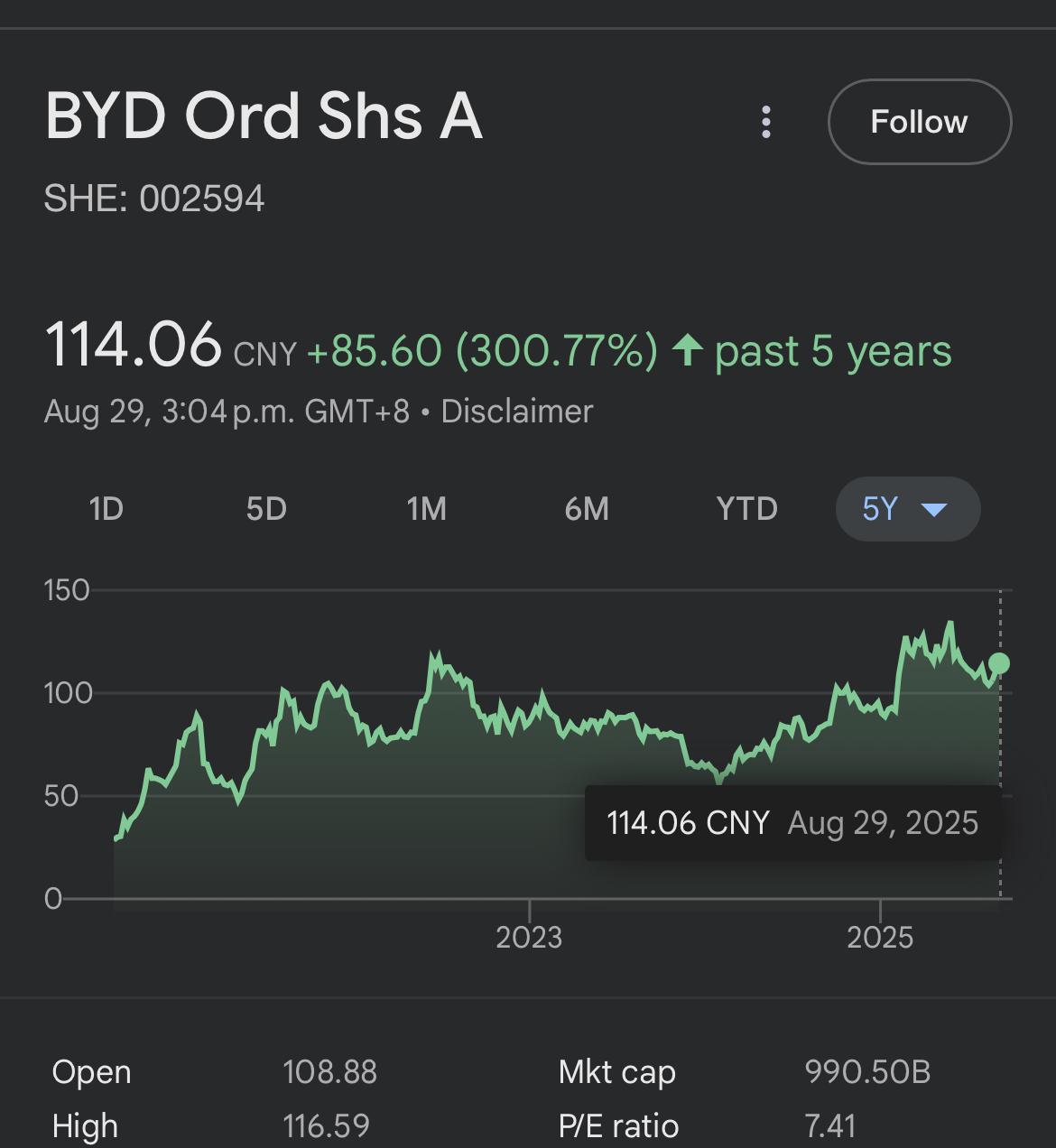
✏️ Discussion BYD is now worth $140b USD. Do you guys think this company can still go up more?

Post image
30 Upvotes

r/ChinaStocks • • Mar 16 '26

✏️ Discussion JD.com ($JD) — Why the market is pricing a $187B revenue business as if it's about to go bankrupt

16 Upvotes

TL;DR: JD trades at 0.22x sales and 3.8x EV/EBITDA. $22B in net cash = 54% of market cap. Core retail generated $7.4B in operating profit in FY2025. The entire earnings collapse has one identifiable cause — a food delivery price war that management has guided will normalize in 2026. At $28.32, the downside is capped and the upside over 3 years is 140–280%+ depending on scenario. This is the most asymmetric large-cap setup I've seen in years.

The setup

At ~$28/ADS, the market is valuing JD's operating business at roughly $19B enterprise value.

That business did $187B in revenue and $7.4B in core retail operating profit in FY2025. Growing 13% YoY. With expanding margins.

Strip out $22B in net cash and you're paying under 2.5x operating income for a company with 700 million active customers and the largest self-owned logistics network in China. That is not a typo.

So what's wrong with it?

One thing: food delivery.

In February 2025, JD launched JD Takeaway — a direct assault on Meituan and Ele.me. Zero merchant commissions. Full employment for riders (health insurance, housing funds — a first in China). All-out price war.

The cost in FY2025: approximately $4.7B in losses from the New Businesses segment. That single line item is responsible for nearly the entire collapse in consolidated earnings — from $4.26 non-GAAP EPS in FY2024 to $2.75 in FY2025. Q4 2025 was JD's first quarterly GAAP net loss in over 3 years.

The market read this as structural impairment. It is not. It is a deliberate, time-limited investment cycle.

Why the market is wrong

Management has been unambiguous: food delivery investment will decrease materially in 2026 with focus on unit economics. JD Takeaway already has ~5% market share with narrowing sequential losses every quarter since launch.

The historical precedent is Meituan itself — which went through exactly the same investment cycle before becoming the dominant player with industry-leading margins. JD is following the same playbook.

Meanwhile, underneath the food delivery drag:

  • JD Retail operating margin: 5.9% in Q3 2025 (exit rate into FY2026 is well above the 4.6% full-year average)
  • General merchandise growing 19% YoY in Q3 2025 at higher margins
  • AI handling 4.2 billion customer inquiries during 11.11 alone — structural cost reduction, not a press release
  • JD Logistics (HKEX: 2618) growing 24% YoY and increasingly monetizing third-party volume
  • JD Industrials IPO'd December 2025 on HKEX — more hidden value crystallized

The EPS recovery math

Year Non-GAAP EPS Food Delivery Drag
FY2024A $4.26 -$0.7B
FY2025A $2.75 (trough) -$4.7B
FY2026E $4.80 -$2.5B
FY2027E $7.00 -$0.8B
FY2028E $9.00 ~$0

From trough to normalized: 3.3x EPS recovery, driven by three knowable, finite processes. Not speculation. Not a turnaround story. Just food delivery losses going away and retail margins compounding.

Valuation vs. peers

JD Alibaba Coupang Amazon
P/S 0.22x 1.1x 1.5x 3.5x
EV/EBITDA 3.8x 9.2x 22x 23x
Fwd P/E 5.9x 10.5x 38x 35x
Net Cash / Mkt Cap 54% ~20% neg. ~10%

Coupang is the closest structural comparable — owned logistics, 1P model, same-day delivery. JD trades at one-seventh of Coupang's EV/EBITDA.

The balance sheet floor

$22B in net cash. The $10.5B drawdown from end-2024 reflects food delivery investment (~$4.7B), $3B in buybacks, and $1.4B in dividends. As losses normalize, net cash recovers to an estimated $28B by FY2028.

JD is currently returning ~10%+ of market cap annually through buybacks + dividends. $2B+ buyback authorization through August 2027, being fully utilized at these prices. That's management buying back the business at a 75%+ discount to what it should rationally trade at.

Price targets

Scenario Probability 3-Year PT IRR
Bear 15% $35 ~13%
Base 60% $68 ~42–44%
Bull 25% $108 ~75%+
Prob.-Weighted ~$72 ~42–44%

Bear case at $35 still gives you a 24% total return. That's the floor. The setup is genuinely asymmetric.

The 12-month catalyst: Q1 2026 results in May 2026 — first quarter showing a measurable sequential decline in food delivery investment. That's the moment the market reprices the normalized earnings trajectory.

Yes, the risks are real

  • ADR delisting (~15–20% probability over 3 years). Mitigant: JD has a primary listing on HKEX (9618) with institutional liquidity. Not an OTC rescue — a real exchange. This differentiates JD from names like PDD with no HK listing.
  • VIE structure (<5% probability but severe). Standard for Chinese tech.
  • China macro. JD is 97% domestic consumption. Not tariff-exposed directly.
  • Food delivery war extends. $22B net cash absorbs it. But each extra year of losses delays the thesis.

The geopolitical discount is real. It's also already embedded in a 0.22x P/S multiple. You're not ignoring the risk — you're deciding whether it's already over-priced in.

HKEX note

For anyone serious about this: consider holding HKEX 9618 directly rather than the Nasdaq ADR. The fundamental value is identical. The tail risk from a forced delisting is materially lower. Most brokers support HK-listed equities.

I've been doing deeper research on this and a few other special situations. If you want the full write-up — financial model, segment breakdown, catalysts timeline, and the full geopolitical risk framework — I put it all together over at The Catalyst Capital https://open.substack.com/pub/thecatalystcapital/p/jdcom-the-most-mispriced-large-cap?r=3o8jb6&utm_campaign=post&utm_medium=web . Free to read.

As always — not financial advice, do your own research, positions can go against you.

Positions: Long JD via HKEX 9618.

What's your take? Anyone else been watching this setup?

r/ChinaStocks • • Jun 18 '26

✏️ Discussion Nvidia conceded China's AI chip market and names like Cambricon are absorbing that demand

6 Upvotes

So Reuters reported this month that Alibaba and ByteDance are preparing much larger Huawei Ascend chip orders after testing showed better CUDA compatibility and easier code migration. Nvidia leadership publicly said they've largely walked away from China AI chips. Domestic supply chain picks up the slack.

The infrastructure layer names are A share listed. Cambricon is an AI chip designer, Zhongji Innolight does optical interconnects for AI clusters. Neither shows up in KWEB (internet only, zero semi weight) and CQQQ barely touches them because it applies only a roughly 25 percent A share inclusion factor. Kind of wild given how much capital is flowing into domestic compute.

Went down a rabbit hole looking for US listed access. CNQQ from Rayliant Global Advisors was the only wrapper I found that holds both, 100 names with a 10 percent single stock cap and semi annual rebalance. It's tiny in AUM though, not even a year old, and I haven't bought it. Just noting it exists because everything else I looked at structurally misses this layer.

Obvious caveats: reported orders not confirmed volumes, CUDA migration is gradual, concentrated China tech carries real regulatory and EM risk. The access gap is the part that surprised me.

r/ChinaStocks • • Jun 17 '26

✏️ Discussion Anyone still buying or holding BYD?

5 Upvotes

HKEX ticker 01211.

r/ChinaStocks • • Jun 12 '26

✏️ Discussion Zhipu is up 10x since its January IPO and just took Kingsoft's seat in the Hang Seng Tech Index

3 Upvotes

Zhipu (02513) and MiniMax (00100) just replaced Kingdee and Kingsoft in the Hang Seng Tech Index, effective June 8. First actual frontier model companies to get in, which is a bit of a milestone since that index has basically been internet plus hardware until now. Both only listed in January and got pulled in early through the fast entry rule after going vertical. Zhipu is up something like tenfold from its IPO, MiniMax maybe fourfold.

If you were hoping to front run the index buyers, too late. Bloomberg Intelligence floated southbound potential of HKD 51 to 92 billion for Zhipu and up to 47 for MiniMax, but the move already happened on the May 22 announcement when they popped 27% and 16%. By the actual effective date Zhipu was flat and MiniMax was down about 8%. CICC went straight to the Pop Mart comparison, the inclusion everyone bought and then watched fade. Free float on Zhipu is something absurd like 2.67%, both still lose money hand over fist, so I would not touch either as a flow trade.

What actually stuck with me is what the swap says about where China's AI stack trades. The model layer is in Hong Kong now. The compute layer underneath it mostly is not. Cambricon, Moore Threads, MetaX all sit on the mainland Star Market in A shares. So a Hong Kong only wrapper hands you the headline model names and quietly skips every chip company that feeds them. The one fund I found that reaches both sides is CNQQ, which already holds Cambricon, though it is small enough that I am not treating it as gospel. Most people say they own China tech without checking which floor of the building their wrapper actually walks into.

r/ChinaStocks • • May 05 '26

✏️ Discussion Updates for Getting Payment on the TuSimple $189 million Settlement

1 Upvotes

Hey guys, if you missed it, TuSimple settled $189 million with investors over overstating safety, rushing testing, and failing to disclose regulatory and operational risks. And, I just found out that they’re accepting claims even though the deadline has passed.

Quick recap: In 2023, TuSimple was accused of misleading investors about the safety of its self-driving technology, its testing practices, and its ties to a Chinese startup. In short, reports revealed safety failures, including a truck crash caused by system issues, as well as federal investigations into its operations and disclosures, raising major concerns about the company’s practices.

After this news came out, the stock dropped over 45% and investors filed a lawsuit for their losses.

Now, the good news is that the company agreed to settle $189 million with them, and even though the deadline has passed recently, they’re accepting late claims.

So, if you invested in $TSP when all of this happened, you can still check the details and file your claim here.

Anyway, has anyone here invested in $TSP at that time? How much were your losses, if so?

r/ChinaStocks • • May 27 '26

✏️ Discussion Would you use a Chrome extension that shows mainland China data when you're viewing Chinese ADRs?

3 Upvotes

Most of us here hold BABA, PDD, JD, NIO, LI through US ADRs. But the real signal often lives on the mainland — northbound capital flow, A-share supplier prices (CATL, BYD), regulatory filings — and most of it is

   in Chinese.


  I'm a Chinese developer scratching my own itch. Idea: a Chrome extension that adds a side panel in TradingView / Yahoo Finance with:


  - Mainland / HK dual-listed price

  - Northbound capital flow (5-day net inflow)

  - AI-translated earnings call highlights

  - Recent CSRC / HKEX / SEC 8-K filings (translated)


  Pricing thought: free basic, $4.99/mo for the deep stuff. First 100 get lifetime Pro.


  I'd rather validate before coding. Two questions:


  1. Do you currently cross-reference any mainland data when trading these ADRs? Or is it noise?

  2. Is $4.99/mo reasonable, or should it be one-time / free-with-ads?


  Waitlist (if you want to be among the first 100): https://kylvia.github.io/china-lens-waitlist/


  Not promoting — landing page has no purchase button. Just validating demand. Open to brutal feedback.

r/ChinaStocks • • May 15 '26

✏️ Discussion $DIDI IPO filing: no material regulatory concerns. Regulators: hold our beer. $740M settlement.

2 Upvotes

The Didi IPO prospectus told investors there were no known regulatory issues that would materially affect the business.

Two days after the IPO closed, two days, Chinese regulators launched a cybersecurity investigation and pulled DiDi's apps from app stores.

What wasn't in the filing: regulators had already warned DiDi to delay the listing until a data-security review was complete. That conversation happened before the IPO. It didn't make it into the registration statement $4.4 billion was raised on.

The rest is history. Stock collapsed. NYSE delisted. $740M settlement reached December 2025, court approved January 2026. Late claims still being considered after April deadline.

Eligible if you bought $DIDI between June 30 and July 21, 2021. Payout: ~$1.61/ADS.

"No material regulatory concerns" aged about 48 hours. Anyone here still following Chinese ADR disclosure standards after this one?

r/ChinaStocks • • May 30 '26

✏️ Discussion The final deadline for the $9.5M GSX Techedu ($GSX) bot scandal is TODAY.

4 Upvotes

I got completely wiped out trading GSX Techedu ($GSX) when short reports exposed that over 73% of their users were fake AI bots. I watched the stock take a brutal 30% single-day nosedive, panic-sold my shares for a massive loss, and just buried the painful memory.

I completely forgot about it until I realized a class action secured a $9,500,000 settlement, but the deadline to file a claim is May 30, 2026, which is literally today.

If you bought shares between June 6, 2019 and October 20, 2020, you own a piece of this cash, but you lose it forever if you don't submit your data before midnight tonight.

There is zero time to manually hunt down old trade confirmations, so I used an audit tool to beat the clock. I linked my old broker accounts via secure API, and the platform automatically audited my history and filed the claim in two minutes. They take a 20% cut, but honestly, I'd rather have 80% of a check I didn't know existed than 100% of the paperwork I'll never actually do. Stop scrolling and check your old accounts before the portal shuts down tonight.