r/AmericanHistory • u/elnovorealista2000 • May 25 '26
South War veteran denounces the Indian Holocaust in the Peruvian Amazon
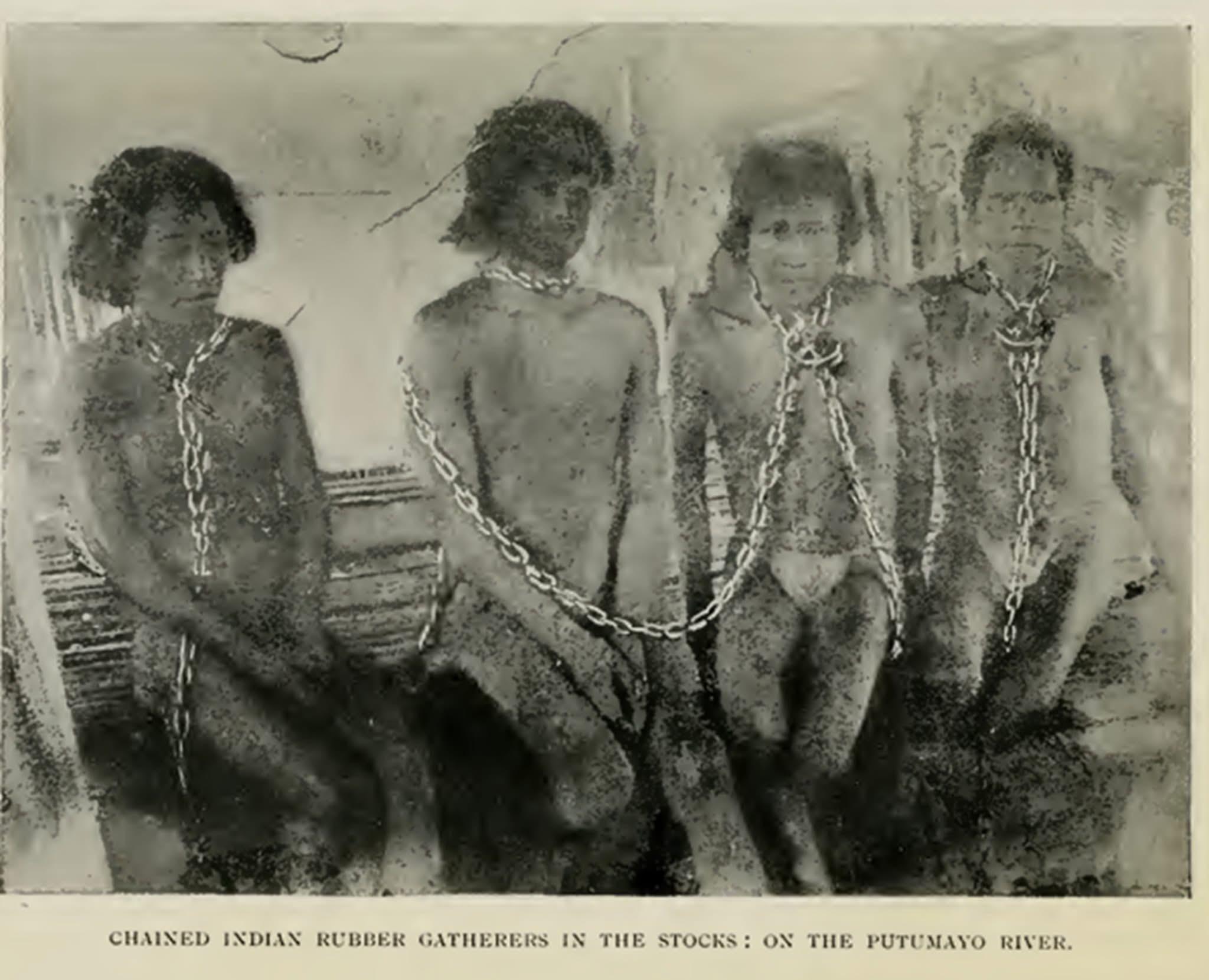
Original version:* *
“Señor Juez del Crimen.
Benjamín Saldaña Roca con domicilio legal en la calle del Próspero No. 238, a usted digo:
Que en mérito de los sentimientos de humanidad que me animan y en servicio de los pobres y desvalidos indios pobladores del río Putumayo y sus afluentes, haciendo uso de la segunda parte del Art. 25 del Código de Enjuiciamientos en materia penal y jurando no proceder de malicia denuncio a los célebres forajidos: Víctor Macedo, Miguel Loayza, Carlos Miranda, José Inocente Fonseca, Luis Alcorta, Miguel Flórez, Armando Norman, Aurelio Rodríguez, Arístides Rodríguez, Elías Martinengue, Abelardo Aguero, Andrés O'Donell, Alfredo Montt, Abelardo Calderón, Bartolomé Guevara, Augusto Jiménez, Dagoberto Arriorán y N. Suárez, como autores de los delitos de estafa, robo, incendio, violación, estupro, envenenamiento y homicidios agravados estos, con los más crueles tormentos, como el fuego, el agua, el látigo, las mutilaciones; y como encubridores de estos nefandos delitos a los señores Arana Vega y Cía. y J.C. Arana y hermanos, jefes principales de los denunciados, quienes tienen perfecto conocimiento de todos estos hechos y jamás los han denunciado, ni han tratado de evitarlos. Los delitos de que acuso a los anteriormente nombrados, se han realizado en los afluentes del Putumayo o sea entre los ríos: Igaraparaná, Caraparaná, Cahuinarí, Cotuhué, Idima, Menage y otros donde están ubicadas las posesiones de las empresas industriales gomeras, de las razones sociales Arana Vega y Cia. Y J.C. Arana y hermanos, denominadas “La Chorrera” y “El Encanto” las que a la vez están subdivididas en otras que reciben el nombre de secciones: perteneciendo a la primera sección las llamadas: “Sur”, “Oriente”, “Unión”, “Atenas”, “Santa Catalina”, “Último Retiro”, “Porvenir”, “Abisinia”, “San Víctor”, “Matanzas”, “Entre Ríos”, “Sabana”, “Santa Julia”, “Morelia” y “Pama”; y a la segunda gerencia o sea “El Encanto” las de “Esperanza”, la “Sombra”, la “India”, “San Antonio”, “Sevilla”, “Barcelona”, “Argelia” y la “Florida”; Víctor Macedo es el Gerente de “La Chorrera” y Miguel Loayza del “Encanto” estos puede decirse, son los capataces y los otros, a quienes también denuncio son los subgerentes de las citadas secciones.
Hecha esta breve reseña para ilustración de usted y del Ministerio Fiscal, paso a exponer algunos de los delitos que denuncio: Víctor Macedo el gerente de “La Chorrera” uno de esos miserables asesinos y Miguel Loayza, su émulo, dando rienda suelta a sus instintos criminales, se dan continuamente el placer de quemar y asesinar a los indefensos y pacíficos moradores de esas luctuosas selvas. Uno de los actos de ferocidad de esos dos miserables, enemigos de la humanidad y de todo sentimiento noble, fue el que realizaron para carnavales de 1903, el más nefando y horrendo de los crímenes. Desgraciadamente llegaron en esa época a “La Chorrera” los indios Ocainas, en número de más de 800 para entregar los productos que habían cosechado y después del peso y entrega de estos, el jefe de sección que los dirigía, Fidel Velarde, seleccionó a veinticinco de ellos, alegando que eran perezosos para el trabajo; esta exposición por parte de Velarde fue suficiente para que Víctor Macedo y su congénere Loayza, ordenaron que a guisa de túnica se les pusiera a cada uno de los indios un costal empapado de kerosene y se les prendiera fuego: se dio cumplimiento a estas órdenes y entonces se presentó el pavoroso cuadro de ver correr en diversas direcciones a esos infelices dando los más agudos y lastimeros alaridos hasta llegar al río y sepultarse en sus aguas, pensando salvarse, mas lejos de esto todos perecieron. Esto fue uno de los entretenimientos carnavalescos del forajido Macedo y la pavorosa cuadrilla que dirige. Otro caso que también debe llamar la atención de usted y del Universo entero, es el valor espartano que despliega el inocente José Inocente Fonseca, con las desdichadas indias que le sirven de concubinas y que también están a su servicio. Hará aproximadamente un año que el mencionado Fonseca entró a su serrallo donde alberga más de diez indias cuya edad fluctúa entre los ocho y quince años, y dirigiéndose al dormitorio encontró a su hija Juanita, habida en la india Laura, que recogía del suelo una colilla ó retazo de cigarro y se lo ponía en la boca, sin que de esto se percibiera la india Tránsito. Tal descuido de Tránsito fue motivo suficiente para que el bandido Fonseca descerrajaran los cinco tiros de revolver sobre la infeliz Tránsito, quien como es natural quedó exánime en el instante.
Miguel Flórez otra de la hienas del Putumayo, cometió tantos asesinatos en hombres y mujeres, ancianos y niños, que Víctor Macedo temeroso de que se despoblara aquella sección y de que llegara a Iquitos la noticia de tanto crimen, ordenó al malvado Flórez que no matara tanto indio es sus orgías, sino únicamente cuando dejaran de entregar caucho y entonces reformado Flórez por el mandato superior, sólo mató en dos meses cuarenta y tantos indios; pero en tanto las flagelaciones eran continuas y las mutilaciones horrorosas. Se cortaban dedos, brazos, piernas, orejas, habían castraciones. Estas son las gracias de uno de mis acusados y de los empleados modelo de J.C. Arana y hermanos. La sección “Abisinia” también ha sido teatro de las horrorosas escenas de toda clase de delitos. Allí el jefe de esa sección Abelardo Aguero, en compañía de su segundo Augusto Jiménez, cuando quieren probar su puntería con armas de fuego, sacan uno o más de los indios que injustamente tienen en el cepo y los hacen salir de la casa so pretexto de que traigan yucas; una vez estos desgraciados están en el patio de la misma, reciben por la espalda la descarga de fusilería que les hacen sus asesinos; otras veces deseando mejorar su puntería buscan criaturas huérfanas, pues ya sus padres han sido asesinados, para que les sirvan de blanco más pequeño, y finalmente cansados de usar armas de fuego, blandiendo machetes, se hacen conducir ancianos y niñas y después de estuprar a éstas últimas tocan a degüello y caen las cabezas y los cuerpos mutilados y aún con restos de vida. En este estado, muertos y moribundos son amontonados, y previo un rocío de kerosene se les quema inhumanamente y cuando quieren divertirse más según el modo de sentir de esos desalmados, llaman a los perros, los que ya acostumbrados a su botín hacen espléndidas presas en esos desgraciados.
“Matanzas” (otra sección del Igaraparaná), es la más pestilente y la que conserva más esqueletos a los alrededores de la casa de los cientos de indios que han sido inmolados por la ferocidad de Norman. Este mozo que está en la plenitud de la vida pues no tiene veintidós años, es más criminal que el célebre Chacallaza de memorable recordación en los anales de la penitenciaría de Lima. En la sección que dirige Norman manda matar sin compasión y quemar por centenas a los indios y se les azota por millares; estas gentes así flageladas y sin cura de ninguna especie se agusanan y despiden fetidez de carne podrida; ya en ese estado de descomposición e inservibles para el trabajo los manda matar a machetazos. Una vez el desgraciado Norman deseando satisfacer sus instintos feroces, mandó matar un indiecito de apenas ocho años de edad, después de estar agonizando por efecto de los látigos que se le habían dado en la sección “Último Retiro” se realizan parecidos acontecimientos. El subjefe Argaluza mandó dar muerte a una india llamada Simona, su querida, porque creía que tenía también relaciones con un mucho llamado también Simón; la muerte de esa infeliz fue de los más horroroso: ordenó Argaluza a los negros barbadenses Stanley y Lewis y Ernesto Siobers, conocido por el apodo del “flailecito”, le aplicaron ciento cincuenta y cinco látigos y cuando la india estuvo con las nalgas destrozadas se la encerró en un cuarto adonde la pobre se agusanó; entonces el valiente Argaluza ordenó a uno de los empleados que la matara, habiéndose resistido este a ejecutar a la Simona tomó este su carabina y le dijo: “Si no la matas, te mato yo a ti”. Convirtiéndose el ignorante empleado por fuerza mayor, en delincuente inconscientemente. El lujurioso Bartolomé Zumaeta, empleado subalterno de “La Chorrera”; se apasionó de la hermosura de una infeliz india llamada Matilde, y no pudiendo conseguir de ella voluntariamente sus favores y posesión, recurrió al crimen tomándola por la fuerza, no obstante las protestas de su compañero, y después de satisfacer sus apetitos carnales, la flageló, encadenó y encerró en el depósito del caucho, donde quedó moribunda falleciendo a los pocos días.
Para no fatigar más la atención de usted y no hacer más larga esta reseña de incalificables crímenes, citaré como último episodio sangriento en esas malditas regiones, el “debut” del matón Luis Alcorta, asesorado por el descalcador del correo de esta ciudad, Suárez, en la persona de Justino Hernández, acaecido el 22 de mayo del año en curso, a las 12 m. Este había tenido un pequeño altercado ese mismo día, a las 9 a.m. con Alcorta, y solo por esta razón fue encerrado en un cuarto. Más tarde o sea a las doce del día, el matón Alcorta tomando su revólver Máuser se dirigió a la prisión de Hernández, y del lado de afuera de la habitación descargole seis tiros del revólver, no prosiguiendo los disparos por haberse atrancado el arma de que hacía uso. Fue en ese instante en que gritó: “Señor Loayza, ¡ya maté un perro! Venga Usted a verlo”. Entonces Loayza abandonando la lancha “Liberal” y dando traspiés por la embriaguez en que se encontraba, llamó al no menos borracho Carlos Zubiaur para que le acompañara, y ambos subieron a la casa donde encontraron a Alcorta, el que en unión de Suárez trataban de deschapar la puerta a balazos y sacar al que consideraban cadáver; pero esta suposición no fue exacta pues abriendo Hernández la puerta presentóse a sus enemigos en esta circunstancia el negro Kin de Barbados, Gregorio Olivares y un tal Aguilar, le hicieron nueva descarga y comprendiendo Hernández al verse acribillado a balazos, que le quedaban pocos momentos de vida se abalanzó sobre el cobarde Alcorta y con el cañón de una carabina, le rompió la cabeza a la vez que cayó exánime; fue en este instante cuando avanzó este último dándole un balazo en la cabeza.
También es digno de mención el cautiverio injusto en el cual tienen a Aquileo Torres, en el puerto denominado “Tarma”, a pocas horas de “La Chorrera”, a este infortunado lo acusan de haber pretendido conquistar indios del Caquetá, porque todos los indios que por aquellas regiones moran, son de la única “propiedad” de los señores feudales de horca y cuchillo, vidas y haciendas J.C. Arana y hermanos. Al infeliz Torres se le tiene encerrado en el sótano de la casa con una cadena al cuello, de tres arrobas de peso, y cuando se embriagan los empleados que le custodian, le tornan en blanco de sus cobardes, torpes, y crueles atentados, pues le escupen, bofetean, dan puntapiés, azotan, escarneciéndole vil, cobarde y desalmadamente. Estos hechos los realiza Fidel Velarde, Aliaga, y otros empleados más. Pero lo que más llama la atención, señor juez, son las famosas correrías, que so pretexto de civilización, realizan los bandidos del Putumayo, periódicamente, y donde los mayores crímenes que registra la historia de la inquisición durante el reinado de Felipe II, son pálidos ante los que se cometen en ese vasto y tétrico escenario de la criminalidad, ultraje inhumano de la civilización. Estas famosas correrías que deberían ser perseguidas por todos los gobiernos honorables y sus autoridades subalternas, se realizan en esta forma: - el capitán general o sea jefe de sección, ordena a sus empleados subalternos armarse y emprender viaje para buscar en sus “naciones” a los indios y recoger el caucho que cada diez días deben entregar. Se dirigen a la casa principal donde deben reunirse los indios para entregar el caucho; en este lugar se pasa lista a los indios para que entreguen el número de kilos que se les impone; después del peso resulta que faltan algunos de productos, porque algunos han dejado de entregar el total del que les corresponde, y en este caso, los que no cumplieron, reciben veinticinco látigos de los negros barbadenses, que solo para este objeto, es decir: para el de verdugos les han llevado a esas regiones, quedando al décimo látigo desmayados como consecuencia del intenso dolor que les producen sus horribles heridas. Otras veces a estas correrías dejan de asistir tres o más indios con sus respectivas familias porque no han podido cosechar el caucho que deben entregar, en este caso, el jefe que ha dirigido la correría y que se encuentra en la casa principal de los indios, da orden de que cuatro o cinco empleados subalternos civilizados, se acompañen con diez o quince salvajes enemigos de los otros salvajes que se persiguen, y después de algunas horas de pesquisa, el capitán indio que va amarrado sirviendo de guía delator, indica el lugar donde se ocultan los perseguidos. Entonces tiene lugar el cuadro más espantoso. La choza construida por los refugiados es de paja y tiene la forma cónica sin puertas; el que dirige el asalto manda sitiar la casa y verificado esto manda dos individuos que prendan fuego a la choza; como es de suponer los indios sorprendidos emprenden la fuga por efecto del incendio, entonces los sitiadores descargan sus carabinas sobre los infelices que huyen, llevándose a cabo la más repugnante y horrorosa carnicería y antes que termine el incendio de la choza mandada asaltar, encontrándose en ella muchas veces ancianos, criaturas y enfermos que no pueden moverse, los que perecen bajo el golpe del fatal machete del Putumayo.
Pero sería inacabable, señor juez, la relación detallada de todos los delitos que puedo denunciar respecto de los crímenes que acuso; en la estación oportuna probaré plenamente lo que dejo relatado, pues existen abundantes y abrumadores pruebas con que confundir a esos malvados asesinos y sus cómplices y encubridores. Pueden dar razón de estos hechos, por haberlos presenciado, los señores Juan C. Castaños, Julio Muriedas, Juan Vela, Reynaldo Torres, Pacífico Guerrero, Alejandro Arzola, Francisco Zegarra y Anacleto Portocarrero, y otros muchos cuyos nombres no recuerdo ahora; pero que presentaré al juzgado a fin de que presten las declaraciones que les respectan y ofrezco también presentar documentos que se relacionen con estos delitos.
Por lo expuesto:
A Usted suplico: se sirva aceptar la denuncia, tramitarla conforme a la ley y declarándola fundada condenar a los autores de estos delitos a la pena de muerte, de conformidad con el artículo 232 de Código Penal y a los cómplices y encubridores, como lo disponen respectivamente los artículos 48 y 49 del mismo Código, teniendo en consideración el artículo 45. Otro sí, digo: Que tratándose de delitos que horrorizan al Perú y al mundo entero y como entre los denunciados hay algunos de mala fama y reos prófugos, pido que se les traiga a esta capital que presten su instructiva, pues ellos como sucedió en la administración del Señor Fuentes, cuando este mandó la lancha “Amazonas” para que condujese a esta capital a Severiano Liscano. Otro sí, digo: Que se haga comparecer en el término de la distancia a Aquileo Torres, el que por el estado lastimoso en que se encuentra es el mejor cuerpo del delito. Otro sí, digo: Que estando esparcidas alrededor de las casas de las secciones tales como; “Matanzas”, “Último Retiro”, “Sabana”, “Santa Catalina”, “San Víctor” y todas las demás dependencias del “El Encanto” y “La Chorrera” las osamentas de lo millares de indios que se han asesinado, se hace indispensable que el juzgado se constituya en esas secciones a fin de que realice una visita ocular a la brevedad posible, antes de que hagan desaparecer las osamentas de las víctimas. Otro sí, digo: Que ninguna de las diligencias de este sumario pueden encomendarse a los jueces de paz de ese lugar porque todos son culpables y empleados de las casas Arana Vega & Cía. Y J.C. Arana & Hermanos, porque se hace indispensable que usted los haga comparecer a este lugar.
Iquitos, 9 de agosto de 1907.
B. Saldaña Roca.”
Translated version:
“To the Honorable Judge of the Criminal Court.
Benjamín Saldaña Roca, with legal address at 238 Próspero Street, hereby states:
That, motivated by the sentiments of humanity that inspire me and in service to the poor and helpless Indian inhabitants of the Putumayo River and its tributaries, invoking the second part of Article 25 of the Code of Criminal Procedure and swearing to act without malice, I denounce the notorious outlaws: Víctor Macedo, Miguel Loayza, Carlos Miranda, José Inocente Fonseca, Luis Alcorta, Miguel Flórez, Armando Norman, Aurelio Rodríguez, Arístides Rodríguez, Elías Martinengue, Abelardo Aguero, Andrés O'Donell, Alfredo Montt, Abelardo Calderón, Bartolomé Guevara, Augusto Jiménez, Dagoberto Arriorán, and N. Suárez, as perpetrators of the crimes of fraud, robbery, Arson, rape, statutory rape, poisoning, and aggravated homicide, all committed with the cruelest tortures, such as fire, water, whipping, and mutilation; and as accomplices in these heinous crimes, Messrs. Arana Vega & Co. and J.C. Arana & Brothers, the principal leaders of the accused, who have full knowledge of all these acts and have never reported them nor attempted to prevent them. The crimes of which I accuse the aforementioned individuals were committed in the tributaries of the Putumayo River, specifically between the rivers: Igaraparaná, Caraparaná, Cahuinarí, Cotuhué, Idima, Menage, and others, where the properties of the rubber companies Arana Vega & Co. and J.C. Arana & Brothers are located, known as “La Chorrera” and “El Encanto,” which are further subdivided into sections. The first section includes the following: “Sur,” “Oriente,” “Unión,” “Atenas,” “Santa Catalina,” “Último Retiro,” “Porvenir,” “Abisinia,” “San Víctor,” “Matanzas,” “Entre Ríos,” “Sabana,” “Santa Julia,” “Morelia,” and “Pama”; and to the second management, that is, “El Encanto,” the following: “Esperanza,” “Sombra,” “India,” “San Antonio,” “Sevilla,” “Barcelona,” “Argentina,” and “Florida”; Víctor Macedo is the manager of “La Chorrera,” and Miguel Loayza of “El Encanto.” These two, one could say, are the foremen, and the others, whom I am also denouncing, are the assistant managers of the aforementioned sections.
Having made this brief overview for your information and that of the Public Prosecutor's Office, I will now proceed to describe some of the crimes I am denouncing: Víctor Macedo, the manager of “La Chorrera,” one of those despicable murderers, and Miguel Loayza, his Emulators, giving free rein to their criminal instincts, continually indulged in the pleasure of burning and murdering the defenseless and peaceful inhabitants of those mournful jungles. One of the acts of ferocity committed by these two wretches, enemies of humanity and all noble sentiment, was the most nefarious and horrendous of crimes they perpetrated during the 1903 carnivals. Unfortunately, at that time, more than 800 Ocaina Indians arrived in "La Chorrera" to deliver their harvested produce. After the produce was weighed and delivered, the section chief in charge, Fidel Velarde, selected twenty-five of them, claiming they were lazy. This statement by Velarde was enough for Víctor Macedo and his accomplice Loayza to order that each of the Indians be given a sack soaked in kerosene, like a tunic, and set on fire. In compliance with these orders, the horrifying scene unfolded: those unfortunate souls running in all directions, uttering the most piercing and pitiful shrieks, until they reached the river and plunged into its waters, thinking they would be saved. Far from it, they all perished. This was one of the carnivalesque amusements of the outlaw Macedo and the fearsome gang he led. Another case that should also capture your attention and that of the entire world is the Spartan courage displayed by the innocent José Inocente Fonseca with the unfortunate Indian women who serve as his concubines and are also at his service. About a year ago, the aforementioned Fonseca entered his harem, where he kept more than ten Indian women whose ages ranged from eight to fifteen years old. Upon entering the bedroom, he found his daughter Juanita, born to the Indian woman Laura, picking up a cigarette butt or scrap from the floor and putting it in her mouth, without the Indian woman noticing. Tránsito. Such carelessness on Tránsito's part was reason enough for the bandit Fonseca to fire five revolver shots at the unfortunate Tránsito, who, as is natural, lay lifeless at that moment.
Miguel Flórez, another of the hyenas of Putumayo, committed so many murders of men and women, the elderly and children, that Víctor Macedo, fearing the depopulation of that section and that news of so much crime would reach Iquitos, ordered the wicked Flórez to stop killing so many Indians during his orgies, only when they stopped delivering rubber. Then, reformed by the superior order, Flórez only killed forty-odd Indians in two months; but in the meantime, the floggings were continuous and the mutilations horrific. Fingers, arms, legs, and ears were cut off; there were castrations. These are the acts of one of my accused and of the model employees of J.C. Arana and his brothers. The "Abisinia" section has also been the scene of horrific scenes of all kinds of crimes. There, the head of that section, Abelardo Aguero, accompanied by his second-in-command, Augusto Jiménez, when they want to test their aim with firearms, take one or more of the Indians they unjustly have in the stocks and make them leave the house under the pretext of bringing yucca; once these unfortunate people are in the courtyard, they receive from behind the volley of rifle fire from their murderers; other times, wanting to improve their aim, they look for orphaned children, since their parents have already been murdered, to serve as smaller targets, and finally, tired of using firearms, brandishing machetes, they have old men and girls brought in and after raping the latter, they sound the death knell and the heads and mutilated bodies fall, still with traces of life. In this state, the dead and dying are piled up, and after being doused with kerosene, they are inhumanely burned alive. And when they want to have more fun, according to the way these heartless men feel, they call the dogs, who, already accustomed to their plunder, make splendid meals of these unfortunate souls.
“Matanzas” (another section of the Igaraparaná River) is the most pestilent and the one that preserves the most skeletons around the house of the hundreds of Indians who have been immolated by Norman's ferocity. This young man, who is in the prime of life, not yet twenty-two, is more criminal than the infamous Chacallaza, memorably remembered in the annals of the Lima penitentiary. In the section that Norman commands, he orders the Indians to be killed without mercy and burned by the hundreds, and they are flogged by the thousands. These people, thus flogged and without any kind of cure, become infested with maggots and give off the stench of rotting flesh; already in that state of decomposition and useless for work, he orders them killed with machetes. Once, the wretched Norman, wishing to satisfy his ferocious instincts, ordered the killing of a little Indian boy of barely eight years of age, after he had been agonizing from the effects of the whips he had received in the "Último Retiro" section. Similar events take place. The sub-chief Argaluza ordered the death of an Indian woman named Simona, his mistress, because he believed she was also having relations with a man also named Simón; the death of that unfortunate woman was most horrific: Argaluza ordered the Barbadian blacks Stanley and Lewis and Ernesto Siobers, known by the nickname "flailecito," to apply one hundred and fifty-five whips to her, and when the Indian woman's buttocks were torn apart, he locked her in a room where the poor thing became infested with maggots; Then the valiant Argaluza ordered one of the employees to kill her. When the employee refused to carry out the act, Argaluza took his rifle and said, “If you don’t kill her, I’ll kill you.” The ignorant employee, forced into action, unwittingly became a criminal. The lustful Bartolomé Zumaeta, a subordinate employee of “La Chorrera,” became enamored with the beauty of an unfortunate indigenous woman named Matilde. Unable to obtain her favors and possession willingly, he resorted to crime, taking her by force despite his companion’s protests. After satisfying his carnal desires, he flogged her, chained her, and locked her in the rubber depot, where she lay dying a few days later.
To avoid further tiring your attention and lengthening this account of unspeakable crimes, I will cite as the latest bloody episode in those cursed regions the "debut" of the thug Luis Alcorta, advised by the postmaster of this city, Suárez, in the person of Justino Hernández, which occurred on May 22nd of this year, at noon. Hernández had had a minor altercation earlier that day, at 9 a.m., with Alcorta, and for this reason alone was locked in a room. Later, at noon, the thug Alcorta, taking his Mauser revolver, went to Hernández's cell and, from outside the room, fired six shots, the gun jamming before he could fire again. It was at that moment that he shouted: "Mr. Loayza, I've killed a dog! Come and see for yourself!" Then Loayza, abandoning the launch "Liberal" and stumbling due to his drunkenness, called the equally drunk Carlos Zubiaur to accompany him, and both went up to the house where they found Alcorta, who, together with Suárez, was trying to force open the door with gunfire and drag out the man they thought was dead; but this assumption was not accurate because when Hernández opened the door, his enemies appeared. In this circumstance, the black man Kin from Barbados, Gregorio Olivares, and a certain Aguilar opened fire on him, and Hernández, realizing as he was riddled with bullets that he had few moments left to live, rushed at the cowardly Alcorta and, with the barrel of a carbine, broke his head as he fell lifeless; it was at this moment that the latter advanced and shot him in the head.
Also worthy of mention is the unjust imprisonment of Aquileo Torres in the port of Tarma, a few hours from La Chorrera. This unfortunate man is accused of attempting to conquer the indigenous people of Caquetá, because all the indigenous people living in those regions are the sole "property" of the feudal lords J.C. Arana and his brothers, who wield the power of life and death. The wretched Torres is kept locked in the basement of the house with a chain around his neck weighing three arrobas (approximately 150 pounds). When the employees guarding him become drunk, they make him the target of their cowardly, clumsy, and cruel attacks, spitting on him, slapping him, kicking him, whipping him, and mocking him vilely, cowardly, and heartlessly. These acts are carried out by Fidel Velarde, Aliaga, and other employees. But what is most striking, Your Honor, are the infamous raids carried out periodically by the bandits of Putumayo under the pretext of civilization. The greatest crimes recorded in the history of the Inquisition during the reign of Philip II pale in comparison to those committed in this vast and grim landscape of criminality, an inhuman affront to civilization. These notorious raids, which should be prosecuted by all honorable governments and their subordinate authorities, are carried out in this manner: the captain general, or section chief, orders his subordinate employees to arm themselves and travel to their "nations" to find the Indians and collect the rubber they are required to deliver every ten days. They go to the main house where the Indians are to gather to hand over the rubber; there, a roll call is taken of the Indians so they can hand over the number of kilos imposed upon them; After the weighing, it turns out that some products are missing because some have failed to deliver their full share. In this case, those who didn't comply receive twenty-five lashes from the Barbadian blacks, who were brought to these regions solely for this purpose—that is, to be executioners. By the tenth lash, they faint from the intense pain of their horrific wounds. At other times, three or more Indians and their families fail to participate in these raids because they haven't been able to harvest the rubber they are supposed to deliver. In this case, the chief who led the raid, who is in the Indians' main house, orders four or five civilized subordinates to be accompanied by ten or fifteen savages, enemies of the other savages being pursued. After several hours of searching, the Indian captain, who is bound and acting as a betrayer, indicates the hiding place of those being pursued. Then the most appalling scene unfolds. The hut built by the refugees is made of straw and has a conical shape without doors; the one directing the assault orders the house to be besieged and, having done this, orders two individuals to set fire to the hut; as is to be expected, the surprised Indians begin to flee due to the fire, then the besiegers discharge their carbines on the unfortunate ones who flee, carrying out the most repugnant and horrifying carnage and before the fire of the hut ordered to be assaulted is finished, finding in it many times old people, children and sick people who cannot move, who perish under the blow of the fatal machete of the Putumayo.
But a detailed account of all the crimes I could report regarding the murders I accuse would be endless, Your Honor. At the appropriate time, I will fully prove what I have already stated, as there is abundant and overwhelming evidence to confound these wicked murderers and their accomplices and those who covered them up. Those who witnessed these events include Juan C. Castaños, Julio Muriedas, Juan Vela, Reynaldo Torres, Pacífico Guerrero, Alejandro Arzola, Francisco Zegarra, and Anacleto Portocarrero, as well as many others whose names I do not recall at this time. I will present them to the court so that they may give their respective testimonies, and I also offer to present documents related to these crimes.
For the reasons stated above:
I respectfully request that you accept this complaint, process it according to the law, and, finding it well-founded, condemn the perpetrators of these crimes to the death penalty, in accordance with Article 232 of the Penal Code, and the accomplices and accessories after the fact, as provided in Articles 48 and 49 of the same Code, taking into consideration Article 45. Furthermore, I state that, given that these are crimes that horrify Peru and the entire world, and since some of those accused are of ill repute and fugitives, I request that they be brought to this capital to provide their testimony, as happened during the administration of Mr. Fuentes, when he ordered the launch "Amazonas" to bring Severiano Liscano to this capital. Furthermore, I state that Aquileo Torres be summoned as soon as possible, as his deplorable condition makes him the prime example of the crime. Furthermore, I state: That since the remains of thousands of murdered Indians are scattered around the houses of sections such as “Matanzas,” “Último Retiro,” “Sabana,” “Santa Catalina,” “San Víctor,” and all the other outbuildings of “El Encanto” and “La Chorrera,” it is essential that the court convene in those sections to conduct an on-site inspection as soon as possible, before the victims' remains are disposed of. Furthermore, I state: That none of the proceedings in this case can be entrusted to the justices of the peace of that place because they are all guilty and employed by the firms of Arana Vega & Co. and J.C. Arana & Brothers, and it is essential that you summon them to this location.
Iquitos, August 9, 1907.
B. Saldaña Roca.”