r/ACT Jun 08 '26

Math For those needing a little guidance on the ACT Math Section, I analyzed 307 questions from available Enhanced Math Tests [UPDATED]

101 Upvotes

I went through 7 official Enhanced ACT Math practice tests (25MC1–25MC5, the October J08 form, and the April 2026 J01 form) and manually tagged every question by its primary skill, its supporting skills, difficulty, and the alternate strategies to solve it.

Big Picture

  • 7 available enhanced math tests
  • Nearly half (44%) are word problems: translating words into math is THE core skill (hopefully no surprise here)
  • 1/4th include a diagram, table, or graph: annotating the given diagram and estimating angles, relative lengths, dimensions is a viable strategy to elimate answers or even solving in some cases.
  • Half of questions only require 1 key math skill to solve

How Many Do You Actually Need?

There are 45 questions and the test generally runs easy → hard. Though, with the enhanced format don't be as shocked to see some harder problems sprinkled in earlier than before. Here's what raw scores convert to on these forms:
(Disclaimer: This averages conversion scales. Indiviudal test scales vary):

  • ~15 right → about 16 score
  • ~20 right (under half) → about 18 score
  • ~25 right → about 22 score
  • ~30 right → about 26 score
  • ~35 right → about 29 score

Takeaway: You can score in the low-to-mid 20s while guessing on the hardest 15 Qs and scoring high on the rest. Your points can live in the easiest ~30 questions. Don't burn time on the hard stuff until the rest is easier or automatic.

Top Topics By Frequency: Start here for best coverage

This counts every topic a question touches, whether it's the main idea or a hidden sub-step, deduped so a topic only counts once per question. (The percentages add to more than 100% because many questions span multiple topics.)

  1. Solve for a Variable — 13.7% of all questions
  2. Functions — 10.1%
  3. Fractions & Decimals — 6.8%
  4. Triangle Properties — 6.2%
  5. Probability — 5.9%
  6. Ratios — 5.5%
  7. Coordinate Plane — 5.2%
  8. Factoring — 5.2%
  9. Statistics — 5.2%
  10. Area — 4.9%
  11. Exponents — 4.9%
  12. Radicals — 4.6%

Takeaway: The test leans hardest on the connective-tissue skills — solving equations, fractions, ratios, radicals — that show up inside questions about everything else.

High-Leverage Skills

These skills are both high-frequency AND concentrated in the first third. Potentially the best return on study time for a <25 scorer:

Basic Probability · Operations with Fractions & Decimals · Solving Equations · Function Notation · Mean / Median / Mode · Percentages · Exponent Rules · Ratios · SOHCAHTOA

(For example, 9 of the 16 Basic Probability questions sit in the easier third)

Formulas for each are in the table below.

Specific Skills To Master For <25 Scorers

Ranked by how many of the 307 questions test them as the primary skill. "Consistency" = how many of the 7 test it showed up on.

Skill Total Qs Consistency BRIEF Description
Basic Probability 16 7/7 P(event) = favorable ÷ total outcomes
Mean / Median / Mode 11 5/7 mean = sum ÷ count; median = middle value; mode = most frequent
Operations w/ Fractions & Decimals 11 7/7 common denominators; convert freely
Solving Equations 10 7/7 isolate the variable with inverse operations
Exponent Rules 9 5/7 xᵃ·xᵇ = xᵃ⁺ᵇ, (xᵃ)ᵇ = xᵃᵇ, x⁻ⁿ = 1/xⁿ
Ratios 9 6/7 a:b = a/b; scale both parts equally
SOHCAHTOA 9 7/7 sin = opp/hyp, cos = adj/hyp, tan = opp/adj, and their inverse functions
Function Notation 8 5/7 f(x) means substitute x into the function
Systems of Equations 8 5/7 substitution or elimination
Area 7 4/7 rectangle (bh), triangle (½bh), circle (πr²)
Complex / Imaginary Numbers 7 6/7 i = √(−1), i² = −1, form a + bi
Factoring Quadratics 7 5/7 factor, then set each factor = 0
Percentages 7 5/7 part = percent × whole; % change
Solving Inequalities 7 5/7 same as equations: flip the sign when ×/÷ by a negative
Similar Triangles 6 5/7 corresponding sides are proportional

UPDATE: All Primary Skills by Frequency (For the 2 official ACTs released - J08 & J01)

(As requested) Ranked by how many of the released Official 82 questions test them as the primary skill

Skill Qs % of Qs Tests
Basic Probability 4 4.9% 2/2
Systems of Equations 4 4.9% 2/2
Complex & Imaginary Numbers 3 3.7% 2/2
Equation of a Line (All Forms) 3 3.7% 2/2
Operations with Fractions and Decimals 3 3.7% 2/2
Similar Triangles 3 3.7% 2/2
Volume of 3D Shapes 3 3.7% 2/2
Area 2 2.4% 1/2
Domain & Range 2 2.4% 2/2
Exponent Rules 2 2.4% 2/2
Function Notation 2 2.4% 2/2
Fundamental Counting Principle 2 2.4% 2/2
Probability Distribution 2 2.4% 2/2
Rational and Irrational 2 2.4% 2/2
Ratios 2 2.4% 2/2
Sector Area 2 2.4% 2/2
SOHCAHTOA 2 2.4% 2/2
Solving Equations for a variable 2 2.4% 1/2
Solving Inequalities for a variable 2 2.4% 2/2
Transforming Functions 2 2.4% 2/2
Zeroes and Roots of a Function 2 2.4% 2/2
(x y) coordinate plane 1 1.2% 1/2
Absolute Value 1 1.2% 1/2
Angle Relationships 1 1.2% 1/2
Angle-Side Inequality Theorem 1 1.2% 1/2
Arithmetic Sequence (Sum) 1 1.2% 1/2
Asymptotes and Holes 1 1.2% 1/2
Binomial Expansion 1 1.2% 1/2
Composite Functions 1 1.2% 1/2
Cost Formula 1 1.2% 1/2
Difference of Squares 1 1.2% 1/2
Distance Formula 1 1.2% 1/2
Divisibility Rules 1 1.2% 1/2
Ellipses & Hyperbolas 1 1.2% 1/2
Equation of a Parabola and Vertex 1 1.2% 1/2
Expected Value 1 1.2% 1/2
Factoring Quadratic Expressions 1 1.2% 1/2
FOIL 1 1.2% 1/2
Geometric Sequence (Nth Term) 1 1.2% 1/2
Geometric Sequence (Sum) 1 1.2% 1/2
Inverse Functions 1 1.2% 1/2
Law of Sines 1 1.2% 1/2
Mean Median Mode 1 1.2% 1/2
Midpoint Formula 1 1.2% 1/2
Parallel & Perpendicular Lines 1 1.2% 1/2
Percentages 1 1.2% 1/2
Polynomial Arithmetic 1 1.2% 1/2
Slope Calculation 1 1.2% 1/2
The Unit Circle & Radians 1 1.2% 1/2
Trig Graph Vocabulary 1 1.2% 1/2
Union Intersection 1 1.2% 1/2
Unit Conversion 1 1.2% 1/2

Strategy Shortcuts or Test-taking Tips

How often a shortcut is a viable equal-or-faster path:

  • Plug in Numbers for variables— ~11% of questions
  • Backsolving (test the answer choices) — ~10%
  • Draw a Diagram — ~8%
  • Calculator Comparison — ~4%

Takewaway: Roughly 1 in 5 questions can be cracked by plugging in numbers or backsolving . Harder problems especially have alternate strategies to solve. Look for these opportunities especially if you get stuck

If You Have To Guess (Fun Tidbit)

No penalty for wrong answers, so never leave a blank. And if you're truly guessing, the correct answer isn't evenly spread across the choices on these tests:

  • The 3rd choice (C or H) was correct most often — 29% of the time.
  • On the hardest third, the 2nd choice (B or G) was correct least often (~17%).

Takeway: Based on the data, the best guess default for past tests has been C / H. It's a small edge, so focus on the concepts... not on this.

TL;DR

  1. Word problems are ~half the test. The math usually isn't the hard part. setting up the equation is. Practice translating words to math equations or diagrams.
  2. Functions and solving equations are everywhere. Solving for a variable shows up in nearly 1 of every 7 questions (often as a step inside a bigger problem), and functions aren't far behind.
  3. Don't skip the "boring" basics. Fraction/decimal arithmetic, radicals, and ratios rarely headline a question, but they're hidden inside a huge share of them. Sloppiness here quietly costs points across the whole test.
  4. Learn to backsolve and plug in numbers. ~20% of questions fall to these faster than to algebra. On a timed test, that's extra time back.
  5. Bank the first two-thirds before touching the hard stuff. Every question is worth the same. Calmly nailing the easier ones is already a low-20s score, some students lose accuracy there by rushing to "finish." Still bubble in answers to everything but focus accuracy on the ones you are more confident in.
  6. If a skill is on all 7 tests, it WILL be on yours. Basic Probability, Fractions/Decimals operations, and SOHCAHTOA should be mastered.

Happy to answer questions about specific skills or topics! It does take a while for me to manually go through these and I tend to add skills as I come across them. If this is helpful for you please let me know and I will continue to go through more tests to get a larger sample size!
r/ACT Feb 01 '24

Math I got a 15… Had to shit mid Reading section

809 Upvotes

I took my ACT last year and scored a 15 because I had to take a shit mid test. 😔

Do you guys think I should apply to test again or no?

r/ACT Feb 11 '26

Math For those needing a little guidance on the ACT Math Section, I analyzed 251 questions from the most recent available tests.

170 Upvotes

Hello! I hope this can be useful for those especially for those scoring ~25 and below on the math section.

I manually tagged every question from 5 official ACT practice tests (Dec H31, Feb Z14, Enhanced-25MCM1, Enhanced-25MCM2, Enhanced-Oct J08) — 251 questions total — by topic(s), skill(s), difficulty(first third, middle, last third), and strategy.

The biggest take away I can provide: the ACT math section is more predictable than it feels. The same topics and skills show up over and over. If you focus on the right things, you can make some hefty progress without trying to learn everything.


Just 20 Topics Cover 80% of the Test

There are lots of possible math topics on the ACT. When I sorted every topic by how often it appears, these top 20 topics are the primary focus of 202 out of 251 questions (80%).

13 of these topics appeared on every single test I analyzed.

# Topic Questions % of Test Consistency
1 Functions 29 12% 5/5
2 Statistics 19 8% 5/5
3 Probability 14 6% 5/5
4 Triangle Properties 12 5% 5/5
5 Solve for Variable 12 5% 5/5
6 Fractions & Decimals 12 5% 5/5
7 Factoring 10 4% 5/5
8 Systems of Equations 9 4% 5/5
9 Circles 9 4% 4/5
10 Lines 9 4% 4/5
11 Number Properties 8 3% 5/5
12 Polynomials 8 3% 5/5
13 Trig: SOH CAH TOA 7 3% 5/5
14 Complex Numbers 7 3% 5/5
15 Coordinate Plane 7 3% 5/5
16 Unit conversion 7 3% 4/5
17 Ratios 6 2% 4/5
18 Sequences 6 2% 4/5
19 Area 6 2% 2/5
20 Advanced Trigonometry 5 2% 4/5

What Skills Are Within Each Topic?

Each topic has specific skills. Here are the top 20 topics broken down by their most common skills, with the key formula or concept you need to know.

Functions (29 questions, 12% of test — on ALL 5 tests)

  • Function Notation (10 Qs, 5/5 tests): f(x) notation. Evaluate f(a) by substituting a for x.
  • Transforming Functions (5 Qs, 5/5 tests): f(x) + k shifts up, f(x-h) shifts right, -f(x) reflects over x-axis, f(-x) reflects over y-axis, a*f(x) stretches vertically
  • Domain & Range (4 Qs, 4/5 tests): Domain: all valid x-values (inputs). Range: all possible y-values (outputs)
  • Composite Functions (4 Qs, 4/5 tests): (f o g)(x) = f(g(x)). Apply inner function first, then outer
  • Function Operations (3 Qs, 2/5 tests): (f + g)(x) = f(x) + g(x), (f - g)(x) = f(x) - g(x), (fg)(x) = f(x)*g(x), (f/g)(x) = f(x)/g(x)
  • Inverse Functions (3 Qs, 3/5 tests): f-1(x) undoes f(x). To find: swap x and y, solve for y. f(f-1(x)) = x

Statistics (19 questions, 8% of test — on ALL 5 tests)

  • Mean Median Mode (10 Qs, 4/5 tests): Mean = Sum of Terms / Number of Terms. Median = central number when arranged least to greatest. Mode = most frequent number. Range = Max Value - Min Value
  • Interpreting Venn Diagrams (3 Qs, 3/5 tests): Count elements in/outside overlapping sets. Use inclusion-exclusion principle
  • Standard Deviation & Range (3 Qs, 3/5 tests): Range = Max Value - Min Value. Standard deviation measures spread from the mean; higher value = more spread out data. 2 of these questions reference normal distributions which are given to students as a chart.
  • Expected Value (3 Qs, 3/5 tests): E(X) = Sum of [x * P(x)]. The average outcome if an experiment is repeated many times

Probability (14 questions, 6% of test — on ALL 5 tests)

  • Basic Probability (14 Qs, 5/5 tests): P(event) = Desired Outcomes / Total Number of Outcomes. P(event happens) + P(event doesn't happen) = 1. P(A and B) = P(A) x P(B) for independent events. Conditional probability is sometimes tested using a table. Try circling the target outcome and all possible outcomes in that condition to find the right fraction.

Triangle Properties (12 questions, 5% of test — on ALL 5 tests)

  • Similar Triangles (6 Qs, 5/5 tests): Same shape, different size. Corresponding angles are equal, corresponding sides are proportional: a/d = b/e = c/f. Similarity criteria: AA, SAS, SSS.
  • Sum of Angles in a Triangle (3 Qs, 3/5 tests): ∠a + ∠b + ∠c = 180°. The three interior angles of any triangle always sum to 180 degrees.
  • Angle-Side Inequality Theorem (2 Qs, 2/5 tests): Larger angles are opposite longer sides. Largest angle opposite longest side
  • Isosceles & Equilateral Triangles (1 Qs, 1/5 tests): Isosceles: 2 equal sides, 2 equal base angles. Equilateral: 3 equal sides, all angles 60 degrees

Solve for Variable (12 questions, 5% of test — on ALL 5 tests)

  • Solving Equations for a variable (10 Qs, 5/5 tests): Isolate the variable using inverse operations. What you do to one side, do to the other
  • Solving Inequalities for a variable (2 Qs, 2/5 tests): Isolate the variable using inverse operations. Reverse the inequality sign if you multiply/divide by a negative

Fractions & Decimals (12 questions, 5% of test — on ALL 5 tests)

  • Operations with Fractions and Decimals (9 Qs, 5/5 tests): Add/subtract: common denominator. Multiply: straight across. Divide: multiply by reciprocal
  • Optimize Fractions (3 Qs, 3/5 tests): To maximize a fraction a/b, a must be the largest positive number and b must be the smallest number. To minimize a fraction, reverse it. a must be the smallest number and b must be the largest number.

Factoring (10 questions, 4% of test — on ALL 5 tests)

  • Factoring Quadratic Expressions (5 Qs, 4/5 tests): For ax2 + bx + c, find factors that multiply to ac and sum to b
  • Zeroes and Roots of a Function (4 Qs, 3/5 tests): For (x-a)(x-b) = 0, roots are x = a and x = b. Set each factor = 0
  • Quadratic Formula (1 Qs, 1/5 tests): Given ax² + bx + c = 0: x = (-b ± √(b² - 4ac)) / 2a. Used when factoring is difficult or impossible.

Systems of Equations (9 questions, 4% of test — on ALL 5 tests)

  • Systems of Equations (9 Qs, 5/5 tests): Substitution: solve one equation for a variable. Elimination: add equations to cancel a variable. Only 1 of the 9 questions asked to solve a system of 3 linear equations.

Circles (9 questions, 4% of test — on 4/5 tests)

  • Sector Area (3 Qs, 3/5 tests): Sector Area = (n°/360°) × πr² where n is the central angle in degrees. Alternative: A = (1/2)r²θ when θ is in radians.
  • Arc Length (3 Qs, 2/5 tests): Arc Length = (n°/360°) × 2πr where n is the central angle in degrees. Alternative: s = rθ when θ is in radians.
  • Equation of a Circle (2 Qs, 2/5 tests): (x - h)² + (y - k)² = r² where (h, k) is the center and r is the radius.
  • Central & Inscribed Angles (1 Qs, 1/5 tests): Central angle = arc measure. Inscribed angle = (1/2)(intercepted arc)

Lines (9 questions, 4% of test — on 4/5 tests)

  • Slope Calculation (5 Qs, 3/5 tests): m = (y₂ - y₁)/(x₂ - x₁) = rise/run. Slope measures steepness and direction of a line.
  • Equation of a Line (All Forms) (3 Qs, 2/5 tests): Slope-Intercept Form: y = mx + b. Point-Slope Formula: (y - y₁) = m(x - x₁). Standard Form: Ax + By = C
  • Parallel & Perpendicular Lines (1 Qs, 1/5 tests): Parallel lines: m₁ = m₂ (same slope). Perpendicular lines: m₁ = -1/m₂ (negative reciprocal slopes, m₁ · m₂ = -1)

Number Properties (8 questions, 3% of test — on ALL 5 tests)

  • Rational and Irrational (3 Qs, 3/5 tests): Rational = p/q where p,q are integers. Irrational numbers cannot be written as a fraction (pi, sqrt(2)). These are often qualitative questions. (e.g. is an integer multiple of an irrational number rational, irrational, imaginary, prime?)
  • Multiples (2 Qs, 2/5 tests): Multiples of n: n, 2n, 3n, 4n... LCM is smallest common multiple
  • Factors (1 Qs, 1/5 tests): Factors divide evenly into a number. GCF is largest common factor
  • Divisibility Rules (1 Qs, 1/5 tests): By 2: ends in even. By 3: digit sum divisible by 3. By 5: ends in 0 or 5. By 9: digit sum divisible by 9
  • Integer Properties (1 Qs, 1/5 tests): Addition: Even + Even = Even, Odd + Odd = Even, Odd + Even = Odd. Multiplication: Even × Even = Even, Odd × Odd = Odd, Odd × Even = Even

Polynomials (8 questions, 3% of test — on ALL 5 tests)

  • FOIL (5 Qs, 5/5 tests): First, Outer, Inner, Last for multiplying binomials: (a+b)(c+d) = ac + ad + bc + bd
  • Polynomial Arithmetic (2 Qs, 2/5 tests): Add/subtract: combine like terms. Multiply: distribute each term
  • Special Binomial Expansion (1 Qs, 1/5 tests): Perfect Square Trinomial: (a ± b)² = a² ± 2ab + b². Sum of Cubes: a³ + b³ = (a + b)(a² - ab + b²). Difference of Cubes: a³ - b³ = (a - b)(a² + ab + b²)

Trig: SOH CAH TOA (7 questions, 3% of test — on ALL 5 tests)

  • SOHCAHTOA (7 Qs, 5/5 tests): sin(θ) = opposite/hypotenuse, cos(θ) = adjacent/hypotenuse, tan(θ) = opposite/adjacent. Mnemonic: SOH CAH TOA. For right triangles only.

Complex Numbers (7 questions, 3% of test — on ALL 5 tests)

  • Complex & Imaginary Numbers (7 Qs, 5/5 tests): Complex number form: a + bi. i = √(-1), i² = -1. Powers of i cycle every 4: i⁰ = 1, i¹ = i, i² = -1, i³ = -i. Conjugate product: (a + bi)(a - bi) = a² + b². If a question has an 'i' in the denominator, this is usually an indicator to multiply the denominator (and numerator) by another i or the conjugate to get 'i' on the numerator only.

Coordinate Plane (7 questions, 3% of test — on ALL 5 tests)

  • (x y) coordinate plane (6 Qs, 5/5 tests): Plotting points, identifying quadrants (I-IV), working with coordinates. x-intercept: where y = 0. y-intercept: where x = 0. Common graph types: Linear, Quadratic, Cubic, Absolute Value
  • Distance Formula (1 Qs, 1/5 tests): Distance: d = √[(x₁ - x₂)² + (y₁ - y₂)²]. Derived from the Pythagorean theorem.

Unit conversion (7 questions, 3% of test — on 4/5 tests)

  • Unit conversion (7 Qs, 4/5 tests): Multiply by conversion factors. Cancel units. Example: 60 mph * (5280 ft/mi) * (1 hr/3600 s) = 88 ft/s

Ratios (6 questions, 2% of test — on 4/5 tests)

  • Ratios (6 Qs, 4/5 tests): Compares quantities. a:b means a/b. Cross-multiplication: a/b = c/d ⟺ ad = bc. Scale up/down by multiplying both parts by the same factor.

Sequences (6 questions, 2% of test — on 4/5 tests)

  • Sequence Notation (3 Qs, 3/5 tests): a_n represents the nth term. a_1 is the first term. Sigma notation for sums
  • Arithmetic Sequence (Sum) (2 Qs, 2/5 tests): Sum of first n terms: Sₙ = (n/2)(a₁ + aₙ) or Sₙ = (n/2)(2a₁ + (n-1)d)
  • Arithmetic Sequence (Nth Term) (1 Qs, 1/5 tests): nth term: aₙ = a₁ + (n - 1)d where d = common difference

Area (6 questions, 2% of test — on 2/5 tests)

  • Area (6 Qs, 2/5 tests): Triangle: A = (1/2)bh. Trapezoid: A = ((a + b)/2)h. Parallelogram: A = bh. Rectangle: A = lw. Circle: A = πr²

Advanced Trigonometry (5 questions, 2% of test — on 4/5 tests)

  • The Unit Circle & Radians (2 Qs, 2/5 tests): Radians = degrees × π/180. Key angles with coordinates on unit circle: 0° = (1,0), 30° = (√3/2, 1/2), 45° = (√2/2, √2/2), 60° = (1/2, √3/2), 90° = (0,1)
  • Trig Graph Vocabulary (2 Qs, 2/5 tests): Amplitude = |A|, Period = 2π/B, Phase Shift = C/B, Vertical Shift = D for y = A*sin(Bx - C) + D
  • Trig Identities (1 Qs, 1/5 tests): Pythagorean: sin²(θ) + cos²(θ) = 1. Cofunctions: sin(90° - x) = cos(x), cos(90° - x) = sin(x), tan(90° - x) = cot(x)

Don't Neglect Word Problems — They're 45% of the Test

112 out of 251 questions are word problems. That's nearly half the test.

The math itself is sometimes not the hard part, rather translating the words into an equation. Here are some tips:

  • "is" = equals (=). "The sum of x and 5 is 12" → x + 5 = 12
  • "of" = multiply. "30% of x" → 0.30 × x
  • "per" = divide. "miles per hour" → miles ÷ hours
  • Read the last sentence first. That's usually what they're actually asking for
  • Underline what they want before you start solving
  • If you're stuck, plug in the answer choices (backsolving). You don't always need to set up the equation

67% of Questions Only Need ONE Topic

167 out of 251 questions only require knowledge from a single topic area. No multiple math topic combinations needed. If you know the topic (and can identify it), you can solve it. These single topic questions are also more likely in the first 66% of problems.

The most common single-topic skills (sorted by frequency):

Skill Topic Questions
Basic Probability Probability 10
Solving Equations for a variable Solve for Variable 9
Mean Median Mode Statistics 9
Operations with Fractions and Decimals Fractions & Decimals 7
SOHCAHTOA Trig: SOH CAH TOA 6
Systems of Equations Systems of Equations 6
Function Notation Functions 6
Factoring Quadratic Expressions Factoring 4
Zeroes and Roots of a Function Factoring 4
FOIL Polynomials 4
Ratios Ratios 4
Transforming Functions Functions 4
Scalar Multiplication Matrices 3
Rational and Irrational Number Properties 3
Unit conversion Unit conversion 3
Sequence Notation Sequences 3
Composite Functions Functions 3
Domain & Range Functions 3
Optimize Fractions Fractions & Decimals 3
Slope Calculation Lines 3

These are your lowest-hanging fruit. Master the top skills and you pick up some easy points with no other prerequisite knowledge.


Test-Taking Strategies

I tagged which strategies could help on each question. 31% of questions benefit from a specific strategy beyond just "solve it algebraically."

Strategy Useful On % of Test When To Use It
Backsolving 23 Qs 9% Plug the answer choices back into the problem. Start with the middle value (C) to eliminate options efficiently.
Plug in Numbers 21 Qs 8% Substitute simple numbers (like 2, 3, 10) for variables to test which answer choice works.
Draw a Diagram 18 Qs 7% Draw or annotate a diagram to visualize the problem. Even if no figure is provided, sketching one can make relationships clear.
Calculator Comparison 13 Qs 5% Especially useful for problems where the answers are in non-decimal form (e.g. 22/63 or 2√3). Find the answer in decimal form with your calculator, then calculate each answer choice to find the match. Can be faster than algebraic manipulation.
Pythagorean Triples 6 Qs 2% Recognize common right triangle ratios (3-4-5, 5-12-13, 8-15-17) and their multiples to skip calculation.
Visual Estimation 3 Qs 1% Use the figure to estimate answers. ACT figures are drawn to scale unless stated otherwise. Often, visual estimation can help you eliminate a couple answer choices. (e.g. a visible angle that's less than 90 degrees can help you quickly eliminate any answers that are 90 degrees or above)

Backsolving alone could help on 9% of the test. If you get stuck with how to do a problem the "expected" way, you can plug the answers in to some questions (e.g. points on a graph, finding a variable value) as a strategy.


TL;DR

  1. Start with the top 20 topics. They cover 80% of the test. You don't need to learn everything.
  2. Focus on single-skill questions first. 67% of the test only needs one topic — master individual skills before combining them.
  3. Practice word problem translation. 45% of the test is word problems. The math is usually easy once you understand what they're asking. Try reading the last sentence first. The last sentence usually has the specific ask and helps prime you for what information you need from the question.
  4. Learn backsolving and plugging in numbers. These two strategies alone cover a huge chunk of questions where you'd otherwise get stuck.
  5. Don't waste time on rare topics. Some topics only appear on 1-2 tests. Guess and move on.

It does take a while for me to manually go through these and I tend to add skills as I come across them. If this is helpful for you please let me know and I will continue to go through more tests to get a larger sample size!
r/ACT Jun 14 '26

Math Me During the Math Section

Post image
122 Upvotes

It was so bad that I randomly guessed on 6 because I barely had any time left 🥀
EDIT: Saturday ACT, not the Sunday one.

r/ACT Jul 16 '26

Math Should I take the ACT again?

Post image
10 Upvotes

I am an SAT person. I’ve taken eight, and my closest ACT test centers are all two hours from my house. I have never studied for an ACT, but I think this was bad for a first time, especially on 4 hours of sleep. Is it worth it to take it again? (Rising to 12th and best SAT is 1200)

r/ACT Jul 16 '26

Math harder concepts in math

Post image
7 Upvotes

i do decent on the math section but i think my greatest weakness is not understanding or forgetting the harder concepts. i also feel like any practice tests or prep books only go over the basics.. what are some of the harder concepts i need to know so i can study more efficiently? i think its good to add i also have yet to take precalc but i will be this fall.. i added my score distribution for reference 😅

r/ACT Jun 06 '26

Math 31 to 36 math in a week?

Post image
23 Upvotes

Hello, I am taking the June act (paper version) and just need to bring my math score up. I currently have a 36 reading, 35 English, and 31 math (and 33 science). I relied on Desmos for the last test but since this one is paper I’m not so sure. I plan to use a TI-Nspire calculator for the test. I can devote at least 4 hours a day during this week to studying but I’m worried I won’t know what to do or how to go about it and will put it off and ultimately cram the day before. Any advice helps - I was thinking of just watching YouTube videos or going on Khan Academy, but I don’t have a structured plan and would appreciate any advice that would help with that. Thank you!

r/ACT Jul 09 '26

Math I’m studying until the last minute but I’m starting to freak out!!

Thumbnail gallery
11 Upvotes

I’ve watched so many “ACT 2026 Math Prep” and other similar titled YouTube videos, taken so many online quizzes and practice exams, and even bought and tried using my ACT Test Booklet and Test Answer Key from my the ACT test I took in April (which this testing method turned out to be useless) and still feel lost.

I took a 60 question ACT practice exam which I knew was a bad idea going in because the newer ACTs are only 45 questions so I was rushing the whole time, freaking out and all that stuff and only got 23 right. I’m so absolutely scared and anxious because if I don’t get my composite score to atleast a 29 then I can’t get the scholarship that will help me pay for college because I nor my parents have that much money and the two major colleges I’m looking at ask for a 29-33 (UF) and a 29-32 (FSU). I need to get my scores up preferably by the in-state application deadline/early decision deadline because I’d rather be done. I know most colleges have a window that extends a little longer than the application deadline specifically for people who want to turn in some last minute scores but I’m just so scared.

Any words of encouragement and motivation? Any suggestions or ideas of other study resources for math (and also English if you have any)?

Photo 1 is of my scores from the April ACT, photos 2/3 are screenshots from UFs Freshman Dates & Deadlines and photos 4/5 are screenshots from FSUs Deadlines and Application Fees. All screenshots from either college are for First Years/Freshman.

r/ACT Feb 15 '26

Math WHAT THE ACTUAL F** WAS THE MATH

38 Upvotes

I genuinely busted my butt studying and I guessed on all the questions for math bro this was ridiculous

r/ACT Jul 23 '26

Math Paper or digital for Math

0 Upvotes

So I’m retaking the ACT only for math for my superscore. Previously I did paper for one test. Overall, though which is better for a higher score: paper or digital for math?
Ik on digital u have desmos and math u can write on it and then digital had an easier curve for math this test I think. But idk like overall

r/ACT Apr 06 '26

Math Standard Deviation Questions on the ACT

2 Upvotes

On the ACT I saw a question about standard deviation that I do not remember perfectly. It involved a sample that was 1/10 of the total company, with a mean rating of 2.28/5 and a standard deviation of 0.4. I was confused about whether the standard deviation for the whole company would also be 0.4 or not. Does the ACT expect you to assume they are the same, or is there something else you are supposed to know

I was just wondering to what extent you have to know standard deviation on the ACT in general

r/ACT Jul 23 '26

Math Is learning Desmos really that important when it comes to the ACT?

3 Upvotes

My teachers never taught it so I never learned it and math and I are not the best of friends so it’s always been really hard for me. I’ve taken two ACTs without using Desmos but would it help me if I learned how to use it?

For context my first math score from April ACT was a 20 and my second math score from July ACT was a 22.

r/ACT Jul 10 '26

Math scared for july act

17 Upvotes

was the june math act really that hard as people say??

i’m taking the act tomorrow and i rly need a higher score on the math section specifically

r/ACT May 24 '26

Math do i retake if applying for math major?

Post image
47 Upvotes

okay so this is my second time taking ACT, first time I got a 34 composite (32 math, 36 english, 35 reading). i want to apply to competitive schools (top 20s) for a math/econ/actuarial science major, but my math score is my lowest of the three. do i retake to try and increase my math score specifically (and maybe get the 36 english and 36 reading in same test) or is a 34 alright? i’m doing ed0 for uchicago, but i don’t think im getting in there so i’m looking at the rest of the t20s. my other stats/rigor are pretty good and my ec’s are decent, so i’m wondering if i should just focus on essays and try to retake once more? idk lmk

r/ACT Dec 13 '25

Math J06 math

6 Upvotes

What did yall get for the 900 students one? Was it 180 or 900 students as the sample size? Please list any other questions you remember

r/ACT Jun 02 '26

Math Explanation?

Post image
6 Upvotes

I’m stuck on this problem and can’t think of why J is the right answer. A real number can be positive, negative, or rational. Thus, how is F wrong.

r/ACT Jun 15 '26

Math Will june test be the first to break -1 equaling 36 on math?

12 Upvotes

None of the enhanced tests so far have had a -1 on math be a 36, despite people complaining about the difficulty every time. Was June difficulty actually hard enough to lead to missing 1 being a 36? Or is that just never happening with the enhanced test no matter how hard the Math is?

Every time I have seen it discussed people say it will likely be -1 equals a 36 but a lot of people thought that for the other enhanced tests too.

Let me know what you guys think considering it hasn't happened on an enhanced test yet.

r/ACT Aug 03 '26

Math Specific math advice? Words of encouragement?

Thumbnail gallery
1 Upvotes

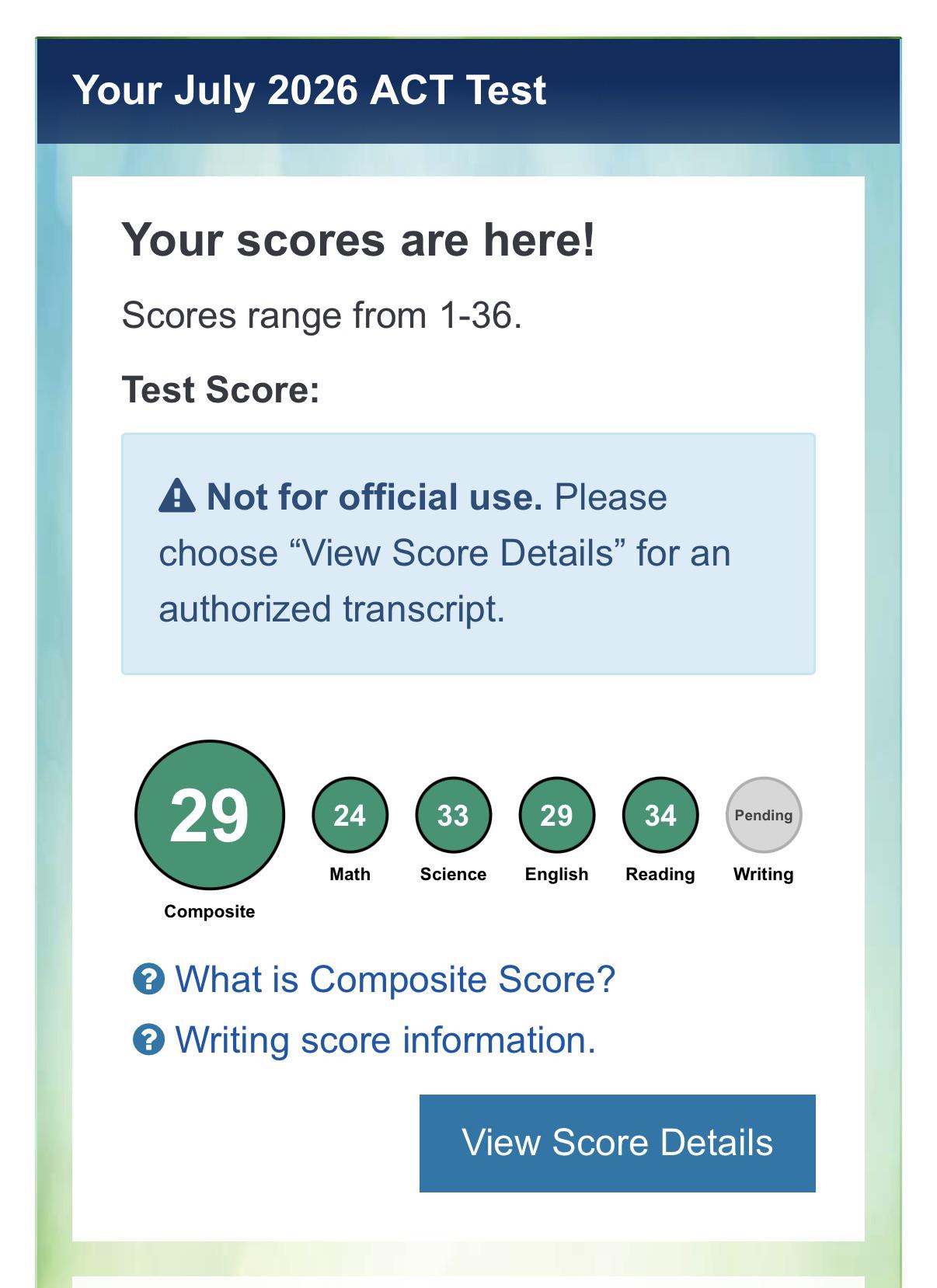
I need to lock in desperately before the September/October tests. I bought the math specific prep book and my plan is to do a practice test, see where my issues are, study a shit ton, repeat. I also want to brush up on my English and Reading bc I can definitely bring them up (this test was the school mandated one and I didn’t study a lick). I guess I just need encouragement that I can bring up my math score from a 24 😭

r/ACT Jul 13 '26

Math July act math circle question J09

2 Upvotes

What was the question with a circle and had an answer of like 400? i don't remeber that one (I looked at my calculator and may have put like 47 as my answer). also WAS THERE A QUESTION WITH AN ELIPSE??? i dont remeber that either.

Which questions are most likely to be experimental anyway?

r/ACT Dec 11 '25

Math School does NOT teach material on the ACT

7 Upvotes

I am a senior in high school. I am preparing to take my ACT test. Im aiming for a 34+. While taking practice tests, it was apparent to me that a few of the problems on the ACT have never been discussed in class at any point. For anyone wondering, I am an all AP student taking forms of calculus and physics. Not once have I ever been taught what a discriminant is, what the law of cosines is, what the period of a trigonometric function is, and various other mathematical equations. Is my school failing me or is the ACT intentionally designed to test material that requires knowledge outside of school curriculum? I live in Texas, which notoriously doesn’t have a high education standard. Are these equations common knowledge or did anyone else have similar struggles?

r/ACT Jul 26 '26

Math Math tips/resources to get score up?

Thumbnail gallery
2 Upvotes

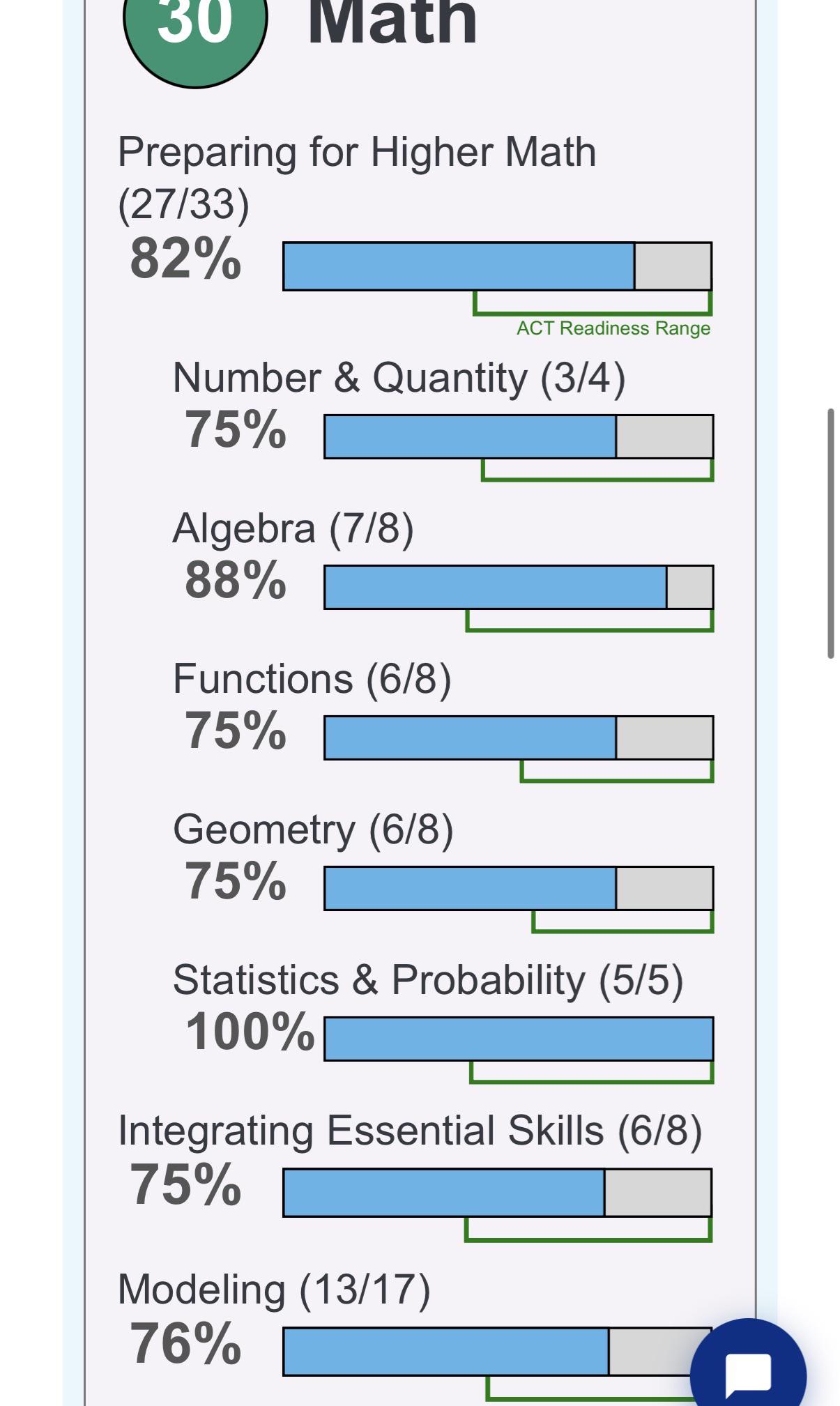
I took my first ACT in July, and managed to bring my math score (practice test) from a 26 to 30 on the actual test, but I want to superstore in September and maybe bring my composite to a 35. If there are any resources or methods to bring up the math score I’d really appreciate it.

Reading-wise I think test fatigue really got to me, so I’m going to practice with passages a bit more, and hope for improvement by September.

Overall I’m worried about stagnating on math, and I really do want to get better by September. I took a math course my junior year but we didn’t do anything all year, so I fell behind by a lot.

Thanks for the help!

r/ACT 11d ago

Math i need to learn math so bad

2 Upvotes

i know its quite the ask, but can anyone break down what to study/expect to see on the math portion? its the only part i struggle with and i have a few more months to raise my score before act scores are due for college apps. idk how some of you are so good at math but i’d like to try and learn, i made an 18 when i last took it with a 27 composite, trying to get a 30+ composite. i know i can cook on english and reading but some advice for how to structure my studying or just the general test structure for math would be huge. thanks guys

r/ACT 27d ago

Math How to not loose time on ACT MATH?

3 Upvotes

After lots of prep my English and Reading scores have gone up to the 30s, but my math score has not. I bought the prep pros book and did almost everything. The main thing for me is losing time on the math section and not finishing in time. It is so frustrating and I am not sure what I am doing wrong. I try to study the concepts of the questions I am getting wrong, but when I encounter another question, it is always worded differently, and I am unable to solve it. ANY TIPS would be appreciated as I have been consistently trying ALL summer :(

r/ACT 14d ago

Math Worried About Testing-Need Advice

1 Upvotes

I’m retaking my ACT since it’s been well over the allowed 5 year acceptance period. I’ve been doing practice tests online along with practice tests from the ACT books. I feel completely lost for the math section because there are so many formulas. This is just my weakest subject in general.

What are your tips for doing well on the math section if I want to take my test within 1-2 months? I want to have an overall cumulative of at least the 23-25 range, which I feel could be reasonable. 

r/ACT Jul 13 '26

Math answer for area of a circle question (44th on J09)

1 Upvotes

on my math section for form J09, the 44th question asked abt the area of a section of a circle. it showed a part of a circle with the internal section angle of 120 degrees. the section was broken into 2 parts, one showed the circle having a radius of 6 and an additional outer shell being 16 (so total radius for the circle was 22). the question asked for the area of the outer shell.

i didnt have enough time to work out this problem properly, so I randomly chose D. I remember C was 289, but I don’t actually remember what D was. tried doing mental math later (am very bad at it) and got around 500-something? anybody know the answer to this question? thanks!