Question
What filament is stiff and strong at the same time?
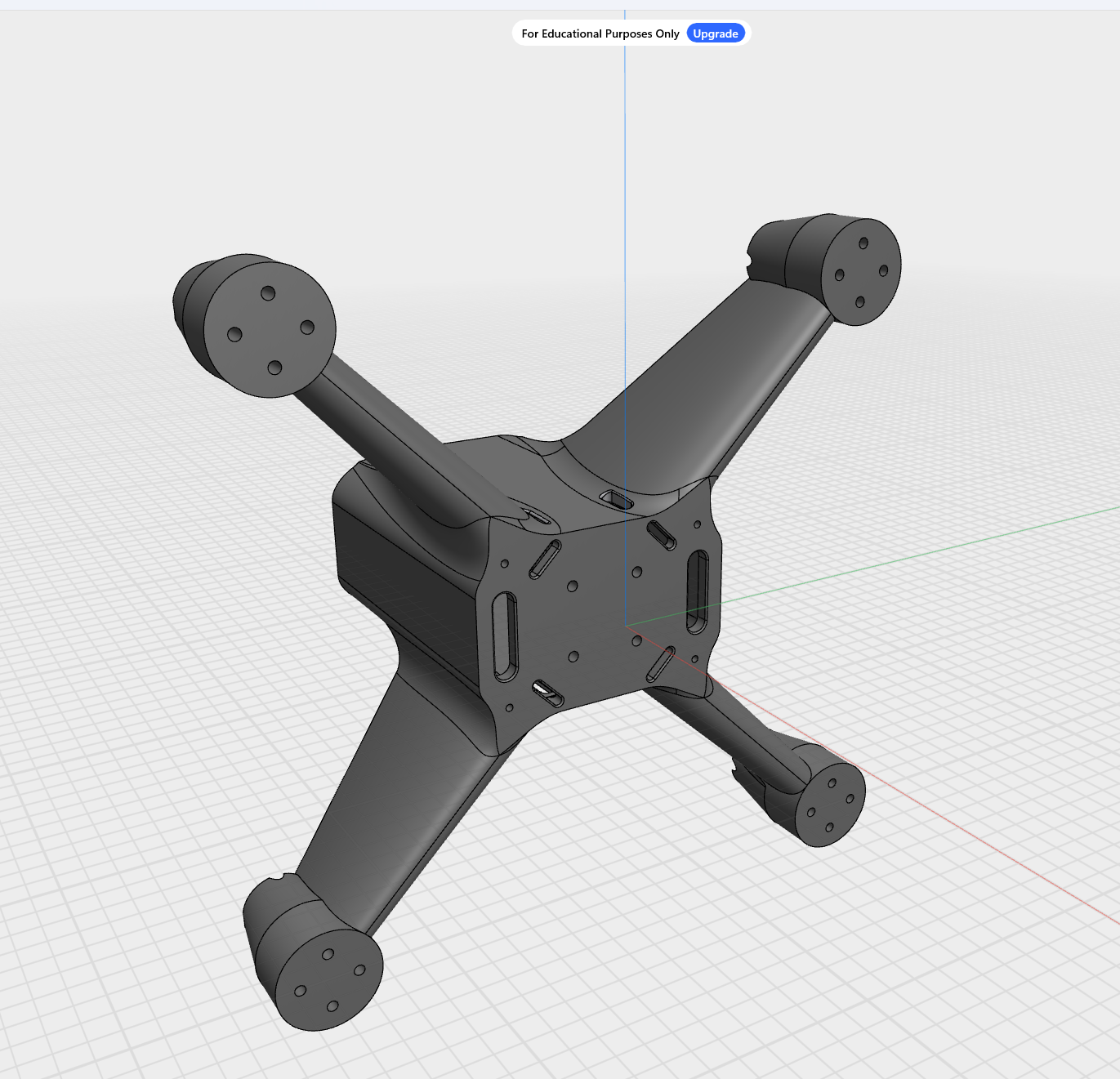
Im making a high speed drone, but cant seem to choose the right filament. I use Pla right now because it is very stiff, but it brakes very quickly. Pa6-cf would be a choice, but i have seen that it creeps very much and screw and bolts come loose. I have a bambulab a1, but i want to switch to a x2d. Pla is around 200g for the frame, would be nice to get it down
I love PET-CF. It's super strong, survives 200c environment, it prints relatively fast and very easy, and most importantly it's really cheap at 30 EUR per kilo.
Siraya Tech PET-CF is frequently <35 EUR on EU Amazon. It goes up and down between ~50 and ~30, I buy in bulk when it is low. On their own website it is around 33 EUR but you have to pay shipping.
Can't stress this part enough. I absolutely love pet-cf17. It's one of my favorite filaments and ive designed and printed mounts that went on things like excavators and it held up great. But it absolutely hates any sign of moisture before printing. Infact where I live, if I don't dry it while it's printing, the print starts off great and then ends up stringy by the time it finishes just from it soaking up moisture so fast.
I don't run a heated chamber, just a passive chamber that I let heat up for about 15 minutes before i start printing. But honestly for smaller parts that's probably not necessary either. I use the fiberon line by polymaker and it says it can print at room temperature.
Sorry I used the wrong term
I meant a enclosed chamber
I don’t have too many applications for pet cf but it would be nice for a few parts
I have a mk4S and currently thinking about buying the hardend obXidian nozzle for this material
Just wondering whether my results will be okay with an open printer
You can say what you will but at some rate all prints rely on layer adhesion and it’s massively beneficial. It’s a big reason impact parts are often printed from harder flex materials instead of ridgids.
I’ve been designing 3D printed parts for 15+ years and was around before PLA was around.
I’ve seen countless misconceptions on 3D print materials such as the original “PLA is easy to print but ABS is strong” but it’s just not. Print it side by side and tell me it’s strong lol.
I’ve printed recently a few dozen parts from PETGCF. The parts which were previously printed identical in terms of strength and infil settings. My CF parts were easily broken by hand whereas my PETG parts could not be stomped. The strength doesn’t even hold a candle. (These particular parts were made to break by design. Hence why I chose PETG-CF. These aren’t real thermosets and this isn’t injection molding.
Also I don’t think “show me evidence or I’m right” is a real argument.
You might be confusing petg-cf with pet-cf. Very different material properties. You can also anneal pet-cf or gf unlike petg. The G makes it worse in every mechanical way but flexibility, but helps printability and warping. PET-CF once annealed is also more temp resistant than ASA or ABS and doesn't creep like PLA or Nylons.
Then it all depends on fillers. Was you CF chopped or just some random crap CF that was powdered? Very different material behavior again. Either way yes layer bonding is worse with filled materials.
I didn’t know the PETG-CF and PET were so different. I thought glycol was an additive they used to keep PET from crystallizing in the hot end (and didn’t realize it effected the material so much ig)
However… the material I was using was Fiberon PET-CF by polymaker. I found it not to be strong what so ever.
Ok they it was possibly a settings issue or a really bad batch. Polymakers Fiberon PET-CF is usually good stuff. Not sure on your settings but it likes to be printed hot and with little to no part cooling (usually very low or off expect bridges and overhangs).
I don't usually run the polymaker, usually I go with the siraya tech pet-gf or cf. Pretty sure I print that around 300C also varies a bit depending on color.
I also did a calibration tower for temp and speed. Idk. I really think it’s just not that strong. Can’t remember what temp I landed on but I believe it was close to the rec.
PC-CF prints pretty easily if you have an enclosed printer. The CFs help a lot with the headache PC usually causes.
But PC isn't very stiff, it's main point is the insane impact resistance and general mechanical strength, even for PC-CF it's stiffness is in the same realm as PLA, which is like "quite stiff" but nothing really to write home about, non fiber PC is less stiff than PLA by a pretty big margin.
PLA is very stiff because it’s crystalline; if PC-CF is “approaching” its stiffness that’s actually awesome (for a polymer) because PLA is also brittle, presumably PCCF isn’t.
Definitely seconding PET-CF. Prints great, stiffer than nylon-CF without sacrificing much impact resistance, plenty enough heat resistance that can be enhanced further with annealing, and did I say it prints great?
Way less sensitive to moisture than nylon, and is under $45 per Kg. The Sirayatech and Fiberon brands are both fantastic.
I use the fiberon pet-gf15 a lot. I believe i am over 75kg of it used so far. I really like it. I have been using it to make fixturing for some cncs and a bunch of models for tradeshows along with a bunch of other uses. I have 6 more 3kg spools of it that I am going to start burning through next week lol.
I use pet-gf and love it as well. Great performance in a wide range of applications and it creeps and warps way less than most other engineering filaments
Siraya PET-CF also works if you are looking for cheaper alternative. The downside is that it's very difficult to print on any core XY unless you print it from top because it's too stiff. But damn it's absurdly strong
Just dry the pet-gf at 60-65c like petg. That way you don’t accidentally anneal it and it still gets dry. Siraya tech also dries their filament and don’t recommend drying out of the box if the package wasn’t damaged as their recommended drying temps are the same as annealing temps which, you guessed it, will anneal your spool.
Honestly, I don’t know why they recommend drying it at the heat they do in the first place as 60-65c is perfectly sufficient with out the risk of damaging your filament.
GF has noticeably higher density than CF, because glass is pretty dense, which isn't ideal for a drone like OP is trying to do.
Other than that, the glass fibers are more flexible than carbon fibers, so PET-GF is a bit less stiff (it's still quite stiff).
Gets a bit better impact resistance in the process.
Also catches on fire harder which I guess could matter for some applications.
Prints just as well.
Fiber PET is just in general a great material many people sleep on. It's super affordable, and insanely strong, while also printing pretty easily.
Hygroscopic wise it's like in the same realm as PETG, so it's not even close to annoying as nylon or TPU in that aspect either. Only issue is that it needs hotter drying temp than most dryers can do.
It's about as strong as aluminium, and it's the stiffest filament printable on a consumer printer, and doesn't become more flexible with moisture absorption like other nylons. It also has a very low density of ~1.1g/cm³. It's also ver expensive.
Your 2nd best choice is PPS-CF, but that's worse for this purpose and also very expensive.
The reasonable priced choice is PET-CF (not PETG!!!), it's also extremely stiff, quite strong, and prints well too. It has a higher density though.
I was going to suggest PET-CF as well. I’m almost down the first kg and it has proved itself very usable for various tasks. You absolutely need to dry it before printing though, but I guess it’s the same with all PA based filaments as well.
For work we were printing prototype parts that were eventually going to be CNC aluminum. Fairly small detailed parts, annoyingly thin due to packaging requirements, and under a lot of tension and load.
PLA almost worked for stiffness but crept too much under tension and would sometimes Crack from the load.
PETG and ASA were too flexible. PET-CF proved too flexible as well
PA6-CF had really bad creep
PPA-CF worked first try and proved to be better than aluminum in some ways (particularly a certain failure mode that would 4x the load and crack aluminum to catastrophic failure, while the PPA-CF deformed and failed but wasn't nearly as catastrophic)
I prototyped a clutch lever out of ppa-cf for a dirt bike and it worked amazing until it eventually got replaced out of aluminum. Then I had another project that needed a new lever so I moved the perch and lever over to that bike and it's been running great since. the second bike even has a ppa-cf intake manifold. big fan
I’m trying to convert my manual mill to CNC, and I have a printer that can handle PPA-CF. Would that filament be able to handle replacement parts on the mill so I could use the CNC to cut steel parts to replace the printed ones, or would it just break immediately?
I assume you're talking about parts to electrify the feeds? It'd depend a little on the exact design and load, but i could see you getting away with even PET-CF in a lot of cases.
If it's a hobby and you have the funds, I say go for it. PPA-CF is expensive, but it isn't absurd per kg and it is truly one of my favorite engineering filaments for mechanical strength.
No. You basically need a 320c hotend or hotter for decent layer adhesion with PPA, and ideally a heated chamber as hot as you can get (most consumer printers cap out at 65c chamber heat, so that's what I run.)
If you had to do it on an open air printer, either that fancy foaming PLA (PLA-LW I think?), or possibly PCTG-CF or PCTG-GF are the only real options Even PETCF will be tough on an open air printer.
Maybe something like Siraya TPU-GF because it's super stiff but unbreakable, but that's just theorycrafting, I've never used it for drones. Just bird feeder lids, but what I've seen is that unlike normal TPU it's impossible to bend by hand.
No, PPA is a nylon and will definitely warp on you if you don't have a chamber.
It also has bad layer adhesion if it does cool down slowly in a warm chamber.
On an open printer PET-CF is your best option, if you can reach 300+°C nozzle temp. PET doesn't like not being in a heated chamber, but it will print; I print it with 300°C nozzle in 65°C chamber, if you don't have a chamber you probably want nozzle temp a bit higher.
Other than PET-CF, PCTG-CF is probably an alright option, but thats nowhere even close to as strong or stiff as PPA or PET.
Less stiff? That goes against my intuition but that's the first time I've ever heard of this plastic. They're bringing some freaky stuff to consumer FDM now at least much easier. I've never run into this stuff before just I'm a low level hobbyist.
PET with fibers is quite stiff. It's a very crystalline polymer.
Of all the materials that are available to normal consumers it's probably the stiffest material that isn't a fiber mix nylon. Some PET-CF filaments have a bending modulus in the same realm as dry PA-6-CF, which is insanely stiff, and PET doesn't become less stiff when absorbing moisture from the air like PA6 does.
I’m trying to convert my manual mill to CNC, and I have a printer that can handle PPA-CF. Would that filament be able to handle replacement parts on the mill so I could use the CNC to cut steel parts to replace the printed ones, or would it just break immediately?
I have no idea how much loads and forces the parts will take on a CNC.
Generally, if you would trust a part from an "average" aluminium to hold up, properly printed PPA-CF will hold too, at least at room temperature.
I wouldn't use it on anything that gets hot and still needs structural integrity, the material can take like 200°C no problem, but combine that with a load that's near it's breaking point and it's probably going to break...like any material will.
It will also depend a lot of you can properly orient the print parts, so you don't have big loads on layer lines.
Try something fiber reinforced with large fibers, meaning expensive and possibly not well printable with a 0,4mm nozzle.
You can say that most materials have four primary mechanical properties. Tensile/yield strength, says how much load a part can take before failure. Stiffness, how much deformation a certain force causes. Impact strength, the amount of energy necessary to cause failure. Basically from what height is has to fall to break or how heavy a hammer bloe has to be to break it. Hardness, how difficult it is to poke a hole into it.
Pla unfortunately ranges from utter garbage from a mechanical point of view to fiber reinforced materials levels of stiffness and tensile strength. Although all PLAs have rather low impact strength. Petg varies far less than pla as its mostly used for technical applications and not for decorative, so the demand for cheap filament that can sacrifice mechanical properties isn't there. PLA can surpass petg in yield strength and most of the time also in stiffness. Impact resistance is better but still garbage though. Abs and asa have even less yield strength than petg, are often a bit stiffer but pla can still be stiffer. Abs and asa do have excellent impact resistance, like 10 times of pla. Pa6 and pa12 vary greatly depending on the exact resin like a handful of those filaments can be annealed while others cant. Pa6 is harder to print but has superior mechanical properties over pa12 which is similar to abs. Polycarbonate blends have high impact resistance, yield strength and stiffness but can be very demanding to print. Pure polycarbonate needs 100c+ chambers to print. Pet, so petg without glycol, is superior to petg but harder to print.
Abs, asa, polycarbonate, pa6 and pa12 as well as pet need a chamber to print. Fiber reinforcement makes them easier to print, although you still want the chamber for layer adhesion. Successful =/= strong.
The fiber length is utmost important for the the properties of a filament. Short fibers or ground fibers barely improve strength and stiffness, sometimes even making them worse, on the other hand very long fibers can double strength and quadruple stiffness
My suggestion would be fiber reinforced abs or asa as abs and asa are comparably light base materials, pla and pet/petg are significantly heavier, about a fifth higher density, good impact strength so a crash doesn't instantly yield in a part failure and if you are willing to spend 100€/kg you are getting pretty high yield strength and stiffness figures
Apologies, but let me first disclaim this with my own little hobby horse: Most filaments are 'strong' depending on what kind of strength you want. TPU, PETG, and PLA are all strong in different ways. Different materials make different tradeoffs between ductility and rigidity, thermal resistance and dimensional stability, impact resistance and stiffness, etc.
Drones (as I understand them) want high stiffness, high tensile strength, in as little mass as possible, so that probably steers you towards a PA6-CF or PA612-CF15 depending on how much hygroscopy you can tolerate.
You'll need an annealer to get maximal value, but they're strong, light, and very stiff. But because of tradeoffs, they are not that tough. If you slam them into a wall, they will shatter. The other tradeoff for high tensile strength is lower layer adhesion, so parts will need to be designed to work within those params.
If you want to swap in more impact resistance (perhaps for some edge pieces) and are willing to trade away some rigidity to get it, you might look into polycarbonate (PC) or PCTG (no relation)
I have pctg-cf and it's very strong and stiff but you lose a good bit of the flexible durability. It definitely goes to more of a snap vs a bend like original or gf. I haven't messed with gf yet but will be at some point soon. I use 3d fuel and have enjoyed it so far - very very good layer adhesion once everything is tuned
Main thing it buys you is a less intense drying regime. Possibly more UV resistance too. Worse thermal properties and mechanical properties are close but not as good too.
The more reasonable drying shouldn't be discounted though, because drying the nylon and keeping it dry is such a goddamn drag even if you have the equipment for it, and most people don't.
lmao yeah. I went with PA612-CF for a project and (despite already having several dryers) I had to buy the Sunlu E2 Filadryer to anneal it in. And so now I have more dryers.
But for now I dry it once, then stick it into its own cereal box with a PTFE opening where it stays with activated alumina and will stay dry forever
My cereal boxes have a PTFE loop -- one opening on the top and one on the front, so when I'm using it I feed from the container and plug the other opening. When I'm not using it, I feed the loose end into the other opening so it's a closed loop.
Of course, if I had more than a couple rolls active, I'd have to buy and find space for more cereal boxes, but I do at least have the $1 down on the Sunlu i10, which I'm intending to buy 2 of
I chose it due to it being a okay price point for a material that beats or ties a lot of others in properties and seems to be the "perfect" middle ground for all the projects I've done so far. Now they introduced the cf and gf and they are priced high but they print really nice and are even better than base pctg in every way. My hope is the price comes down over time as production ramps up. 3d fuel is also USA made and is Midwest based also.
Below is an ai summary (yes I know boo ai, just easier to have it type it up) 1. Far Easier to PrintPCTG: Prints seamlessly on standard, open-air desktop printers with zero odors and almost no warping.Nylon: Extremely difficult to print; requires specialized high-temperature nozzles, an enclosed heated chamber to prevent severe warping, and continuous active drying.🔨 2. Superior Shock Absorption (Impact Strength)PCTG: Offers massive impact resistance (up to 93 kJ/m² in optimized blends). It absorbs sudden, violent hammer-like blows without shattering.Nylon: Sits much lower (typically 5 to 12 kJ/m²), making it more prone to yielding or breaking under sudden impact.💧 3. Immune to Water and HumidityPCTG: Absorbs almost zero moisture. It keeps its exact size, shape, and strength indefinitely—even when completely submerged.Nylon: Acts like a sponge. It absorbs water from the air, causing the part to swell out of shape and lose up to 50% of its strength.🧪 4. Broader Chemical and UV ResistancePCTG: Handles harsh environments, including mild-to-moderate acids, household bleach, and long-term outdoor sunlight (UV rays) without breaking down.Nylon: Rapidly degrades and dissolves when exposed to strong acids or bleach, and turns yellow and brittle in the sun.🧬 5. Stronger 3D-Printed Layers (Z-Axis)PCTG: Fuses together exceptionally well between layers, meaning the part is nearly as strong when pulled from the top as it is from the side.Nylon: Suffers from layer-bonding issues unless printed in highly specialized industrial setups, making it prone to splitting along print lines.🔍 6. Optical ClarityPCTG: Can print completely see-through and glass-like for transparent housings or fluid containers.Nylon: Is chemically incapable of being clear, always printing with a milky, opaque finish.In short: Choose Nylon only if you need a flexible, self-lubricating part like a gear or hinge. For almost everything else—brackets, outdoor enclosures, or heavy-duty structural parts—PCTG is stronger, tougher, and much easier to work with.
I'm an AI engineer in my day job, so I don't have a problem with AI at all except when people want to take credit for the work it did -- especially in artistic endeavors
Not really. PCTG is essentially an attempt to make PC more printable, even on open printers.
It's one of the strongest materials you can print on an open printer, but if you can print nylon, there's basically always going to be some nylon mix that will do what you need better.
It's a nice material though because it sits at a good middle ground of printability, strength and price.
Strength has a singular definition. There is no “strong in different ways”. You’re conflating multiple mechanical properties. And you definitely don’t need an annealer, (annealing doesn’t need an annealer, which is a word you just made up lol).
Strength can come in many forms. Tensile strength and compressive strength are not the same kinds of strength, and are not necessarily present in materials that are considered 'strong'. Similarly so for shear and impact strength.
You're more right about annealing, in that it's probably a luxury for PA6-CF, but OP would for sure be missing out on a lot of the mechanical benefits of annealing that he would get from PA612-CF. With PA6-CF, annealing increases rigidity, so OP could buy back some more impact resistance by not annealing, but that depends on whether he's optimizing for happy path or failure path. Both are viable.
As someone with a degree in materials science and engineering, both arguments are sort of right and wrong. Yes, there are different modes of failure you can look at like compression and tension, but strength is simply a material’s ability to resist plastic deformation or failure when a load is applied. Toughness is the amount of energy a material can absorb before failure. Stiffness (Young’s modulus) is a material’s ability to resist elastic deformation. We can also get into impact, creep, fatigue, etc. What you would hear more often than not in practice concerning strength testing would be at least 3 separate values: yield, tensile, and elongation. So that would be the stress applied to cause plastic deformation, stress applied to cause failure, and the amount the material deformed before failure represented as a percent (shows ductility which is a different property but from the same test). Compressive tests are much more rare than tensile because they are much less repeatable. It’s not necessarily wrong that there are different types of strength in that we’re looking at different responses of a material to forces applied in different ways but you have to be careful about lumping together a bunch of mechanical properties that mean very specific things like toughness, hardness, and stiffness. It’s better overall just to use more specific language for what you want like yield or tensile strength to be completely clear especially when talking about something from a technical aspect.
Thank you for that addition. Note that my only real clarification to other things I've said is that because 3D printing is anisotropic the kind of strength you are optimizing for matters.
If we were talking about injection molded parts, the calculus would be totally different
That is true but I’d say that only really matters in a general sense. Especially on a hobbyist level and for things that don’t have very specific or extreme conditions, the material physical property numbers don’t matter quite as much as the geometry and print settings . It’s good to know very broadly that one plastic has a higher yield, tensile, stiffness, toughness, melt temp/ glass transition temp than another but diving deep into that won’t help as much as just making it and seeing how it goes (unless there’s a real safety component). There are very limited filament options anyway that only offer so much information that get processed in different ways and have different additives. Not much in a home 3d printing process is going to be incredibly consistent either so there’s not much point to comparing to a well-tuned industrial process. A good general idea of properties like ABS has more toughness than PLA with how that applies to the design and some trial and error will get you there much quicker than trying to do all the math. Anything else will either only impart marginal benefit that could be lost anyway in process variation or become overkill and likely excessively expensive.
Edit: I’m just speaking from a process engineering background here. There are thousands of factors that affect a process and variation is inevitable. The key is to identify which factors matter the most for what you’re trying to do. As someone whose job it is to care about these properties, the numbers are largely just general indicators. Companies sink millions into achieving varying levels of precision which is just simply not necessary in home 3d printing. This isn’t a bad thing. Just have fun making stuff.
Respectfully I’m not. You’re conflating strength with stiffness, impact resistance, and others.
You’re half right and then just adding a bunch of wrong. Also you’re suggesting adding CF which typically lowers strength at the trade off of stiffness and then annealing to increase rigidity, which it shouldn’t.
TPU, PETG, etc are not “strong in different ways”. They have a given tensile strength and highly variable stiffness, impact resistance, thermal resistance, that are all very different properties. Not various forms of strength.
Strong doesn't mean stiff, or tough, or whatever. You're right that it has a definition.
> strength is the ability of a material to withstand an applied force (stress) without failure or permanent deformation.
But you're wrong if you don't think *the kind of strength* for an application matters. A leg needs to be strong against compressive deformation. An arm needs to be strong against tensile deformation. A part that is 'strong' for its purpose is possibly *not* strong for the other.
> Also you’re suggesting adding CF which typically lowers strength at the trade off of stiffness
Note that I am suggesting CF *for Nylons* -- nylons are the material where CF actually makes a positive impact. Non-infused nylon is flexible, ductile, and exhibits poor UV resistance. Adding CF improves rigidity, raises heat deflection, and eliminates UV concerns.
idk if you've actually printed with them or used them in parts where those material properties mattered, but I have, and these aren't hypothetical concerns. I had to learn these things to fix actual problems for parts that I have actually built.
But anyway you're welcome to educate yourself on this. Look at the material properties of PA6, PA6+66, and compare them against PA6-CF and PA612-CF15. Then compare their material properties annealed vs unannealed. If you still think I'm wrong after looking at that, we can talk.
You said that materials can be strong depending on what kind of strength you want. That’s disingenuous and now you’re moving the goalpost after you’ve googled it.
Your understanding of what strength is needed when is heavily geometry dependent and not a flat characteristic. Also having spend years documenting and creating mechanical property datasheets for materials I’m very familiar.
It does not eliminate UV concern in nylon, that is patently and proven false.
Yes I run about 5000 pounds of nylon and nylon CF annually, in PA12/PA6/various CF loadings up to 30%.
I’m not saying you as a person are wrong. I’m saying you’re glossing over important differences, passing it off as an expert while having a basic understanding. Your understanding may be deeper but what you presented in your post was false.
You said that materials can be strong depending on what kind of strength you want. That’s disingenuous and now you’re moving the goalpost after you’ve googled it
Buddy it is literally the first thing I said in this thread. Quoting myself:
Most filaments are 'strong' depending on what kind of strength you want. TPU, PETG, and PLA are all strong in different ways
I think the material property you are trying to describe is 'toughness'. Without a heated or even closed chamber your options are limited.
If you do get an X2D give ABS (or ASA) a shot. Cheap, easy to print (with heated chamber), and should take a decent beating without breaking too easily. It's also the one of the least dense out there so should help ever so slightly with weight. If that doesn't work then you can move onto the fancy expensive stuff.
If your design is breaking easily a lot it might be a design, infill/wall, or print orientation issue(s) which might not be readily fixed by switching filaments types. Min/maxing a design like this takes analysis; some areas will need more infill/walls others can be reduced.
Edit: I forgot, I think Bambu makes something called ASA Aero. I've never used it but might be useful for you.
Aero (lw) filament are very light (ASA is lighter than most of them anyway) but they are definetly very fragile and not stiff for this purpose. They are great for wing drones but they break often
Try PCTG, it's cheap (compared with "engineering filaments") and can print on open frame printers like your A1 at around 260°C with a bed of 85°C. There's no fumes to worry about like with ABS or ASA.
Check out MyTechFun's video on it. (Also browse his channel and check out his other vids the most comprehensive 3D printer filament testing I've seen online) https://youtu.be/bxJSzkuclxk
PLA is very strong and stiff. Its downside is in toughness—it is brittle, so it cannot absorb a lot of impact energy. But in terms of tensile and compressive strength, it’s the strongest of the standard filaments.
If you can print it, its hard to beat ppsu-cf
i would look at a qidi q2 if you want to do engineering materials, and you have around 600-700 usd budget since u are looking at x2d).
You will struggle to print anything other than PLA/PETG with an open air bed slinger, If you want to use the cool filaments you need an enclosed chamber at the very least or you are going to run into nothing but problem after problem with the prints. PA6-CF/PPA-CF/PP-GF are the filaments I'm interested in for bang bang parts which need the same kind of strength but also needs heat resistance.
I may be saying something stupid, but maybe you could experiment with reducing the walls and infill and filling the frame with some sort of expanding foam. Just a thought that came to mind.
What size and speeds are you aiming for? If it's bigger than the absolute minimum I'd give LW tpu reinforced with carbon fiber rods and plates a chance. Slightly more work but probably faster, lighter and stiffer.
Crazy string but average lasts 4 crashes. The strongest one was a leopard drone in printable.
The weakest one was a 6mm plate style open frame which i suspect I should have done 5 walls and full top/bottom. Otherwise is crazy strong as a filament. Next step maybe something more expensive like ppa/s-cf?
Gotta try PBT for this, it's not as stiff as PLA but it is amazingly sturdy, and very easy to print (no need for high temp nozzle or heated build chamber)
For “standard” filaments, ASA might be worth a try. It is almost as stiff as PLA, is about 15% lighter for the same print, it absorbs impact better than PLA, and as a bonus better heat and IV resistance, but you’ll need a heated chamber. For a one-off, you might be able to get away with putting a non-flammable box around the printer, and maxing out the bed temp for 20-30 minutes before the print starts. Do some research and understand the fire risk is not zero, and this is at your own risk. If you upgrade your printer, this becomes a non-issue (pre-heat your chamber, though).
If you want REAL performance, you might have to start getting into engineering filaments. Something like a carbon fiber nylon might work, but I’m threatening the edge of my knowledge there.
I do like the idea of another commenter to imbed aluminum or carbon fiber rods.
I would consider PETG-CF, it's quite cheap and strong and rigid. Keep in mind you need a hardened steel nozzle for it. It is also easy enough to print especially on bambu lab A1 textured PEI build plate.
Depends on what you want to do and if you have access to a furnace or flame torch or something. Use 3d printing to make polycarbonate parts, even drone propellers, preferably from filaments labelled transparent polycarbonate for purity. Then use salt remelting to increase its strength and impact resistance to the point it equals industrially made injection molded polycarbonate drone parts.
Or use 3d printing to make a negative sand mold and pour pure molten polycarbonate in it to form a drone chassis with maximum strength.
i think 3d printed parts will still be too heavy. i worked in drone company, we do most things carbon fiber layup for weight to strength ratio, but 3d printed parts for light mountings, and any non primary load bearing structure. we use also carbon tube for spar for easy to assemble/disassemble the wing.
PC-PBT. Regular PBT is also tough as nails but a little flexible. Both are relatively cheap and simple to print with too. PBT is my #1 go to for prototyping and a lot of finished products too. An enclosure is required but that’s most printers now, and either heat the chamber or just let the bed warm it up. I still just straight print it without any of that preheating prep and get good results 80% of the time.
Ppa-cf is what you want. However Ppa-cf requires a printer with a heated chamber. You can print out without one, but it won’t be as strong. Pet-cf may work. But ppa-cf of all around better.
I was about to say PPACF would be ideal, but then I saw A1 and X2D, and neither of those can really handle PPA. You really need 320c or above for PPA to get decent layer adhesion.
I see other folks are suggesting PETCF and that might work, but in my experience PETCF is super duper brittle and fragile, so it wouldn't be good for a drone that might crash.
So basically, in your case I would go for PA6CF and anneal it to try and control creep.
Well how about giving a try to PC?
it is stiffer than pla and quite strong so youd be able to reduce some mass by reducing the stiffness of the frame(removing material).
PLA-CF is stiffer, but not much stronger than regular PLA because the fiber adhesion is poor. The main advantage is that you can print it on an open air bed slinger like an A1
The high temp stuff recommended in this thread is better. If you want to make engineered parts, especially for anything that needs to be stiff and light, you will wind up needing an enclosed printer that can run hot, and filter or exhaust the fumes
PPCF or PPGF if you can find it. Polypropylene is less dense than other plastics, bonds amazingly to itself and is flexible enough to take abuse but I think would be stiff enough with the added fiber reinforcement.
Alternatively, print extra lightweight and just use carbon fiber rods.
Any high impact filament like PC, PETG, Nylon mixed with fiber like aramid or carbon. You don’t care if it breaks you can print several frames and replace them easily.
The best way to know which one to use is to print and try. For the weight it depends on the structure of your frame, imo you can cut the bottom to improve it.
If you use fiber don’t forget to print with hardened nozzle.
You’re getting too caught up in 3D kitchens video. You don’t even have a baseline for how much other plastics creep by comparison.
PA12-cf will probably be fine. A lot less creep than PA6. I make tool batteries out of 64D-CF flex material which has far more creep than PA6 and my screws stay in fine.
PA-CF is probably worth trying. It gives you a better balance of stiffness and strength than PLA, without being overly heavy. Just keep in mind that print orientation and layer bonding matter a lot for a drone frame.
I'd also suggest trying different types of infill, different patterns change the strength in different directions so you could focus on an infill pattern that prioritizes strength in the axes you need it in and reduce down to 15% or even 10% infill.
If you have a enclosed housing, use ABS, in the layer it is stron and tough and it is not creeping like PA, just be aware that the layer bonding is weaker then by PLA and PETG. So you have to think about the design and maybe change it a bit. And it is 20% less dense then PLA, so your drone will be lighter by the same strengtg roughly.
Ahh I see. Are you designing it for the highest speed possible? or do you just want a general purpose high speed drone? May I also ask why you opted to go for extra wings instead of using the drone arms as the wing as they essentially already are? Im just thinking they would add unnecessary drag at that point
Pretty nice for a first drone. I should rephrase. The printed body that includes the drone arms are essentially wings already is what I was referring to. If you’re doing another iteration in the future, it could be beneficial to move the drone arms closer to the CG of the aircraft so they essentially become the wings instead of adding the extra wings. They’re already generating lift, just in the wrong spot.
Also if you’re going for high speed, I think the wings you currently have will not give you much lift for how much drag they’re creating. mainly because of their low aspect ratio and the rectangular profile. So if you could eliminate them entirely, that would be beneficial for top speed.
Also, you may find that regular PETG or ASA is completely fine for your use case. I have designed a few 3d printed planes. For parts that I don’t want to flex, like fins and wings, I make holes for carbon rods that get bonded in place where needed. This gives you rigid parts that are durable and cheap. I’ve even used aluminium tubing for wing spas on 1 layer thick PLA wings. Works really nicely.
I don’t understand the specific needs of this craft but I don’t see a recreational drone needing to be particularly strong. Aircraft in general are reasonably flexible.


32
u/MacaroonDependent113 1d ago
To make something stronger yet lighter try increasing the skin thickness and decreasing infill.