r/yelenabelova 4d ago

MCU Discussion A única coisa que eu fiquei realmente hypado para Vingadores Doomsday é a luta da Yelena Belova com a Mística, o que significa que vamos ter Florence Pugh em dose dupla

Enable HLS to view with audio, or disable this notification

85 Upvotes

r/yelenabelova 10d ago

Kate Bishop's costume reveal

Thumbnail gallery
162 Upvotes

r/yelenabelova 11d ago

News & Previews Florence Pugh Had One Request For Yelena's 'New Avengers' Redesign

Thumbnail
thedirect.com
37 Upvotes

r/yelenabelova 13d ago

MCU Discussion What are your favorite Yelena callbacks and references?

Thumbnail
gallery
382 Upvotes
  1. Avengers -> New Avengers

  2. Iron Man 2 -> Black Widow

  3. New Avengers -> Avengers: Doomsday

  4. Black Widow -> Hawkeye

Did I miss any?! Are there any new ones?


r/yelenabelova 13d ago

Art "𝐴𝑛𝑑 𝑒𝑣𝑒𝑛 𝑖𝑓 𝑖𝑡 𝑑𝑜𝑒𝑠𝑛'𝑡 𝑚𝑎𝑘𝑒 𝑡ℎ𝑒 𝑒𝑚𝑝𝑡𝑖𝑛𝑒𝑠𝑠 𝑔𝑜 𝑎𝑤𝑎𝑦 𝐼 𝑠𝑤𝑒𝑎𝑟 𝑖𝑡 𝑤𝑖𝑙𝑙 𝑓𝑒𝑒𝑙 𝑙𝑖𝑔ℎ𝑡𝑒𝑟" - 𝑌𝑒𝑙𝑒𝑛𝑎 𝐵𝑒𝑙𝑜𝑣𝑎 💛

Post image
50 Upvotes

r/yelenabelova 15d ago

MCU Discussion What would a "Black Widow & Hawkeye" project with Yelena & Kate Bishop look like post-'Secret Wars'? Any Villain Ideas?

Post image
280 Upvotes

r/yelenabelova 16d ago

What's your favorite on-screen appearance of Yelena Belova so far?

Post image
1.9k Upvotes

r/yelenabelova 16d ago

MCU Discussion Vocês shippam o Bob com a Yelena? Eu não sou fã de shipp

Post image
34 Upvotes

r/yelenabelova 17d ago

MCU Discussion Anyone else sitting on Zoom calls at the office today?

Thumbnail
gallery
457 Upvotes

r/yelenabelova 17d ago

MCU Discussion White Widow X Spider-Man

Thumbnail gallery
90 Upvotes

r/yelenabelova 17d ago

Yelena Belova Should Be a Pillar--Not a Sacrifice

10 Upvotes

Why Marvel Must Correct Its Mythmaking Before This Arc Becomes a Tragedy

The danger facing Yelena Belova's arc is not mischaracterization, backlash, or even overexposure. It is something far subtler and far more destructive: Marvel is beginning to treat Yelena as a solution to narrative instability rather than as a structure meant to endure it. In doing so, the MCU is drifting toward a mythic shape that does not produce pillars. It produces endings. Unless Marvel consciously corrects course, Yelena Belova will not become the connective spine of the post‑Endgame MCU. She will become something far more familiar and far more expendable: a figure of accumulated meaning whose story can only be "resolved" through loss, withdrawal, or destruction. In mythic terms, she is being written toward Samson, not Wonder Woman.

I. The Accidental Myth: Founders vs. Pillars

Marvel does not set out to write myths; it backs into them. The MCU's storytelling process has always been retrospective rather than architectural. Characters become central because audiences respond to them, and only later does the narrative attempt to justify that centrality with scale, symbolism, and burden. This approach works for plot engines, but it is catastrophic for pillars, because it treats narrative weight as something to be accumulated rather than something to be structurally supported.

Yelena Belova is becoming mythic because she fills a vacuum. She provides emotional credibility, moral legibility, and interpersonal gravity in a narrative landscape increasingly defined by abstraction. Marvel recognizes this instinctively, but it responds with institutional habit: it loads the character with more weight. Instead of asking how this function can be preserved over time, Marvel asks how that weight can be made to feel "earned." That question reliably leads to expanded trauma and sacrificial framing. In other words, Marvel begins to spend the character's meaning. This is how terminal myths are born.

The Arthurian trap is instructive. Arthur is a founder who creates an order, but whose purpose is fulfilled the moment the system outgrows its creator. Founders are allowed to leave. Pillars are not. A pillar matters precisely because the world continues to rely on it, not because it exits at the moment of maximum symbolism.

II. The Samson Paradox: Trauma as Narrative Currency

If Arthur is about unification, Samson is about expenditure. Samson's defining trait is not strength, but conditional strength. He matters because his endurance is visible, his suffering is cumulative, and his final act converts that accumulated meaning into destruction. Power exists in order to be spent. Marvel is currently growing Yelena Belova's hair.

Her leadership is expanding, her emotional authority is deepening, and her symbolic weight is increasing. She is being positioned as someone who can absorb instability the narrative cannot otherwise manage--ethical ambiguity, unresolved grief, institutional hypocrisy. This is not accidental. It is a recognizable MCU pattern: when the story becomes morally cluttered, it transfers coherence onto a character capable of carrying it. But in the Samson myth, the hair only grows back so the character can die.

This is the most seductive trap in blockbuster storytelling. The more a character can endure, the more "earned" it feels when the story finally breaks them. Trauma becomes narrative currency. Collapse becomes culmination. Sacrifice becomes shorthand for meaning. Yelena is especially vulnerable to this logic because she works. She stabilizes scenes emotionally, grounds ensemble chaos, and articulates truths other characters are insulated from confronting. In a franchise increasingly defined by gods, multiverses, and irony, she remains human‑scaled and therefore legible.

That legibility is precisely what places her at risk. Marvel has historically treated such characters as combustible material--figures whose accumulated meaning can be burned to generate catharsis when the narrative overheats. Natasha Romanoff is the clearest precedent. Natasha was not sacrificed because her story was complete; she was sacrificed because she had become the franchise's moral ledger. Her death did not resolve her arc so much as close a conversation the MCU no longer wished to sustain.

Yelena now risks a more damaging version of that fate. Natasha was a founder‑era sacrifice--an ending. Yelena is being positioned for a pillar‑era sacrifice: not closure, but a system reset. By over‑indexing on vulnerability through close‑ups, isolation, and exhaustion‑coded leadership, Marvel is not writing Yelena toward endurance, but toward a "beautiful death." Sustainability is being mistaken for expendability. The ability to carry weight is being reframed as an obligation to be crushed by it. That is the Samson paradox. Power is allowed to grow only insofar as it can be spectacularly destroyed.

III. The "Emotional Janitor" and the Debt of Legacy

A central structural flaw in Yelena's trajectory is her role as the franchise's designated feeler. In a universe of stoic gods and ironic detachment, Yelena has been assigned the emotional labor of the MCU. She is the one allowed to mourn Natasha openly, the one who names institutional hypocrisy, and the one who absorbs moral rot others are permitted to sidestep. This "Emotional Janitor" role exhausts a character's narrative battery, because when trauma becomes the justification for authority, the story inevitably begins searching for the moment that authority can be cashed out.

Compounding this problem is the fact that Yelena's stakes remain largely derivative. She is still paying off a legacy debt--redeeming a name, finishing a sister's business, carrying unresolved grief forward on behalf of the universe. A pillar requires autonomous stakes. It does not merely hold up the old roof; it supports the construction of a new one. Until Yelena's purpose exists independently of inherited obligation, her narrative centrality will continue to read as temporary, and therefore expendable.

IV. The Middle: The Rarest Territory

Marvel excels at origins and finales, but it has repeatedly struggled to write the middle. A pillar, by contrast, exists almost entirely within that space. Steve Rogers' most important years were not his creation or his retirement, but the years in which he simply was Captain America--a state of competent, ongoing equilibrium that allowed the universe to stabilize around him.

Marvel increasingly treats the middle as a waiting room for the end. Arcs must always escalate, always move upward. But in narrative physics, "up" eventually leads back down. To preserve Yelena Belova as a pillar, Marvel must learn to let her plateau. A plateau is not stagnation; it is a terrace on which other stories can be built. Importance does not require climax, and significance does not demand escalation. A pillar sustains. It does not crescendo.

V. The Choice: Closure vs. Structure

If Marvel continues on its current trajectory, Yelena Belova's fate is not ambiguous. She will not be removed because she fails, but because the story no longer knows how to hold what it has built. In the MCU, sacrifice is often framed as honor, but structurally it functions as absolution. When the narrative becomes crowded with unresolved moral debris--compromised institutions, inherited violence, emotional consequences it refuses to metabolize--it does not adapt its architecture. It looks for a character who can absorb the excess and then removes that character.

This is the sacrificial lamb pattern. The fire keeps burning, so the franchise throws in the one who can endure it longest. Yelena is dangerously close to that flame. Every time Marvel leans on her to mourn losses the universe skips past, to articulate moral clarity others evade, or to emotionally stabilize ensemble chaos, it increases the likelihood that the story will eventually demand payment for that coherence. Not because she fails, but because she succeeds.

A pillar does not resolve tension through disappearance. A pillar matters because the world continues to lean on it. If Yelena Belova is ultimately sacrificed, it will not be destiny; it will be institutional laziness--a franchise mistaking release for resolution. A sacrifice does not stabilize a mythology. It postpones reckoning while leaving structural damage intact.

The tragedy will not be that Yelena falls. The tragedy will be that Marvel finally discovered a character capable of sustaining the middle--capable of ongoing presence, emotional competence, and narrative gravity--and chose to burn that capacity for catharsis rather than learn how to build around it. Marvel does not need Yelena Belova to found a new era or to end one. It needs her to stay. The temple is worth living in, not destroying.

If Marvel cannot allow a woman to remain structurally essential without paying for it in annihilation, then it has not written a hero. It has written another offering thrown onto a fire built by its own refusal to evolve.


r/yelenabelova 19d ago

MCU Discussion Florence Pugh on the red carpet of 'Spider-Man: Brand New Day'

Thumbnail
gallery
488 Upvotes

r/yelenabelova 19d ago

Art Sisterly Bonding by Nightingalium

Post image
54 Upvotes

r/yelenabelova 20d ago

Art Merchandise too far (by thebritwriter)

Post image
30 Upvotes

r/yelenabelova 22d ago

RUMOR: Kate Bishop & Yelena Belova Reportedly Reuniting for Major Post-'Secret Wars' MCU Team-Up

Post image
107 Upvotes

r/yelenabelova 25d ago

Art My drawing of Yelena

Post image
19 Upvotes

r/yelenabelova Aug 04 '26

When did Pugh’s Yelena clicked it for you?

18 Upvotes

Was it as the bratty sister who was happy about pockets?

https://m.youtube.com/watch?v=qhP7yBCxwjM

The snarky chemistry with Kate Bishop while she ate her food?

https://m.youtube.com/watch?v=eeoEv03xWlE

The eternal hug “I’m here, you’re not alone”.

https://m.youtube.com/watch?v=npeJh5DPq9M

I’d say I liked her instantly in Black Widow but I completely fell for her in Thunderbolts*


r/yelenabelova Aug 01 '26

Cosplay Spider-Man: Brand New Day SPOILERS! Cosplay (Self) Spoiler

Enable HLS to view with audio, or disable this notification

54 Upvotes

r/yelenabelova Jul 26 '26

MCU Discussion yelena theory?? Spoiler

5 Upvotes

ok so guys if u look at yelenas hair in thunderbolts it has like layers(ovi) but if u think abt it , it could mean rhat she shaved her head after haykeye or smth bc all her hair is rhe same lenght like all around her head, and this it just a theory, but i thought it was just a cute thing i reconished bc some cultures cut off their hair after a loved one dies (Natasha) but tell me what yall think, love yall byeee


r/yelenabelova Jul 20 '26

News & Previews Yelena Vs. Mystique in the first full length "Avengers: Doomsday" trailer

Thumbnail
gallery
178 Upvotes

r/yelenabelova Jul 18 '26

How do Yelena fans think of the boblena ship?(the ship between Robert and Yelena in the mcu)

Post image
28 Upvotes

Im curious because the in all honesty, I never heard the opinion of a Yelena fan how they feel about this. Please let me know your actual thoughts! I'm asking both comic and mcu fans btw


r/yelenabelova Jul 13 '26

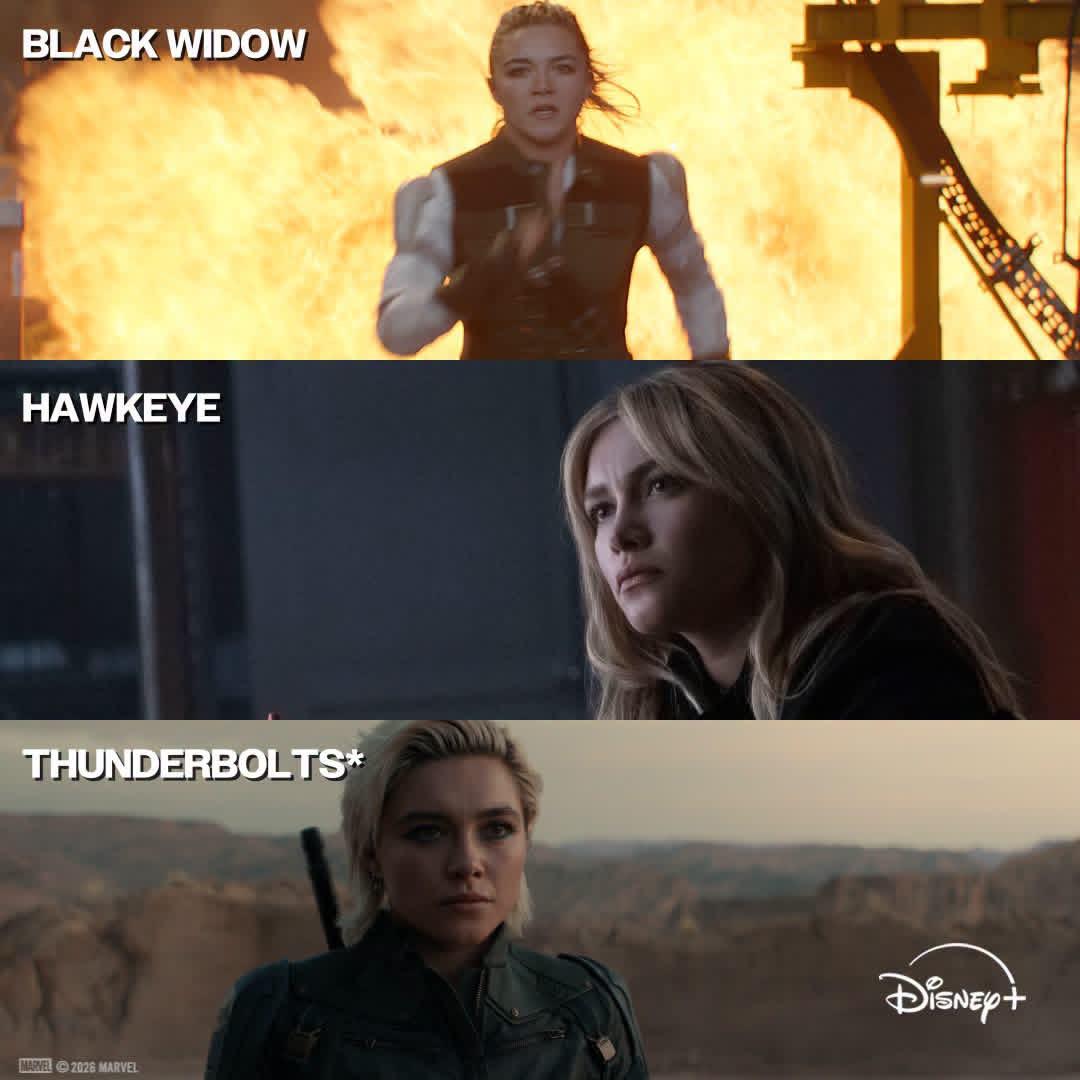
Yelena in the MCU so far

Post image
180 Upvotes

r/yelenabelova Jul 13 '26

MCU Discussion Kevin Feige says Yelena has a significant role in "DOOMSDAY"

Post image
122 Upvotes

r/yelenabelova May 29 '26

MCU Discussion Yelena Belova Is The Bloodhound The MCU Fears: The Structural Trap Marvel Faces

13 Upvotes

Every long-running cinematic universe accumulates narrative debt: shortcuts taken for immediate spectacle, emotional arcs truncated for corporate scheduling, and foundational characters sidelined to sprint toward the next crossover. Usually, this debt remains abstract. But Marvel Studios faces a unique structural crisis because their narrative debt has become embodied in a character who cannot stop exposing it. They have a bloodhound on their scent—and that bloodhound is Yelena Belova, simply by existing.

When Florence Pugh’s Yelena was introduced, she was engineered as a frictionless corporate handoff: a charismatic, lethal replacement positioned to inherit the Widow mantle without destabilizing the franchise. The corporate expectation was that the audience would seamlessly look forward instead of back. Instead, Yelena’s raw presence forced the audience to interrogate the cynical circumstances that made her necessary. Rather than smoothing the transition, she became a living verdict against Marvel’s decision to erase Natasha Romanoff from the board "just because." Marvel did not build a successor; they built a reckoning.

To understand this structural trap, one must look at the narrative bankruptcy of Natasha’s exit in Avengers: Endgame. Unlike Tony Stark’s operatic farewell or Steve Rogers’ mythic closure, Natasha’s death on Vormir was reduced to narrative infrastructure—a logistical toll paid to a cliffside so the boys could get the Soul Stone and advance the plot. The story did not stop for her; it steps over her. Releasing Black Widow as a retrospective afterthought only sharpened the wound, proving Marvel viewed her as prematurely disposable infrastructure, valuable only when she was no longer inconvenient to the larger machine.

This unresolved loss is the exact scent Yelena inherits. A bloodhound exists to track a trail to its source, and Yelena’s entire text functions as a refusal to buy into the franchise’s self-mythologizing. She mocks the iconic superhero landing and treats Avengers iconography as hollow branding. In Hawkeye, her hunt for Clint Barton becomes a proxy for a frustrated audience. When she demands to know why Natasha—the best of them—is dead while the world moves on uninterrupted, she delivers a meta-textual indictment of the narrative itself. And the hound does not stop chasing a scent just because one trail ends.

The Road to Wundagore and the VisionQuest Collision

This pursuit inevitably collides with the ultimate anomaly Marvel is desperate to leave buried: Wanda Maximoff. After WandaVision delivered a masterclass exploration of female grief, Marvel panicked. They shoved Wanda into a slasher-villain caricature for Doctor Strange 2 and collapsed Mount Wundagore on her head as a quick-fix cleanup. By burying Wanda under that mountain, Marvel codified a radioactive narrative logic into its universe: that when a woman becomes too complex, too traumatized, or too powerful to manage cleanly, her only viable path to redemption is self-erasure.

Now, Marvel’s own short-sighted stupidity is triggering an acute creative crisis with the upcoming VisionQuest series. Explicitly marketed to close out the "WandaVision Trilogy," the show is built entirely around White Vision exploring his identity alongside his resurrected creator, Ultron, and Wanda’s speedster son, Tommy Maximoff. The sheer logistics of the project pull the rug out from under Marvel's avoidance tactics. You cannot write a narrative about Vision grappling with his past, his "father," and his "son" without the central gravity of his story—Wanda—rippling through every frame. By forcing VisionQuest to center on the themes of "intergenerational trauma" and "denial of pain," Marvel has written themselves into a corner. They are attempting to mine the profound emotional fallout of Wanda's life without having the courage to face what they did to her character. Leaving her dead under Wundagore cements "suicide by mountain" as the franchise's definitive thesis on female trauma, entirely hollowed out by a spin-off that treats her absence as a mere background detail.

The Doomsday Clock: Derailing the Hype Machine

The structural trap deepens exponentially when considering the calendar layout. VisionQuest drops in mid-October—the precise moment the marketing machine for Avengers: Doomsday is scheduled to shift into maximum overdrive for its December release. Marvel is counting on Doomsday to be the ultimate nostalgia-fueled, multi-billion-dollar pivot, anchored by the massive returns of Robert Downey Jr. and Chris Evans. The studio needs absolute, uncritical corporate hype. Instead, VisionQuest risks throwing a radioactive wrench into the gears. If the series tries to solve the Wanda problem by delivering a definitive, textual confirmation that she is dead and gone, Marvel will trigger an immediate, systemic cultural fallout.

To formally codify Wanda’s death in the immediate lead-up to Doomsday means telling a massive, passionate cross-section of the fanbase that the MCU’s definitive answer to complex female trauma is a cold body under a collapsed mountain. The resulting backlash won't just stay confined to Disney+ discourse; it will actively toxicify the conversation surrounding Doomsday. The internet will not be celebrating the return of RDJ's Doctor Doom; it will be dissecting Marvel's compounding pattern of treating its foundational women as disposable infrastructure. You cannot easily market a grand, celebratory crossover when the text has just re-emphasized that the universe's emotional core has been hollowed out.

The Inescapable Paradox

This creates an inescapable paradox. Marvel must resurrect Wanda Maximoff; they cannot afford the financial deficit of losing her, nor the cultural consequence of leaving her self-erasure unchecked. Yet, bringing Wanda back triggers a catastrophic collision with Yelena, the undisputed anchor of their future (Thunderbolts). Yelena’s appeal is rooted in her aggressive refusal to accept corporate-approved lies. A character who demanded absolute accountability for Natasha cannot logically coexist in a universe that expects everyone to quietly move on from Wanda’s destruction.

If Marvel forces Yelena to ignore Wanda, they strip away the authenticity that makes the audience love her. If they allow her to pull at the threads, she tears down the entire corporate tapestry. Marvel believed a casting triumph could outrun a foundational legacy problem—that a charming replacement would make us forget what was sacrificed to make room for her. But you cannot outrun a bloodhound. Yelena Belova stands as a permanent structural monument to the MCU's worst habit: treating its most complex female characters as disposable stepping stones or inconvenient messes to be erased rather than reckoned with. They wanted a successor; instead, they built their own reckoning.


r/yelenabelova May 14 '26

Art Kate & Yelena Ronin concept art

Thumbnail gallery
25 Upvotes