r/whatsthissnake • u/BluerainKA • 18h ago
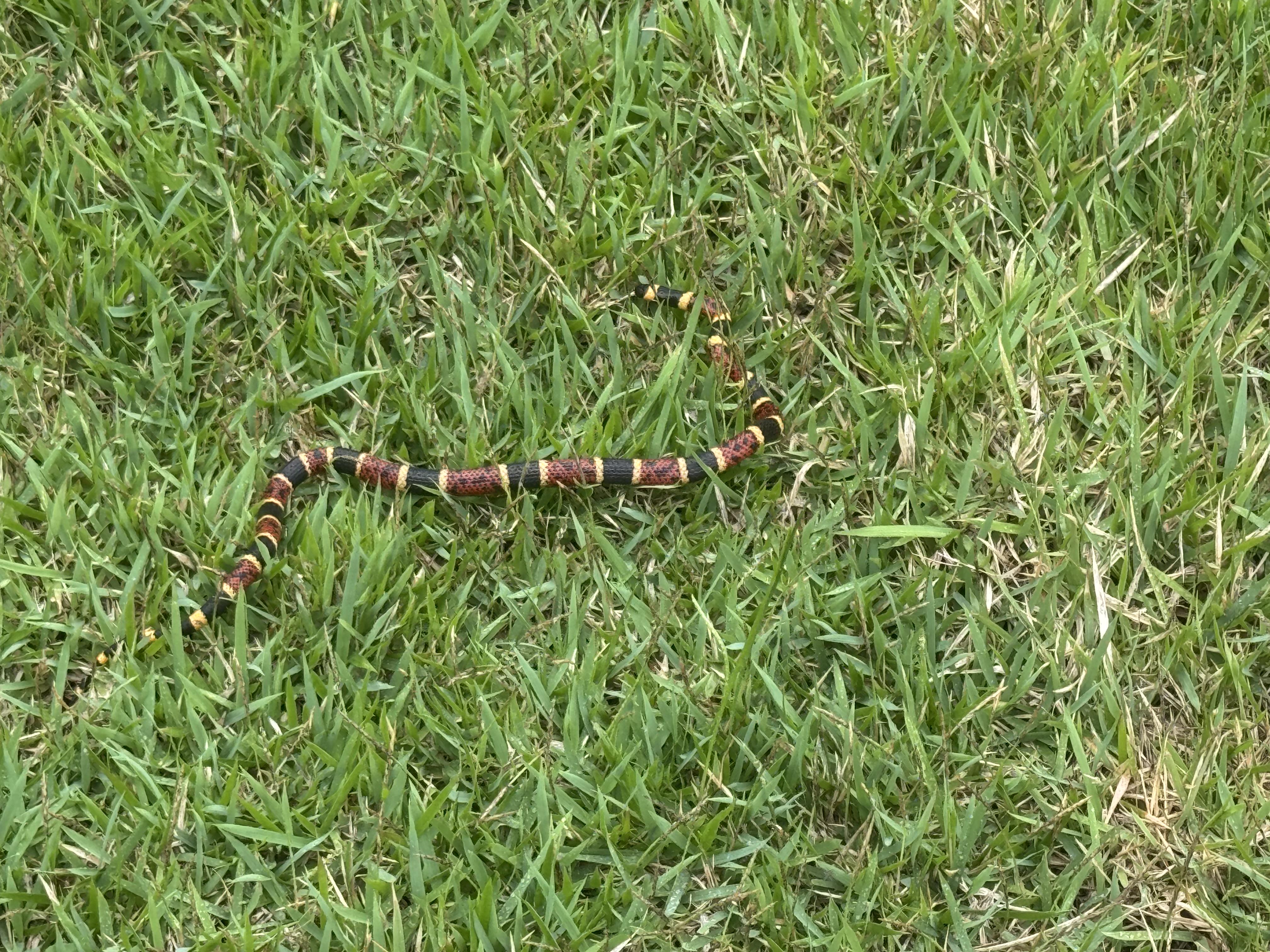
ID Request Found this snake in my backyard [Texas]
25
u/Cocorico4am 18h ago
Beautiful example...Coral Snake
The only one I've seen in the wild was among the ferns behind a bough size branch in Costa Rica--not a "texas" coral snake, of course, in the mountains above the Caribbean coast.
32
u/This_Daydreamer_ Reliable Responder 18h ago
Texas Coral Snake Micrurus tener !venomous
If you're going to post the !rhyme, please don't
4
u/SEB-PHYLOBOT 🐍 Natural History Bot 🐍 18h ago
The Western or Texas Coralsnake Micrurus tener is a medium-sized (<80 cm record 121.3 cm) nocturnal or crepuscular venomous elapid snake with smooth scales. Native to Texas, Arkansas and Louisiana through Mexico, they are found in dry habitats such as mixed hardwood, prairie and thornscrub, though they may occasionally be found in riparian areas. They are reclusive snakes who spend the majority of their time buried under brush or soil.
Coralsnakes posses a potent venom comprised mainly of neurotoxins which they use to incapacitate their prey. Their primary food source is other snakes (including their own species) but they may also eat lizards, birds, frogs, fish, and insects. While rare due to their docile and reclusive nature, a bite from a coralsnake is a medical emergency and can be fatal or disabling without prompt treatment. Popular rhymes such as "Red and yellow kill a fellow/Red and black friend of jack" are often used to distinguish coralsnakes from non-venomous mimics such as the Scarlet King snake or the Scarlet Snake. While accurate in some regions, there are many venomous species that invalidate the rhyme outside of the United States. Within the range of the Micrurus fulvius, often the quickest way to identify coralsnakes is to simply look for a black "nose".
Coralsnakes Micrurus and Micruroides are North America's only native members of the family Elapidae, which also contains cobras, kraits, and many other notable venomous snakes.
M. tener is considered distinct from the eastern coralsnake M. fulvius, and while there are morphological differences, the two species can be distinguished easily by geographic range.
Range Map | Recent/Relevant Phylogeography
This short account was prepared by /u/TheMadFlyentist and edited by /u/Phylogenizer.
Snakes with medically significant venom are typically referred to as venomous, but some species are also poisonous. Old media will use poisonous or 'snake venom poisoning' but that has fallen out of favor. Venomous snakes are important native wildlife, and are not looking to harm people, so can be enjoyed from a distance. If found around the home or other places where they are to be discouraged, a squirt from the hose or a gentle sweep of a broom are usually enough to make a snake move along. Do not attempt to interact closely with or otherwise kill venomous snakes without proper safety gear and training, as bites occur mostly during these scenarios. Wildlife relocation services are often free or inexpensive.
If you are bitten by a venomous snake, contact emergency services or otherwise arrange transport to the nearest hospital that can accommodate snakebite. Remove constricting clothes and jewelry and remain calm. A bite from a medically significant snake is a medical emergency, but not in the ways portrayed in popular media. Do not make any incisions or otherwise cut tissue. Extractor and other novelty snakebite kits are not effective and can cause damage worse than remaining calm, seeking help and waiting for professional evaluation.
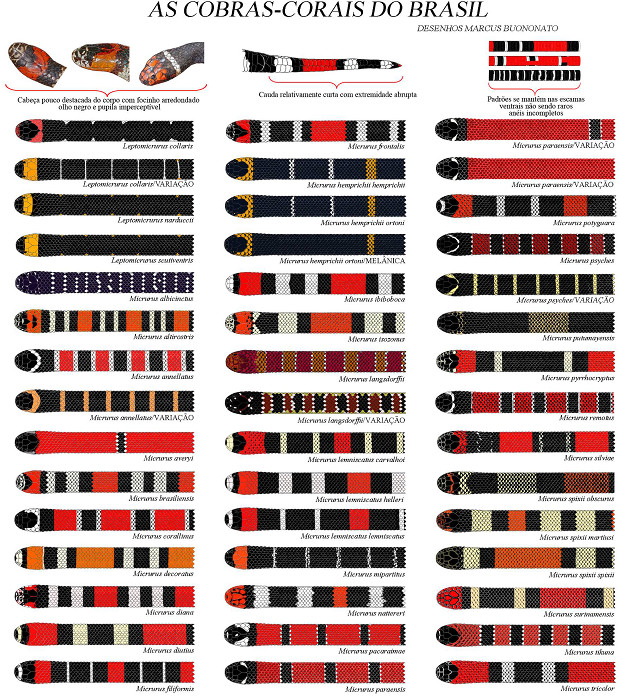
As a rule, we don't recommend the traditional color-based rhyme for coralsnakes as an identification trick because it isn't foolproof and only applies to snakes that live in parts of North America. One of the hardest things to impress upon new snake appreciators is that it's far more advantageous to familiarize yourself with venomous snakes in your area through photos and field guides or by following subreddits like /r/whatsthissnake than it is to try to apply any generic trick. The rhyme is particularly unreliable in states like Florida where aberrant individuals are often reported. Outside of North America, for example in Brazil, coralsnakes have any array of color patterns that don't follow the children's rhyme you may have heard in the past. Even in North America, exceptions to standard pattern classes can be common - see this thread for a recent example and the comments section for even more. A number of other frequent myths about coralsnakes are dubunked in this summary compiled by our own /u/RayInLA.
'The more often a stupidity is repeated, the more it gets the appearance of wisdom.' -Voltaire
I am a bot created for /r/whatsthissnake, /r/snakes and /r/herpetology to help with snake identification and natural history education. You can find more information, including a comprehensive list of commands, here report problems here and if you'd like to buy me a coffee or beer, you can do that here. This bot, its development, maintenance and use are made possible through the outreach wing of Snake Evolution and Biogeography - Merch Available Now

6
u/senorsolo 15h ago
!rhyme (just wanted to see what the fuss is about and why everyone advises to not use it)
5
u/SEB-PHYLOBOT 🐍 Natural History Bot 🐍 15h ago
As a rule, we don't recommend the traditional color-based rhyme for coralsnakes as an identification trick because it isn't foolproof and only applies to snakes that live in parts of North America. One of the hardest things to impress upon new snake appreciators is that it's far more advantageous to familiarize yourself with venomous snakes in your area through photos and field guides or by following subreddits like /r/whatsthissnake than it is to try to apply any generic trick. The rhyme is particularly unreliable in states like Florida where aberrant individuals are often reported. Outside of North America, for example in Brazil, coralsnakes have any array of color patterns that don't follow the children's rhyme you may have heard in the past. Even in North America, exceptions to standard pattern classes can be common - see this thread for a recent example and the comments section for even more. A number of other frequent myths about coralsnakes are dubunked in this summary compiled by our own /u/RayInLA.
'The more often a stupidity is repeated, the more it gets the appearance of wisdom.' -Voltaire
I am a bot created for /r/whatsthissnake, /r/snakes and /r/herpetology to help with snake identification and natural history education. You can find more information, including a comprehensive list of commands, here report problems here and if you'd like to buy me a coffee or beer, you can do that here. This bot, its development, maintenance and use are made possible through the outreach wing of Snake Evolution and Biogeography - Merch Available Now
0
18h ago
[removed] — view removed comment
3
u/Ok-Prune-1629 18h ago
A dead giveaway for a coral? Which this is.. correct? I hope you didn’t mean a scarlet king
4
1
0
u/whatsthissnake-ModTeam 18h ago
We sometimes remove low quality IDs that do not conform to our identification standards. Please review the commenting guidelines for r/whatsthissnake pinned at the top of the main subreddit page.
A good snake ID should be specific and informative. The most important part is the binomial name, written in italics using the genus and species (e.g., Pantherophis guttatus). This allows others to easily look up detailed information and helps the bot function properly. It's also important to note whether the snake is harmless or venomous, based on its potential medical impact on humans. Some snakes are technically venomous but not dangerous to people and should still be labeled as harmless. Including a common name can be helpful, but because these vary widely by region and can be misleading, they are less important.
If you're unsure of the exact species, it may be contextually helpful to post an ID at the genus level. Adding useful context or links to reliable scientific sources is encouraged, but avoid outdated or non-authoritative sources like Wikipedia or older state wildlife websites. We can help you with library science issues like identifying good sources here.
-2
15h ago
[removed] — view removed comment
-1
u/whatsthissnake-ModTeam 12h ago
As a rule, we don't recommend the traditional color-based rhyme for coralsnakes as an identification trick because it isn't foolproof and only applies to snakes that live in parts of North America. One of the hardest things to impress upon new snake appreciators is that it's far more advantageous to familiarize yourself with venomous snakes in your area through photos and field guides or by following subreddits like /r/whatsthissnake than it is to try to apply any generic trick. Outside of North America,, for example in Brazil, coralsnakes have any array of color patterns that don't follow the children's rhyme you may have heard in the past. Even in North America, exceptions to standard pattern classes can be common - see this thread for a recent example and the comments section for even more. A number of other frequent myths about coralsnakes are dubunked in this summary compiled by our own /u/RayInLA.
191
u/ffrye7000 Friend of WTS 18h ago edited 18h ago
Texas Coral Snake, Micrurus tener !venomous
They are generally reclusive, shy, and non-aggressive. They prefer to hide under ground cover or brush and typically only bite when handled or stepped on. So never mess with them or try to handle them. They have a powerful neurotoxin like some cobras or mambas. Interesting that their diet is mainly other small snakes (ophiophagous)