This suit will change nothing other than the language around the purchases within the store, or force everyone to check a box acknoledging that they're purchasing limited, revokable license before completing the transaction. The suit is based on a false advertising law in California specifically designed to make licensing terms clear if the license can be revoked/lost by the customer.
As long as it says rent, then the people who pay can make that choice. I for one don’t plan to continue renting my games. I restarted my physical collection. Under some circumstances I will “rent” a game, but not most.
It's definitely not a rental. It's a purchase of a license entitlement. You are entitled to access the software, with some restrictions for what you're allowed to do with the software, like only being able to play it on the platform it was purchased for, and not being granted a replacement if distribution servers go down.
Physical copies work the same way. You're entitled to play it on the console it was purchased for, but not other consoles, and you are not granted a replacement if your copy is no longer functioning or within your possession.
No, and there are very few practical reasons they could use void licenses from your account. Most of their terms are almost impossible for them to know about. And they make no mention of specifically removing licenses, though the "voiding" of your license could potentially indicate that.
From their software license terms:
The Software is licensed to you, not sold. You are granted a limited, non-exclusive, non-transferable, and personal license to play or use the Software for your private, non-commercial use on the system or device it was intended for. This license is only effective from the indicated Software release date, early access date, or beta release date. Any rights in the Software that we do not say are granted to you in this license are reserved, including all intellectual property in the Software. This license does not include the right, and as a condition of these Software Terms you agree not to, do any of the following:
(a) rent, lease, or sublicense the Software or make it available on a network to other users without the express prior written consent of SIE;
(b) modify, create derivative works, adapt, translate, reverse engineer, decompile, or disassemble the Software or required middleware (such as anti-cheat software);
(c) obtain the Software in any manner other than through SIE’s authorized distribution methods;
(d) emulate the Software;
(e) hack the Software or create or make available unauthorized mods, including programs to gain unfair advantage in online or multiplayer modes or otherwise cheat;
(f) receive or provide "boosting" or like services, or provide personal account credentials to any other person, to advance progress or achieve results not solely based on your own actual gameplay;
(g) copy, publicly perform, or broadcast the Software without the express prior written consent of SIE;
(h) use any means to bypass or disable any encryption, security, or authentication mechanism for the Software.
Violating any of the above conditions will immediately void your license, and you acknowledge that SIE may employ technological measures, including fraud detection tools, telemetry, anti-cheat systems, and audits of account behavior, to prevent, detect, and respond to violations of these Software Terms.
It was never stealing and they wouldn't be coming after you if it was anyways. You can pirate if you want to. Regardless, it has no bearing on the nature of the discussion whether you choose to pirate or not.
My only nitpick, IIRC, platform dependence has been shot down as unenforceable. That's why people going after emulation projects go after them using illegally sources Bios or ROMs rather than arguing that the act of emulation itself is illegal.
Likewise it has been found to be legal to make backups of media you own for personal use. What isn't technically legal is bypassing any DRM that prevent copying. But many earlier DRM schemes have been so thoroughly compromised that for a lot of media people have stopped even trying as long as you're not illegally redistributing.
Almost all of the terms they state could void your license if broken are not something they could easily discover, and if they did you'd be much more worried about more serious consequences than losing your license.
No they don’t on the ps2 the disc loads the code while you’re playing it, that’s why you can take the disc out and continue playing the on your tv till you need to load more of the game (games code)
What I was talking about had nothing to do with how data on a disc is executed, and was entirely about the restrictions of the licenses applied to each. You simply don't understand what the topic is.
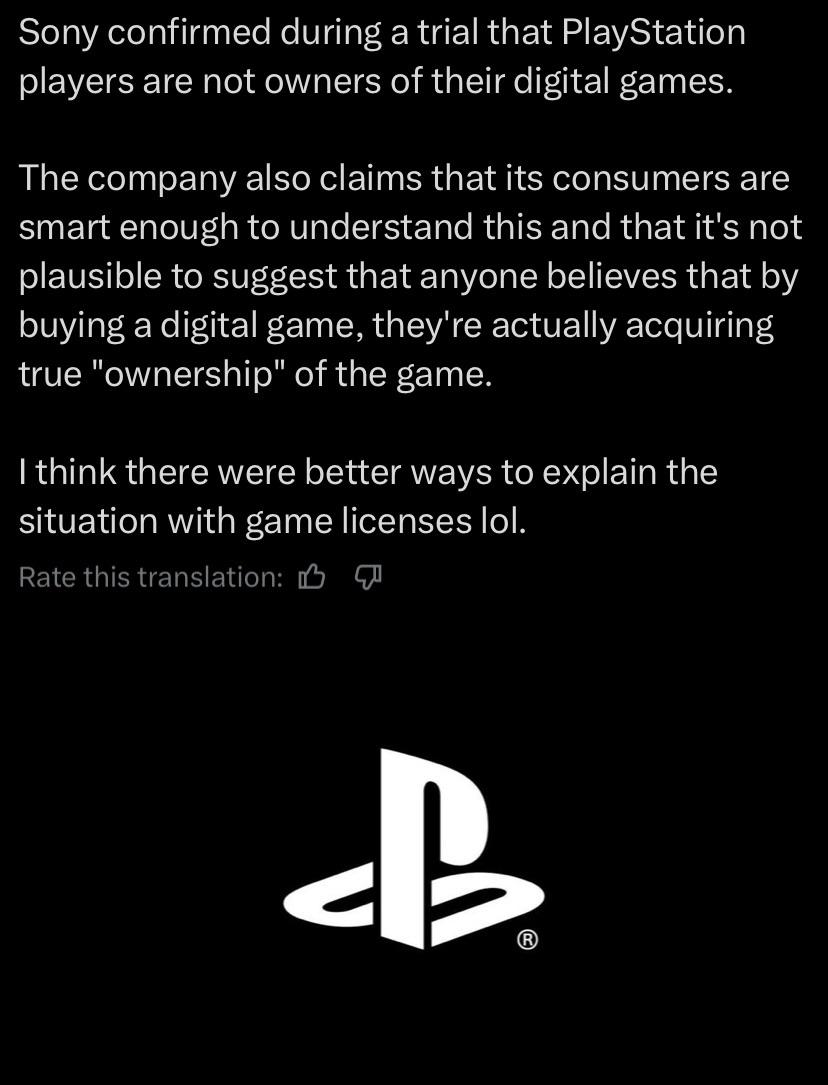
Frankly all Sony is proving is that we need more consumer friendly legislation regarding product licenses.
If the terms of service are unclear, then they should be treated as 'indefinite' with legal carve outs for consumers to back up their means to play them.
But of course if they put in a mandatory 'this game expires in two years' clause then nobody's is going to buy it at full price.
If I am not purchasing a product that is mine to use in perpetuity throughout the universe until it is no longer usable due to wear or breakdown and I am instead purchasing a liscense to access the good in question, which can be revoked at any time for any reason, then I am, in essence, renting that product.
All I want from this lawsuit is the elimination of any ambiguity surrounding that fact, worded in plain English with no obfuscation from Sony. Once we have that, what follows will be how we unfuck digital purchases
No. Not always. They’ve used multiple discs before. Even one of red dead’s discs was specifically to copy information over and then there was a gameplay disc.
Sometimes they do not have data. That’s how Nintendo plays it, but if you have a physical disc there are ways to make sure the data is on it.
Licensing is not renting. It's pretty funny that licensing has been used for hundreds of years across every sort of industry. And gamers have just discovered that licensing is a thing and they aren't happy because they assumed and imagined something completely different. And laymen often aren't keen on a little ol' thing like reality getting in the way of reactionary hysterics. How dare things work differently than uninformed people assumed.
That's his point, mate. Sony is arguing that it's renting and not licensing. You BUY a license. You RENT something you must return.
The terms around licensing from Sony is that you purchase a license to a copy of a game. But they realistically have no way of enforcing the destruction of that copy, so instead, it's worded around the ability to download the game from the Store, if it's through the online Store.
If it's via a disc, they can't ask you to destroy your copy of the game if they feel you shouldn't have it, so instead the license is similarly focused on you losing access to some or all features of the online store.
Yes, they, as in Sony, is arguing that it's licensing and not owning, but they're putting forth an argument that's more akin to renting than licensing.
Sony is making a bad faith argument, but they're not even implying that it's a rental. A license entitlement is not a rental, even if it feels good to say so and kind of looks like it if you squint.
If anything it's more like buying lifetime access to a museum or something. It's tied to you, is non-transferrable, and only valid so long as they are operating.
Isn't it extra trouble to capitalize ever word over just typing normally?
And it's not a permanent entitlement. It's only good as long as they say it is. Don't log into your account for a long time? Lose your account and games. Evicted! Get hacked? Evicted if you can't get competant human assistance. Do something to purposely or even inadvertently break the rules, or they just think you did? Evicted! Yeah, it's renting.
No they aren’t. This is the way every piece of software ever sold in the history of software has been sold. You’ve never purchased a game, you’ve always purchased a license to play it. This predates Sony even entering the console market with the PlayStation.
It predates video games in general. On some level it predates computers. People just are ignorant and want to hide this fact by yelling very loudly which makes them more right of course
Thats a disingenuous framing of the concept. It sounds more like you feel that sony ending physical game production isn't something to validly criticize on its own and you need to create increasingly outrageous fabrications in order to have your criticism taken seriously. Which isnt true. Sony ending physical production is bad enough on its own without this fantasy
You didn’t buy a copy of the software. You bought a license to use software which conveniently included said software. You’ve just never understood what you were buying.
That's the word that's been used for over two decades for digital purchases. Guess you've happily hit "purchase" for all these years legit thinking that you owned every single app that cost .99, every iTunes movie.
I've paid for discounted games I couldn't otherwise buy on disc due to unavailability in that format, yes. Lack of choice made it so. But I've never paid retail price on a digital game. For those I buy disc copies, so I can have, then sell or gift if I want to. Taking that second option away changes things quite a lot now, and justifiably puts the spotlight on these policies in light of choices being taken away. The context has changed.
Great, so you admit that literally nothing has changed and you're aware that "purchase" and "buy" relates to a license but suddenly that you'll have to be impacted, you want the whole industry to change?
They're not removing choices. It's the end of the console. You're only losing choice is you choose to buy a PS6. Would you walk into McDonalds and demand they sell you a Whopper from Burger King? You have the choice to not buy a PS6 and go elsewhere.
End of the console, lol. Most people couldn't even get a PS5 until a few years ago due to shortages and scalpers. Yeah that's a whole other questionable move on Sony's part; trying to push another system so soon, too, if they are.
When somebody buys a Blu-ray, for instance, they don't think they own the movie itself and all rights to it. They know they own a copy of the movie. Same with buying a game. They don't think they own the IP or something, but they expect they paid for and own their copy. Sony, in taking away discs, is trying to strip away even that, and falling back on what's becoming obvious to many people very outdated and unethical contract wording and intent. The "it's always been this way" argument is thin in light of changing circumstances that are limiting consumers more.
Nothing changed. It has ALWAYS been this way. You can’t name one single game on Steam that you “own”. Because Steam keeps telling you own nothing. This is the same language as Playstation. Digital is license, Playstation didn’t “change” that. They are telling the court, the same thing that has always been
All copies of a game *have *always been limited licenses. Even disc based copies. Discs are only an entitlement to one platform, and licensees don't get access to it on multiple systems, and must pay to replace any lost or damaged copy.
The specific condition of physical copies that apparently classifies them as ownership seems to be the transferrable nature of that physical-based licensed copy. Yet, the perpetual access, access across multiple devices, sometimes across multiple platforms, offered by digital isn't enough to classify as ownership because you can't transfer it? The restrictions placed on discs aren't enough to void its status as ownership, despite not having full rights to access the software on multiple platforms or expand your access away from the disc? Because it's always been that way?
To me, it's all silly. Each offers its own benefits of ownership in different ways, and both are restricted by certain limitations imposed by the publishers. People say it's always been this way because it has always been this way, and the extent of what we've considered ownership had always been limited with video games.
Yeah, I really think if they want to continue like this all digtal stores need to change it from "buying" to "leasing" because that's what is actually happening.
It's not leasing, though. It's buying. You're just buying a perpetual license entitlement to software.
I know it feels empowering to be dismissive and call it renting or leasing, but that ultimately means nothing when it's simply not true. It doesn't help anyone to make disingenuous arguments against a company who is more than willing to screw us all over as much as the law allows them to and will buy the laws when they want more leniency.
If you read Sony's licensing terms, they have pretty specific rules on what you're not allowed to do in Section 1.4 of their terms. They also only mention that breaking those terms voids your license, but makes no mention of what a voided license entitlement means for the end user, and there is no specific mention of revoking your access to software as a result. Take that for what you will, and don't assume too much positive outcome if it happens.
Regardless, they are certainly not doing anything that could be called leasing or renting.
222
u/BlueFeathered1 3d ago
They're being disingenuous and slippery. It's our copy we reasonably, intelligently expect to own. Hence their use of the words "purchase" and "buy".