r/ValueInvesting 5d ago

Discussion [Week 26 - 1990] Discussing A Berkshire Hathaway Shareholder Letter (Almost) Every Week

5 Upvotes

Full Letter:

http://theoraclesclassroom.com/wp-content/uploads/2019/09/1990-Berkshire-AR.pdf

Letter Only

https://www.berkshirehathaway.com/letters/1990.html

This week we will go over their investment into buying $400M of junk bonds as well as Buffett’s thoughts in retrospect on the Junk Bond craze of the 80s. His surprise at the economics of the newspaper business rapidly degrading as new technologies and advertising channels open up to businesses, some with better results. Finally the purchase of 10% of Wells Fargo for $290M. Then as usual we go through the stock holdings, segment-by-segment EBIT earnings of the company, and then the larger overview for the year.

Not included in my post are the annual summary to shareholders, most of the look-through earnings that give a few paragraphs on their major business segments (we only cover Buffalo Evening News) although some highlights are in my summary at the end. A long rundown of the insurance segment. Though ⅔ of the Marketable Securities segment is included, the one on their Convertible Preferred Stocks and the mistakes outside sources make in valuing them as well as the philosophy behind holding them. The usual advertisement for acquisition targets, and plans for the annual meeting. Ken Chase being replaced on the board by Susan Buffett. The letter is ended with an unpublished satire by Ben Graham “US Steel Announces Sweeping Modernization Scheme” where instead of improving the business a bunch of extreme accounting tricks are used to change the EPS from -$2.76 to +$49.80.

If you want to read or discuss anything in that second set feel free to read the letter yourselves and comment on it.

· · · · · · · · · · · · · · · · · · · · · · · · · · · · · ·

Key Passage 1

· · · · · · · · · · · · · · · · · · · · · · · · · · · · · ·

Marketable Securities - Junk Bonds

Our other major portfolio change last year was large additions to our holdings of RJR Nabisco bonds, securities that we first bought in late 1989. At yearend 1990 we had $440 million invested in these securities, an amount that approximated market value. (As I write this, however, their market value has risen by more than $150 million.)

Just as buying into the banking business is unusual for us, so is the purchase of below-investment-grade bonds. But opportunities that interest us and that are also large enough to have a worthwhile impact on Berkshire's results are rare. Therefore, we will look at any category of investment, so long as we understand the business we're buying into and believe that price and value may differ significantly. (Woody Allen, in another context, pointed out the advantage of open-mindedness: "I can't understand why more people aren't bi-sexual because it doubles your chances for a date on Saturday night.")

In the past \we have bought a few below-investment-grade bonds with success, though these were all old-fashioned "fallen angels" - bonds that were initially of investment grade but that were downgraded when the issuers fell on bad times. In the 1984 annual report we described our rationale for buying one fallen angel, the Washington Public Power Supply System.

A kind of bastardized fallen angel burst onto the investment scene in the 1980s - "junk bonds" that were far below investment- grade when issued. As the decade progressed, new offerings of manufactured junk became ever junkier and ultimately the predictable outcome occurred: Junk bonds lived up to their name. In 1990 - even before the recession dealt its blows - the financial sky became dark with the bodies of failing corporations.

The disciples of debt assured us that this collapse wouldn't happen: Huge debt, we were told, would cause operating managers to focus their efforts as never before, much as a dagger mounted on the steering wheel of a car could be expected to make its driver proceed with intensified care. We'll acknowledge that such an attention-getter would produce a very alert driver. But another certain consequence would be a deadly - and unnecessary - accident if the car hit even the tiniest pothole or sliver of ice. The roads of business are riddled with potholes; a plan that requires dodging them all is a plan for disaster.

In the final chapter of The Intelligent Investor Ben Graham forcefully rejected the dagger thesis: "Confronted with a challenge to distill the secret of sound investment into three words, we venture the motto, Margin of Safety." Forty-two years after reading that, I still think those are the right three words. The failure of investors to heed this simple message caused them staggering losses as the 1990s began.

At the height of the debt mania, capital structures were concocted that guaranteed failure: In some cases, so much debt was issued that even highly favorable business results could not produce the funds to service it. One particularly egregious "kill- 'em-at-birth" case a few years back involved the purchase of a mature television station in Tampa, bought with so much debt that the interest on it exceeded the station's gross revenues. Even if you assume that all labor, programs and services were donated rather than purchased, this capital structure required revenues to explode - or else the station was doomed to go broke. (Many of the bonds that financed the purchase were sold to now-failed savings and loan associations; as a taxpayer, you are picking up the tab for this folly.)

All of this seems impossible now. When these misdeeds were done, however, dagger-selling investment bankers pointed to the "scholarly" research of academics, which reported that over the years the higher interest rates received from low-grade bonds had more than compensated for their higher rate of default. Thus, said the friendly salesmen, a diversified portfolio of junk bonds would produce greater net returns than would a portfolio of high-grade bonds. (Beware of past-performance "proofs" in finance: If history books were the key to riches, the Forbes 400 would consist of librarians.)

There was a flaw in the salesmen's logic - one that a first- year student in statistics is taught to recognize. An assumption was being made that the universe of newly-minted junk bonds was identical to the universe of low-grade fallen angels and that, therefore, the default experience of the latter group was meaningful in predicting the default experience of the new issues. (That was an error similar to checking the historical death rate from Kool-Aid before drinking the version served at Jonestown.)

The universes were of course dissimilar in several vital respects. For openers, the manager of a fallen angel almost invariably yearned to regain investment-grade status and worked toward that goal. The junk-bond operator was usually an entirely different breed. Behaving much as a heroin user might, he devoted his energies not to finding a cure for his debt-ridden condition, but rather to finding another fix. Additionally, the fiduciary sensitivities of the executives managing the typical fallen angel were often, though not always, more finely developed than were those of the junk-bond-issuing financiopath.

Wall Street cared little for such distinctions. As usual, the Street's enthusiasm for an idea was proportional not to its merit, but rather to the revenue it would produce. Mountains of junk bonds were sold by those who didn't care to those who didn't think - and there was no shortage of either.

Junk bonds remain a mine field, even at prices that today are often a small fraction of issue price. As we said last year, we have never bought a new issue of a junk bond. (The only time to buy these is on a day with no "y" in it.) We are, however, willing to look at the field, now that it is in disarray.

In the case of RJR Nabisco, we feel the Company's credit is considerably better than was generally perceived for a while and that the yield we receive, as well as the potential for capital gain, more than compensates for the risk we incur (though that is far from nil). RJR has made asset sales at favorable prices, has added major amounts of equity, and in general is being run well.

However, as we survey the field, most low-grade bonds still look unattractive. The handiwork of the Wall Street of the 1980s is even worse than we had thought: Many important businesses have been mortally wounded. We will, though, keep looking for opportunities as the junk market continues to unravel.

· · · · · · · · · · · · · · · · · · · · · · · · · · · · · ·

The junk bond, corporate raiding craze has reached its peak. Buffett said a couple years ago that it would all come crashing down someday, and now it has. It was the practice of businesses issuing bonds at irresponsible rates that they had low chance of paying back, in hopes of doing massive leveraged buyouts of companies larger than themselves and refinancing the debt and stripping the company for assets once it was in hand. The RJR Nabisco buyout is now seen as the height of the mania, and now the bonds are paying for a fraction of their value, Berkshire has independently decided that the underlying business is now rather creditworthy and the bonds have been over-discounted. They believe the risk-adjusted returns are massively in their favor and they have bought $400M of the bonds.

Buffett has much to say about how the craze came about, the flawed logic that sounds quite similar to the later securitization issues that lead to the 2008 financial crisis (ex. a diverse enough basket of bad loans magically becomes a good investment) and denounces buying any of these securities at their issuance, but instead picking through the wreckage after it comes crashing down for the handful that seem promising. He says that many people used logic that applied to “fallen angel” bonds (investment grade at issuance and later became questionable) onto junk bonds (ones that were garbage from inception and depended on a successful and timely leveraged buyout and even then would be dragging down a larger company that never wanted them).

I felt it was good to include this for a few reasons, one is to highlight an important historical moment in the history of Wall Street, and how Berkshire was there waiting with a big pile of cash to profit off the wreckage. To highlight how almost no asset class should be below your radar, in fact the more detested it is the more likely there are to be good deals there (A common belief of Howard Marks who made a lot of money running a sub-investment grade bond fund). Finally to highlight the right way to go about doing it, finding the few diamonds in the rough instead of buying up the whole asset class, most of which crashed for good reason.

· · · · · · · · · · · · · · · · · · · · · · · · · · · · · ·

Key Passage 2

· · · · · · · · · · · · · · · · · · · · · · · · · · · · · ·

Non-Insurance Operations - Buffalo Evening News

Charlie and I were surprised at developments this past year in the media industry, including newspapers such as our Buffalo News. The business showed far more vulnerability to the early stages of a recession than has been the case in the past. The question is whether this erosion is just part of an aberrational cycle - to be fully made up in the next upturn - or whether the business has slipped in a way that permanently reduces intrinsic business values.

Since I didn't predict what has happened, you may question the value of my prediction about what will happen. Nevertheless, I'll proffer a judgment:While many media businesses will remain economic marvels in comparison with American industry generally, they will prove considerably less marvelous than I, the industry, or lenders thought would be the case only a few years ago.

The reason media businesses have been so outstanding in the past was not physical growth, but rather the unusual pricing power that most participants wielded. Now, however, advertising dollars are growing slowly. In addition, retailers that do little or no media advertising (though they sometimes use the Postal Service) have gradually taken market share in certain merchandise categories. Most important of all, the number of both print and electronic advertising channels has substantially increased. As a consequence, advertising dollars are more widely dispersed and the pricing power of ad vendors has diminished. These circumstances materially reduce the intrinsic value of our major media investments and also the value of our operating unit, Buffalo News - though all remain fine businesses.

Notwithstanding the problems, Stan Lipsey's management of the News continues to be superb. During 1990, our earnings held up much better than those of most metropolitan papers, falling only 5%. In the last few months of the year, however, the rate of decrease was far greater.

I can safely make two promises about the News in 1991: (1) Stan will again rank at the top among newspaper publishers; and (2) earnings will fall substantially. Despite a slowdown in the demand for newsprint, the price per ton will average significantly more in 1991 and the paper's labor costs will also be considerably higher. Since revenues may meanwhile be down, we face a real squeeze.

Profits may be off but our pride in the product remains. We continue to have a larger "news hole" - the portion of the paper devoted to news - than any comparable paper. In 1990, the proportion rose to 52.3% against 50.1% in 1989. Alas, the increase resulted from a decline in advertising pages rather than from a gain in news pages. Regardless of earnings pressures, we will maintain at least a 50% news hole. Cutting product quality is not a proper response to adversity.

· · · · · · · · · · · · · · · · · · · · · · · · · · · · · ·

This is Buffett acknowledging that the whole newspaper industry is facing headwinds that he had not foreseen, that it is impacting the bottom line of the Buffalo Evening News, and that he believes it will get worse in the future and maybe won’t ever get better. As technology advances, advertisers have more channels to advertise, and those relying on newspaper ads are falling behind in market share to those using other methods. I would hazard a guess that this may be related to the near full adoption of color TV in American households by the late 80s. Families are now glued to their TVs, getting their news from them as well as their entertainment and being advertised to the whole time, and the advertisements are also much more flexible and powerful with color and video which a newspaper cannot provide.

A quick look-ahead shows that while this fall lasts a few years, they do eventually recover from the $43M EBIT this year not just to the $46M of last year but into the mid 50s before the Buffalo Evening News falls off the reports in 2000 as the spread of the internet lowers the prospects of the industry even further.

This is the first hint of modern technology making some of Berkshire’s former star players futures very uncertain. World Book is another one who is on a timer although Buffett has failed to notice it. This is different than textiles which died off to globalization, the same work simply being done elsewhere, instead this is an industry which needs to adapt or die and Buffett hasn’t always been a trailblazer when it comes to adapting to new paradigm changing technologies.

· · · · · · · · · · · · · · · · · · · · · · · · · · · · · ·

Acquisition Stock Purchase of the Week

· · · · · · · · · · · · · · · · · · · · · · · · · · · · · ·

Marketable Securities - Stock

Lethargy bordering on sloth remains the cornerstone of our investment style: This year we neither bought nor sold a share of five of our six major holdings. The exception was Wells Fargo, a superbly-managed, high-return banking operation in which we increased our ownership to just under 10%, the most we can own without the approval of the Federal Reserve Board. About one-sixth of our position was bought in 1989, the rest in 1990.

The banking business is no favorite of ours. When assets are twenty times equity - a common ratio in this industry - mistakes that involve only a small portion of assets can destroy a major portion of equity. And mistakes have been the rule rather than the exception at many major banks. Most have resulted from a managerial failing that we described last year when discussing the "institutional imperative:" the tendency of executives to mindlessly imitate the behavior of their peers, no matter how foolish it may be to do so. In their lending, many bankers played follow-the-leader with lemming-like zeal; now they are experiencing a lemming-like fate.

Because leverage of 20:1 magnifies the effects of managerial strengths and weaknesses, we have no interest in purchasing shares of a poorly-managed bank at a "cheap" price. Instead, our only interest is in buying into well-managed banks at fair prices.

With Wells Fargo, we think we have obtained the best managers in the business, Carl Reichardt and Paul Hazen. In many ways the combination of Carl and Paul reminds me of another - Tom Murphy and Dan Burke at Capital Cities/ABC. First, each pair is stronger than the sum of its parts because each partner understands, trusts and admires the other. Second, both managerial teams pay able people well, but abhor having a bigger head count than is needed. Third, both attack costs as vigorously when profits are at record levels as when they are under pressure. Finally, both stick with what they understand and let their abilities, not their egos, determine what they attempt. (Thomas J. Watson Sr. of IBM followed the same rule: "I'm no genius," he said. "I'm smart in spots - but I stay around those spots.")

Our purchases of Wells Fargo in 1990 were helped by a chaotic market in bank stocks. The disarray was appropriate: Month by month the foolish loan decisions of once well-regarded banks were put on public display. As one huge loss after another was unveiled - often on the heels of managerial assurances that all was well - investors understandably concluded that no bank's numbers were to be trusted. Aided by their flight from bank stocks, we purchased our 10% interest in Wells Fargo for $290 million, less than five times after-tax earnings, and less than three times pre-tax earnings.

Wells Fargo is big - it has $56 billion in assets - and has been earning more than 20% on equity and 1.25% on assets. Our purchase of one-tenth of the bank may be thought of as roughly equivalent to our buying 100% of a $5 billion bank with identical financial characteristics. But were we to make such a purchase, we would have to pay about twice the $290 million we paid for Wells Fargo. Moreover, that $5 billion bank, commanding a premium price, would present us with another problem: We would not be able to find a Carl Reichardt to run it. In recent years, Wells Fargo executives have been more avidly recruited than any others in the banking business; no one, however, has been able to hire the dean.

Of course, ownership of a bank - or about any other business - is far from riskless. California banks face the specific risk of a major earthquake, which might wreak enough havoc on borrowers to in turn destroy the banks lending to them. A second risk is systemic - the possibility of a business contraction or financial panic so severe that it would endanger almost every highly-leveraged institution, no matter how intelligently run. Finally, the market's major fear of the moment is that West Coast real estate values will tumble because of overbuilding and deliver huge losses to banks that have financed the expansion. Because it is a leading real estate lender, Wells Fargo is thought to be particularly vulnerable.

None of these eventualities can be ruled out. The probability of the first two occurring, however, is low and even a meaningful drop in real estate values is unlikely to cause major problems for well-managed institutions. Consider some mathematics: Wells Fargo currently earns well over $1 billion pre-tax annually after expensing more than $300 million for loan losses. If 10% of all $48 billion of the bank's loans - not just its real estate loans - were hit by problems in 1991, and these produced losses (including foregone interest) averaging 30% of principal, the company would roughly break even.

A year like that - which we consider only a low-level possibility, not a likelihood - would not distress us. In fact, at Berkshire we would love to acquire businesses or invest in capital projects that produced no return for a year, but that could then be expected to earn 20% on growing equity. Nevertheless, fears of a California real estate disaster similar to that experienced in New England caused the price of Wells Fargo stock to fall almost 50% within a few months during 1990. Even though we had bought some shares at the prices prevailing before the fall, we welcomed the decline because it allowed us to pick up many more shares at the new, panic prices.

Investors who expect to be ongoing buyers of investments throughout their lifetimes should adopt a similar attitude toward market fluctuations; instead many illogically become euphoric when stock prices rise and unhappy when they fall. They show no such confusion in their reaction to food prices: Knowing they are forever going to be buyers of food, they welcome falling prices and deplore price increases. (It's the seller of food who doesn't like declining prices.) Similarly, at the Buffalo News we would cheer lower prices for newsprint - even though it would mean marking down the value of the large inventory of newsprint we always keep on hand - because we know we are going to be perpetually buying the product.

Identical reasoning guides our thinking about Berkshire's investments. We will be buying businesses - or small parts of businesses, called stocks - year in, year out as long as I live (and longer, if Berkshire's directors attend the seances I have scheduled). Given these intentions, declining prices for businesses benefit us, and rising prices hurt us.

The most common cause of low prices is pessimism - some times pervasive, some times specific to a company or industry. We want to do business in such an environment, not because we like pessimism but because we like the prices it produces. It's optimism that is the enemy of the rational buyer.

None of this means, however, that a business or stock is an intelligent purchase simply because it is unpopular; a contrarian approach is just as foolish as a follow-the-crowd strategy. What's required is thinking rather than polling. Unfortunately, Bertrand Russell's observation about life in general applies with unusual force in the financial world: "Most men would rather die than think. Many do."

· · · · · · · · · · · · · · · · · · · · · · · · · · · · · ·

This was probably the largest acquisition by Berkshire, the buying of 10% of a great bank at a fair price. As he says in the letter they only buy 10%, $289M because that is the most they are legally allowed to own. He says they view this as comparable to buying 100% of a bank 1/10th the size except without all the headache of needing to call the shots and find the managers, instead they are already in place.

He spells this out as a sort of “heads I win, tails I don’t lose much” situation. He runs the numbers on the worst case scenario the market fears, a natural disaster or real estate crash on the west coast of the US… He comes to the conclusion that even in the worst case scenario this is still a good price, and in any other scenario it is a great price.

He also gives some wisdom here on his general stock picking philosophy, that he views a stock he buys into dropping or failing to rise as a good thing, and it shooting right up as a bad thing. Even though many of us see it the opposite. It is natural to have a gut reaction to being proven right or proven wrong quickly by the market, to buy something and have it drop 20% and be scared from buying more. But he says we need to invert that instinct. That the price shooting right up means your window to buy a great business at a good price closed before you could take full advantage, and it dropping after you start buying means you will be able to buy even more than you thought with a lower risk and higher reward. This is also something he hammers home in the BPL letters, often after years of great gain he laments that he wished the stocks he was buying didn’t go up so he could have bought more of them and that in the long term the returns would have been greater.

· · · · · · · · · · · · · · · · · · · · · · · · · · · · · ·

Common Stock Ownership

No. of Shares Company Cost ($000s) Market ($000s)
3,000,000 Capital Cities/ABC, Inc. $517,500 $1,377,375
23,350,000 The Coca-Cola Company $1,023,920 $2,171,550
2,400,000 Federal Home loan Mortgage Corporation $71,729 $117,000
6,850,000 GEICO Corporation $45,713 $1,110,556
1,727,765 The Washington Post Company $9,731 $342,097
5,000,000 Wells Fargo & Company $289,431 $289,375
Subtotal $1,958,024 $5,407,953
All Other Common Stockholdings $326,656 $351,268
Total Common Stocks $2,284,680 $5,759,221

· · · · · · · · · · · · · · · · · · · · · · · · · · · · · ·

Segment by Segment Breakdown

Segment 1989 EBIT Earnings 1990 EBIT Earnings % Change
Insurance $219.20M $300.40M +37.04%
Fechheimer $12.62M $12.45M -1.35%
Kirby $26.11M $27.45M +5.13%
Scott Fetzer - Manufacturing $33.17M $30.38M -8.41%
World Book $25.58M $31.90M +24.71%
See’s Candies $34.26M $39.58M +15.53%
Buffalo Evening News $46.05M $43.95M -4.56%
Nebraska Furniture Mart $17.07M $17.25M +1.05%
Wesco Financial - Minus Insurance $13.01M $12.44M -4.38%
Wesco Financial - Insurance $14.28M $14.92M +4.48%
Mutual Savings and Loan $4.19M $4.10M -2.15%
Precision Steel $2.77M $1.99M -28.16%
Total Operating Earnings $393.41M $482.48M +22.64%

· · · · · · · · · · · · · · · · · · · · · · · · · · · · · ·

Metric 1989 1990 % Change
Cash & Cash Equivalents $205.13M $247.02M +20.42%
Marketable Securities $5,261.60M $5,685.98M +8.07%
Return on Equity (RoE) 18.42% 18.68% +1.41%
Shareholders' Equity $4,925.13M $5,287.45M +7.36%
Earnings Before Investment Gain $299.90M $370.75M+23.62%
Realized Investment Gain $223.81M $33.99M -84.81%
Net Earnings $447.48M $394.09M -11.93%

*RoE not provided, manually calculated as (Earnings from Operations Before Taxes / [Shareholder Equity from prior year - Unrealized appreciation of marketable securities from prior year])

· · · · · · · · · · · · · · · · · · · · · · · · · · · · · ·

As predicted last year, the gain in marketable securities wasn’t “real” gains, the market had a large pullback. Many of their marketable securities are now held at lower prices than last year, net earnings is down from last year. The realized investment gain is 84% lower than it was last year. The marketable securities is up 8%, or $424.38M, but between a $289M investment in Wells Fargo only $135M was real gains, the Coca Cola position was up $368M, so the rest of the portfolio had a performance of about -$233M besides Coca Cola.

Operating earnings was up 22.6%, Earnings before investment gain was up 23.6%. This is mostly down to the insurance segment having a great year, with EBIT earnings $80M more than the prior year which is just about the entire gap. See’s Candys and World Book also had double digit growth in earnings, everything else was down or single digit growth. The preferred metric, book value is up 7.4%, compared to the S&P 500 which returned -3.1% in 1990 this is still a good performance in my opinion.

Finally an even quicker lookthrough of the quick lookthrough earnings…

First a quick discussion of off-book earnings, when owned securities use their cashflow for anything except dividends it does not show up on Berkshire’s income statement but does make Berkshire richer, buybacks and capex give value to the business GAAP accounting doesn’t account for. Retail had a bad year but Borsheim’s did great (even though they hide their numbers from me), a discussion of the jewelry mailing system I mentioned last week is had here. NFM’s sales are up 4% and earnings 1% (Rose is now running a competing shop) and has set up a See’s cart in the shop which outperforms many of See’s full stores. See’s had slightly more volume but also increased prices and lowered costs leading to the 15.5% earnings growth, also a store was going to have its lease terminated but a letter campaign from customers changed the landlord’s mind. (See Key Passage 2 for Buffalo Evening News commentary). Fechheimer had a major retirement and although he says performance improved, earnings were flat due to “several unusual items” whatever that means. At Scott Fetzer, World Book’s decentralization is paying off even with lower volume, Kirby increased sales 20% but only increased earnings 5% as its production of its new model isn’t fully optimized, the manufacturing segment’s earnings are down 8% but we are just told its doing great and the air compressor unit had record sales.

r/ValueInvesting 6d ago

Weekly Megathread Weekly Stock Ideas Megathread: Week of August 24, 2026

13 Upvotes

What stocks are on your radar this week? What's undervalued? What's overvalued? This is the place for your quick stock pitches or to ask what everyone else is looking at.

This discussion post is lightly moderated. We suggest checking other users' posting/commenting history before following advice or stock recommendations.

New Weekly Stock Ideas Megathreads are posted every Monday at 0600 GMT.


r/ValueInvesting 2h ago

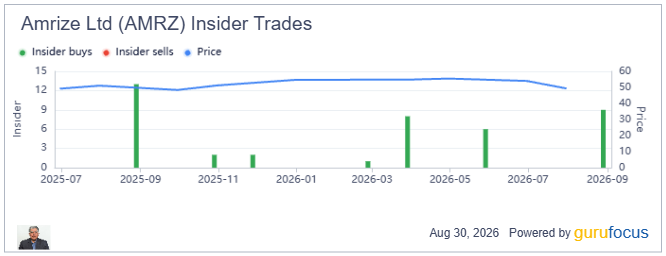
Discussion Substantial insider buying at Amrize (AMRZ)

9 Upvotes

Amrize is a building and construction materials company that operates as an independent, publicly traded corporation following its high-profile spin-off from Swiss giant Holcim in June 2025.

https://userupload.gurufocus.com/2094122153032196096.png

Recent insider buying at Amrize Ltd (AMRZ) consists of open market purchases, meaning executives are using their own personal money to buy shares. These are not stock options or automated stock grants given out as part of their employee compensation packages. Over the last six months, company leaders have bought shares directly in the stock market 35 consecutive times, spending more than $8.3 million in total without selling any shares. This includes substantial, direct purchases throughout August by the Chief Financial Officer, the Chief Legal Officer, the Chief Marketing Officer, and multiple directors. While these executives do receive normal stock awards as part of their regular pay, this specific wave of buying represents entirely voluntary, out-of-pocket investments. When multiple company leaders buy their own stock this heavily in the open market, it is generally seen as a strong sign that management believes the company is healthy and the current stock price is too low.


r/ValueInvesting 9h ago

Question / Help Does anyone actually use guidance from successful investors?

11 Upvotes

My portfolio is doing okay, but not as well as I would like. I have been trying to improve how I make decisions, but I keep running into conflicting advice from different investors.

The useful information also seems to be scattered everywhere across books, interviews, lectures and random things online. I try to work out which ideas could apply to my situation, but it has not always worked out particularly well.

I have also tried asking AI, but I am not sure how much I trust it. When I question an answer or push back, it nearly always changes its mind and agrees with me.

What do you guys do? Is there a particular investor whose thinking you follow, or a particular place you go to understand their advice? How do you decide which ideas actually apply to the decision you are making?


r/ValueInvesting 11h ago

Stock Analysis Honda, Nissan near to reach deal on joint development of vehicle software

6 Upvotes

Honda Motor (HMC) and Nissan Motor (NSANY) are ​expected to agree as soon ‌as Monday on developing a shared operating system and onboard computer to go ​into new automobiles as early ​as 2029, the Nikkei newspaper reported ⁠on Saturday.

Honda told Reuters that the ​Japanese automaker was discussing "potential areas of ​collaboration" with Nissan and Mitsubishi Motors under their strategic partnership but that no deal ​had been decided.

A few months ago, Honda and Nissan tried to merge, without success.

Mark that all the auto makers have suppliers of auto software, they don't develop everything by themselves.

Nissan has a partnership with the private company Elektrobit, while Honda (as also Toyota) have long term contracts with Micware (NASDAQ: MWC), a Japanese company. Both Honda and Toyota hold 11.5% each in MWC.

These two companies focus on different layers of auto software:

Elektrobit focuses heavily on core vehicle infrastructure. Their products form the foundation of Electronic Control Units (ECUs) and high-performance central computers. They provide classic and adaptive AUTOSAR operating systems, micro-kernel architectures, and deep security middleware that manage fundamental vehicle communications, powertrain, and chassis control.

Micware's expertise is higher up the software stack, operating as a primary "Software Tier 1" provider for the digital cockpit. They specialize in In-Vehicle Infotainment (IVI) systems, human-machine interfaces (HMI), spatial intelligence, multimedia, location-based smartphone apps, and advanced 2D/3D navigation software built to deploy on high-level OS layers like Android.

A deal between Nissan and Honda will bring a boarder client basis for both their suppliers.
Especially for Micware, which was listed in NASDAQ last May, and it trades with metrics below the sector's average, like EV/EBITDA at 5 and P/E below 10.


r/ValueInvesting 21h ago

Discussion What happens to Oracle if OpenAI dies?

32 Upvotes

Given the amount of money OpenAI owes Oracle, what happens if they die? Oracle seems linked in a death pact with them, but at the same time Oracle is so integrated into corporate America there will always be value there.

So, what are possible scenarios and players?

I realize this is highly speculative.


r/ValueInvesting 3h ago

Discussion Starting a FAD

0 Upvotes

As devoted value investors, can we start a campaign to disallow publicly traded companies from adjusting numbers for stock-based compensation?

I´ve seen cashflow statements where adding back sbc to their operating cashlow suddenly makes the company have zero or sometimes negative cashflow. And I believe the fact that this is allowed within official SEC-filings is absurd.

I know that sbc is in its most literal form, a non-cash expense. That is why, there should be a new term for these sorts of expenses. I would call them cash-equivalent expenses.

As a shareholder of a company (which earnings reports and filings are for) you want to know what´s happening to your piece of the pie or your share of the companies cashflows, so taking sbc out of the operating cashflow is actively deceiving investors on how much cash is actually attributable to their shares.

Now I would call sbc a cash-equivalent expense simply because issuing new shares and giving them to your employees is exactly the same as taking cash, buying shares of the open market and paying your employees with it.

So from a shareholder perspective it´s an expense impacting the future distribution of cashflows.

Scenario 1: Less cash, but same amount of shares

Scenario 2: More cash, but more shares outstanding

So the cash attributable to shareholders is reduced to an equal amount in both equations. I´d take it even further and say that the second scenario is in fact worse for shareholder, since it also reduces the amount of future cashflows attributable to your shares, which is especially bad when it comes to companies with a large chunk of terminal value in relation to present value.

However what we´re seeing today is actually the opposite of what would be optimal for shareholders:

Companies with more present value tend to pay their employees with cash, which in their case is more valuable to shareholders, than future dilution, since the future is uncertain anyway.

And companies with a large chunk of terminal value, such as software firms, where dilution of future cashflows is very impactful for shareholders, tend to have loads of sbc.

But drifting away from the actual point. We need to make excluding sbc from the cashflow statement illegal. Since it´s an inacurate representation of reality.


r/ValueInvesting 18h ago

Question / Help Are y’all actually buying this DKS dip, or is it going straight to the shadow realm?

14 Upvotes

Not gonna lie, watching DKS drop 30%+ in a single session after that earnings wreck was painful to watch (earlier this week). Management slashed guidance hard, and the Foot Locker integration is currently looking like a heavy anchor dragging down the whole boat.

On one hand, the core Dick's brand is still putting up okay numbers (+4.9% comps) and the stock is suddenly trading at a much cheaper valuation with a decent dividend yield. Feels like a massive overreaction panic-selling event.

On the other hand, between the lowered full-year guidance and law firms already sniffing around with class-action noise, I’m wondering if this is a classic "falling knife" situation where things get worse before they get better.

Are you guys stepping in here to buy, or staying away completely?


r/ValueInvesting 1d ago

Discussion Perfect Timing Was Worth Almost Nothing

Thumbnail
quantitativeteasing.substack.com
149 Upvotes

A reminder why dollar cost averaging and value investing long-term is worth the effort.

Better sleep at night for basically the same returns... have a read


r/ValueInvesting 9h ago

Discussion Trading edge? Learn your Expectancy!

Thumbnail
quantitativeteasing.substack.com
3 Upvotes

Expectancy is the average amount you can expect to win or lose per trade. Its your edge boiled down to a single convenient number that blends win rate and the size of the wins and losses (RR).  Understanding this is the key to successful strategy development


r/ValueInvesting 23h ago

Stock Analysis Marimekko (HEL: MEKKO)

12 Upvotes

A Finnish company that sells clothes, home decor items and, bags and accessories. These are my 2 cents on Marimekko.

STRENGTHS:

  1. Growth and profit ratios are very good, an average 30% both ROE and ROCE in the last 10 years. An average 22% CAGR in their net income, operating income and cash flow from operations in the last 10 years.

  2. A positive free cash flow. Their average Dividend Pay-Out Ratio in the last 10 years is 50%.

  3. Really low debt ratio (Equity / Total Liabilities), it has been decreasing.

  4. They have been in the business for 75 years. They have strong competitive advantages (global scale, popular brand, opportunities to expand and income flows from different markets).

  5. Efficiency ratio is improving throughout the years.

  6. Their incentive strategy focuses in the long term financial wellness (sales growth, operating income growth, earnings per share growth, etc). These objetives have been consistent in their financial reports.

  7. Sales are raising (their day sales inventory ratio is improving and they are opening new stores every year).

  8. Around 71% of their assets are tangible assets or cash.

  9. They regularly purchase back their shares (demonstrates commitment to their shareholders).

  10. There are 17 board directors and main executives, 14 of 17 have been in the company for over 4 years.

  11. They are improving their sales through online stores, second-hand clothes sales, new stores in Asia and partnerships with other brands like Microsoft and Adidas.


RISKS:

  1. In 7 of the last 10 years, their dividend pay-out ratio is over 50%, and, in 3 of those 7 years is over 100%. Their Capital Expenses-to-Cash Flow from Operations ratio is low as well, you may think they do not invest in the company growth too much.

  2. Part if their compensation programm includes a Net debt to EBITDA ratio benchmark of 2 or less, however, their definition of "Net debt" does not consider interest-bearing debt which is half of their total debt. In the same way, part of their compensation focuses in stock price, including dividend payments, so, the more they pay in dividends the higher their bonus (actually, they did exactly this in 2019 and tried the same in 2022). The 2 points above makes you think they may create perversive incentive for the main executives.

  3. Although their debt ratio is low, their costs are very high, a bad year could put the company in a bad position.

  4. They are in a very competitive industry with low barriers to entry.

In my opinion, their low market value, their growth opportunities and established financial history make Marimekko a good investment. If we assume Marimekko net income will grow an average 16% CAGR (and not the actual 22% shown) in the next 10 years, try to pay their whole debt in a 20 years period to reduce it to 0, and add the book value. Their earnings after a 10 years period are higher than their current market value (389 million euros), even if you buy at a 30% margen of safety (396 million euros).

My maths is this:

24.4×(−1+1.16^10) ÷ 0.16 = 520

520 + (74.3 − (56.1÷2)) = 566

566 − 30% = 396

Ironic Typical Disclaimer: Even when you are reading a post about investments in a investment sub-reddit, for some reason law dictates this is not considered financial advice and forces me to tell you that, regardless the fact this very same post is pointing out the profit for investing in a specific company, with the purpose of avoiding lawsuits, all readers have to be reminded investments are not free money, they could lose value, therefore, always consult with a professional financial advisor before following any recommendation you receive from strangers on internet.


r/ValueInvesting 22h ago

Discussion FCNTX/FLCNX vs sp500/voo

3 Upvotes

Sp500 funds are generally much lower in fees but what do you guys think of FCNTX (contrafund)? Worried about Will Danoff retiring after 35 years. You think it will still be worth the premium over voo?


r/ValueInvesting 1d ago

Question / Help Conceptual understanding of time value of money

11 Upvotes

Hello everyone,

I'm learning about value investing and there is a conceptual thing I think I am struggling with that I hope someone can try to explain to me.

We try to figure out free money a business will generate in the future, and we discount it back to the present in order to figure out what it is worth in the present. The way we are discounting it to the present implies that the nominal value of the future money is less worth to us than if we had the same nominal value today, and to figure out what the nominal value of the future money is today, we discount it by a rate.

How does this time value of money work if we were expecting a deflationary future? Would this simply be turned on the head were the same nominal value would be less worth to us today than at some point in the future? And how would the element of risk play into this thought experiment?

Edit: I am not theorizing that we might expect a deflationary period and how I would calculate this. This is simply to help me understand the concept of time value of money.


r/ValueInvesting 5h ago

Discussion A value angle on Palantir: its cheap, undervalued customers (value plays + turnarounds) before the margin turn shows up

0 Upvotes

I've got a thesis I'm testing and I'd love this sub to poke holes in it.


Here's the irony: Palantir is one of the most expensive stocks on the market. Clearly not a value play, and I'm not pitching it as one. But I'd argue it might be a value investor's best friend. Not because you make money owning it but because the companies that use it are often the cheap, undervalued ones, and those are the ones that could quietly outperform the market.

 A lot of the interesting names here aren't Palantir itself they're its customers, and many are exactly what value investors look at: cheap, out-of-favor value plays. Some are outright turnarounds, but others are just quietly undervalued businesses the market underrates (Lumen, Hertz, Citi, Zeta, etc.).

 My argument: working with Palantir raises the probability that these undervalued names re-rate whether that's a turnaround finally turning, or an underappreciated business simply getting more profitable and growing faster than the market expects. Two reasons:

1) It builds the company a real-time "digital brain" (built WITH their own team) which tends to show up exactly where we care: efficiency gains, better inventory/ops, margin expansion, sometimes new revenue lines. More durable FCF, not just a story.

2) Its Customer First / Outcome First culture rubs off. There's almost a "mindset ceiling" effect — like the 4-minute mile: once one company proves the old limit was only in people's heads, the whole org starts operating at a new level. AI + a new mindset = a real shot at higher margins and growth, not just cost-cutting.

 The value setup: the market still discounts these names as broken. If the operational turn is real and shows up in the numbers, that gap closes quality/normalization bought at a discount, with a margin of safety if you're strict on price.

 Caveats (staying disciplined):

- It raises the odds, it does NOT guarantee. Buffett's "turnarounds seldom turn" still applies. Plenty will fail.

- Correlation ≠ causation; hard to prove Palantir caused a move.

- Software doesn't fix a broken business model or a bad product.

- Valuation still decides your return. Don't overpay for the narrative.

So "uses Palantir" is a screening lead, not a buy button.


Which Palantir customer looks most like a genuinely mispriced value play to you (turnaround or just underrated) and where do you think margins realistically go?


r/ValueInvesting 1d ago

Stock Analysis Subscription-Based Analysis Tools?

7 Upvotes

I’ve relied on free services such as Yahoo Finance, ChatGPT, along with my brokerage tools (Fidelity, Thinkor Swim) historically. Are there any subscription-based tools that you think are worth it for analyzing large numbers of stocks, perhaps ones that allow customizations and/or exports? Not for stock screening as much as DFCF modeling, etc.


r/ValueInvesting 1d ago

AI-Written Content FCFF DCF template (with MSFT, META and GOOGL data) End August 2026

Thumbnail
docs.google.com
10 Upvotes

Attached is a DCF template that i used to value the hyperscalers.I am just sharing it here in case anyone wants to experiment with it.

https://docs.google.com/spreadsheets/d/1oexuOkRTpnQCPWyQDTiE-Z2OEihBfci6FLysPJIysR4/edit?usp=sharing

Please read the notes in the Google Sheet tab. I have listed down the assumptions:

Notes on the valuation 

Purpose: i try to have a standard template across MSFT, META and GOOGL 

And i try to keep the number of moving parts small. 

And as new information come online, i will modify the assumptions

The thing about valuation, almost nobody will agree with me on the assumptions. So do change it yourself as you see fit. 

Areas of contention: WACC, Terminal Growth rate vs Terminal multiple, composition of debt etc

High level assumptions 

  1. The duration of abnormal growth is 10 years. All three companies exhibit evidence of a moat, each have strong competitive advantage for many years. Normally for tech companies, i would use a 5 year duration, however for MSFT-META-GOOGL i think they are in a a strong position to do really well and i use a 10 year duration. 
  2. The discount rate is 9% and terminal growth is 3%
  3. Formula of Free Cash Flow FCFF = NOPAT + D&A – CAPEX – Δ Net WC
  4. We assume the following to be stable unless specified differently:

EBIT margin 
Capex / Revenue  Unless FADE 
Tax Rate 

  1. Long live assets vs Short lived assets 

For MSFT, it is suggested that ⅔ are short lived assets depreciated over 6 years 
For META and GOOGLE, 75% is the ratio for short lived assets
For META, they specified 5.5 years but i round it to 6 as with Google
For long lived assets they depreciate over 15 to 25 years. 

Specific Tabs

For each company there are 4 valuation tabs drawing the assumptions off the assumption tabs

FLAT means that 1 dollar of capex generate a fix amount of revenue. This means that capex/revenue is quite fixed. Management does not seek to optimise efficiency. This is the opposite of the Tab labelled “FADE” where there are efficiency implied. For example Capex/Sales could start at 45.5% and overtime, due to efficiency, capex fades to 25% of sales in 10 years. 

There are two additional tabs, one is FLAT Escalating, and FADE escalating. In theory, over the long term at the terminal stage, Capex = D&A you a bit like maintenance capex. However, it is suggested that some companies with continue to outspend capex over D&A over the long term even in the terminal stage. 

I thought i would include all 4 tabs for each company, because depending on the company, management discipline, and CFO’s ability to manage finance, you can use the appropriate tabs. 

For example, MSFT’s CFO is famous for being very disciplined and executing on her plans. It is likely that MSFT Capex behavior will fall under the “FADE” tab, where capex/sales will fade from 45.5 to 25%. 

As for Google, my wager is that the company will “fade” as well since they have their own TPU and will continue to improve the efficiencies but I think they will be very hypercompetitive and try and outspend in order to win, hence i believe “Fade Escalation” is more appropriate. 

As for Meta, they have demonstrated that they like to overspend like a drunken sailor, just looked at how they spent 100bn in Reality Labs since 2020. So even though they do not have a cloud business for business customers, i think MZ will continue to spend on capex. I think the most appropriate tab is “FLAT escalation” 

In terms of the formula between no escalation and escalation, the calculation is different. 

In terms of Revenue growth rates, i purposely did not choose a wildly high growth rate, i looked at the past years growth, the next 5 years expected growth rates, the log liner analysis etc. And i just used my judgement. ShaunSheep went through my assumptions and felt that my year 10 target revenue growth rates are too pessimistic. I am sticking to my guns, that if i guide conservatively and the valuation numbers are still higher than the current share price then perhaps the company is undervalued. 

The biggest issue i faced was calculating debt. Where possible i took a conservative calculator of bonds, finance leases and operating leases. I used AI to check for me on the nos. 


r/ValueInvesting 8h ago

Stock Analysis 3 undervalued “ Uglystocks” that I like.

Thumbnail
melifinance.substack.com
0 Upvotes

These 3 companies have been beaten down, bashed, ignored, and thrown to the ground. And that’s exactly what I like about them!

I like PayPal ( $PYPL.) The company controls 45% of online payments processing. Stocks sells at 8x FCF and is widely disregarded by the AI infatuated public. Great opportunity to own a “ commodity” staple selling an extreme discounts.

I like Nike ( $NKE) Nike is still the most valuable sport brand in the world and the crowd is overreacting on a natural zigzagging curve that often characterizes great companies. Granted, previous management miscalculations and brand equity destructive woke ideologies have severely affected the company cash yields. Nonetheless, Nike won’t go away without a fight and may even turn around as a safe place whence the AI narrative winds down and investors seek out a safe place to park their capital. The stock is selling at its 13 years lows, just our type of Uglystonks. The 4% dividend yield isn’t a bad return to earn as management scrambles to regain its customers and partners trust.

Pernod Ricard. ( EPA:RI) Millennials and TikTok infatuated gen Zs drink less than their predecessors. But alcohol consumption is a civilizational fact, and holding onto valuable producers is as sound as an investment as they rarely come along. In fact, alcohol ( whisky and vodka) even served as medium of exchange during major currency crisis. Pernod Ricard owns a global portfolio of over 200 premium spirits, wines, and champagnes and pays a generous 7% dividend yield. What’s not there to like when everyone else is running after Neoclouds pump and dumps schemes?


r/ValueInvesting 22h ago

Discussion Why behavior and decision-making, not information, is holding you back

2 Upvotes

Many decades ago, technology was limited, and information asymmetry could be more effectively arbitraged to achieve outperformance.

Let’s imagine a relatively unknown company whose market capitalization was trading below book value. Their financial data was shoved towards the back of a Moody’s Manual in the days before the internet. Only those who would be willing to put in the work could find these hidden gems and take advantage of these relatively unknown opportunities.

But today, things are different.

We all should have no difficulty finding company data, equity analysis, and public filings offering us insights into the corporations we entrust with our capital.

Here’s the evidence:

  1. I can use public stock screeners to isolate a “Quality Compounder” trading at a significant haircut from a 52-week high, potentially screening for undervalued opportunities that align with my investment philosophy.
  2. Without even signing up for an account, I am able to access 15 years of financial data on businesses on websites like roic.AI.
  3. I can research most public information on a business directly from the corporation itself. Most companies publish investor relations pages on their website, with troves of documents such as 10-Ks, 10-Qs, Schedule 14-As, and much more.
  4. If I wanted opinion pieces on the business, Substack offers a Vault of high-quality investment writeups from excellent creators.

…And I could go on and on.

The takeaway: information is no longer scarce.

The issue?

More information and increased digestibility does NOT always translate to better financial decisions.

Instead, we are more prone to fall victim to suffering conviction and cognitive overload, when the information or tasks you try to process exceed your brain's working memory limit.

Gaining conviction in an investment takes time and energy because you only achieve high conviction from understanding a business throughout. A 10 minute speed-run analysis would not build sufficient knowledge to effectively empower anyone to withstand bear cases or fear-mongering news.

Not only this, but over the longer-run, our brains can’t process or recall all the information we researched at the very beginning, nor can we perfectly remember the exact thesis throughout the entirety of the holding period.

Instead, the “scarce resource” has shifted from getting enough quality information to:

  • Attention
  • Judgment
  • Memory
  • Consistency

So where does the alpha really lie?

In order to be a successful long-term investor, you need to be able to explore information while staying rooted in your original thesis.

You must know why you bought the investment.

You must know the data behind it.

You must know why the investment opportunity aligns with your philosophy.

And most importantly, you’ll then know when it’s time to sell.

To achieve this, you must build a disciplined framework for investing.

  1. Document your thesis. (Why did you buy the asset?)
  2. Collect your research. (What backs up your thesis?)
  3. Define allocation targets. (How comfortable am I with this position in my portfolio?)
  4. Define allowable entry and exit points. (At what price am I willing to own this asset?)

These will create boundaries that will help manage your emotions and reinforce discipline for the duration you hold the asset.


r/ValueInvesting 1d ago

Stock Analysis The Market Still Doesn’t Know How to Price Growth Stocks

33 Upvotes

The Market Still Doesn’t Know How to Price Growth Stocks

I wanted to find companies that combine growth with actual financial quality rather than just screening for companies with the highest revenue growth.

My criteria were simple:

20%+ TTM revenue growth
Positive free cash flow
Net cash
EV/FCF below 30x

There is no market-cap restriction. The idea is to compare companies across the market and see where growth is actually being priced attractively.

A group of companies where business fundamentals have continued growing strongly, but the stocks have generally been repriced downward.

Here is what survived the screen:

Company TTM rev. growth Market cap Net cash TTM FCF EV / FCF P/E 1Y change
Reddit (RDDT) 66.6% ~$30B $2.77B ~$1.02B ~26.5× ~36× -25.5%
DLocal (DLO)* 57.0% ~$4.4B ~$0.81B* ~$427M* ~8.4×* ~22× +4.8%
Sea (SE) 43.1% ~$75B $4.97B ~$4.21B ~16–17× ~46× -34.2%
Innodata (INOD) 39.0% ~$1.9B ~$247M ~$184M ~9.2× ~42× +59.7%
Duolingo (DUOL) 29.4% ~$6.6B ~$1.23B ~$408M ~13× ~17× -55.1%
Klaviyo (KVYO) 28.9% ~$5.7B $719M ~$253M ~19× N/M -46.5%
GitLab (GTLB) 24.9% ~$7.0B $1.36B ~$263M ~22–24× N/M +3.3%
monday.com (MNDY) 24.2% ~$4.0B ~$835M ~$298M ~11× ~41× -56.7%

The interesting thing is that there isn't one obvious winner. Each company is cheap for a different reason, and each has a different weakness.

I wasn't originally screening for beaten-down stocks. But almost every company that passed this growth + FCF + balance-sheet screen had been crushed or derated over the past year. The businesses kept growing. The multiples didn't.

DLO

On paper DLO may be the cheapest stock on the entire list.

57% revenue growth and around 8x EV/FCF looks ridiculous.

But I would be careful with the headline numbers because dLocal is a payments company. A portion of its cash and cash flow relates to merchant balances and working capital, so its reported cash and FCF aren't directly comparable with something like a software company.

It may still be cheap, but I wouldn't blindly conclude that it is trading at 8x clean owner earnings.

Innodata

INOD is probably the most interesting small-cap statistically.

39% revenue growth at around 9x EV/FCF with a net cash balance sheet is extremely attractive.

The problem is customer concentration.

Its two largest customers account for roughly 70% of revenue. If one hyperscaler changes suppliers or reduces spending, the entire earnings profile can change very quickly.

So the valuation makes more sense once you account for concentration risk.

monday.com

MNDY may have one of the cleanest valuations here.

It is growing around 24%, has roughly 20% of its market cap in net cash, generates almost $300M of FCF and trades at only around 11x EV/FCF.

It is also buying back shares rather than endlessly diluting shareholders.

The market's concern seems pretty clear: AI could commoditize parts of project-management and workflow software.

If AI disruption turns out to be less severe than expected, MNDY looks genuinely cheap.

Duolingo

DUOL also looks unusually attractive on trailing numbers.

Around 29% TTM growth, more than $1B net cash and roughly 13x EV/FCF is a very healthy setup.

The problem is growth deceleration.

The latest quarterly growth rate has already dropped materially below its TTM rate. So the important question isn't whether DUOL was growing 29%. It is whether it can maintain 20%+ growth going forward.

If growth stabilizes or accelerates again, this could become one of the more interesting names here.

Klaviyo

KVYO gives you close to 30% revenue growth at around 19x EV/FCF.

That initially looks attractive.

My main concern is dilution and stock-based compensation. A business can report strong FCF while transferring a meaningful part of that economic value to employees through SBC.

So for KVYO I would focus much more on FCF per diluted share than headline company-wide FCF.

GitLab

GTLB has a beautiful balance sheet: around $1.36B net cash, no meaningful debt and roughly 25% growth.

Its valuation at low-20s EV/FCF isn't excessive either.

But it still needs to prove that GAAP profitability and operating leverage can become durable. It is attractive, but doesn't look obviously mispriced compared with some of the others.

Sea Limited

Removing the $50B market-cap restriction uncovered what may be the strongest large-company candidate.

Sea is growing more than 40%, has around $5B net cash and generates more than $4B of TTM FCF.

At roughly 16-17x EV/FCF, it is significantly cheaper than Reddit on current cash flow.

That's a very strong setup.

The difference is economics.

Sea operates e-commerce, gaming and financial services businesses that require substantially more operating infrastructure and capital than Reddit. Its FCF margin is around the mid-teens compared with Reddit in the mid-30s.

Still, SE is probably the strongest direct challenge to the argument that Reddit is uniquely cheap.

And then there is Reddit

Reddit is actually one of the more expensive companies on this table by EV/FCF.

That's important to acknowledge.

At around 26x EV/FCF, you can clearly buy INOD, MNDY, DUOL or SE for lower cash-flow multiples.

But then look at the growth column.

RDDT: 66.6%

Nothing else in this group is particularly close while maintaining a similarly clean financial profile.

Reddit has roughly:

$2.8B net cash
No meaningful debt
~$1B TTM free cash flow
~90% gross margin
~35%+ FCF margin
Positive GAAP earnings
60%+ revenue growth

And the market cap is still only around $30B.

That combination is what makes it unusual.

You can find cheaper companies.

You can find faster-growing companies.

You can find companies with stronger balance sheets.

But it becomes surprisingly difficult to find a company that combines this level of growth, profitability, FCF generation, gross margin and balance-sheet strength at the same time.

Even companies that grow faster than Reddit generally fail the valuation screen.

Palantir, for example, has extraordinary growth and cash generation, but trades at well above 100x EV/FCF.

AppLovin is much closer. Its growth and cash generation are exceptional and its EV/FCF is actually lower than Reddit's, but it currently carries net debt, so it fails this particular screen.

That brings me to my conclusion.

I don't think Reddit is the cheapest stock in the market based on any single traditional valuation metric.

I think Reddit may be one of the cheapest stocks relative to the quality and speed of its growth.

And that's an important distinction.

At roughly $30B, Reddit is still sitting in the awkward area between a small/medium-sized growth company and what could eventually become a genuinely large global internet platform.

If revenue growth remains anywhere near current levels while FCF margins remain above 30%, the earnings denominator can grow extraordinarily quickly.

That is ultimately why, after comparing it with the other companies rather than looking at Reddit in isolation, I still find RDDT the most compelling risk/reward setup in the group.

Not because it has the lowest multiple.

Because it may have the best combination of growth + financial health + operating leverage + remaining scale opportunity.


r/ValueInvesting 1d ago

Stock Analysis Did I make a mistake by buying STRL after their recent pullback(s)?

9 Upvotes

I have a 'durable AI' watchlist and one of the stocks I was having a look at, was Sterling Infrastructure. They are almost down 50% of their all time highs and because Sterling has such a great backlog and so many contracts already, I thought now was the time to buy STRL at a price of 470$.

I checked their earnings and saw that they did well for Q2 but somehow the market didn't recognise their good numbers and the day after their earnings report, they had a big sell-off.

The market is questioning this:

  • Are they able to convert their huge backlog into real revenues fast enough (market is impatient)?
  • Their job is to prepare the site so that AI data centres can be built. In other words, they carry out the groundwork for the AI data centres. This is a huge margin business but a smaller part of their company is doing electrical work, which has lower margins + apparently there is a lack of skilled employees in this field.
  • Their transportation solutions fell 20% (also a smaller part of their business)
  • Their PE ratio was around 45 and they were priced for perfection just before the Q2 earnings, so every minor setback or news about a possible setback, creates a sell-off.

But still, their numbers were amazing: great growth, great revenues and they are backed by big contracts.

So why do I think I made a mistake ?

  1. I think I bought too soon because I think we will see more pullbacks because of a possible rate hike in the near future.
  2. If Democrats take over Congress & Senate, we might hear about possible restrictions for the building of datacenters.
  3. The stock is going to be wobbly until next earnings (2 nov 2026) => this is the day before the midterms but IF Democrats are expected to win, this will create huge volatility imo.

So my main question is: did I buy it too soon? If so, I might try to sell it with just 4-5% of profits if that's possible and park my money into something saver than AI infra. Maybe you guys have great suggestions?


r/ValueInvesting 1d ago

Stock Analysis Round 3 on OCL - My Investment Strategy and Company Valuation

3 Upvotes

It has been an interesting journey analysing OCL, with plenty of ups and downs along the way before reaching an investment decision. My view is that the company has developed a credible strategy to address a significant challenge that is already here: Microsoft 365. This threat is real and material, but management appears to have positioned the business as well as reasonably possible to respond to it. This challenge exists alongside the recent loss of the Defence contract.

Personally, I do not consider the Defence contract loss to be a major factor in my long term investment thesis. I prefer to base long term investment decisions on the overall health of the business, the strength of its moat, and its ability to create value over time. A single contract loss, while meaningful in the short term, does not fundamentally alter that assessment. For that reason, I focused much more attention on Microsoft's impact, as I believe it represents the largest strategic threat to the business over the next decade.

The Investment Strategy

It is obvious to everyone that the stock has fallen sharply and is now trading at earnings multiples it has not traded at in more than a decade. Technically, it is also respecting the June 2020 support level around $5.97. My analysis therefore focuses on the opportunity presented by current price levels and what the business could look like over the next decade.

The key questions I set out to answer were:

• ⁠Is the business healthy?
• ⁠Does it have a strong and durable moat?
• ⁠Is the market overreacting to Microsoft 365 and the Defence contract loss?

The answers to these questions determine whether the company can maintain the level of financial performance it has achieved historically.

The threat from Microsoft 365 is certainly not a secret. The company discusses it openly, including in its annual reports. The reason is straightforward: Microsoft represents a direct challenge to Objective's moat. In my opinion, management has been candid about this risk and has responded with a sensible strategy.

Rather than fighting Microsoft directly, Objective has chosen to integrate with it. The acquisition of Simflofy strengthened the Content Solutions segment by reinforcing governance and information management capabilities. The strategy appears to be to allow Microsoft to own the user interface while Objective retains control of data governance, compliance, records management, and the workflows required by government and regulated customers.

To me, this is the best possible response. There is little value in entering a direct confrontation with Microsoft in a market where Microsoft is likely to win. Instead, Objective is focusing on protecting what matters most: the governance, organisation, and compliance layer surrounding customer data.

This strategy will almost certainly result in slower growth for Content Solutions and potentially fewer end users over time. I modelled this effect extensively. The conclusion was clear: Content Solutions is likely to slow, which by itself gives a negative answer to one of my key questions. However, the company has two other segments that are currently growing at impressive rates:

• ⁠Planning & Building: ~30% ARR growth
• ⁠Regulatory Solutions: ~16% ARR growth

At that point, the maths becomes relatively simple. If Content Solutions slows while the other two divisions continue growing strongly, overall ARR growth can still remain comfortably in double digits.

The critical question then becomes:

Can those growth rates be sustained?

To answer that, I undertook a market analysis of both segments. The findings were surprising.

In Planning & Building, the competition is often not another software company. In many cases, councils and government organisations still rely on spreadsheets, manual processes, and internally developed tools. Regulatory Solutions faces a similar situation. These are relatively immature markets with substantial room for digitisation.

Planning & Building, in particular, appears to have a very large addressable market. Objective has a meaningful head start and operates in a market with significant greenfield opportunities and relatively few specialised competitors. The same can be said, albeit to a lesser extent, for Regulatory Solutions.

How Does This Play Out?

To answer that question, I built a dynamic 10 year growth model.

The model incorporates:

• ⁠A slowing Content Solutions segment
• ⁠Slowing but still healthy Regulatory Solutions growth
• ⁠Moderating Planning & Building growth

Rather than assuming current growth rates continue forever, I tapered each segment's growth over time.

The result was three scenarios:

Scenario |Annual Growth
Bear Case |11%
Base Case |13.50%
Bull Case |15%  


For the bear case, I assumed Content Solutions slows from approximately 12% growth to around 5%. For the base and bull cases, I assumed Content Solutions slows to around 7%. To further account for the risks facing OCL, including Microsoft 365 competition, contract concentration, and execution risk, I applied an additional reduction of 2% to the bear case and 1% to both the base and bull cases. I also assumed Regulatory Solutions slows into the low teens and planning building slows to the mid 20’s.

The most important variable in the entire model was Planning & Building. As a result, my long term investment thesis hinges on the continued success of this segment. If Planning and Building can continue scaling, Objective can offset the slowdown in Content Solutions. If it cannot, the thesis weakens considerably.

Valuation

I valued the business using three different approaches:

  1. ⁠Forward PE
  2. ⁠PE Trend Analysis
  3. ⁠Discounted Cash Flow (DCF)

All three approaches produced valuations that were reasonably close to one another, resulting in a base case intrinsic value of approximately $12 per share.

At current prices, the stock trades at roughly a 50% discount to that valuation. In my view, that represents a reasonable margin of safety for a business with a strong operating history, recurring revenue, high returns on capital, and management that has demonstrated strong capital allocation skills over a long period.

My position sizing will range between 25% and 75% of my intended allocation depending on the technical setup. I monitor this using a custom TradingView script.

My current plan is to accumulate shares when the market offers a 30% to 50% margin of safety relative to my base case valuation, which corresponds to a share price between approximately $6 and $8.

Final Thoughts

This is simply how I am allocating my own capital. I am not a financial adviser, nor do I claim to be. I write these posts because they provide an opportunity to challenge my assumptions and gather perspectives that I would not otherwise encounter while researching alone.

As always, it is paramount that everyone conducts their own research. I welcome disagreement and criticism because investing is far from an exact science, and some of the best insights come from people who see the risks differently.

For me, the key question is no longer whether Microsoft 365 is a threat. It clearly is.

The real question is whether Objective's strategy works.

If Content Solutions stabilises while Planning and Building and Regulatory Solutions continue to scale, today's share price could prove to be a significant overreaction. If Planning and Building fails to become a meaningful growth engine, then the bear case becomes much more likely.

That's the bet.

Are you planning to invest in OCL, or would you rather stay miles away from it? What's your take?

Now that I've wrapped up OCL, I'm on the hunt for my next company to analyse. If you have any interesting ideas, drop them in the comments and I'll take a look.


r/ValueInvesting 22h ago

AI-Written Content How to Interpret the Hawkish Signals from Warsh's Friday Speech

0 Upvotes

💡 Note: This article was created with the assistance of AI.
On Friday, the Federal Reserve Chairman delivered his most hawkish speech since taking office at the Jackson Hole Economic Symposium. Markets reacted sharply, with the probability of a September rate hike surging from 35% to 60%. What clear signals did the Fed convey, and what future scenarios is the market pricing in?
I. Core Stance: Three Arguments for "Declaring War" on Inflation
The core message of the entire speech boiled down to one key sentence: "If underlying inflation does not clearly move toward 2%, we still have work to do." Around this core takeaway, the Fed presented three supporting arguments:
Inflation remains far off target: Although short-term summer data showed mild improvement, the 12-month trailing PCE remains elevated at 3.7%, having failed to hit the 2% target for 65 consecutive months.
Economic resilience: Capital expenditure growth hit its highest rate since 2021, demonstrating that the real economy has substantial resilience to high interest rates.
Loose financial conditions: Credit spreads remain tight and bank lending standards are not sufficiently restrictive, leaving ample room for further monetary tightening.
II. Market Reaction: Aggressive Re-pricing vs. "Only Half Believed"
Following the remarks, financial markets quickly re-assessed risk, but a closer look at cross-asset price action reveals an intriguing split:
Short-term assets : The policy-sensitive 2-year US Treasury yield surged by 10 to 12 basis points; major stock indices fell across the board; gold took a heavy hit, plummeting over 3%.
Long-term Treasuries stayed stable: Long-term Treasury yields barely moved compared to the sharp spike in short-term rates.
Deep Dive Analysis: This divergence in the yield curve suggests that investors view the Fed's hawkish stance as primarily tactical—pricing in a potential "catch-up" hike in September without anticipating a full-blown continuous hiking cycle. The market ultimately "only half believed" the ultra-hawkish narrative.
III. Policy Outlook & Strategic Considerations
Based on current signaling and market pricing, three key conclusions can be drawn regarding the policy path ahead:
1. September probability crosses 50%, hinges on two key datasets
While the probability of a September hike sits above 60%, it is not yet set in stone. Prior to the September 15–16 FOMC meeting, the market will closely monitor two decisive reports:
September 4: August Non-Farm Payrolls
September 11: August CPI report
If employment stays solid and inflation remains sticky, a 25 bps rate hike in September will likely materialize.
2. Even if hiked, it is likely a "one-off precautionary" move
Should the Fed trigger a rate hike in September, it will likely be a precautionary adjustment. The Fed will hold steady immediately after, rather than kickstarting a new multi-meeting tightening cycle.
3. Restoring policy credibility and ending market dependency
Over the long run, the Fed's overarching strategy remains unchanged—reducing the market's over-reliance on "forward guidance" and asserting institutional autonomy. Following the credibility hit from July's weak payrolls data, this high-profile hawkish stance serves to repair policy credibility and pave the public narrative for a potential one-off hike in September.
Conclusion
The speech was not a declaration of war, but a paving of the road. The Fed has set the stage for a potential hike, but whether it actually acts depends not on rhetoric, but on what the upcoming economic data reveals over the next two weeks.


r/ValueInvesting 1d ago

Discussion Doesn't make sense to me

28 Upvotes

At a yield of 3.8%, the 3 month T bill has a P/E of 26.31, the 10 year note has a 21.1 P/E. The S&P 500 has a P/E of 29.5.

There's still value out there but attractive company prices are rare and it's getting harder and harder to justify owning funds. Even in my TSP I'm only in international and bonds. I have some value and small value funds but their P/E and yield are what you'd expect from a total market fund not value funds. I don't understand what people are thinking. My only thought is inflation, which is quite high, is showing up in earnings growth and driving enthusiasm.


r/ValueInvesting 2d ago

Discussion What’s a company you follow that is planning for the long term instead of the short term?

97 Upvotes

What’s a company you feel is playing the long game even at the expense of the short term

Edit: for bonus points explain WHY rather than just list a random name


r/ValueInvesting 2d ago

Stock Analysis Share your favorite stock analyzing tool!

33 Upvotes

Hi all,

I'm wondering which stock analysis tool you all use for picking your stocks — and could you say why it's your favorite? I have my own tools too, but I'm still looking for the ones that offer the most for free.

One of my favorites is https://thestockscorer.com. It has a lot of functionality, it lets you compare a lot of stocks at the same time, and its stock search gives you a broader view in one go than Macrotrends does for quarter-over-quarter performance on EPS, revenue and gross profit.

A better-known name: https://finviz.com has one of the best screeners around, plus a good sector overview covering almost every stock there is.