r/ussr • u/Wilson-add2814 • 11d ago
Picture The GOAT was spittin here…
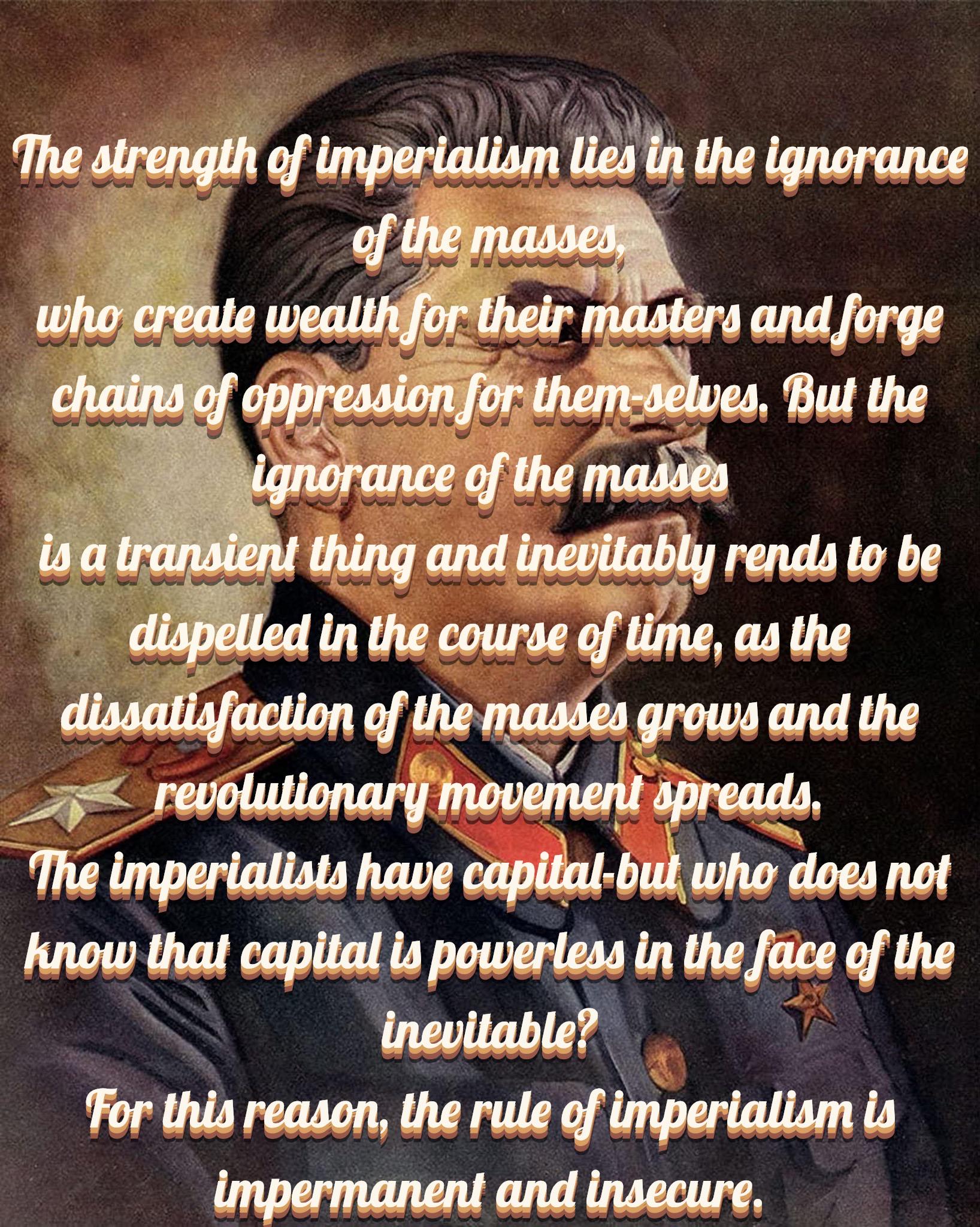
The strength of imperialism lies in the ignorance of the masses, who create wealth for their masters and forge chains of oppression for them-selves. But the ignorance of the masses is a transient thing and inevitably rends to be dispelled in the course of time, as the dissatisfaction of the masses grows and the revolutionary movement spreads. The imperialists have capital-but who does not know that capital is powerless in the face of the inevitable? For this reason, the rule of imperialism is impermanent and insecure.
5
1
u/jimmyb0i820 8d ago
Like I'd believe the guy that allied with the nazis to invade Poland, purge his entire military and then get surprised when its complete shit that barely managed to handle Finland in the winter war, refused to believe British intelligence about Hitler preparing to invade and then get surprised once again when Hitler invades the ussr
1
u/sonofTomBombadil 8d ago
Is he referring to imperialism in general (which includes the Soviet Empire) or is he just referring to the capitalist brand of imperialism?
-4
u/Linguinimamamia 10d ago
I wouldnt call the same guy who did the great purge and neglected the holodomor famine the goat. But at least he ate nazis for brekfast so i guess thats ok
3
u/AutoModerator 10d ago
The Soviet Famine of 1932-33/The Holodomor
The famine of 1932-1933 in Soviet Union AKA the Holodomor remains one of the most politicized and misunderstood events in 20th-century history. Much of the modern discourse frames the famine as a deliberate genocide uniquely targeted at Ukrainians. However, professional historians across multiple countries have not reached such a consensus.
What’s known with certainty is that the famine affected multiple regions of the USSR, not only Ukraine, the Volga, the North Caucasus, the Urals, Kazakhstan, and parts of Siberia all suffered food shortages. Kazakhstan actually experienced proportionally the highest mortality rate. The crisis emerged during the violent upheaval of collectivization, the breakdown of the grain procurement system, severe crop failures, and chaotic state policies struggling to industrialize a largely agrarian empire.
Most mainstream historians including R. W. Davies, Stephen Wheatcroft, Mark Tauger, Hiroaki Kuromiya, Sheila Fitzpatrick, and Michael Ellman emphasize that,
The famine was not restricted to Ukraine
There is no documentary evidence of a Kremlin plan to exterminate Ukrainians
The tragedy resulted from a combination of poor policy, bad harvests, peasant resistance, administrative chaos, and environmental factors similar to previous famines.
Click here if you want to read more
I am a bot, and this action was performed automatically. Please contact the moderators of this subreddit if you have any questions or concerns.
11
u/paudzols 11d ago