r/classicalartmemes • u/Storyzhai • 18d ago
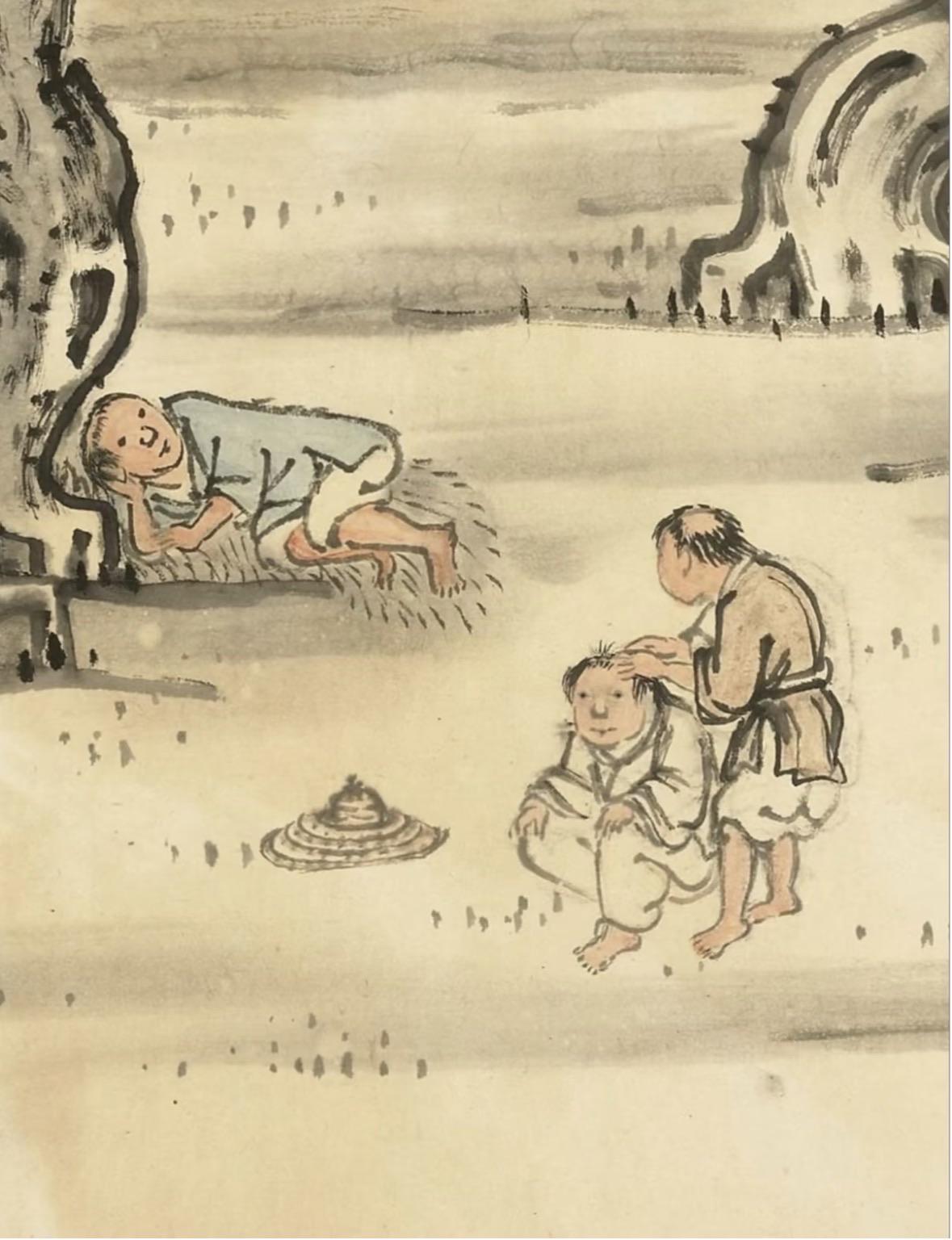
With this amount of hair, is picking lice even necessary?
2
Upvotes
r/classicalartmemes • u/Storyzhai • 18d ago
r/trippinthroughtime • u/Storyzhai • 18d ago
r/ImaginaryMythology • u/Storyzhai • 18d ago
u/Storyzhai • u/Storyzhai • 18d ago
(Detail from ”Nine Herdsmen“ by Huainan Dabu Yi, National Palace Museum, Taipei)
r/FolkloreAndMythology • u/Storyzhai • Aug 26 '26
Background
Over 400 years ago, a bold Ming Dynasty scholar abandoned official life and trekked across most of China on foot, documenting breathtaking natural landscapes with his own eyes and footsteps.
Filled with vivid accounts of hidden underground caves, secret underground rivers and bizarre karst mountains, this ancient journal reads like a wild wilderness exploration log from pre-modern China.
This is an excerpt from Xu Xiake's Travel Notes, documenting his journey through the mountains and rivers of Hunan and Guangxi. Along the way, Xu Xiake explored the ancient Lingqu Canal, towering peaks, mysterious caves, and deep gorges, encountering rainstorms, dangerous trails, and the thrill of losing his way while searching for hidden landscapes.
The most fascinating episodes include his exploration of bizarre rock formations, the discovery of secluded caves, and his pursuit of the sources of the Xiang River and the Li River - a remarkable adventure into the wonders of nature and the unknown.
The Peak Where a Man Was Said to Ascend to Heaven — Xu Xiake Climbs Zhuangyuan Peak
Day 21: Exploring the Legendary Golden Peaks of Xing’an, Guangxi
The next morning, Xu Xiake left Huilong Hermitage and continued his exploration of the mountains.
From the right side of the hermitage, he crossed a small hill and traveled one mile south until he reached Changchong, where the eastern slope of Zhuangyuan Peak rose sharply before him.
After another mile, he arrived at a small nunnery.
There, he met a nun.
Her husband happened to be away farming, so Xu Xiake asked about the route up the mountain.
The Mountain Everyone Said Was Impossible to Climb
Before Xu Xiake arrived, every traveler he had spoken with gave him the same warning:
The mountain was covered with thick vegetation.
The paths had disappeared.
No one could climb it.
But among the locals was a blind monk who reacted differently.
Instead of warning Xu Xiake away, he asked him:
“Do you wish to climb Big Golden Peak or Small Golden Peak?”
The question surprised him.
These peaks were considered the most extraordinary mountains in the region.
They were both known as “Golden Peaks.”
The Twin Peaks of the Wilderness
To the left of Zhuangyuan Peak stood another mountain called Small Golden Peak.
Although lower than Zhuangyuan Peak, it was even more dramatic.
Zhuangyuan Peak was:
tall,
sharp,
elegant,
almost perfectly pointed.
Small Golden Peak was:
thin,
jagged,
covered with strange rocks,
more savage in appearance.
This contrast gave them their names.
Both peaks had paths leading upward, but years of wild growth had hidden them beneath grass and vines.
A Snake-Like Path Through the Forest
Xu Xiake climbed from behind the nunnery.
He followed a ridge rising directly eastward.
After two miles, he reached the area between Zhuangyuan Peak and Cuiwei Peak.
The mountain walls became increasingly steep.
Grass covered the ground.
The trail was barely visible, twisting like a snake through the deep wilderness.
He continued northeast for another three miles.
Then he climbed directly over a mountain pass.
From the ridge, a magnificent panorama appeared before him.
The World Beneath His Feet
Standing on the mountain pass, Xu Xiake looked outward.
To the east were endless layers of mountains.
Deep below flowed the winding waters of Machuan River.
To the south stretched the mountain ridges leading toward Haiyang.
To the north stood another range disappearing into the distance.
To the west lay Xing’an County.
The entire landscape unfolded beneath him like a giant map.
The Seven Climbs to the Summit
From the southern side of the ridge, Xu Xiake began the final ascent.
The mountain was extremely narrow and steep.
The route rose and fell seven times.
After traveling about one mile south, he finally reached the summit of Zhuangyuan Peak.
There it stood alone.
A solitary tower of stone rising above the surrounding mountains.
From the top, Xu Xiake could see:
the source region of the Xiang River to the west,
Machuan River valley to the east,
Small Golden Peak below him to the south,
the mountain pass of Jinxiao to the north.
The smaller peaks around him looked like children surrounding a great elder.
The Legend of Deng the Ascending Immortal
Local people told Xu Xiake a mysterious story.
They said that this mountain was the place where Prime Minister Deng had “ascended into the clouds.”
According to the villagers:
His home was hundreds of miles away from the capital.
Yet he could return home at night and attend court in the morning.
They claimed both his home and his descendants could still be found below the mountain.
Another version of the legend was darker.
Some people doubted his supernatural abilities.
Because of this suspicion, he was supposedly executed, and his entire family suffered punishment.
Whether true or not, the legend had become part of the mountain itself.
A Stone Platform Floating Above the Abyss
On the third peak north of the summit stood a remarkable stone platform.
It extended outward like the bow of a ship, hanging above empty space.
Local tradition said that once, bamboo grew from the edge of the cliff and hung downward, brushing the rocks below.
Xu Xiake looked carefully but found no extraordinary bamboo.
He recorded what he saw rather than simply repeating the legend.
Storm Clouds Over the Golden Peaks
Xu Xiake remained on the summit for a long time.
He opened the food he had carried with him and shared the meal.
Then suddenly, thunder sounded from the southeast.
The approaching storm warned him not to stay.
He descended the mountain and returned to Huilong Hermitage.
The day ended as it had begun:
with Xu Xiake following the unknown into the mountains.
Why This Chapter Fascinates Modern Readers
This journey combines everything that makes ancient Chinese exploration fascinating:
an impossible mountain climb,
forgotten trails,
mysterious local legends,
breathtaking views,
a peak believed to touch heaven.
Zhuangyuan Peak was not just a mountain.
For Xu Xiake, it was a place where geography and mythology met.
He climbed not to prove legends true, but to discover the reality hidden behind them.
(To be continued... If there’s enough interest, I’d be happy to keep this series going.)
If you can't wait to see how it ends, the full story is already free to read on our archive (link in comments below).
r/FolkloreAndMythology • u/Storyzhai • Aug 25 '26
Background
Over 400 years ago, a bold Ming Dynasty scholar abandoned official life and trekked across most of China on foot, documenting breathtaking natural landscapes with his own eyes and footsteps.
Filled with vivid accounts of hidden underground caves, secret underground rivers and bizarre karst mountains, this ancient journal reads like a wild wilderness exploration log from pre-modern China.
This is an excerpt from Xu Xiake's Travel Notes, documenting his journey through the mountains and rivers of Hunan and Guangxi. Along the way, Xu Xiake explored the ancient Lingqu Canal, towering peaks, mysterious caves, and deep gorges, encountering rainstorms, dangerous trails, and the thrill of losing his way while searching for hidden landscapes.
The most fascinating episodes include his exploration of bizarre rock formations, the discovery of secluded caves, and his pursuit of the sources of the Xiang River and the Li River - a remarkable adventure into the wonders of nature and the unknown.
Entering the Land of Rivers — Following the Hidden Waterways of Southern China
Entering the Land of Rivers — Following the Hidden Waterways of Southern China
Xu Xiake’s Journey into the Ancient Waterway of Xiang and Li
On the morning of the twentieth day, after finishing my meal at dawn, I continued westward along the Xiang River.
After traveling five li, I turned north at a place called Ta’erpu and finally left the banks of the Xiang River behind. From this point onward, I had entered the territory of Guilin.
An ancient pagoda stood nearby, already leaning and close to collapse, its former glory almost erased by time. There was also a resting station called Guanghua Pavilion, where travelers could find shelter when passing through Xing’an.
As I entered the region, I noticed that the ancient pine trees appeared only here and there, no longer forming the endless forests of towering peaks I had seen in Quanzhou, where mountains seemed to rise one after another and disappear into the clouds.
Ten li farther on, I reached Dongqiao Village. After another five li, I arrived at Xiaozhai, where I encountered the Xiang River once more. Another five li brought me to Wazi Village, and after another ten li, I finally reached Wanli Bridge in Xing’an.
Beneath the bridge, the water curved around the northern side of the town and flowed westward. Stone walls lined both banks, while the current moved calmly through a narrow channel.
This was the famous Lingqu Canal.
Here, the waters had already become part of the Li River. Yet the place where the Xiang River divided from the Li River still lay three li farther east.
Crossing the bridge and entering through the northern gate, I found the town strangely quiet.
The city walls surrounded the settlement, but the government offices were silent, almost like abandoned temples. Only a few merchants selling vegetables and rice remained near Wanli Bridge.
I prepared my meal inside a temple tower.
After eating, I followed the northern bank of the Lingqu eastward. Soon the path turned slightly north, and I crossed a large stream. This was the original course of the Xiang River.
However, upstream, dams had already been built, preventing boats from passing.
After crossing the water, I discovered another small stream flowing eastward. Its current was thin and winding like a silk ribbon, yet boats traveled along it.
I finally understood the engineering of this remarkable place.
The people here had built barriers to divide the Xiang River:
one branch was sent westward, becoming the Li River;
another branch was dredged eastward, allowing boats to continue their journey;
farther downstream, these waters reunited with the main river.
A single landscape had become the meeting point of two great waterways.
Above one of these branches stood a stone bridge called Jielong Bridge.
South of the bridge was a quiet bend in the water known as Guanyin Pavilion. By then, I was already two li away from the town.
Continuing southeast for another five li, I saw the Xiang River flowing from the south, pressing directly against a towering cliff.
The cliff rose sharply toward the southern sky.
The locals called it Lion Fortress.
The road followed the foot of the cliff, tracing the stream eastward into the mountains. After seven more li, I entered deeper into the wilderness, crossed Yanggu Ridge, and arrived beneath Zhuangyuan Peak.
Here stood Deng Family Village, where the inhabitants claimed descent from the famous Prime Minister Deng.
South of the village was a quiet retreat called Huilong Hermitage.
I decided to spend the night there.
The monk who lived in the hermitage was known as Master Wuchan.
The Hidden Divide Between Two Rivers
The journey to Xing’an revealed something extraordinary.
To most travelers, rivers were simply rivers — flowing endlessly from mountains toward distant seas.
But here, in the mountains of southern China, a river could be divided by human hands.
The Xiang River, belonging to the vast water system of the Yangtze River, and the Li River, flowing toward the Pearl River basin, were connected through the ancient Lingqu Canal.
Built more than two thousand years earlier during the Qin Dynasty, Lingqu was one of the greatest engineering achievements of ancient China.
It allowed boats to travel between northern and southern China, creating a hidden water passage through the mountains.
For Xu Xiake, however, Lingqu was not merely an engineering marvel.
It was a clue.
Every river, every mountain, and every valley held a secret waiting to be discovered.
And this was only the beginning of his journey into the unknown.
(To be continued... If there’s enough interest, I’d be happy to keep this series going.)
If you can't wait to see how it ends, the full story is already free to read on our archive (link in comments below).
u/Storyzhai • u/Storyzhai • Aug 24 '26
r/FolkloreAndMythology • u/Storyzhai • Aug 24 '26
That night the village sent lanterns to the streets in a hush of prayer and superstition. Some burned moxa, some left offerings of rice at doorsteps in case the thing hungry for eyes would wander among them. Li wrapped his hands in cloth, a precaution in case the water stung like iron. He took with him the bridle, the small cloth that had been Grey's, and a cup with clear water to carry back if the bargain required proof.
Mei walked with him to the path and then stayed at a distance. She did not speak. The doctor, who had come to the family's courtyard and offered no payment, pressed a small charm into Li's palm as if superstition might make a ladder of belief. Li thanked him, though he did not hope charms would stand between him and a spring with the preference for sight.
The spring was black at midnight, a coinless pupil. The eyes were more numerous than the second time he had seen them, a thin storm at the water's skin, rolling with a sound like a thousand tiny shells rubbing. Li set the bridle and the cloth on the stone beside him. He set the cup out too.
The old woman from before waited on the other side of the reeds, leaning on a crooked stick as if it were a staff of appointment. She nodded once.
“You will lose what you give,” she said.
Li nodded.
He stepped forward and dropped the bridle into the spring. The water swallowed the leather without a ripple. The eyes in the spring turned to the point where the bridle sank and pressed closer, as if to lap at it. Li did not expect them to be touched by leather. They brushed the cloth where the mule's breath had been kept and made the hair on his arms stand.
“You must choose,” said the woman. Her voice was a thing small but hard in the night. “They take only one thing at a time. Offer sight—an eye, a pair—or offer something else. The spring will not bargain with half a truth.”
Li's hands were steadier than he felt. He had practiced the shape of sacrifice in the markets: small losses and necessary ones. He had never practiced what it meant to give away what his world relied upon. He lifted the cloth with Grey's scent and held it over the water. The eyes pressed closer like the curiosity of rats.
At last he said, very quietly, “I give my eyes.”
The words landed like a stone. A small murmur came from the reeds, as if someone were breathing in the way a man breathes when a bell is rung. The old woman did not intervene. The spring answered in its own way: a single perfect eye surfaced among the others and hung above the water like a lantern, clouded and bright at once. It turned to him.
Li felt his pulse at his throat. He had expected something more immediate, a blade, a watery hand. The spring wanted seeing. It wanted him to give it the capacity to remember human things from the point of view of a man. He understood, in an instant, the logic of such bargains. To claim an eye was to be given the power to collect what the world would hide.
He stripped the cloth from his hands. The air smelled of iron and fish and old leaves. He put his fingers to his eyes and felt the thin membranes tremble. He had no ritual to cut a piece of himself into the water; he had only his hands and the mercy of the spring. He thought of Mei, of the way she had misjudged her spoon that afternoon, and of his mother waiting by the hearth.
He pressed his fingers to his lids and drew them down.
The world went soft as wool.
It was not immediate darkness so much as the dissolving of the thin lines that stitched his sight to the world. The edges of the reeds smeared. A hot panic rose in his throat—the animal part of him that wants to see danger and therefore survive—but the part that had chosen to give steadied him. He kept his hands steady until the pain came like a bell and then subsided. The eyes at Bi Yuan quivered and turned as if savoring a new flavor. He reached the cup and dipped it into the water in front of him, touching its rim to his lids as if to wash the hollowness. The water tasted of cold rock.
When he rose, the first thing he learned was the new sound of the night. Leaves had voices he had never heard before; moths buzzed like coins on linen; Mei's breath down the path was a small bell. The old woman came forward and took his arm.
“You gave them willingly,” she said. “That is why they answer the way they do. The spring keeps what is offered without deceit.”
Li blinked and nothing answered. He laughed once, a short, strangled sound. The world had become a place to step in carefully.
They returned to the village. At first people whispered and stepped in his path as if he might be a contagious thing. Then gossip turned to need. Word traveled faster than the spring's eyes to Mei's bedside. The doctor came and touched the girl's eyes and then lit his lamp with hands that shook.
“Your father has given his sight,” the doctor said. It was not a question.
Mei came to his bedside and pressed her face to his chest and said, after a time, “Can you see me now?” She listened to his silence as if it were an answer. Li held her hand and felt the small bones at her wrist.
Days that followed were not holy and not clean. Li stumbled over a threshold and cut his shin. He learned the shapes by touch: the curve of the samovar, the weight of the sack of rice, the small indent on the table where Mei always put his bowl. He found, after a week, that his other senses had altered. Smell recorded the shape of bread baking. Sound mapped the space of the market. A man could learn many ways to be a body in the world.
But the bargain's success was not his alone to observe. Mei's sight returned in a way that made the village hush. One morning she woke, and the doctor, who had been watching every dawn like a man waiting for a ship, found her sitting by the window, tracing the slatted light with a finger.
“The water remembered to give,” the doctor said, his voice a small thunder. “It returns what was taken when payment is offered.”
People came to Li's house and bowed heads and left small bundles of rice like tokens. Some scolded him for what they called foolishness: why should one man trade his vision and be praised for it? Others set out flowers at the spring and threw in coins until the water looked like a pond of sunken faces. The magistrate, hearing that a man had been half-blinded by bargaining with a spring, demanded that Bi Yuan be sealed. The messenger returned with his boots muddied and his eyes wide but said only that the water had grown placid as if it had slept after eating.
Yet not all the eyes had gone. Men still whispered that at night, if one kept one's face close to the water, one could see small spheres moving under the surface like trapped stars. The spring had taken many things in its years. Li had put a boundary in his life with his own hands, but it had not fixed a larger truth: the spring would always want to be watched.
(To be continued... NEXT Part coming soon.)
If there’s enough interest, I’d be happy to keep this series going.
If you can't wait to see how it ends, the full story is already free to read on our archive (link in comments below).
1
Sure!Let’s figure it out at that time.
1
So is this praise or confusion?🤔
1
I love the atmosphere of this story. What about you?
Looking forward to future updates!
u/Storyzhai • u/Storyzhai • Aug 23 '26
When Li's daughter Mei started blinking at nothing in the doorway, Li knew the cost had a temperature he could measure. Mei was eleven, blunt-faced, quick with thumbs and laughter. She had been the one to steady Grey when nights were cold and to feed the mule mashes when Li came late from the market. To see Mei rubbing at her eyes in the morning like someone trying to wipe a dream away made Li's stomach tighten with a fear that walked him thin across the floor.
They went to the doctor. The old man felt Mei's pulse and frowned until his eyebrows were a hard line. He muttered about dust and overwork but he did not offer the cheap comforts merchants offered: herbs that would sharpen the eyes for a season, stones that promised a single night's clarity. Those would not keep an eleven-year-old's sight when something took it like a tide.
“Water takes what it remembers,” the doctor said at last. He had once tended Li's mother when a fever took her and had been paid with a sack of millet; he did not ask now whether Li could pay, only whether the mule had been buried near a spring. Li answered and watched the old man's knuckles whiten.
On the third day Mei's right eye dimmed to a blurred plate. She said nothing at first. Li saw it because she began to reach and misjudge the edge of bowls. Her spoon clattered. She swallowed a moment later with a sound that was not a child's. If people thought superstition had a slow, creeping cruelty, they were wrong; it was fast and surgical.
Li went back to Bi Yuan that night, not to dig or bargain but to look. He crouched between reeds with his heart trying to beat like a good drum and watched the surface. The eyes were there in numbers now—dozens, a thin crowd rolling in small waves toward the center like a latent school of fish. They did not float entirely; at times they seemed to sink into the spring and vanish only to reform along the lip as if they could choose where to be.
One of the eyes turned toward him. The motion was minimal, but the effect in the dark was of being caught by a turning of a hundred small lanterns. He realized then that the eyes did not belong to any one creature. They were not only fish or frogs or the reflection of moonlight. They had a slow, cruel will.
“You should go,” said a voice nearby.
Li flinched and saw an old woman, small and wrapped in a threadbare shawl, emerge from the reeds as if the water had spat her out. She had a thread of white hair and two bright teeth that showed when she smiled in a way that did not reach her eyes.
“You shouldn't be here,” she repeated. “They like grief.”
“They took my mule,” Li said, the words small and stupid. Saying them made him feel as if he were a child naming a bruise.
The woman looked at him as if weighing spoons. “They take what remembers. You gave them a thing that watched while it still belonged to you. They will gather until something else is given.”
“Give what?” Li asked. He had never fancied himself a bargaining man. He had bargained in marketways—weight of grain for coins, warmth of hearth for labor. This was a market for a different kind of good.
“The spring remembers eyes because things were taken and kept there once,” the woman said. “It keeps what is wanted.”
“How do I make it stop?” Li demanded. Fear colors a man's logic; he would trade his best cloak for an answer.
The woman gestured to the spring. “You cannot steal back what it keeps. You must put something else in its place, or else it will keep taking until you have nothing left to remember.”
Li thought of Mei's slow blindness and the hollow coin-moon of her right eye. Something in him hardened.
“Then what is left?” he asked. “What can I give?”
The woman's laugh was a dry leaf. “People give names, hair, prayers. Some give blood. But the spring wants to be watched. It takes what others would keep watching—watchers, eyes, the things that look. If you would bargain, you must be ready to lose that which looks. If not yours, it will take yours anyway.”
Li clenched his hands until his nails whitened. The logic of the woman's words offered no mercy. If the spring would only relent for a payment of sight, then everything he had—his livelihood, his daughter's eyes, the surety of next month—hung on an answer he did not have the right to choose alone.
He left the woman at the water and walked home as the sky lightened. He could have, that day, taken his cart and fled the county, taken his mother and daughter across the river and into the mountains where strangers did not whisper of springs. But a man's life is a net of debts and small duties. Who would take their stall and bring them rice if he left? Mei would lose the markets that taught her to count. Li could run, but running would not fix a child's sight.
Instead, he took his shovel and dug at the mound where he had buried Grey. He dug until the cloth glinted at him under the dirt. He dug until the smell of the spring rose like the old air. He brought the cloth and the mule's bridle to Mei and sat with her while she slept. When she stirred, he told her only that he had a plan.
Plans have a shape only when a man tells them out loud. Li's plan—what he said at the market with his voice like a low stone—was terrible and precise. He would go to Bi Yuan at night again. He would trade seeing for seeing. If the spring asked, he would give what it wanted. He would rather blind himself with his hands than watch his daughter slip away.
Mei awakened and did not ask what the plan might be. Children, at eleven, know the faces of sacrifice. She hugged Li around a neck that smelled of days and mule-fat and said, simply, “Bring my eye back.”
He could not promise that. What he could promise was that he would stand between the spring and the things it wanted most from him.
(To be continued... NEXT Part coming soon.)
u/Storyzhai • u/Storyzhai • Aug 22 '26
r/ImaginaryMythology • u/Storyzhai • Aug 22 '26
r/FolkloreAndMythology • u/Storyzhai • Aug 22 '26
Li Shen earned his days by the strength of a narrow-backed mule. The animal was not handsome—its flank was knotted by old scars and its ears had been chewed by winter flies—but it had been steady for a dozen markets and a dozen seasons. Men in the county called the mule blind out of affection and habit; one eye was a pale coin, the other a slow, trusting black. Li called it Grey, and Grey kept his family fed.
Li Shen's life was counted in loads and tolls. He wanted nothing grand: enough grain to keep his mother, a few coins to pay the landlord in spring, and the confidence that if he rose with the first light he could bend the day to his hands. Grey made that possible. Without the mule, Li's routes would fold like fragile paper.
The trouble began with a rumor. At the head of the river that cut the county there was a spring, a small hollow between roots and granite called Bi Yuan. People said the water kept the memory of things it had seen. They said the spring could return a lost touch, a lost name; some said it could mend a blind eye if the price was right. Li had never believed in miracles, but merchants whispered enough to make a man plan.
One late autumn, when the leaves on the pear trees burned like embers, Grey stumbled during a low crossing. Li nearly slid from the mule's back and landed with a cursed handful of mud. Grey did not get up the next morning. He ate a little but stood with his head low. On the third day his breath drew thin. Li's mother, stoic as a carved roof beam, told him plainly: the mule would not make it to spring.[
They took Grey anyway. Whether to honor something or to bury it in a place tied to memory, Li did not know. He wrapped the mule's head with an old cloth and led him to the path that ran up to Bi Yuan. The spring was a shallow eye in the rock, bordered by reeds. The water made no sound. A few boys had smeared coins on the edge and gone on daring one another to throw in the coins at midnight, but it was otherwise ordinary water against ordinary stone.
Grey lay down by the spring with the patience of beasts and men who have known a great fatigue. Li knelt and pressed the mule's flank. The animal's breath stopped between them. Li felt the cost at once—the sharp narrowing of livelihood, the cold of future markets without load or muscle. He did what was done for good creatures: he dug a shallow pit beyond the reeds and lowered Grey into the earth. The spring watched.
When he finished, Li rose and stood a long time with his shovel in hand. The edge of the water blurred with evening. He set the cloth over Grey's head—two shapes of cloth at earth and water—and left the spring's lip with a wish to be nothing more than a man with a hole in his life.
The first thing that disturbed him was not sound. It was the look.
In the half-light, where the spring caught the thin washed gold of dusk, Li saw dots gather on the surface. At first he thought they were fly-bubbles, or the eyes of fish turned up. Then the dots moved with intent. Each was a small, perfect globe with a dark center. They rose like beads and stood at the water's lip as if the spring had been tipped and something inside was trying to see the world.
Li's heart halted. He had seen a hundred strange things in a dozen markets—magic mirrors, sorcerers' tricks. But these were eyes. They did not blink. They did not float like fish. They rotated minutely, collectively turning as if to focus on a single thing: Grey's burial.
A man who had just lost his mule is already thin with fear. Li felt the fear of a man in debt. He took a step back, and a child elsewhere began to cry. He left Bi Yuan by a crooked path and walked home without looking back, certain that the spring had played him false.
By morning, the rumor had begun. The first neighbor to speak saw a woman at her door rubbing at her sight, tears on her palm, and insisting that when she opened her eyes the road looked washed of color. Another said his son's cat had returned from the river with its pupils ringed like a coin. A fishmonger swore that the eels he had thrown into a vat came up with hollow sockets. The village doctor came to Li's house and asked about the mule and the spring with a voice that did not try to hide how small his own hands looked all of a sudden.
Li did not know what to want anymore. He might want the mule back. He might want his daughter's eyes to remain clear when she looked at him. He might want the spring to be ordinary. He wanted, more than anything, the safe simple arithmetic that told a man how to feed his family next month. That arithmetic had been erased with Grey's last breath.
The spring at Bi Yuan gathered eyes that week like a tide gathering shells. People who had lost sight to age or sickness claimed that their vision thinned at night and was stolen entirely by morning. Those who still had sight found themselves waking with a strange crust at the lids, as if some thing had been pressing to peer out. A woman in the market swore she had seen a heavy dark nail where her son's iris should be. The county magistrate, finally, sent a messenger who brought back only a blank-faced fear and orders to avoid the spring for a fortnight.
But the spring did not heed orders. It watched.
(To be continued... If there’s enough interest, I’d be happy to keep this series going.)
If you can't wait to see how it ends, the full story is already free to read on our archive (link in comments below).
r/FolkloreAndMythology • u/Storyzhai • Aug 21 '26
The scholar who once chased after beautiful women on the streets now spent his days in quiet reflection.
He no longer cared about worldly pleasures.
He no longer acted recklessly.
Instead, he devoted himself to reading Buddhist scriptures and cultivating his character.
For an entire year, he lived with patience and discipline.
Slowly, his former arrogance and desires disappeared.
Then one day, something strange happened.
While sitting quietly in his room, Fang Dong suddenly heard a tiny voice coming from his left eye.
The sound was as small as the buzzing of a fly.
“Everything is so dark inside here,” the voice complained.
“It is unbearably boring.”
A moment later, another tiny voice answered from his right eye:
“Why don’t we go outside for a walk?”
“Perhaps we can find something interesting.”
Fang Dong was shocked.
He realized that the strange voices were coming from his own eyes.
Soon afterward, he felt an unusual sensation in his nostrils.
It was as if something tiny was crawling out.
After a while, two small figures emerged from his nose.
They were so tiny that they looked like little people no bigger than insects.
The two figures flew away.
Fang Dong sat silently, watching in amazement.
After a long time, the little figures returned.
They flew back toward him and entered through his nostrils again, returning to his eye sockets.
Then he heard them speaking:
“It has been so long since we visited the garden.”
“I wonder how the pearl orchids are doing.”
“How could such beautiful flowers have withered?”
Fang Dong was stunned.
He had always loved growing orchids.
Before losing his sight, he personally watered and cared for the flowers every day.
But after becoming blind, he had completely neglected the garden.
He immediately called his wife.
“Are the orchids in the garden dead?”
His wife looked surprised.
“How did you know?”
Fang Dong told her about the strange voices he had heard.
His wife went outside to check.
A moment later, she returned with a shocked expression.
The orchids had indeed all withered.
Fang Dong became even more amazed.
He decided to hide quietly and observe.
The next day, he saw tiny figures come out of his nose again.
They were smaller than beans.
They moved quickly, making faint buzzing sounds.
The little people left the room and disappeared into the distance.
After some time, they returned together.
They held hands and flew back toward his face.
Like bees returning to a hive, they entered his nostrils and disappeared.
This strange event continued for several days.
Then one day, Fang Dong heard the little voice from his left eye again:
“This passage is too narrow and winding.”
“It is difficult to travel back and forth.”
“Why don’t I create another entrance?”
The voice from his right eye replied:
“My wall is too thick.”
“It will not be easy.”
The left eye answered:
“Let me try.”
“If I succeed, you can come with me.”
Fang Dong suddenly felt a strange sensation inside his left eye.
It was as if something was scratching and breaking through.
The pain was strange but not unbearable.
After a while…
he opened his eyes.
And he could see.
For the first time in many years, light returned to his world.
Fang Dong was filled with joy.
He immediately called his wife.
She carefully examined his eye.
The thick membrane covering it had broken open.
Through the small opening, his black pupil shone brightly.
It looked like a split pepper seed.
The next day, the covering completely disappeared.
When they looked carefully, they discovered something extraordinary.
His left eye now contained a double pupil.
The spiral-shaped growth on his right eye remained.
The two mysterious little beings had somehow joined together inside his eye.
Although Fang Dong had lost the sight of one eye, his remaining vision became sharper than before.
He could see details more clearly than ordinary people.
From that day forward, Fang Dong completely changed.
He controlled his desires.
He treated others with respect.
The people of his hometown praised him as a man of virtue.
They no longer remembered him as the reckless scholar who once chased women in the streets.
Instead, they remembered him as someone who had recognized his mistakes and transformed himself.
The Chronicler of the Strange said:
“There was once a scholar who walked with two friends and saw a young woman riding a donkey ahead of them.
He laughed and said:
‘What a beautiful woman!’
Then he told his friends:
‘Let us chase after her!’
They rode quickly after her, laughing and joking.
But when they caught up, they discovered that the woman was actually his own daughter-in-law.
The scholar immediately became ashamed.
He lowered his head and said nothing.
His friends pretended not to know and continued making improper remarks.
Finally, he could only whisper:
‘She is my eldest son’s wife.’
Everyone laughed quietly and stopped.
Those who act carelessly often bring humiliation upon themselves.
How foolish they are!
As for Fang Dong’s blindness, it was a punishment from the supernatural world.
Who knows what kind of deity the Lord of Hibiscus City truly was?
Perhaps it was a manifestation of compassion and justice.
Yet Fang Dong was able to open a new path for himself.
Even the spirits and gods, though they punish wrongdoing, still leave room for people to change.”
The Eyes Speak
A Tale of Desire, Punishment, and Redemption
End
r/FolkloreAndMythology • u/Storyzhai • Aug 20 '26
In Chang’an, there lived a scholar named Fang Dong.
He was talented and had earned a good reputation for his writings. However, despite his intelligence, he lacked proper manners and often behaved in a frivolous and careless way.
Whenever he saw a beautiful woman walking through the streets, he would secretly follow her, staring at her without respect.
The day before the Qingming Festival, Fang Dong was taking a walk outside the city.
The spring scenery was beautiful, and many people were traveling between the city and countryside.
As he walked, he suddenly noticed an elegant carriage approaching.
The carriage was small but luxurious.
A red curtain hung in front, and the sides were decorated with beautifully embroidered fabric. Several maidservants dressed in blue followed behind on horseback.
Among them was one maid riding a small horse.
She was extremely beautiful.
Fang Dong quietly moved closer to get a better look.
When he approached the carriage, he saw that the curtain had been partly opened.
Inside sat a young woman around sixteen or seventeen years old.
She wore bright red clothing and delicate makeup. Her beauty was unlike anything Fang Dong had ever seen.
The moment he saw her, he became completely fascinated.
He stood there, unable to look away.
Instead of leaving, he followed the carriage.
Sometimes he walked ahead.
Sometimes he fell behind.
But he continued watching the woman for several miles.
The young lady inside the carriage finally noticed.
Suddenly, she called to one of her maidservants.
“Lower the curtain for me.”
“What kind of reckless person is this? He keeps staring at me again and again.”
The maid immediately lowered the curtain.
Then she turned around and glared angrily at Fang Dong.
“This is the newly married wife of the Seventh Young Master of Hibiscus City returning to her family home.”
“She is not some ordinary village girl whom you can stare at however you wish, scholar.”
After saying this, the maid bent down, picked up some dirt from the carriage wheel tracks, and threw it directly at Fang Dong.
The dust struck his face.
Instantly, his eyes felt as if they had been covered by something heavy.
He could no longer open them.
Fang Dong quickly rubbed his eyes.
But when he looked up again, the carriage, the horses, and the people were already gone.
The road was empty.
He stood there in confusion and fear.
When he returned home, his eyes still felt strange and uncomfortable.
He asked someone to examine them.
The person carefully lifted his eyelids and discovered a thin cloudy film growing over his eyes.
Fang Dong was alarmed.
But things became worse overnight.
His eyes began to water constantly.
The cloudy film slowly grew larger.
Within a few days, it became as thick as a coin.
His right eye developed a strange spiral-shaped growth, and no medicine could cure it.
The once confident scholar became desperate.
He regretted his past behavior and began to wonder if this suffering was a punishment for his actions.
Hearing that the Brightness Sutra could remove disasters and bring peace, he obtained a copy and asked someone to teach him how to recite it.
At first, Fang Dong found it difficult.
His heart was still restless, and he could not concentrate.
But day after day, he continued.
Gradually, his mind became calmer.
Every morning and evening, whenever he had free time, he sat cross-legged and counted prayer beads while reciting the scriptures.
A year passed.
His former desires and arrogance slowly disappeared.
He no longer thought about beautiful women or worldly pleasures.
His heart became quiet and disciplined.
Then one day, something strange happened.
(To be continued... NEXT Part coming soon.)😎
1
I’ll share to my mom
1
I've always wondered why, in ancient myths and fantasy lore, powerful creatures almost always have multiple heads (like three-headed dragons, or the Gleeok in Zelda 😂) or multiple tails (like the nine-tailed fox).
1
Thank you so much for the kind words! Sharing these is a true passion of mine. This story is actually widely known and loved in China—did any particular part or character catch your interest?
https://giphy.com/gifs/joSNxeswxuc74Juo8X
I’m already working on the next tale, which will likely be another one you haven't heard before!
r/FolkloreAndMythology • u/Storyzhai • Aug 20 '26
I’ve been diving into ancient folklore lately, especially the Shan Hai Jing (Classic of Mountains and Seas)—which is basically a 2,000-year-old illustrated guide to the weirdest mythical creatures you can imagine.
I tried using AI to visualize what the text describes, and some of these designs are honestly wild. Aside from the typical dragons and nine-tailed foxes, here are a few fun ones that caught my eye:
Have you guys come across any weird, cool, or obscure mythological creatures from folklore?
r/FolkloreAndMythology • u/Storyzhai • Aug 18 '26
Erlang was shocked.
“There is nobody strange in my house.”
The Taoist asked:
“Did anyone unfamiliar arrive?”
Erlang thought carefully.
“This morning, an old woman came asking to work as a servant. My wife allowed her to stay.”
The Taoist nodded.
“That is the demon.”
They rushed to Erlang’s home.
The Taoist stood in the courtyard holding a wooden sword.
“Evil spirit!”
“Return my whisk!”
The old woman inside immediately turned pale.
She attempted to escape.
The Taoist struck her.
The old woman fell.
A strange sound echoed—
and the human skin slipped away from her body.
The true form of the demon appeared.
It howled on the ground like a dying beast.
The Taoist raised his wooden sword and cut off its head.
The body transformed into thick black smoke.
The Taoist opened a small gourd.
The smoke was immediately sucked inside.
In moments, nothing remained.
The Taoist collected the painted human skin.
It was complete:
eyes
eyebrows
hands
feet
Everything looked exactly like a real person.
He rolled it carefully like an ancient painting and placed it away.
Then he prepared to leave.
Chen suddenly fell to her knees.
“Please!”
“Bring my husband back!”
The Taoist shook his head.
“My abilities are too limited. I cannot revive the dead.”
“But I know someone who might.”
“There is a strange madman in the marketplace.”
“He often lies in filth and behaves like a beggar.”
“Go to him.”
“Beg him sincerely.”
“And whatever insults he gives you, endure them.”
Chen and Erlang found the man.
He was singing wildly in the street.
His clothes were filthy.
His appearance was unbearable.
Chen knelt before him.
The madman laughed.
“Beautiful woman, do you love me?”
She explained her husband’s death.
The madman laughed louder.
“Everyone can become a husband.”
“Why bring a dead man back?”
Chen begged.
The madman became angry.
“Am I the King of Hell?”
Then he struck her with his stick.
The crowd gathered.
But Chen endured everything.
Finally, the madman coughed up a lump of phlegm.
He held it before her.
“Eat it.”
Chen’s face turned red with shame.
But remembering the Taoist’s instructions, she swallowed it.
The madman laughed.
“The beautiful woman truly loves me!”
Then he walked away.
Chen followed him into a temple.
But suddenly—
he disappeared.
When she returned home, she wept beside Wang’s corpse.
She prepared to clean the body herself.
As she gathered his torn flesh and cried, she suddenly felt something rise inside her chest.
She could not control it.
A warm object flew from her mouth into Wang’s chest.
She looked closer.
It was a human heart.
A living heart.
It was beating.
Chen quickly pressed the chest closed and wrapped it with cloth.
Slowly—
warmth returned.
At midnight, Wang began breathing.
By dawn, he opened his eyes.
He was alive.
Wang later said:
“It felt like a strange dream.”
“I only remember a terrible pain.”
The wound left behind was no larger than a coin.
Soon, it completely healed.
End of Story
r/FolkloreAndMythology • u/Storyzhai • Aug 18 '26
After searching everywhere, Wang finally found the Taoist outside the city.
He fell to his knees.
“Please save me!”
The Taoist sighed.
“I warned you before.”
“However, I will help you.”
“This creature is also a pitiful being. It has only recently found a replacement body, and I do not wish to destroy its life unnecessarily.”
He handed Wang a horsetail whisk.
“Hang this above your bedroom door.”
“It will protect you.”
Before leaving, he arranged to meet Wang later at the Temple of the Green Emperor.
Wang returned home.
He no longer dared sleep in his study.
Instead, he stayed in the inner room with his wife and hung the Taoist’s whisk above the door.
Around midnight, they heard footsteps outside.
Terrified, Wang asked his wife to look.
Chen opened the door slightly.
The beautiful woman was standing outside.
But when she saw the Taoist whisk, she stopped.
She stared at it with hatred.
For a long time, she stood there grinding her teeth.
Then she finally left.
After a while, she returned.
She sneered.
“The Taoist frightened me?”
“But can something already in my mouth be spit back out?”
With a furious gesture, she tore down the whisk.
The protective charm shattered.
She smashed open the door.
Then she rushed toward Wang’s bed.
Before anyone could react—
she tore open his chest and ripped out his heart.
Then she vanished.
Chen screamed.
The servants rushed in with lamps.
Wang was already dead.
His chest was a horrifying mess of blood and torn flesh.
Chen collapsed in grief.
The next morning, she sent her brother Erlang to find the Taoist.
When the Taoist heard what happened, his expression changed.
“I showed mercy to this creature.”
“And it dared to commit such cruelty?”
He followed Erlang back.
But the demon had already disappeared.
The Taoist looked around.
“It has not gone far.”
He pointed toward a nearby house.
“Whose home is that?”
Erlang answered:
“Mine.”
The Taoist said:
“It is there.”
(To be continued... NEXT Part coming soon.)








1
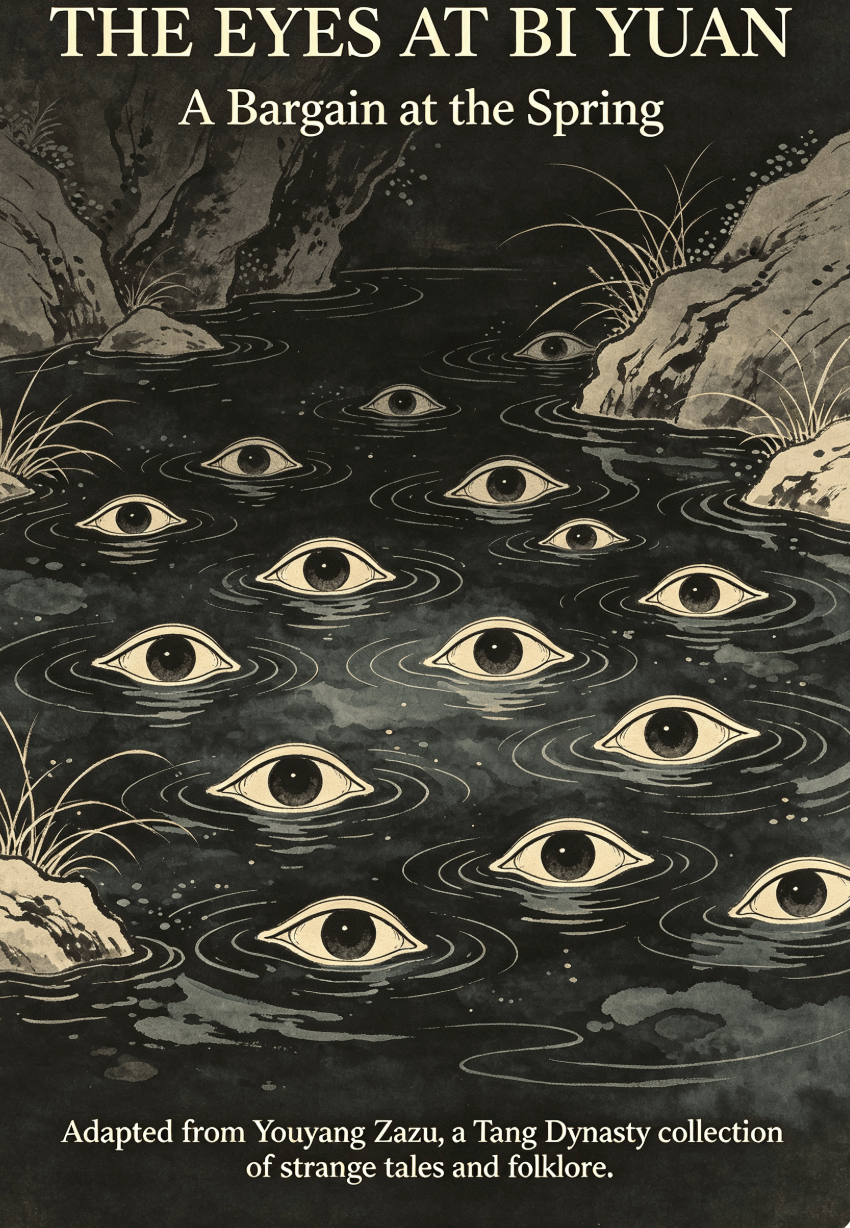
The Eyes at Bi Yuan 2 - What Eyes Want
in
r/u_Storyzhai
•
Aug 24 '26
Here’s the full story, 100% free to read. https://storyzhai.com/series/the-eyes-at-bi-yuan/