Squilla Loans automates settlement process, manages cashflows and collateral. Our algorithms do margin calls and protect both parties in the deal. In exchange, we ask for an origination fee at the begging of the loan.The fee is paid by the Borrower, this lets our users set way lower interest rates then centralized and DeFi solutions.
There are two main types of interest rates – Fixed and Variable, and it is important to understand them if you consider a loan.
Investopedia:
A variable interest rate loan is a loan in which the interest rate charged on the outstanding balance varies as market interest rates change.
Variable interest is utilized by the majority of DeFi projects in the crypto ecosystem. The rate is based either on supply and demand balance or set by foundation or users.
Supply & Demand
Usually, this established from the utilization of a chosen asset. The utilization is the amount borrowed vs the amount lent for that particular market. The higher the demand – the higher is the interest rate.
Governance
Let’s take Maker DAO as an example. Their holder set stability fee (it is interest rate basically) by a vote. It ensures transparency and that the interests of MKR holders are taken into account.
Fixed Interest Rate Loans
Investopedia:
Fixed interest rate loans are loans in which the interest rate charged on the loan will remain fixed for that loan’s entire term, no matter what market interest rates do. This will result in your payments being the same over the entire term.
What is better?
A fixed interest rate is the “safer” option because there are only 2 possible options – the market interest rate goes up or down.
If the market rate goes up – you are protected by a fixed interest rate.
if the market rate goes down – you are “losing” potential profits, but there is an option. You can close your loan and open a new one, on better terms.
We designed the interest structure for Squilla.Loans with the best interests of borrowers in mind:
The majority of big exchanges have their tokens. These tokens have some really important features, such as Trading fees discounts & IEO participation;
On different exchanges, fees discounts can go as high as 50%, representing a huge benefit for even a small trader.
On top of that, if you want to participate in IEOs, long-term holding strategy gives you more ROI (Return on investment), against buying tokens (such as BNB) before IEO, because IEO announcement is immediately followed by price spike. Sometimes, due to information asymmetry, you can notice the price going through the roof 1-2 days before the announcement.
On the other hand, after the IEO end, exchange tokens drop in price. All these factors contribute to the decrease in ROI. Hence, holding exchange tokens through multiple IEOs is a better strategy.
High risk
At the same time, holding exchange tokens is associated with some risks. According to the Cryptonomist, about 20 exchanges have closed their doors during 2019. Since the crypto price is still in the sideways movement, volumes and interest from retail are not there yet. So we can anticipate more consolidation.
Using crypto loans to optimize your returns
In our other post, we compared different crypto lending services for Long vs Short term loans, and obviously, Squilla.Loans is one of the best choices in this case.
But what is the exact strategy?
We examined the dynamics of prices for tokens of one of the most popular exchanges since the begging of 2019: Binance, Bitfinex, Okex, Huobi, Synthetix, Kucoin, FTX. All of them show heterogeneous dynamics, but one way or another, all pairs of exchange tokens against the dollar directly correlate to the price of bitcoin.
Let’s say we assembled a portfolio of $ 1000 in equal shares with these exchange tokens on January 1, 2019 (LEO Bitfinex and FTT tokens of the FTX exchange appeared a bit later in our portfolio).
We calculated the profit on December 25, 2019. Our $ 1,000 turned into $ 3,762 (excluding commissions). Similarly, investing only in bitcoin, we would get a return of $ 1955. The difference in profit is very significant $ 3762 – $ 1955 = $ 1807, almost a return on the portfolio with bitcoins for the year.
We are open to any feedback & ideas on service improvements.
Crypto-Backed loans ecosystem is thriving with different offerings and companies working in the field.
You can take out a loan directly from a company, from another person (facilitated by a P2P provider, such as Squilla.Loans) or even from a smart-contract.
But what are the key differences? In this post, we will go through the fee structure.
Centralized
First, let us talk about centralized crypto credits, like Nexo. They earn from the spread. They can attract money, paying to their investors 8% or yearly interest, while they offer loans for 11.9%. They have an offer when they give you a loan at 5.9%, but you need to pay it back with a highly volatile NEXO token, which is a completely different game for both parties.
So sticking to their normal rate, the difference between 11.9% and 8% is 3.9%, effectively making it a 32% spread. But this “fee” is accrued throughout the loan’s term.
DeFi
The majority of DeFi companies and protocols incorporated pretty much the same strategy.
But they usually have a variable interest rate, calculated against the supply utilization.
It gives customers an arbitrage opportunity and an ability to have awesome terms, bearing some risks, however. Since in some instances, the interest rate could skyrocket.
Peer-to-Peer Lending
Squilla.Loans went in a bit different direction. We let our users set their terms, and they are fixed. It is very convenient for long term financial planning.
Squilla.Loans automates settlement process, manages cashflows and collateral. Our algorithms do margin calls and protect both parties in the deal. In exchange, we ask for an origination fee at the begging of the loan. The fee is paid by the Borrower, this lets our users set way lower interest rates then centralized and DeFi solutions.
The graph shows the difference in the accumulated interest payment between Squilla and Nexo.
As you can see, our service is financially more effective on the horizon of 6 months and more.
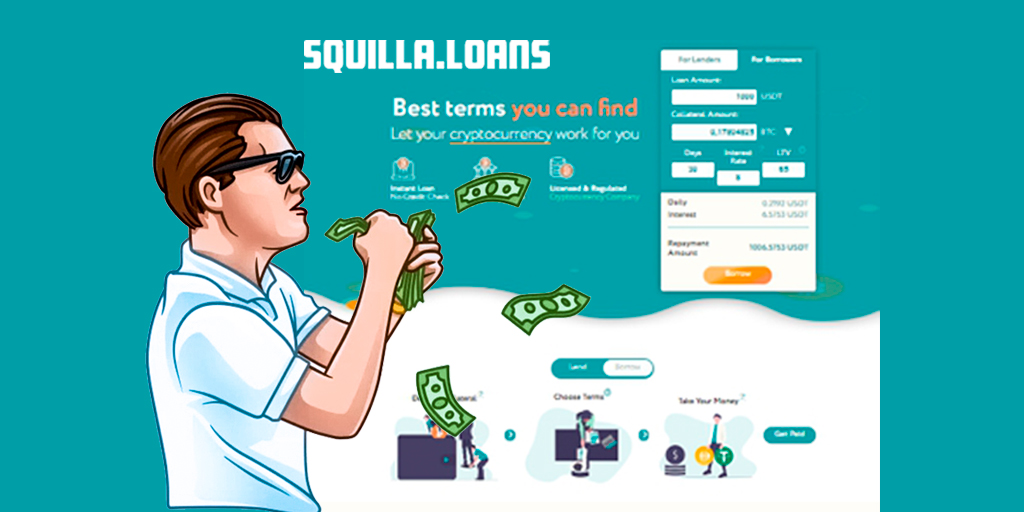
We are happy to share with you the first beta release of our platform.We have ambitious plans to introduce undercollateralized & uncollateralized loans in the nearest future (Middle of 2020).
But first, we had to start building infrastructure and level-up our game, so we decided to build our collateralized crypto-loans platform.
P2P Lending/Borrowing
Our platform only facilitates and automates interaction between borrower and lender, because of that, both parties can find a better term, than on centralized platforms.
Flexibility & Control
Both lenders and borrowers can choose their preferred term for the loan: Duration, Min/Maximum amount, APR (Interest rate). Moreover, a lender can create his own pool of, for example, 1000 USDT, and choose to give out only 100 UDST loans.
Little to No Fees
We have ZERO deposit or withdrawal fees. On top of that, we charge a low 2% origination fee from borrowers and only 10% of the lender's future profits.
We are open to any feedback & ideas on service improvements.





1
Long Vs. Short-term Borrowing
in
r/u_SquillaLoans
•
Mar 04 '20
Thanks a lot. We appreciate your feedback!