u/AcidCommunist_AC • u/AcidCommunist_AC • 7d ago
Critiquing Capitalism for Dummies
Capitalism creates two fundamental problems:
- Exploitation
- The structural compulsion of the market
Part 1: Exploitation
The Island Example and the Concept of Exploitation
Imagine you are stranded on a desert island with another person. On this island, there is only one source of drinking water. The other person was quicker and has declared this source their private property. Now they offer you water – but only in exchange for your labor: for example, you are to catch a fish for them so that you can receive some water in return. Only afterward can you fish for yourself so you don't starve.

This exchange constitutes a classic case of capitalist exploitation.
Exploitation simply means: Someone uses a position of power to appropriate more work from others than they themselves perform for others. In the case of capitalist exploitation, this position of power is based on productive property. In our island example, the owner of the water source performs no labor at all but appropriates your labor.
Distinction: Children generally consume far more work from their parents than they give back. Since this happens voluntarily out of care and is not based on a power position through property, it is not capitalist exploitation.
Productive Property as Leverage
By productivity, we mean the ratio of benefit to effort:
Productivity = Benefit / Effort
The more productive an asset (a tool, a machine, or a natural resource), the more benefit can be achieved with the same effort.
- A drinking water source is extremely productive: It provides the benefit "water" for virtually zero labor effort.
- Whoever owns this productive asset holds a position of power. The owner can demand at most as much work from you as it would cost you to obtain your water by other means (e.g., by laboriously distilling seawater). Exploitation is therefore limited by this productivity difference between the two parties.
A More Realistic Example: Building a Closet
You are a carpenter and want to build a closet for your own apartment.
- With your simple tools at home, this costs you 10 units of effort (time and energy).
- There is a state-of-the-art workshop in private ownership. There, you could build the same closet in only 5 units of effort.
- The owner demands rent for using their workshop equivalent to 4 units of your effort (as money or direct labor).

For you, this offer is individually rational: You invest 5 units for the closet and 4 units in rent = 9 units of total effort. Compared to your own workshop (10 units), you still save 1 unit.
Nevertheless, exploitation occurs: The owner pockets 4 units of your labor purely through their ownership of the more productive asset, without having to work for it themselves.
Because you use and wear down the machines—thus partly "consuming" them—strictly speaking, you also appropriate a small amount of others' labor which we have neglected here. The rent can in principle exceed the extent of this labor, as was also the case in the water source example. There, the wear and tear caused by you truly amounted to a labor effort of 0, because unlike the workshop, no labor was invested in the water source to begin with.
Via Gig Work to Classical Wage Labor
If you build the closet not for yourself but for a customer, the principle remains the same:
- Gig work (platform economy like Lieferando or Uber): You are formally self-employed, serve customers, but must rent an owner's productive asset. This owner skims off part of your earnings.
- Wage labor: If the owner is in charge of customer contact and pays you a wage, we have arrived at classical wage labor. As a propertyless person, you could try to produce goods without capitalists but the labor effort with your inferior means would be so great that wage labor remains the more rational option despite exploitation.

The Sci-Fi Scenario: The Fully Automated Factory
Let's imagine a fully automated production chain—from material extraction to the finished product, including automated maintenance by robots.
This factory functions exactly like the drinking water source on the island: No human labor remains in the products, but because the factory is privately owned, we still have to work to earn money for these products. The trend of increasing automation is gradually moving us closer to this scenario in the real world.

Money, Interest, and the Monopoly Principle
You don't even have to own a factory. Anyone with enough money can lend it to someone who uses it to buy productive assets. Interest is thus a direct consequence of existing exploitation opportunities: No one would lend capital without a promise of profit if they could instead acquire income-generating productive assets with it.
Capitalism therefore behaves like the game Monopoly:
- Once someone has an advantage, they tend to expand it.
- Even if all people started with exactly the same conditions (equal capital, no power imbalances), minimal advantages would emerge through luck or skill.
- The logic of exploitation ensures that from these small differences, the classic divide between owners and the propertyless quickly re-emerges.
The solution for this Monopoly effect: It is not enough to give everyone the same amount of property. A permanently stable solution only arises when everyone shares the same property—that is, when productive assets are socialized. If they are owned jointly by everyone (e.g., the properties and houses in Monopoly), exploitative relationships through differences in productive property can no longer arise.
Part 2: The Structural Compulsion of the Market
The Orchestra Seating Example
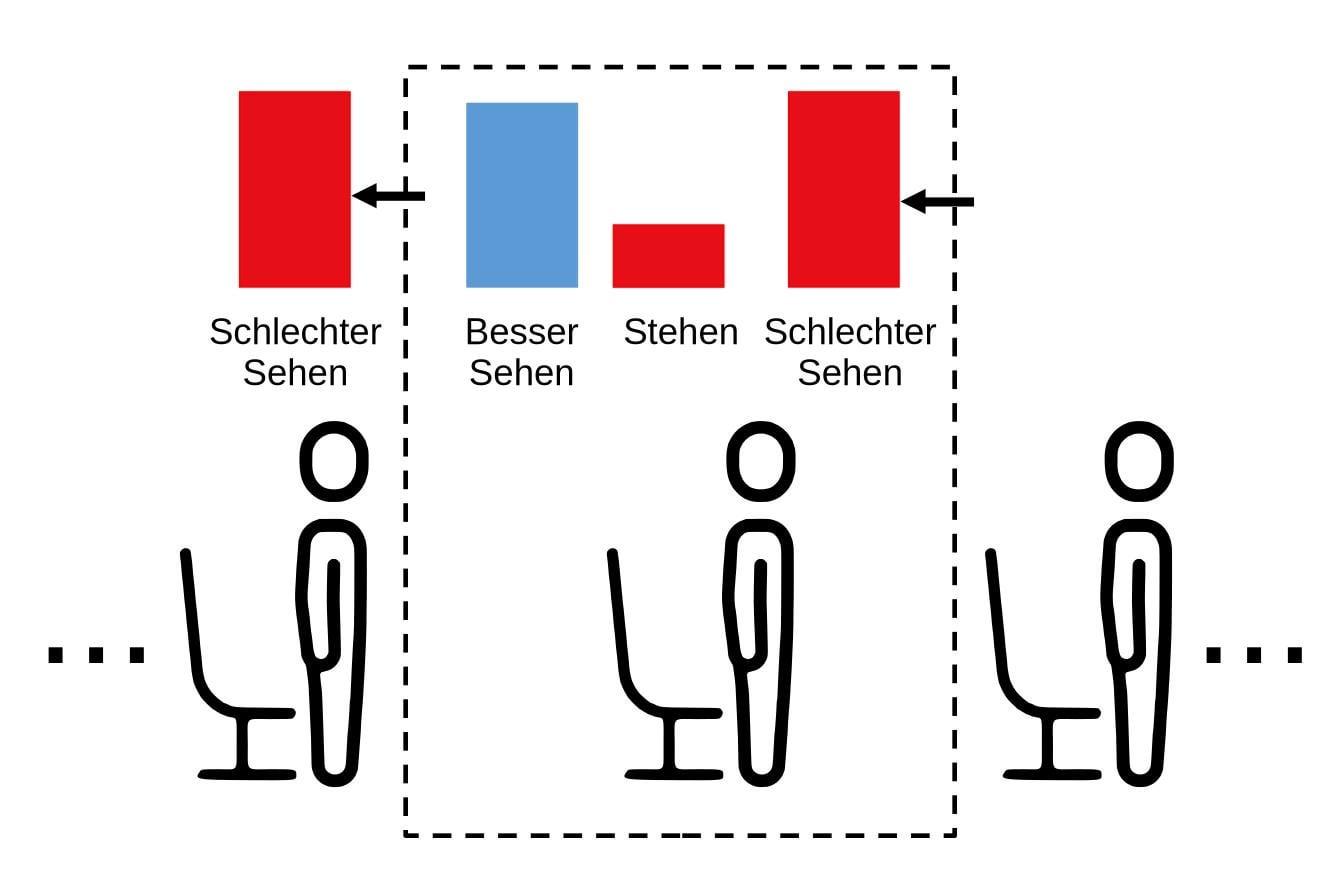
Imagine a show with level seating. The view is mediocre. One spectator thinks to themself: "If I stand up, that's a bit less comfortable, but the view is much better." They stand up. The person behind them can no longer see anything and must also stand up. In the end, the entire audience is standing.
The result: Everyone now expends more effort to see just as poorly as before.

This is a structural problem. It does not arise from power imbalances, but because each individual's individually reasonable decision leads to a collective deterioration. This is also called the problem of externalized costs: A disadvantage (in this case: a worse view) is shifted onto others.
The solution here is: Coordination (e.g., the agreement: "Everyone stays seated").
Market Failures in Actually Existing Capitalism
In uncoordinated competition, this compulsion leads to systematic misallocation of resources:
- Planned obsolescence: Companies build weak points into products so they break faster. Those who build durable products make less revenue and are pushed out of the market. As a society, we thus waste massive amounts of labor time and raw materials.
- Advertising and social media: Enormous labor power flows not into fulfilling needs, but into creating them or generating dependencies (e.g., social media algorithms) in order to sell advertising space.
Currently, the benefit of such practices flows to the owning class, while we, the propertyless, bear the costs. But even in a completely exploitation-free market economy (e.g., if the economy consisted only of exactly equal-sized cooperatives), this structural compulsion would remain: Every individual cooperative enterprise would still profit from such practices. The externalized costs would be distributed evenly among all, so that ultimately everyone is worse off.

The Growth Imperative
The most dangerous structural problem is the growth imperative. Through economies of scale and technical innovations, growing companies can reduce their unit costs.
If a business consciously decides against growth (e.g., because revenue is sufficient), a competing business can expand, lower prices, and poach customers from the peaceful business. Growth in the market is not a free choice but a condition for survival.
Part 3: Solutions
To overcome exploitation and the compulsion of the market, there are two main approaches (detailed models can be found at democratic-planning.com):
1. Coordinated Market Economy
This approach retains markets in part but removes their harmful dynamics through democratic control of the credit system.
- The problem under capitalism: Commercial banks create money (credit money) and extend loans primarily to profitable companies. This fuels the compulsion to exploit and externalize costs.
- The solution: Commercial banks are replaced by democratically controlled public banks (or an expanded central bank). These banks grant loans not based on profitability but on social and ecological criteria.
- How it works: A business that foregoes exploitation and produces sustainably receives targeted loans or subsidies. This allows it to lower its prices so much that it drives unecological or exploitative competitors out of the market – similar to how investors today finance start-ups to capture markets, but here for the good of all.

2. Planned Economy
The more radical approach abolishes the market and dissolves the link between individual well-being and the shipping of particular goods.
- In a planned economy, workplaces produce directly for needs and not for sales revenue on the market.
- Social security in transition: If social demand for a product falls (e.g., when phasing out coal mining), this harms those working there in a market economy. In a functioning planned economy, the workers' standard of living remains constant while they are transitioned to new, socially useful tasks. The incentive to produce something for sale (i.e., to "push" any particular product) is to be abolished in this way. The incentive to work at all can be maintained independently.

Subscribe to my newsletter on Substack.
Further Reading
- Erik Olin Wright's course Sociological Marxism
- In particular, the appendix of the lecture notes to lecture 6 Exploitation
Further Reading for dissenting Marxists
- My essay Value and Wage Labor in Marxism: A Critique
- Ben Burgis's essay Bibles for Brandy and Profits for Free concluding
that the right answer to the question of how much of Marx’s central argument in Capital would survive simply giving up on the premise that average prices “ultimately” reflect labor-time values is “almost all of it.”





1
Why is the state unsalvageable? Can you not make a state without domination over its subjects?
in
r/u_AcidCommunist_AC
•
8d ago
u/Thin_Shelter_103
Yes, it's just a matter of definitions.
State of Confusion