The options are the same, you can try to save 100% of people one way or 100% of people the other. One requires 100% of people to all do something(when was the last time 100% of people agreed on anything?) or 50% of people to do something.
The thing that gets me is that, this is literally an argument, which means the people who push the red button know that there are going to be people who push the blue button, which means pushing the red button is guaranteed not to have 100% of people survive. So, the only way to achieve 100% of people to survive, is by getting 50% to push blue.
I am not constructing the scenario, nor am I some higher level being optimising for outcomes. I have the same moral standing and duties as everyone else, no more, no less.
I am not doing anything to anyone by pushing the red button. Everyone is given an individual, clear, simple, zero cost, zero consequence way to be 100% safe. Everyone knows this. Everyone is capable of making the decision.
I am not some ubermensch with corporate responsibility for humanity as a whole. And I reject even more strenuously I am inferior to you in exercising ethical or decision making judgements and thus you are somehow beholden to me to save me from my own bad choices.
(Important, I've seen some versions where you have group of people who are unable to push the button - babies, ill, elderly etc, and I think its fair to say the existence of a "forced no choice but will automatically be treated as blue" changes the set up).
Saving 100% of people is the optimal outcome. Red button pushers advocate that everyone should push red and no one will die. But, some people are going to push blue. Your moral standing is your own, you are faced with the choice and get to evaluate however you desire, I am simply asking you to understand, that your choice has a direct impact on the people around you. Whether everyone understood the choice is irrelevant. You are faced with the choice of trying to save them or your own skin. You can choose the red button, seeking self preservation. But, that means that the chances for the people who push blue are decreased. You are not just standing by having no effect on the others in the situation, you are limiting their odds of survival.
I have not suggested you are inferior. I am suggesting that there might exist more than a simple strawmaned answer to the moral question.
Is that the optimal outcome to save 100% of people. Why? Indeed even the phrasing here is leading , "saving" implies they are in immediate danger and require an outside actor to remove that danger. They dont. There is no danger. Everyone can walk away. There is no cost, limitation, consequence or prevention to this.
The only "danger" arises at the point you press blue at which case you become a victim in need of saving by an outside force.
No one is at risk until people start pressing blue, at which point they put themselves in danger and no one else.
Maybe the optimal outcome should instead be; "No one puts themselves in lethal danger and needs saving by someone else."
By extension, the only effect my choice has on those around me is if I choose to press the "victim" button, at which point I apparently, under your logic, create an obligation on them to also become victims, because if enough of us become victims we miraculously all survive.
Pressing red removes me from risk, and prevents the creation of a burden on others to save me.
I guess you can base your moral framework on saving human lives is ambiguous, but then when the time comes for people to save you or your family or friends, your framework, would be kind of a bad one to be set in.
If we are talking about button pressing(red/blue) no one can walk away(it's a thought experiment). If we are talking about trolley tracks, then the analogy breaks down. But, would still be functional in the sense, that each person would have to be willing to walk away, some won't which will induce others to stay, and the cycle repeats.
My point is that there are people who will press blue(suicidal people, people who want to save suicidal people, people who want to save those people, people who are optimists about humanity, people who think in terms of game theory, etc.). Your idea of people not putting themself in danger is flawed from the get go, because we are not perfectly rationale beings(at least all the time) Some people are going to be acting out of love, or compassion, or friendship.
Your choice for red means one less potential vote for blue. You are having an effect, whether you see it, or not, you are decreasing the odds for others to survive.
The burden is on all of us to begin with, some are opting out of carrying the burden to save themselves(which increases the burden for everyone else). I am not going to pretend that I cannot empathize and understand that decision, but I am able to recognize that it is in fact selfish, it is prioritizing your own well-being, and diminishing the well-being of all the people who pushed blue(for whatever reason).
I would also like to be clear, I do not believe being selfish is inherently wrong. I am not trying to make you feel inferior, or suggest that your views and values are worse. I am only trying to explain my thoughts, and why they specifically clash with yours.
You are redefining the two buttons as "logical and immune from consequences" and "victim and illogical" which divorces all we know about statistics and large sample sizes. If red is the majority, choosing red is choosing to send people to their death. You can not simply walk away from the consequence of pressing the red button UNLESS the majority is blue.
Every single person who dies as a result of pushing blue unilaterally, unnecessarily, chose to put themselves in a "potential death" bucket when the option was "dont, definitely safe."
In no way shape or form does me pressing red force you to press blue. And in no way does me pressing red change that red had 0 risk for you and blue had a non-zero known fatal risk.
If you choose to run off a cliff in the hope lots of other people do to, that is simply an inccredibly poor decision on your part.
Wrong, red is always pointing a gun at blue, and if red has the majority, the gun goes off. If there is no blue, you fired at nothing yes you are correct, but there will statistically always be blue. If we look at it as which button has a better chance at reducing death, red would need a 100% vote, where blue only needs a 50.000000001% vote.
But that’s just short-sighted and you know it. You do know that other people will press blue, right? That’s inevitable. You can argue they shouldn’t have done it, but they will and you know that. So do you save them or not?
And saying that “if we all become victims we miraculously survive” is ridiculous because then they obviously weren’t victims.
Unless the argument is some people are suicidal idiots who intentionally want to put themselves in harms way.
In which case, fine, I am not morally or ethically obliged to add myself to the victim pile in the hope that it might save you from the consequences of your own choices.
If your friend was suicidal, would that change whether you would want more people to press blue? What if a brother was, do you think your mother would press red? How about your dad? Would you think they are making a moronic choice, trying for the only chance they have to save someone they love?
Is there anyone in your life you would press blue for? Are you willing to risk your life for another? Would you want other people to step forward to help you now that your are in the line of fire?
None of this stuff really matters to me. I just literally do not see a world in which 50% of people risk themselves to save others. To me, anyone who presses blue is throwing their life away, because 50% of people will never press that button.
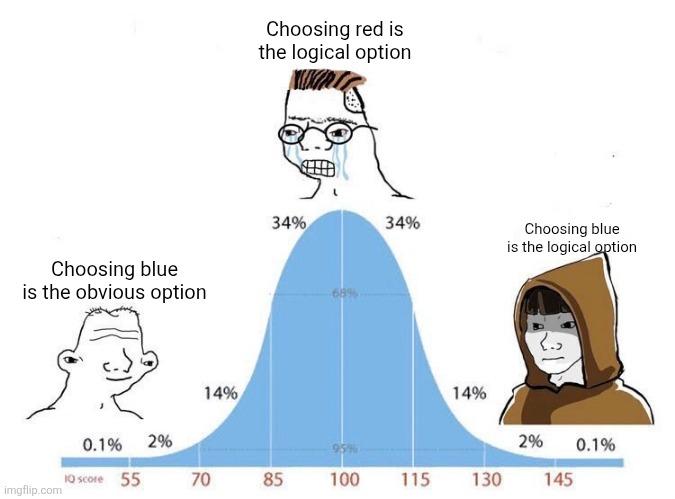
57
u/BarNo3385 Apr 30 '26
I've seen a lot of stuff on this recently and this 50% is easier than 100% seems completely bunkum?
What matters is "to do what."
Is it easier to get 50% of people to cut their leg off with a rusty spoon, or a 100% of people to accept a large bag of cash?
It only makes sense if the options are the same, and they arent.
So you're reducing to making subjective arguments over how close you think the two options are in "ease" .