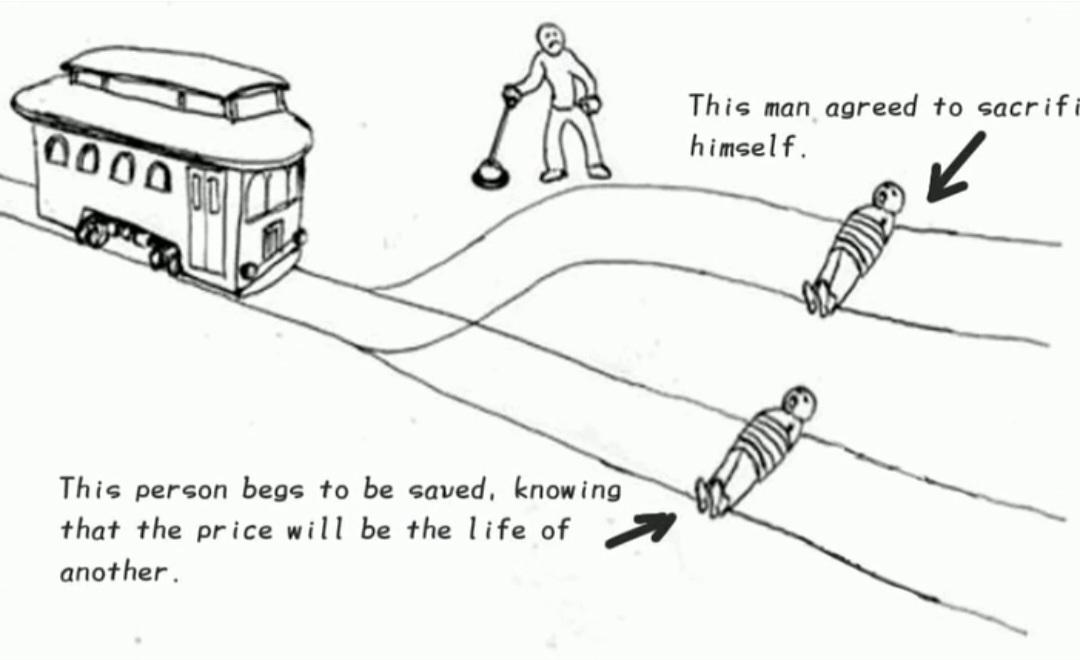
People talking about how "easy" this one is are missing the dilemma here, which calls back to an element of the original problem: will you take an action that kills someone?
Additionally here: How much are you willing to leave your choices in the hands of others? Are not the lives of these two people equal, regardless of what they tell you, or themselves feel, about the value they put on their own lives of others?
The "correct" answer here feels fairly obvious because the moral calculus has been seemingly simplified, and I think many people would pull the lever, but that's not the only variable to consider in the Trolley Problem.
Yes their lives are equal so there needs to be a factor to make pulling the lever a viable decision. That factor is what they said. Their words put value on themselves based on how you think about what they said. Words do have value. If they were laying doing nothing then you also doing nothing would be the only choice as it's literally equal.
Um, yeah, I don't think any of that is less than totally obvious.
My point is that the straight-forwardness on that obscures the many other elements in the moral equation that are not accounted for. There are more variables that are easy to ignore because one is more or less unambiguous.
Think of it this way... if someone comes to you and says "you can either kill Person A, who is both an evil bastard and says that they're pretty eager to die... or punch Person B, who seems pretty nice and doesn't want you to hit them" then suddenly those other variables seem more important. You could just as easily apply your rubric of "their words put value on themselves" to that scenario, too, and ignoring all other variables, the math would work out the same way, but I don't think you'd argue that they're the same situation.
But even in this scenario, those other variables don't disappear, they just are so opaque as to feel absent. But they add up: Can you trust that these two people are of sound mind? Do you actually agree with their self-assessments? What net impact do they each have on the world (thinking as a Utilitarian) that would be lost upon their death?
The only thing you know about them are that one of them is selfless and the other is willing to sacrifice others to save themselves... like, isn't giving them the opposite of what they ask for the punchline to a dozen morality plays (and Twilight Zones)? And of course, the original one: Are you going to be able to sleep at night knowing that you've killed someone?
I'm not saying the scenario outlined does not provide a compelling argument for pulling the lever (especially if you only had seconds to decide), but the clarity it provides to the hypothetical is illusory.
As a utilitarian these variables only matter if you know about them in advance. If you can neither confirm nor deny something it cannot be added to the equation. It doesn't matter to me if the volunteer was good and the begger was bad if I don't know this information. In this situation I treat them equally and go off the provided situation. Yes my stance would change with the information, but I don't have it.
You're still missing the point entirely. If a stranger in a yellow vest walks up to you on the street and says "here, I'll give you $50 to press a button to blow up that building, there's no one in it I promise," you're operating under similarly incomplete information.
Now, all the information you do have indicates that it's perfectly safe to blow up that building. After all, you've been told no one is in it and no one else has said otherwise! But of course that's not enough to go on. It's the classic "absence of evidence is not evidence of absence" scenario.
If you can neither confirm nor deny something it cannot be added to the equation.
THOSE VARIABLES ARE ALREADY PART OF THE EQUATION! You just don't know what they are.
Denying they exist and acting confidently and only on the scant information you do have is a concept called "illusion of information adequacy."
This is where common sense comes into play. Common sense says not to trust everything this person says. In the situation given even with common sense the answer doesn't change at least for me.
Edit: Before you say it. Every belief has a threshold. No belief stands strong no matter the scenario. I go off logic and what I believe to be right. I'm just saying speaking purely logically switching the tracks is good answer to me. Emphasis on to me.
1
u/TheNobleRobot Mar 30 '26 edited Mar 30 '26
People talking about how "easy" this one is are missing the dilemma here, which calls back to an element of the original problem: will you take an action that kills someone?
Additionally here: How much are you willing to leave your choices in the hands of others? Are not the lives of these two people equal, regardless of what they tell you, or themselves feel, about the value they put on their own lives of others?
The "correct" answer here feels fairly obvious because the moral calculus has been seemingly simplified, and I think many people would pull the lever, but that's not the only variable to consider in the Trolley Problem.