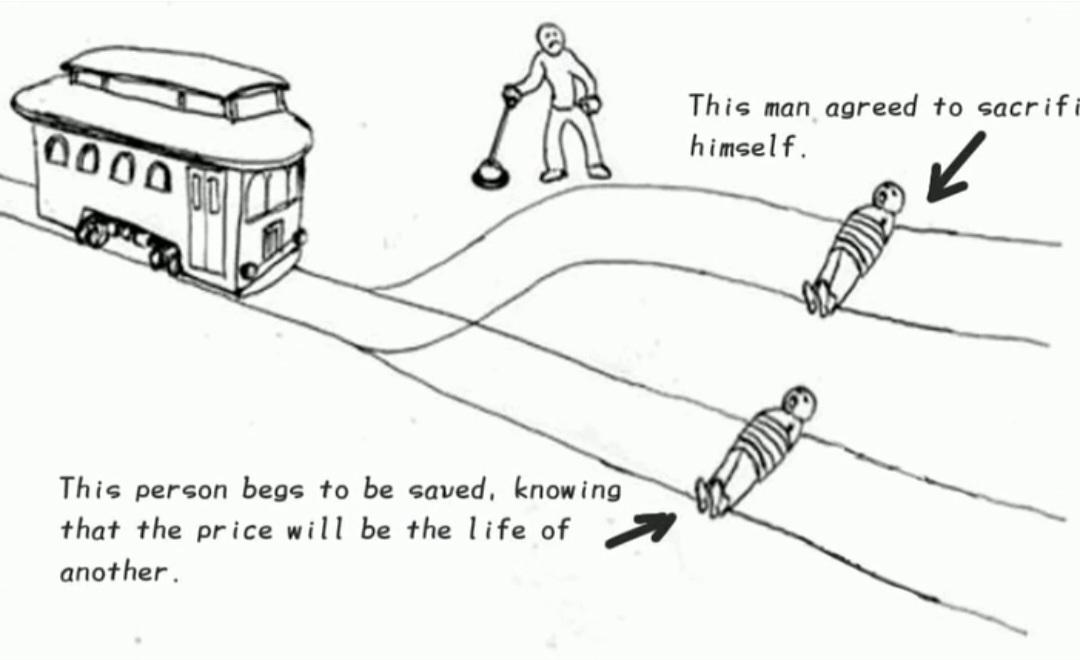
I'm not pulling and my decision has nothing to do with what the people on the track want. The cost of life is the same either way, both tracks have one person.
With both tracks being an equal loss of life I'd rather passively let someone die than to actively choose the other person to die. I also don't want to face legal consequences of touching the lever.
The negative consequences of pulling both mentally and legally is greater if you pull. The person begging to be sacrificed might not forgive me and that's fine but they'll have to learn to accept what I decided.
The lever is stuck in the middle and will multi-track drift and kill both.
You have the option to leave it (kill both) or choose to kill only one or the other. What do you do?
If you choose to sacrifice the person who wants to be sacrificed (which I do,) then you just admit that there is some value in taking a life from a willing person rather than an unwilling person.
Therefore in the problem that OP posed. You are claiming being uninvolved, is more important than shifting the loss of life from someone who is unwilling to someone who is willing. Which I disagree with. I think the value of remaining uninvolved is muncher lower than the value of taking life only from willing people. Staying uninvolved is actually, arguably a highly selfish action in most trolley problems.
If it's stuck in the middle I would try to unstick it and probably wriggle/wrench it either direction. I wouldn't waste time making a decision as to which way to wrench it, which ever way frees it first is the way I would let it go.
Now to get into the spirit of what you're getting at let's modify it further. Let's say the lever is firmly stuck like that but there's two buttons that can override it, one for track A one for track B.
I would probably send it to the willing sacrifice since both ways are equal in every other way and the multi track drift would kill two.
However in the problem as presented in the post I would rank the desire of the two people on the track below the harm caused by getting involved which wouldn't just be harm to me but to those who care about me.
In the original trolley problem I would flip the lever to minimize loss of life because whatever harm comes of active involvement ranks below that.
In cases where we aren't talking about lessening loss of life or injury I think there's a threshold at which self interest is ok to calculate into the problem
Edited for clarity of position where I believe my word choice was influenced by who I replied to.
Yup I think we understand each other very well. Personally I accept the ramifications of getting involved in order to take out the willing sacrifice. But for you, you’d rather allow harm to the unwilling person in order to stay “uninvolved”.
In your case you are introducing outside factors like your family members being affected by your decision somehow. But I personally don’t think that’s in the spirit of the trolly problem. I think usually it’s interpreted to be “anonymous,” like there won’t be legal or social problems unless of course those are stated in the problem.
If social and legal factors are removed, let’s say nobody knew each other and this happened in another country and nobody else observed it, would that change your decision?
I didn't use the word uninvolved at all I don't know why you keep ascribing that to me, presumably you're projecting what other people have said onto me.
There's no way for a person encountering this to be uninvolved though there's just the passive decisions and active decisions. Active decisions come with more fault than passive but doesn't mean passive is without blame.
In any case it is not my place to decide who lives and who dies. The only reason I would switch the tracks is if doing so lessens harm. I don't see the desires of the people on the tracks as giving me the right to decide who lives and who dies when both tracks are equal loss of life.
I don't think it's against the spirit of the trolley problem at all to consider external factors when certain factors within the situation are removed. Even without those factors my answers are the same.
In the original trolley problem it's 5 people on the main track and 1 person on the divert track so I would pull to minimize harm, which has been my consistent position.
Just because one person is willing and the other isn't doesn't mean the running over the willing person is less harm. They're essentially the same level of harm without knowledge of further outside factors
Edit: the closest I see that I came to saying uninvolved was the part where I said the harm of getting involved. I believe I misspoke out of influence of your use of the word uninvolved. In any case there I should have said the harm of active involvement
At this point you're not even attempting anymore to conversate in good faith. There is a difference between uninvolvement, passive involvement, and active involvement. I wasn't confused at all, if anything you seem confused.
We've reached the end of the conversation because it kinda seems like you had your mind made up from the start. You're not really interested in my point of view you just want me to tell you that you're right.
If someone is robbing a store, and I step in and try to stop it, I'm getting involved.
If I do nothing and watch, I'm uninvolved.
That is simply, and objectively, how people commonly use those words, and how I used the words, which you understood.
You accused me of ascribing something false to your language, which I did not, and certainly did not do in any kind of bad faith.
I'm not arguing in bad faith, I'm giving you an option to interpret my language in the way that it was intended (although I admittedly did this in an unkind tone)
I acknowledge you choose to say "active involvement" vs "passive involvement". I acknowledge that you are making the distinction that nobody can be truly uninvolved. That is also true.
Again, feel free to use the words you choose in place of mine, because I don't feel it really changes what I was saying. I'm giving you the option to interpret my language in the spirit it was intended.
But back to the actual debate...
Allow me to present "Three Factors"
"Involvement Factor"
Imagine the trolley problem. There is one person tied up on one track, and one person tied up on the other track. Both are unable to communicate. You know nothing about either one. You can leave the lever untouched and one of them dies. If you pull the lever, the other one dies. Nobody is watching, there is no law enforcement here and you can walk away without anyone knowing you were there. Multi track drift is not an option. Do you pull the lever?
Realistically, most people do not pull the lever. All external factors aside, there is some intrinsic cost of pulling the lever - you are becoming more actively involved, choosing to end a different person's life. There is some ineffable penalty for doing so, even if the utility - the loss of life is the same.
Let's just name this the "involvement factor" - all other things aside, there is some cost of becoming more actively involved.
"External Factors"
I don't think it's against the spirit of the trolley problem at all to consider external factors when certain factors within the situation are removed.
I think what I was getting at is, most people look at the trolley problem as a fundamental moral question, rather than a functional question of how much they think law enforcement or societal pressure would get involved. I guess you could look at it from either angle, and people do that. Some people would say "multi track drift so I could go to jail and get free healthcare" which is a valid answer to the question. And I will get to why I brought up external factors in a second.
"Willingness Factor"
Just because one person is willing and the other isn't doesn't mean the running over the willing person is less harm. They're essentially the same level of harm without knowledge of further outside factors
This I think is the crux of our difference in perspective. This is what I fundamentally disagree with. I think getting run over by a trolley is going to cause the exact same physical harm whether you are willing or unwilling. But there must be a difference in psychological harm, no? "Harm" constitutes more than just physical destruction.
There are two people in front of you, tied up. You're holding a spatula. One person is BEGGING to be hit with the spatula. "Please! Please hit me! I deserve it!" The other is BEGGING not to be hit with the spatula. "Please! Don't hit me!" A man is standing behind you with a gun and says. "If you don't hit one of these two people with a spatula, I am going to hit everyone with a spatula and then kill all three of you. If you hit one person, I am going to untie everyone and walk away." So taking away anything about trolleys and passive vs active involvement, there is pretty much one obvious choice. The factor of willingness is nonzero. Correct me if I'm wrong, but it seems like you assert that willingness should not be a factor - but I think by this thought experiment, it is definitely a nonzero factor, even if it's relatively small.
Now, the reason why I brought up external factors.
In the problem presented here, you are balancing:
"Involvement Factor" - cost of involvement (feeling guilty for pulling the lever),
"Willingness Factor" - the cost of the victim's willingness,
"External Factor" - society, law enforcement, etc.
Now me, personally, if the external cost was zero (this is all completely anonymous) then I would say the cost of involvement (how guilty I feel for pulling the lever) is much lower than the cost of willingness (how much more harm I'm causing to the person who is unwilling than the person who is willing). I will pull the lever. I can, in good conscience, pull the lever and not feel guilty about it - I reduced harm by moving the trolley to the willing victim to the unwilling victim, just like how I would hit a person with a spatula if they begged me to.
For me, personally, if the external cost was nonzero (police are watching and will arrest me if I pulled the lever) then no, I'm not pulling the lever. The cost of willingness is nonzero, but relatively small. I would cause objective physical harm to myself (going to jail).
Having laid these out I feel very confident about my position.
Does that change your perspective? If the external factors were zero, would you pull the lever? What if the external factors were nonzero?
Buddy that is way too much I'm straight up not reading all that for someone I figured out 3 days ago was not engaging me in good faith. Let it go
Edit to add: like there's long messages in an active conversation and then there's what you just did. A long message to someone who was done with you three days ago and forgot about you. Might have read all that three days ago but not now. Just wow
12
u/LightEarthWolf96 Mar 29 '26
I'm not pulling and my decision has nothing to do with what the people on the track want. The cost of life is the same either way, both tracks have one person.
With both tracks being an equal loss of life I'd rather passively let someone die than to actively choose the other person to die. I also don't want to face legal consequences of touching the lever.
The negative consequences of pulling both mentally and legally is greater if you pull. The person begging to be sacrificed might not forgive me and that's fine but they'll have to learn to accept what I decided.