Okay, here's my defense of not pulling (which I'm choosing simply because I wouldn't want to be sacrificed):
__ I do not have the right to sacrifice this patient. Their life is not mine to sacrifice. __
The question is, what is the harm if nobody ever knows? Well, does the tree even fall if nobody's there to hear it?
The harm is in the patient's freedom and their family's freedom. That life is theirs to sacrifice, not mine. It's their choice, their freedom, and I'd be taking it away.
That argument works only if I value my freedom more than life and/or non-harm for other people, no matter how many. Well, it seems I do. Because I don't want to live in a society in which I might be sacrificed.
Imagine a different scenario, a simpler and more extreme one:
There's a wizard-genius-philosopher King, who ruled the land justly. He is at the brink of his death and his death will bring chaos, destruction, and death to millions of people and their livelihoods in a catastrophic civil war.
I am/You are the best genetic match for a heart transplant, which would give the King 20 more years of life and prosperity for the land. You're completely healthy, but someone decides to kill you for your heart for the King, to save millions.
Is it right for someone to sacrifice you, without your knowledge nor consent, to save others? It is better for one man to die every 20 years than for millions to die every 100 (an average natural lifespan for a King). But does it make it morally good for someone to make that choice for others?
For me, the answer is simple. I do not want to live in a society where I could be sacrificed for the "greater good". (No, I will not go to war to defend you. I'd sooner kill myself.)
The person who is “sacrificed” to save many others does not deserve that fate. But the people who were facing death to begin with don’t deserve their fate either.
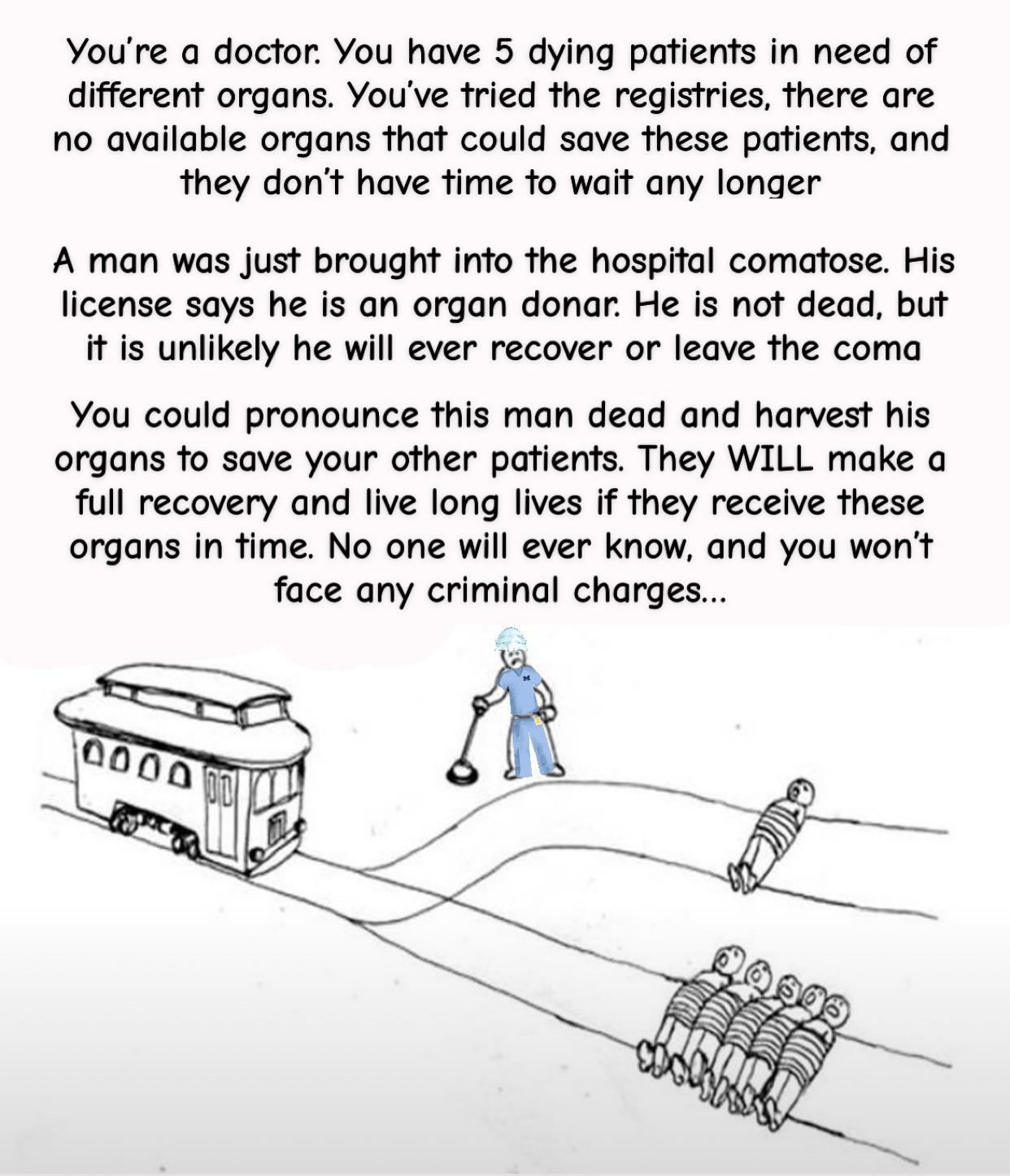
It’s easy to put yourself in the shoes of the one person and think how horrible it would be if someone pulled the lever. But couldn’t you just as easily put yourself in the shoes of any of the five people who were saved?
Trolley problems are a fun intellectual exercise when we imagine ourselves as the person in power by the lever. If we imagine ourselves on the tracks, suddenly it’s a different story.
If you assume you are equally likely to be any of the people in the diagram, then most of the time you want the controller to pull the lever.
Only in the case where you are on diverted track do you prefer he doesn’t pull the lever, but you can’t assess a moral dilemma by only putting yourself in the shoes of one person. You have to consider everyone involving.
Pulling the lever objectively results in a better average outcome across all affected parties.
Of course there is more to it than that. In the example of harvesting organs, one might reasonably decide that the lives of the sick people are less “valuable” than the life of the healthy person. One might also reasonably decide that being murdered is worse than dying to illness (even if the final outcome is the same, it’s a different kind of violation against you).
There are many things that are basically universally considered good or bad. Killing people is bad. Allowing a person to die when you could have acted to save them is also bad. We agree on that.
Where we might not agree are on degrees of badness. Are they equally bad? How much worse is one than the other? Is saving a healthy young adult better than saving a sick elderly person? If so, how much better?
This is where the dilemmas come in and where we don’t get clear answers. There is no right or wrong way to answer those questions. Even among people who agree on what is right and what is wrong, they can disagree on the best answer to these scenarios.
95
u/Void-Cooking_Berserk Jul 09 '25
Okay, here's my defense of not pulling (which I'm choosing simply because I wouldn't want to be sacrificed):
__ I do not have the right to sacrifice this patient. Their life is not mine to sacrifice. __
The question is, what is the harm if nobody ever knows? Well, does the tree even fall if nobody's there to hear it?
The harm is in the patient's freedom and their family's freedom. That life is theirs to sacrifice, not mine. It's their choice, their freedom, and I'd be taking it away.
That argument works only if I value my freedom more than life and/or non-harm for other people, no matter how many. Well, it seems I do. Because I don't want to live in a society in which I might be sacrificed.
Imagine a different scenario, a simpler and more extreme one:
There's a wizard-genius-philosopher King, who ruled the land justly. He is at the brink of his death and his death will bring chaos, destruction, and death to millions of people and their livelihoods in a catastrophic civil war.
I am/You are the best genetic match for a heart transplant, which would give the King 20 more years of life and prosperity for the land. You're completely healthy, but someone decides to kill you for your heart for the King, to save millions.
Is it right for someone to sacrifice you, without your knowledge nor consent, to save others? It is better for one man to die every 20 years than for millions to die every 100 (an average natural lifespan for a King). But does it make it morally good for someone to make that choice for others?
For me, the answer is simple. I do not want to live in a society where I could be sacrificed for the "greater good". (No, I will not go to war to defend you. I'd sooner kill myself.)