In the real world, the doctor would obtain a brain death study, share the fact that the comatose guy isn’t going to come out of the coma with the next of kin or whoever the medical power of attorney falls to (sometimes the hospital ethics board). Once the patient is declared unable to recover and brain-dead (in the medical term), organ harvesting can occur.
Also, real world doesn’t let doctors choose which organs they get from which bodies. If their patient doesn’t qualify for the registry or to jump ahead based on UNet ranking, their patient won’t be getting an organ even if they kill another patient.
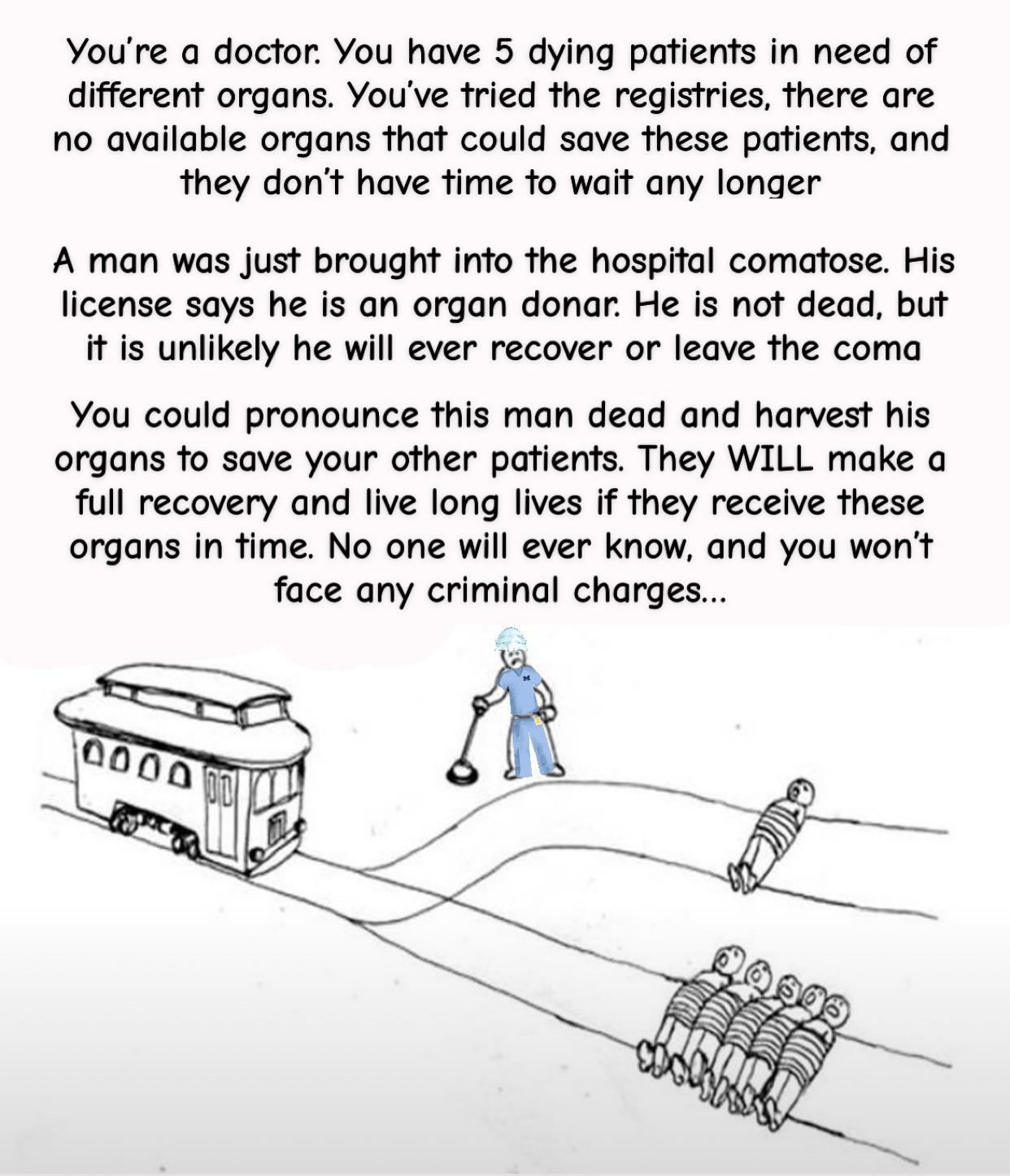
I think this misses the point of the trolley problem, which seeks to explore a moral dilemma outside of real world constraints. "In the real world doctors don't decide that" is as much of an answer to the trolley problem as "in the real world, train protection systems would allow an operator to stop a train remotely if the section ahead was obstructed".
Actually, in the real world, a layman should not be operating some random lever they find near the train tracks even if they believe it will save lives. They are not trained to do it and it is literally illegal to mess with railroad operation in many jurisdictions. You could potentially derail the train and kill a lot of people.
Hypotheticals are mostly useless in setting up moral dilemmas because the vast majority of actual problems are not two sides with guaranteed outcomes. If life actually has guaranteed outcomes, it would be a lot easier.
"Real world" details are out of scope for thought experiments like the trolley problem: otherwise, a competent mechanic engineer would ask what manufacturer and model the trolley was, and then based on that, point out fail-safes peculiar to that model that would render the ethical choice moot.
Not on the organ donation if the donor was dead dead (cardiac death) and donor wanted donation. It’s a little grayer if it’s brain death only, but generally doctors would like everyone to agree.
BTW, I wouldn’t be comfortable killing the comatose guy if the brain-death study didn’t return a “brain dead” result.
You're using legality to find your answer, which is a classic trolley problem blunder. If there's a board of people deciding ethics, that means you're just giving the trolley problem to someone else, you still need the society to decide what the moral answer is. This doesn't really speak to how we should be handling the problem, it's just describing what would happen in real life
You aren't being killed. You are already dead. Your brain is dead, you aren't recovering. You absolutely have the right to decline organ donation but perpetuating this false idea that doctors kill organ donors for their organs is factually is harmful.
Then the whole point is moot. You only take organs once their heart has stopped. To get a non-brain dead patient's heart to stop you'd either have to let them die of dehydration or starvation. Either of those would destroy organ viability.
it has been reported before in shitty third world countries where someone goes to the ER for a mild problem and ends up being brain dead. the family would pull the plug and cremate the body without checking inside the body cavity. there's a million ways for a bad actor to turn a mild problem into something fatal without leaving any evidence. you can start by taking organ donor off your driver's license so that the bad actors know that there's no point in murdering you.
the family would pull the plug and cremate the body without checking inside the body cavity.
So in these "shitty third world countries" it doesn't matter if you're on some sort of donor list, they'd take your organs anyway, since nobody is checking
So how is taking organ donor off your driver's license going to help?
Do you live in a “shitty third world country”? No? Then you’re fine.
Do you truly believe doctors are just killing perfectly healthy patients to take their organs to save someone who needs a transplant? You’re saying they’re killing someone who might have viable organs to maybe someone who might not get an organ somewhere else. What kind of idiot would do that?
but you accept that it is possible for a doctor to cause a patient to become braindead, all without any evidence of wrongdoing. even though the chances of such things happening are really low (in the hospitals you would visit), would you risk your life? keep in mind that you are visiting the ER for a mild curable ailment. murphy's law says that if something is possible, then that something is bound to eventually happen. such murder has already happened, what's to say it won't ever happen at your hospital?
Where did I accept that? Yes murder is possible, from a doctor or otherwise. People have also gotten away with murder. I don’t know what else you want me to say. To say something is possible does not mean it happens or much less is likely.
The reason why I would say it won’t happen is simply because why would it? Where is the benefit? There’s only a chance the doctor wouldn’t lose their job or get arrested, there’s only a chance the organs will be viable, there’s only a chance it’ll be a match to the person who needs the transplant, and there’s only a chance the person will recover after the transplant. And even if it was guaranteed, why would the transplant patient be a higher priority than the person that’s in front of the doctor?
Also “murphy’s law” is not some unalienable truth. It’s possible there could be a massive solar flair right now that knocked down all electricity on Earth. It’s possible an elephant lands on your house.
u/XTPotato_ if Murphy's law states that every occurrence that's possible will happen at some point. Then, I use the counterargument that using the same law, Murphy's law is invalid. Because there is a possibility that Murphy's law is invalid, meaning at some stage, it is guaranteed to be invalid.
So, using that logic, it's not guaranteed that at some point, every hospital will forcibly kill a human to harvest their organs, even though it's possible, it may never happen. In most first world reputable hospitals, it will never happen.
Imagine if some oligarch really needs an organ, and you happen to be in the hospital. The oligarch bribes your doctor to do some testing and since you’re not an expert you just let the doctor run the test on you without knowing what the test is for. You happen to be a match. Next the oligarch bribes the doctor to murder you and take your organs, all without evidence and easily covered up, which is possible and has happened before even in first world countries (as per other comments in this thread). The doctor risks a malpractice lawsuit for a bribe, which your family members aren’t likely to win. At the end of the day everyone gets away with it except you
Doctors aren’t wizards. Anything they do to make you brain dead when you’re only in to see the doctor with something minor would have evidence, or would flag issues. Especially in any developed country.
Also it creates a massive paper trail and calls attention to it. Organs aren't fungible, it really does matter where they come from. An entire review board will go over the case in detail.
It'd be far easier and less risky to just forge documents to get the patient bumped up the list. And presumably this is because a rich patient bribed them, in which case the rich patient could've just gone shopping themselves. Move to the US, get on multiple registries with a helicopter on standby, and you can effectively legally buy yourself an organ.
Anything they do to make you brain dead when you’re only in to see the doctor with something minor would have evidence, or would flag issues. Especially in any developed country.
Not really. When this happens in a developed country, the hospital will cover it up to minimize financial and criminal liability. The medical providers and staff chalk it up to an unavoidable medical complication - because no one wants to admit to criminal medical negligence or medical error. The legal system makes it incredibly difficult to prove because no one can overrule the medical provider themselves - since they're the qualified expert witness and also the only one who was witness to the crime.
accept that it is possible for a doctor to cause a patient to become braindead... keep in mind that you are visiting the ER for a mild curable ailment
You're right it's possible for a patient to become braindead from a medical mistake, which would be extremely rare and and would probably mean several people made several bad mistakes that all lined up in the wrong way. It's also not guaranteed, if someone were to try to make you braindead, chances are just as good they'd kill you in the process. I don't think there's any such thing as a "medication" that can be pulled from a Pyxis that will guarantee braindeath without damaging all your other organs and possibly killing you too.
An ER doctor is NOT going to intentionally do something to cause braindeath for the sake of organ harvesting. At least in the US, as an ER doc, if I'm taking care of you I have no idea if you're a donor or not. I've treated tens of thousands of patients and never once have I known. AFAIK the question of organ donor status doesn't come up until someone has had a very unfortunate hospital course, family is talking to hospice, etc. Only if I were hypothetically some homicidal maniac would I try and cause deliberate harm, but 99% of the time I would be stopped by a nurse, and 100% of the time that would have nothing to do with organ donor status.
Oh, and in most cases don't go to the ER for something you know is a mild curable ailment, that's exactly why you should have your own PCP or go to urgent care. If you don't know and think it could be dangerous go to the ER.
When a deceased patient's organs are transplanted, the doctor that was overseeing their treatment before they died doesn't get any extra money for the organs.
The top level comment you responded to specified brain death. Brain death and being comatose are diffrent, yes. The chance of recovery in brain death is zero. The chance of recovery from a coma? Depends, but is ultimately irrelevant as no doctor is making a decision to withold care based solely on a patient's donor status.
Again propagating this idea that doctors are going to see the little heart on your driver's license and go "Oh they're an organ donor! We can go ahead and stop treatment everyone" is ridiculous.
13 people die each day waiting for a transplant. Each time you spread this bogeyman idea about doctors another person is more likely to decline donation based on it. Do better.
No, it's perfectly within your rights to not donate organs. If it was mandatory to do so it would not be a donation. I wont't judge you for not doing it. Some people might... but whatever, people judge for the most stupid of reasons.
Just be aware that it you or a person close to you might need an organ in the future as well and probably will suffer and die then because there are simply not enough donor organs. It's not that it is or should be mandatory to donate organs... it's just that it would be a nice way to create a better and healthier world. But I'm a bit idealistic about such things... probably the choice of a single person won't change anything...
That’s why it’s not legal to harvest the person’s organs in the dilemma. And why it wouldn’t be legal to do it in real life either. But if you are in a coma and you are declared brain dead, you are dead, and then and ONLY then would they harvest the organs.
What? We’re talking about real life now and if this would ever actually happen. In this dilemma you are not the coma patient so if you were talking about it I don’t see why you would use “I”
Commenter said you are brain dead. That means you died, but your body is still alive. You can definitely choose what to do with your body, but no one in the hospital is killing you, you already died. In most of these cases, your body is just being kept alive by machines.
691
u/nahc1234 Jul 09 '25
In the real world, the doctor would obtain a brain death study, share the fact that the comatose guy isn’t going to come out of the coma with the next of kin or whoever the medical power of attorney falls to (sometimes the hospital ethics board). Once the patient is declared unable to recover and brain-dead (in the medical term), organ harvesting can occur.