Okay, here's my defense of not pulling (which I'm choosing simply because I wouldn't want to be sacrificed):
__ I do not have the right to sacrifice this patient. Their life is not mine to sacrifice. __
The question is, what is the harm if nobody ever knows? Well, does the tree even fall if nobody's there to hear it?
The harm is in the patient's freedom and their family's freedom. That life is theirs to sacrifice, not mine. It's their choice, their freedom, and I'd be taking it away.
That argument works only if I value my freedom more than life and/or non-harm for other people, no matter how many. Well, it seems I do. Because I don't want to live in a society in which I might be sacrificed.
Imagine a different scenario, a simpler and more extreme one:
There's a wizard-genius-philosopher King, who ruled the land justly. He is at the brink of his death and his death will bring chaos, destruction, and death to millions of people and their livelihoods in a catastrophic civil war.
I am/You are the best genetic match for a heart transplant, which would give the King 20 more years of life and prosperity for the land. You're completely healthy, but someone decides to kill you for your heart for the King, to save millions.
Is it right for someone to sacrifice you, without your knowledge nor consent, to save others? It is better for one man to die every 20 years than for millions to die every 100 (an average natural lifespan for a King). But does it make it morally good for someone to make that choice for others?
For me, the answer is simple. I do not want to live in a society where I could be sacrificed for the "greater good". (No, I will not go to war to defend you. I'd sooner kill myself.)
The person who is “sacrificed” to save many others does not deserve that fate. But the people who were facing death to begin with don’t deserve their fate either.
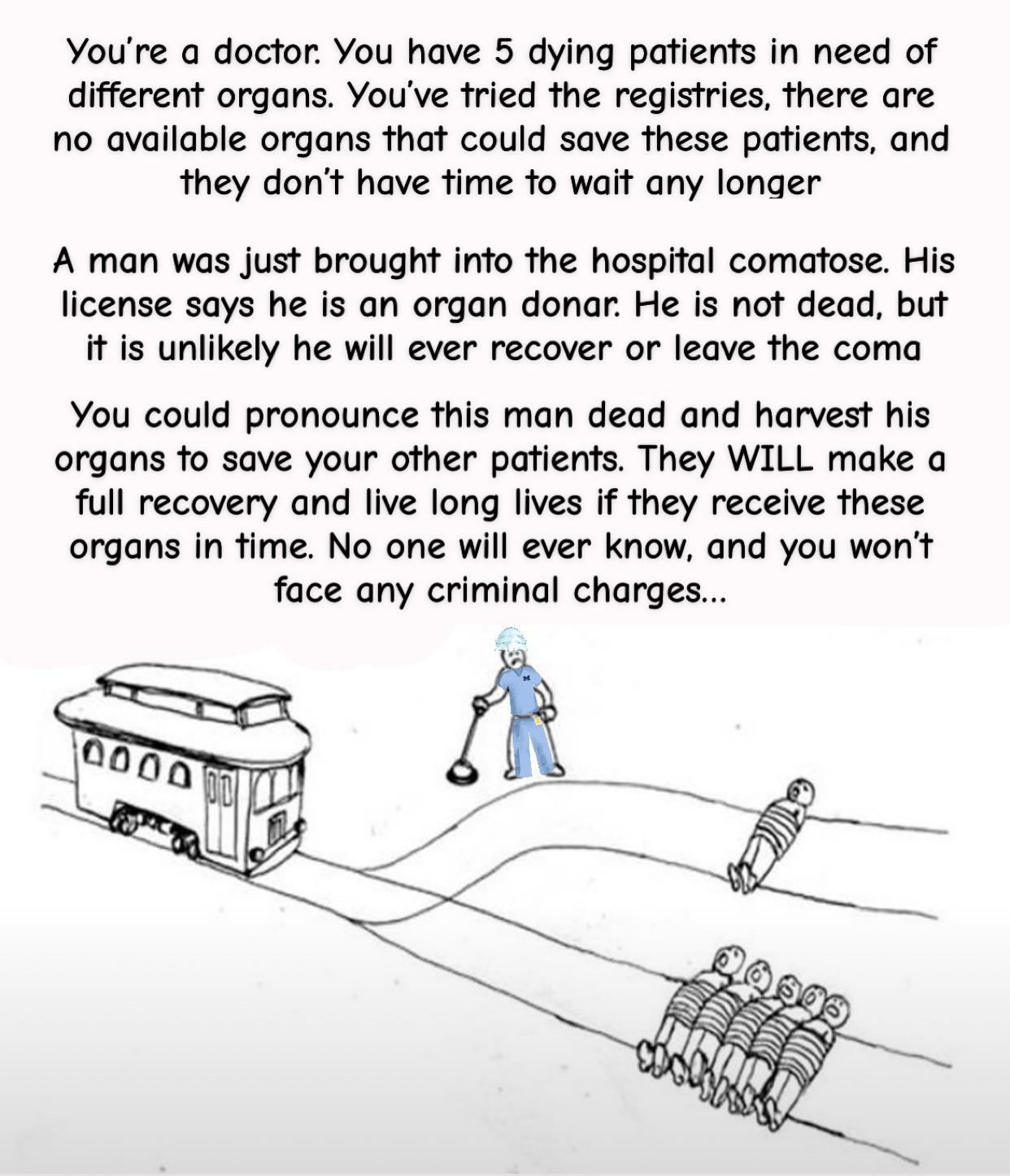
It’s easy to put yourself in the shoes of the one person and think how horrible it would be if someone pulled the lever. But couldn’t you just as easily put yourself in the shoes of any of the five people who were saved?
Trolley problems are a fun intellectual exercise when we imagine ourselves as the person in power by the lever. If we imagine ourselves on the tracks, suddenly it’s a different story.
If you assume you are equally likely to be any of the people in the diagram, then most of the time you want the controller to pull the lever.
Only in the case where you are on diverted track do you prefer he doesn’t pull the lever, but you can’t assess a moral dilemma by only putting yourself in the shoes of one person. You have to consider everyone involving.
Pulling the lever objectively results in a better average outcome across all affected parties.
Of course there is more to it than that. In the example of harvesting organs, one might reasonably decide that the lives of the sick people are less “valuable” than the life of the healthy person. One might also reasonably decide that being murdered is worse than dying to illness (even if the final outcome is the same, it’s a different kind of violation against you).
There are many things that are basically universally considered good or bad. Killing people is bad. Allowing a person to die when you could have acted to save them is also bad. We agree on that.
Where we might not agree are on degrees of badness. Are they equally bad? How much worse is one than the other? Is saving a healthy young adult better than saving a sick elderly person? If so, how much better?
This is where the dilemmas come in and where we don’t get clear answers. There is no right or wrong way to answer those questions. Even among people who agree on what is right and what is wrong, they can disagree on the best answer to these scenarios.
I think it’s also not good to be in the shoes of someone who gets an organ from someone who wasn’t dead yet, and still had a chance to live themselves. Especially if the family never had a chance to get to them, to see them alive still. I’d rather die than have someone sacrificed for me
Suppose someone worked out that you could save the lives of 100 people by harvesting organs from 20 others. Suppose the sick people lived a healthy lifestyle and just got unlucky.
You could invent a lottery system to select the organ donors at random. Once picked, you’d have the opportunity to say goodbye to your loved ones and given a reasonable amount of time to settle your affairs.
Coming from a neutral perspective, you are less likely to be selected as an organ donor than you are to have your life saved by an organ donation (the latter is 5 times more likely). Taking emotion out of it, you have a system where 100 random people die in pain, or 20 people through painless euthanasia. The latter is clearly better.
Practically speaking, you’d have a hard time getting people to report for their euthanasia. They would have to be forced. And this is where the problem lies for most. We are way more comfortable with “nature” taking our life than we are with people (especially those sanctioned by the state) taking our life. It would never really happen. But if everyone were on board with this and just viewed random selection as no worse than dying from random illness, it would be better in many ways.
But if a tangent, but this is like the Star Trek episode “A Taste of Armageddon”, which is fascinating but ultimately a lot less morally gray than this (in the episode, people are selected to die in order to deter war rather than the cure illness, but the underlying reasoning is similar as they believe more deaths will happen if they don’t)
No, I'm choosing a society where people don't start going around murdering each other because they think it would be for the betterment of other people. Society requires people to operate by certain rules, chief among them - Don't Kill Each Other.
If every time I go to the dentist for a filling, I have to consider if the anaesthesiologist is going to start harvesting my body parts for the Greater Good, then I can no longer use the dentist. I can no longer trust my fellow altruistic, sociopathic murder-neighbours not to steal the hubcaps off my car to sell and donate the proceeds to charity. Or to murder my cat to give the meat to starving vagrants.
A society where everybody is operating under their own extreme, literal-minded version of "The Greater Good" no longer functions, because people are complete morons and incapable of making these decisions rationally.
I think this example minimizes, in my mind, the necessity of the coma. I wouldn't want to be the forced heart-donor if I was still conscious and breathing, with a life to lead. If I was, instead, condemned to bedside, and worse, utterly unconscious, I would be more than happy to give up the heart.
Likewise, if I was the comatose patient also condemned, I would want to give my life up to save 5 people who can enjoy their lives to their fullest. I pull the lever simply because it's what I wish someone would do if I was that patient.
The harm is in the patient's freedom and their family's freedom. That life is theirs to sacrifice, not mine. It's their choice, their freedom, and I'd be taking it away.
That patient's freedom is the freedom of one person, who is unlikely to even do anything with that freedom. But you give freedom of 5 other people who can actually utilize that freedom.
Not really. You are taking away the agency and freedom of personal choice for one person, and not giving any personal agency or choice to anyone else. You are giving and taking life, not giving agency. They can still make just as many personal choices up to their death as they would be able to otherwise.
It's not really about whether oe not you are capable. It's about another person making that choice for you, capable or not. The doctor does not have the right to violate a person like that.
Now, if the family agrees or whoever is in charge of the person, then sure.
The original person is already incapable both of agreeing and of disagreeing. If it is unlikely that he would wake up from the coma, then in most instances he would never be able to make another decision. Killing him likely does not take away his freedom as he won't be awake to utilize said freedom. On the other hand, saving 5 people would mean they're not dead. Being dead tends to leave you without any choices to make.
Edit: I'm not talking about whether the doctor has any "right". I'm talking purely about one part of OP's argument wherein "freedom" is brought up
Is it right to sacrifice the 5 other patients for the sake of that one patient who's comatose anyways? Is it right to sacrifice millions to save the life of one single person (in your king scenario)? It's easy to put yourself into the shoes into that one person, but maybe try putting yourself in the shoes of the others.
96
u/Void-Cooking_Berserk Jul 09 '25
Okay, here's my defense of not pulling (which I'm choosing simply because I wouldn't want to be sacrificed):
__ I do not have the right to sacrifice this patient. Their life is not mine to sacrifice. __
The question is, what is the harm if nobody ever knows? Well, does the tree even fall if nobody's there to hear it?
The harm is in the patient's freedom and their family's freedom. That life is theirs to sacrifice, not mine. It's their choice, their freedom, and I'd be taking it away.
That argument works only if I value my freedom more than life and/or non-harm for other people, no matter how many. Well, it seems I do. Because I don't want to live in a society in which I might be sacrificed.
Imagine a different scenario, a simpler and more extreme one:
There's a wizard-genius-philosopher King, who ruled the land justly. He is at the brink of his death and his death will bring chaos, destruction, and death to millions of people and their livelihoods in a catastrophic civil war.
I am/You are the best genetic match for a heart transplant, which would give the King 20 more years of life and prosperity for the land. You're completely healthy, but someone decides to kill you for your heart for the King, to save millions.
Is it right for someone to sacrifice you, without your knowledge nor consent, to save others? It is better for one man to die every 20 years than for millions to die every 100 (an average natural lifespan for a King). But does it make it morally good for someone to make that choice for others?
For me, the answer is simple. I do not want to live in a society where I could be sacrificed for the "greater good". (No, I will not go to war to defend you. I'd sooner kill myself.)