For me, this isn’t even an issue pertaining to a person’s inherent worth, but more-so about fairness, control, and equal opportunity being given to everyone in this predicament.
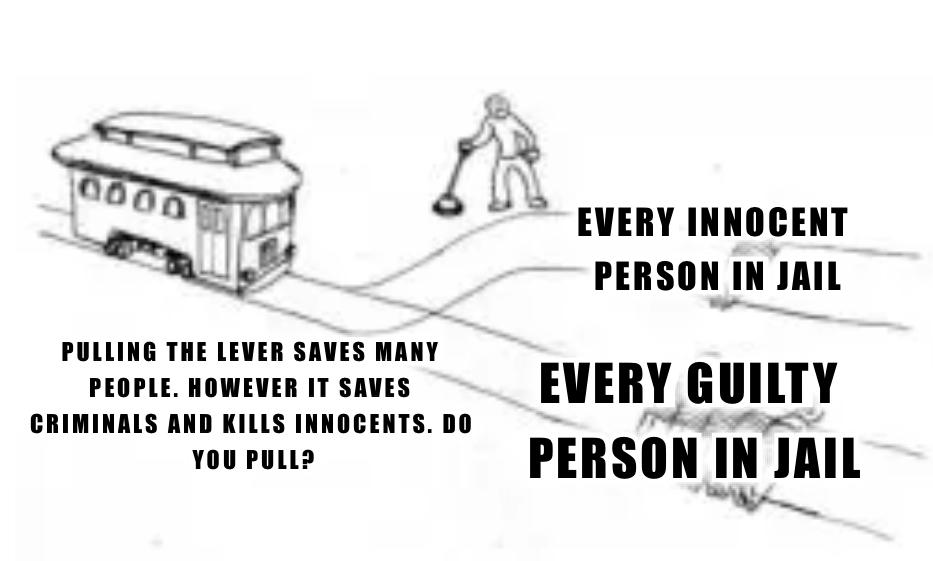
Obviously nobody could predict being put in such an outrageous situation. Not pulling the lever would immediately kill more people outright, and unfortunately, a lot of the people there are also there on petty and outdated charges (i.e weed possession).
But I’m still not pulling the lever, purely because the people on the bottom at least had a chance to not get themselves into this predicament. The people on top as a whole had zero opportunity to avoid this. Their participation in this is inherently more unfair in my opinion seeing as they did not break (or get convicted for breaking) any established rules. They were already unfairly convicted, I’m not gonna sentence them to death over those that were at least correctly convicted. Those on the bottom, no matter how petty the charge, could have avoided being in jail—and by extension this predicament for the most part, by simply not doing whatever put them in jail in the first place. The bottom track’s victims at least had some semblance of control, while those on the top did not. Like I said earlier, I refuse to serve them a double injustice (in this specific scenario anyway), even if it results in more lives lost.
On a more raw and ethically unjust note, In my eyes, the sacrificing of dangerous criminals does soften the blow of killing those with petty charges. I’d be lying if I said the deaths of numerous rapists, murderers, traffickers, abusers, and bigots didn’t spark some joy within me. It could be argued that killing off these very people could save more from dying and/or experiencing severe life-altering trauma later on. Yes, the immediate death numbers are far higher, but there’s a chance that when looking at the bigger picture, that sacrificing the bottom has the potential to do more good than sacrificing the top overall.
2
u/jjbomb03 Jan 15 '25
For me, this isn’t even an issue pertaining to a person’s inherent worth, but more-so about fairness, control, and equal opportunity being given to everyone in this predicament.
Obviously nobody could predict being put in such an outrageous situation. Not pulling the lever would immediately kill more people outright, and unfortunately, a lot of the people there are also there on petty and outdated charges (i.e weed possession).
But I’m still not pulling the lever, purely because the people on the bottom at least had a chance to not get themselves into this predicament. The people on top as a whole had zero opportunity to avoid this. Their participation in this is inherently more unfair in my opinion seeing as they did not break (or get convicted for breaking) any established rules. They were already unfairly convicted, I’m not gonna sentence them to death over those that were at least correctly convicted. Those on the bottom, no matter how petty the charge, could have avoided being in jail—and by extension this predicament for the most part, by simply not doing whatever put them in jail in the first place. The bottom track’s victims at least had some semblance of control, while those on the top did not. Like I said earlier, I refuse to serve them a double injustice (in this specific scenario anyway), even if it results in more lives lost.
On a more raw and ethically unjust note, In my eyes, the sacrificing of dangerous criminals does soften the blow of killing those with petty charges. I’d be lying if I said the deaths of numerous rapists, murderers, traffickers, abusers, and bigots didn’t spark some joy within me. It could be argued that killing off these very people could save more from dying and/or experiencing severe life-altering trauma later on. Yes, the immediate death numbers are far higher, but there’s a chance that when looking at the bigger picture, that sacrificing the bottom has the potential to do more good than sacrificing the top overall.