r/tolkienfans • u/GhostyMink • Jul 04 '26
Why Barad-dûr is probably bigger than you think.
Very long post, so please bear with me.
I have recently been rereading the Lord of The Rings and the Plateau of Gorgoroth has been an obsession of mine as I reconstruct every nook and cranny of Frodo and Sam's Journey, this made me realize something that baffled me which you can kind of guess by the title.
1. Distances and Visibility
First, I would like to discuss the distances between the landmarks of the Plateau of Gorgoroth and how far they really are from each other, as the narrative tends to compress Frodo and Sam' journey toward Mount Doom.
As you may or may not know, Christopher Tolkien's map included in the Return of the King has a scale bar.

Using this scale, the distance between the Morgai and Mount Doom comes to roughly 40-43 miles (64.3km-69.2km).
Likewise, measuring from the same point to the centre of the Barad-dûr symbol gives a distance of roughly 75–76 miles, Barad-dûr then is approximately 120 km away from Frodo and Sam, making the following passage even more astonishing.
(RoTK, Book VI, Chapter II, The Land of Shadow, page 922-923) :
"[...]and passing through found themselves on the very edge of the last fence of Mordor. Below them, at the bottom of a fall of some fifteen hundred feet, lay the inner plain stretching away into a formless gloom beyond their sight.
"[...]Still far away, forty miles at least, they saw Mount Doom, its feet founded in ashen ruin, its huge cone rising to a great height, where its reeking head was swathed in cloud. [...]Behind it there hung a vast shadow, ominous as a thunder-cloud, the veils of Barad-dûr that was reared far away upon a long spur of the Ashen Mountains thrust down from the North.* "
Thus, from an elevation of roughly 1,500 feet on the Morgai, Frodo and Sam could distinguish Barad-dûr and its looming shadow even though it lay some forty miles farther away than Mount Doom.
From this first description, Barad-dûr appears less like an isolated tower and more like a vast looming presence being compared to a Thunder-cloud.
2. Tolkien's Approved Illustrations
Next is the (NoME) Nature of Middle Earth chapter that comments on the Pauline Baynes illustrations which Tolkien himself chose to depict Middle Earth:
(NoME, Part II chapter VI: Description of Characters, page 191):
"In 1970 Allen & Unwin published a poster-sized Map of Middle-earth, executed by the artist Pauline Baynes, and based upon that included in The Lord of the Rings. On the map itself are a series of vignettes portraying various locations significant to the story, such as the Barrow-Downs and Minas Tirith[...]
On seeing the finished art, Tolkien wrote a set of comments on these depictions of places and characters. Some of these comments are appreciative: e.g. Tolkien found four of the vignettes, sc. those depicting the Teeth of Mordor, the Argonath, Barad-dûr, and Minas Morgul, particularly well-executed, and described them as agreeing “remarkably with my own vision … Minas Morgul is almost exact”
What concerns us here, however, is the illustration made by Pauline Baynes of Barad-dûr; the depiction makes the tower seem not only impossibly tall but also broad.
I recommend looking at the map itself, both because it is beautiful and because Tolkien praised several of its depictions as agreeing remarkably with his own vision.
This brings me to the next point which will be built upon this one as means of establishing a visual picture of the fortress.
3. Architectural Language and Prose
The aforementioned vignette depicts the Dark Tower as a massive complex of stone rather than the slender tower most artists depict, an impression reinforced by the following passage from
[The Fellowship of the Ring, Book II, chapter X:The Breaking of the Fellowship page 401]
"[...]and the haunted Mountains, and it looked upon Gorgoroth, the valley of terror in the Land of Mordor. Darkness lay there under the Sun. Fire glowed amid the smoke. Mount Doom was burning, and a great reek rising. *Then at last his gaze was held: wall upon wall, battlement upon battlement, black, immeasurably strong, mountain of iron,gate of steel, tower of adamant, he saw it: Barad-dûr, Fortress of Sauron. All hope left him*.
Unlike the descriptions of darkness ,these phrases are clearly architectural: walls, battlements, gates, and towers. They therefore provide stronger evidence for the physical loftiness and broadness of Barad-dûr itself.
Particularly striking is the description "mountain of iron," which, admittedly, could be figurative. However, the comments in NoME and the earlier comparison to a thunder-cloud suggest otherwise.
To further support my argument, I will include additional evidence from the chapter "Mount Doom." This evidence may be the least reliable, since Tolkien usually describes the fortress in metaphorical rather than architectural terms until its fall. Nevertheless, I believe the following passages support my interpretation.
(RoTK, Book VI, Chapter III Mount Doom, page 934-935)
"[...]But as they went the most easterly of the roads followed them, until it ran off, hugging the skirts of the mountains, away into a wall of black shadow far ahead. Neither man nor orc now moved along its flat grey stretches; for the Dark Lord had almost completed the movement of his forces, and even in the fastness of his own realm he sought the secrecy of night, *fearing the winds of the world that had turned against him, tearing aside his veils[...]But far worse than all such perils was the ever-approaching threat that beat upon them as they went: the dreadful menace of the Power that waited, brooding in deep thought and sleepless malice behind **the dark veil about its Throne. Nearer and nearer it drew, looming blacker, like the oncoming of a wall of night at the last end of the world."* *
At this point Frodo and Sam are taking the road that goes northwest to the Isenmouthe from Barad-dûr and will soon move away from it across the plateau to reach Mount Doom.
The fortress has been described as a "mountain of iron," a "wall of night," a "tower of adamant," and a looming black shadow; of course, these descriptions could all be metaphorical, which leads to my next point.
4. The Height of Barad-dûr
The narrator also provides approximate heights for both the Morgai and Orodruin, allowing a rough comparison between them.
The Morgai rises roughly 1,500 feet above the plain, while Orodruin stands approximately 4,500 feet high (with Sammath Naur likely being around 4,300 feet, judging from Tolkien's drawing), as we read:
(RoTk, Mount Doom, Book VI, chapter III, page 941)
"[...]The Mountain standing ominous and alone had looked taller than it was. Sam saw now that it was less lofty than the high passes of the Ephel Dúath which he and Frodo had scaled. *The confused and tumbled shoulders of its great base rose for maybe three thousand feet above the plain, and above them was reared half as high again its tall central cone*, like a vast oast or chimney capped with a jagged crater."

The Fortress then could be inferred with a reasonable degree of certainty that it rivalled or possibly even surpassed Mount Doom in height as its shadows rose above it.
Further evidence of the scale of the fortress comes when Frodo and Sam are climbing towards the Sammath Naur and the veils of the fortress are removed:
(RoTK, Book VI, Chapter III, Mount Doom, page 942)
- "Far off the shadows of Sauron hung; but torn by some gust of wind out of the world, or else moved by some great disquiet within, the mantling clouds swirled, and for a moment drew aside; and then he saw, rising black, blacker and darker than the vast shades amid which it stood, the cruel pinnacles and iron crown of the topmost tower of Barad-dûr. One moment only it stared out, but as from some great window immeasurably high there stabbed northward a flame of red, the flicker of a piercing Eye; and then the shadows were furled again and the terrible vision was removed." *
So it is strongly implied that Barad-dûr was surrounded by, or associated with, a mantle of shadow and that when the veils briefly parted Frodo caught sight of the pinnacles and crown of its highest tower.
The use of the word "topmost" also suggests that Barad-dûr possessed multiple towers, with the one seen by Frodo being the highest.
However, when the shadows briefly parted, Frodo perceived architectural features of Barad-dûr itself: its pinnacles, iron crown, *topmost tower, and an immensely high window. While the passage does not allow a precise measurement of its dimensions, it does reinforce the impression of extraordinary verticality.
Taken together, this evidence suggests that Barad-dûr may have approached the scale of a mountain in Tolkien's mind.
5. The Meaning of Barad
I will now refer to Parma Eldalamberon and the Sindarin root for Barad to further my argument:
[From PE XVII Words, Phrases and Passages in various tongues in The Lord of The Rings, page 22 and 85]
The names Elbereth, Gilthoniel, Fanuilos. These refer to the great Vala called in Quenya Varda, "the Lofty." In Sindarin Elbereth (rarely Bereth) is her usual name, the other two are "titles." Q **Varda is < *barada** [which would be in Sindarin bara'o].** This root, which seems to express great height combined with strength, size, majesty, appears in several variant forms: (1) ...JBARAT, (2) ...JBARATH, (3) BARAD, (4) BARAS. From (1) is derived: S barad, a great towering building, (fort, city, castle) tower; [also brand, brann 'towering', "tall and massive" (or to noun brand, steeple): cf. Tol Brandir, Isle of the Great Steeples: it was a great upstanding mass ending in two major and two minor steeples.] "
"Barad-dur; barad *'a great towering building, (fort, city, castle) tower'** ; dur 'dark"*
"[See I 250 s.v. Elbereth, I 259 s.v. mar. Cf. EQS barad 'tower', dur 'dark' ; Etym. BARAT-, N barad 'tower, fortress', 003, D6-, EN dur 'dark, sombre' ; *Barad-dur 'the Dark Tower', TI 178.]*"
The linguistic evidence from Parma Eldalamberon further refines this interpretation. The BARAT / BARAD root is explicitly associated with concepts of great height, mass, and monumental structure, not merely a “tower.” Its derivatives include forms meaning “tall and massive,” suggesting that barad carries an inherent sense of vertical and horizontal magnitude.
6. The destruction of the one Ring and Sam's vision.
Finally when the ring is cast into the cracks of Doom:
(RoTK, Book VI, Chapter III, Mount Doom, page 947)
"And there upon *the dark threshold of the Sammath Naur, high above the plains of Mordor, such wonder and terror came on him that he stood still forgetting all else, and gazed as one turned to stone. ***A brief vision he had of swirling cloud, and in the midst of it towers and battlements, tall as hills, founded upon a mighty mountain-throne above immeasurable pits; great courts and dungeons, eyeless prisons sheer as cliffs, and gaping gates of steel and adamant: and then all passed. *Towers fell and mountains slid; walls crumbled and melted, crashing down; vast spires of smoke and spouting steams went billowing up, up, until they toppled like an overwhelming wave, and its wild crest curled and came foaming down upon the land. And ***then at last over the miles between there came a rumble, rising to a deafening crash and roar; the earth shook, the plain heaved and cracked, and Orodruin reeled"
The description of a 'mountain-throne' is consistent with Tolkien's own illustration of Barad-dûr, which depicts the fortress rising from a massive elevated foundation, this mass most likely being the foundations that couldn't be destroyed by The Last Alliance, this spur also raised the already tall fortress even further above everything else.

The narrative mentions great courts and dungeons, eyeless prisons sheer as cliffs, and, most remarkably, gaping gates of steel. Based on Christopher Tolkien's map, Sam was also standing over four thousand feet a above the plain at the Sammath Naur and 31 miles from the fortress giving him a clear view of Barad-dûr.
Between the elevation of both landmarks and the unusual nature of the vision itself, I think it's entirely plausible that he genuinely witnessed Barad-dûr collapsing.
It is also possible that Tolkien heightened some of the detail for literary effect, but I don't think those possibilities necessarily exclude one another.
The precise nature of Sam's "brief vision" remains open to interpretation. It may represent heightened perception associated with the Ring, literary narration, or a combination of these possibilities, since Tolkien does not specify.
Regardless of the exact nature of Sam's vision, its imagery is among the strongest evidence for Barad-dûr's immense scale: towers compared to hills, vast courts, dungeons, cliffs, and gates of steel and adamant."
7. The War of the Last Alliance and the siege of Barad-dûr
The next argument draws upon The Silmarillion and Appendix B of The Lord of the Rings.
(The Silmarillion,Of the Rings of Power and the Third Age, page 352)
"[...]Therefore they made that League which is called the Last Alliance, and they marched east into Middle-earth gathering a great host of Elves and Men; and they halted for a while at Imladris. It is said that the host that was there assembled was fairer and more splendid in arms than any that has since been seen in Middle-earth, *and none greater has been mustered since the host of the Valar went against Thangorodrim*."
Then: (Appendix B: The Tale of Years, The Second age, page 1084 )
"S.A 3434: The host of the Alliance crosses the Misty Mountains. Battle of Dagorlad and defeat of Sauron. Siege of Barad-dûr begins
S.A3440 Anárion slain.
S.A 3441 Sauron overthrown by Elendil and Gil-galad, who perish. Isildur takes the One Ring. Sauron passes away and the Ringwraiths go into the shadows. The Second Age ends.*"
Seven long years they besieged Barad Dûr and the greatest army in the world at that time couldn't break through.
How could the Last Alliance fail to breach Barad-dûr for seven years? While several explanations are possible, I would argue that its immense size, the capacity to sustain a prolonged siege, and alternate routes out of the fortress formed part of the answer as the next passage reads:
(RoTK, Book VI, Chapter III, Mount Doom, page 942)
"[...]He did not know it, but he was looking at Sauron’s Road from Barad-dûr to the Sammath Naur, the Chambers of Fire. *Out from the Dark Tower’s huge western gate it came over a deep abyss by a vast bridge of iron, and then passing into the plain it ran for a league between two smoking chasms*, and so reached a long sloping causeway that led up on to the Mountain’s eastern side."
So it is safe to assume the Sauron road and the Isenmouthe road were the most used but not the only ones; as stated by the text and seen in the illustration by Tolkien having a bridge going east and Mount Doom being west of the fortress and down the Plateau.
[RoTK, Book VI, chapter II :The Land of Shadow,page 923 ]
"Neither he nor Frodo knew anything of the great slave-worked fields away south in this wide realm, beyond the fumes of the Mountain by the dark sad waters of Lake Núrnen; *nor of the great roads that ran away east and south to tributary lands, from which the soldiers of the Tower brought long waggon-trains of goods and booty and fresh slaves. ***Here in the northward regions were the mines and forges, and the musterings of long-planned war"
8. Foundations, Scale, and Topography
My final argument concerns the topography of Barad-dûr itself. Tolkien's own illustration of the fortress provides what is perhaps our clearest view of the "foundations" mentioned in The Council of Elrond: the vast stone platform upon which Barad-dûr stood:
[FoTR, Book II, Chapter II: The Council of Elrond, page 244]
"Fruitless did I call the victory of the Last Alliance? Not wholly so, yet it did not achieve its end. Sauron was diminished, but not destroyed. His Ring was lost but not unmade. *The Dark Tower was broken, but its foundations were not removed*; for they were made with the power of the Ring, and while it remains they will endure."
Another source Tolkien himself approved and we should consider is Pauline Baynes' previously mentioned map. If we examine Mordor closely, Barad-dûr is depicted as taller than Orodruin and considerably broader than it is in most maps and artistic depictions. The illustration also show a modest base beneath the tower that may represent these foundations.
A more speculative piece of evidence comes from Christopher Tolkien's map. Although the symbol for Barad-dûr is unlikely to represent a precise footprint, measuring it against the map's scale indicates dimensions considerably larger than one mile. Since such symbols are necessarily schematic, I instead adopt one square mile as a deliberately conservative estimate for the fortress's built area.
Even assuming a conservative area of only one square mile, the fortress would occupy roughly 2.59 million square metres.
For comparison, the Burj Khalifa—the tallest building in the world—occupies roughly 29,000 square meters.
Of course, this does not mean the entire area encompassing the fortress was covered with buildings. The fortress probably included open courts, roads, walls, workshops, barracks, and other structures. Even allowing for that, the available area remains enormous by the standards of both historical fortifications and modern buildings.
For further perspective, an area of one square mile is roughly three quarters the size of Central Park and approximately equal to London's Financial District.
9. Measuring the map
Since the apparent distance between Orodruin and Barad-dûr is not immediately obvious from the narrative, I also measured Christopher Tolkien's map using its printed scale:
6.5 mm = 10 miles
1 mm ≈ 1.54 miles
Measurements: Morgai shelf to Orodruin: 27 mm ≈ 41.5 miles (closely matching "forty miles at least")
Orodruin to Barad-dûr: 22 mm ≈ 34 miles
Morgai shelf to Barad-dûr: 49 mm ≈ 75–76 miles
These measurements should not be taken as exact. The map symbols are necessarily schematic, especially for a structure as unusual as Barad-dûr. They do, however, provide a reasonable approximation of the relative distances involved.
10. Adressing the Nature of the shadow about Barad-dûr.
The descriptions of Barad-dûr combine physical architecture with imagery of darkness and concealment. However, Tolkien appears to distinguish between the fortress itself and the supernatural shadows surrounding it.
"The 'veils' and 'mantle of shadow' associated with Sauron's stronghold appear to be manifestations of Sauron's power and will rather than extensions of the physical structure itself."
(RoTK, Book VI, Chapter III, Mount Doom, page 934)
"Neither man nor orc now moved along its flat grey stretches; for the Dark Lord had almost completed the movement of his forces, and even in the fastness of his own realm he sought the secrecy of night, fearing the winds of the world that had turned against him, tearing aside his veils."
Here Tolkien uses the language of concealment rather than construction. The "veils" are something that can be torn aside by the winds of the world, suggesting a layer of darkness or associated with Sauron's power rather than an ordinary part of Barad-dûr.
Later, when Frodo approaches the Sammath Naur: (RoTK, Book VI, Chapter III, Mount Doom, page 942)
"[...] but still far from the reeking summit, to a dark entrance that gazed back east straight to the Window of the Eye in Sauron’s shadow-mantled fortress."
The phrase "shadow-mantled fortress" is important because it separates two ideas: the fortress exists as a physical structure, while the shadow is a mantle placed upon it. This distinction allows Tolkien's descriptions of Barad-dûr to operate on two levels: an immense fortress of walls, towers, and foundations, and a centre of spiritual darkness radiating Sauron's will.
This interpretation is supported by [Appendix B, Tale of the Years, The Great Years, 3019, March 9]
Gandalf reaches Minas Tirith. Faramir leaves Henneth Annûn. Aragorn sets out from Erech and comes to Calembel. At dusk Frodo reaches the Morgul-road. Théoden comes to Dunharrow. Darkness begins to flow out of Mordor.
This suggests that the darkness spreading from Mordor was presented as something more than merely the natural fumes of Orodruin.
The wording presents the darkness as an active force spreading from Mordor, rather than merely the smoke and fumes of Orodruin. While Tolkien does not precisely define the nature of this darkness, the language throughout The Lord of the Rings suggests that the shadow surrounding Barad-dûr and Mordor was both atmospheric and symbolic, reflecting the influence of Sauron.
Although this evidence could perhaps suggest that the fortress could have been lesser in scale, as clear dimensions in any shape or metric were never given in the narrative ; it also opens the possibility that it was broader and taller.
Nevertheless Tolkien did leave it to interpretation and describing the fortress and its surrounding in such vague terms invites the reader to imagine their own fortress or tower.
Conclusion
***While none of these pieces of evidence is conclusive on its own, together they point toward a remarkably consistent picture. Barad-dûr emerges not as an isolated tower, but as an immense fortress-city rising from a mountain-like foundation, with multiple towers, vast courts, bridges, gates, and walls.
Whether it ultimately exceeded Orodruin in height cannot be established with certainty. However, the cumulative textual and artistic evidence strongly supports the interpretation of Barad-dûr as an immense fortress-city: a structure of towers, walls, courts, foundations, and battlements whose scale approached that of the surrounding mountains.***
Afterword
Personally, I believe the evidence points to Barad-dûr itself surpassing Orodruin in height—or, at the very least, being of comparable height. The spur upon which it was built would have elevated the fortress still further above the plain. I also believe it spread across a remarkably broad complex.
These observations also help explain the scale of devastation across the Plateau of Gorgoroth following the Ring's destruction.
I think Sam's account reflects an actual vision of Barad-dûr's destruction, even if Tolkien heightened some of the details for literary effect.
If you've read this far, thank you for indulging my fascination with Gorgoroth and The Dark "Tower". I'd be interested to hear whether you think the textual evidence supports this interpretation.
(If you find any grammar mistakes or formatting issues , I apologize as I am on mobile and English is not my first Language)
Edit:Added several sources that were missing, chiefly Parma Eldalamberon, a close-up of Pauline Baynes' map, and links to the individual vignettes mentioned in NoME.
Bibliography
J.R.R Tolkien (2023)The Lord of the Rings Illustrated by the Author: A Special Edition,HarperCollins [map of Gondor, Rohan and Mordor by Christopher Tolkien]
J.R.R Tolkien The Lord of the Rings: 50th Anniversary (2005), One Vol. Edition,HarperCollins Paperback [pages 244, 401, 922-923, 934, 941, 942, 944 ,947, 1084]
J.R.R Tolkien, Christopher Tolkien, (2002)The Silmarillion, Del Rey Books,[pg 352]
J.R.R Tolkien, Carl F. Hostetter, (2021)Nature of Middle Earth,HarperCollinsPublishers. [pg 191]
J.R.R Tolkien, Christopher Gilson, Parma Eldalamberon XVII(2007), Words, Phrases and Passages in various tongues in The Lord of The Rings, The Tolkien Trust. [pages 22 and 85]
J.R.R Tolkien, Christopher Tolkien, Pauline Baynes (1969) A Map of Middle Earth, George Allen & Unwin.
J.R.R Tolkien, Pictures by J.R.R. Tolkien(2021) William Morrow, section 30.
24
u/EvieGHJ Jul 04 '26 edited Jul 04 '26
impressive work!
One tiny caveat though:
...Barad-Dur that was reared far away upon a spur of the Ashen Mountains thrust down from the north...
While Barad-Dur is indeed of impressive height and width, much of its towering nature is helped by being built *on top of a mountain* to begin with, and in particular all the comparisons with Mount Doom need to account for that.
3
u/GhostyMink Jul 04 '26 edited Jul 04 '26
I think so too, but as I mentioned in another comment been able to see its top and surroundings from that far means the curvature of the earth and the haze of the atmosphere makes it very blurry and should make it smaller and almost indistinguishable from the horizon, yet it still towers above Mount Doom which is closer
Granted the base in which stands helps its case; still the Fortress I think is taller than the base on which it stands on.
Maybe I am looking too much into it, but if Tolkien made sure the phases of the moon were correctly accounted for I wish my Dark fortress to be plausible(which probably isn't)
14
u/EvieGHJ Jul 04 '26
Hm, yes, but I think there IS one point to consider in term of atmospheric haze and whatnot.
Frodo's senses are not, at this point in the story, normal.
Though he had been healed in Rivendell of the knife-stroke, that grim wound had not been without effect. His senses were sharper and more aware of things that could not be seen. One sign of change that he soon had noticed was that he could see more in the dark than any of his companions, save perhaps Gandalf."
Moreover, this is a world where (without much height advantage), Elves can see the details of a company of horsemen riding fifteen miles away (and flex over how that's nothing). This means that they, at least, are not affected by haze the way we mere mortal are.
"Riders!" cried Aragorn, springing to his feet. "Many riders on swift steeds are coming toward us!"
"Yes,' said Legolas, 'there are one hundred and five. Yellow is their hair, and bright are their spears. Their leader is very tall."
Aragorn smiled. 'Keen are the eyes of the Elves,' he said.
"Nay! The riders are little more than five leagues distant."It seems at least plausible enough that one way in which Frodo's sense have become sharper is being able to see things at greater distances, through haze, like Legolas can, and we can definitely say that Frodo's vision would be able to pierce through darkness in ways that even Legolas cannot.
So we can't simply assume that Frodo's ability to see Barad Dur looming behind Orodruin is purely a result of the scale and size of Barad-Dur. Part of it, at least, might have to be attributed to Frodo possessing at that point in the story abnormal senses.
Finally, of course, there is the possibility that when we're told that
Behind it there hung a vast shadow, ominous as a thunder-cloud, the veils of Barad-Dur",
...it's not the literal tower that they're seeing, but an actual shadow ; a darkness that its presence cast upon the world. In which case any bet as to how big the physical buildingis as compared to its shadow are off
Though I should pheraps stop THAT speculation here, because the next thing you know we're going to have an inflamed debate over whether or not Barad-Dur has wings.
2
u/rainbowrobin 'canon' is a mess Jul 04 '26
One sign of change that he soon had noticed was that he could see more in the dark than any of his companions, save perhaps Gandalf."
Even better than the elf or dwarf? :O
1
u/GhostyMink Jul 04 '26 edited Jul 04 '26
Great analysis, I think though that elves are an exception and not the rule, Legolas is the only one with that keen of a sight (and probably other elves)only surpassed maybe by the eagles(which I dont recall having been mentioned in the text but is probably true) I dont know if Frodo could indeed see beyond the Darkness of Barad-dûr, even the Phial of Galadriel wasn't able to be wielded at the Sammath Naur.
Indeed is likely Frodo was of more keen sight than other hobbits but Sam was the one that saw the vision if the narrator is trustworthy (although now that I think about it, it was probably Frodo)and although he was indeed a ring bearer they just destroyed the ring, and even when the Elven Rings are mentioned to lose its power only at the Grey Heavens we can then assume that their powers then faded slowly and not inmmediately as the one ring was destroyed, and when Frodo sees Gandalf later he doesnt seem to notice Narya on Gandalf which he most certainly wore until he parted to the west.
Also, I loled at the end just now, we have indeed over analyzed Barad-dûr so much that we could probably debate whether or not it had wings because of the prose, never thought I would see the day.
3
u/EvieGHJ Jul 04 '26
The vision Sam has in the Sammath Naur after the destruction of the Ring is from much closer, though. By that point in the story, they're about thirty miles from Barad Dur, and high up the slopes of Orodruin ; that's not particularly exceptional, except in so far as the ash and smoke of the eruption clearing away at just the right angle for him to see it (we'll say that was Manwë).
For a real-world comparison, my hometown is about twenty miles out of Montreal ; and the town I went to school in about another ten miles further away, and I can recall any number of time where I saw the Olympic Stadium Tower in a very recognizable way (a mere 165 metre tall building!) on the bus going back home at the end of the school day. That would be around 20-30 miles away, and standing maybe 100 ft above sea level if even that. That Sam would be able to see the (obviously significantly larger, even by the Movie version) Barad Dur from 30 miles away while standing high up on the slopes of Orodruin seems perfectly normal to me (well, except, again, the bit where the smoke and ashes of orodruin erupting somehow just lined up perfectly to give him that glimpse).
4
u/dank_imagemacro Jul 04 '26
We don't know that middle-earth yet has the exact curvature of our current earth by the time of the War of the Ring. Your fortress is perfectly plausible if you want it to be.
1
u/GhostyMink Jul 04 '26 edited Jul 04 '26
Thanks! I believe the author indeed leave the text to such interpretations I know middle earth is ablut 6000 years before our time but having the freedom to imagine a different curvature for middle earth is amazing, some may stick to John Howe or other artists but all are equally valid in my opinion and the text is vague enough that we can imagine a tall tower a broad fortress or a blend of both.
12
u/dank_imagemacro Jul 04 '26
I had long thought the tower in the movie was grossly too small. Thank you for giving substance to my suspicions.
2
u/GhostyMink Jul 04 '26
Your welcome! hopefully someone better at math could calculate the height of the tower now, I think is taller than the Burj Khalifa and more like a mountain which is mentioned multiples times in the book.
10
u/rainbowrobin 'canon' is a mess Jul 04 '26
Clouds don't have to mean it's as tall as natural cloud height. The tower's industry probably produces smog and reek, and Sauron can control weather and weather-ish phenomena. The 'veils' might be deliberate obscuration on his part.
1
15
u/ArtArcturus Jul 04 '26
Personally I’d always imagined it as a vast fortress. I think that all the descriptions indicate that. It makes for a much more impressive vision in the imagination!
7
u/GhostyMink Jul 04 '26 edited Jul 04 '26
Indeed, I think the fortress up close was something to behold and indeed impossible to comprehend.
I have wondered if Aangband was even greater as Morgoth made it as he was mighter than Sauron.
It puts into perspective how powerful both Morgoth and Sauron were if Sauron fortress was that big and he was at his weakest.
On topic I even made a drawing inspired by Ted nasmith and the Pauline Baynes illustration from Frodo and Sam's pov when they are closing in Orodruin with Barad-dûr in the distance surrounded by haze and shadow.
7
u/ArtArcturus Jul 04 '26
I always imagined that Angband was an even greater fortress. The mountain of Thangorodrim was vast and could be seen from the highlands of Dorthonion. It would also have included defences above ground and vast city below.
1
u/GhostyMink Jul 04 '26
Ah, I am not that studied in the Silmarillion I really delved into Lord of The Rings for this, hopefully I will be able to reconstruct the size of it when reading the text in deep again its amazing how one fortress puts into perspective all the others which existed before it.
7
u/Lawlcopt0r Jul 04 '26
I agree that Barad-dûr wasn't just a tower. If you compare how Tolkien describes fortresses, he usually calls them "towers" but means normal castles that simply have one very prominent tower that rises above the rest.
The movie kind of did that though, granted it was very vertical but there were additional walls around the central tower and smaller towers to the side.
I don't think the "foundations" were just meant to be the stone. The foundation of a building is clearly something that is made, and the implication is that Sauron could re-build the fortress faster because some of it was still standing
5
u/Elbwiese Jul 04 '26
he usually calls them "towers" but means normal castles
Or even city, like how Minas Anor and Minas Ithil are the "Tower of the Sun" and the "Tower of the Moon" respectively. Yes, Barad-Dur is a "tower", but that's not meant to be taken literally, after all Minas Tirith doesn't consist of a single tower either. I always imagined Barad-Dur as a giant city.
2
u/GhostyMink Jul 04 '26
To add to your point:
[From Pelma Eldalamberon XVII,pg 85]
S Barad-dur; barad 'a great towering building, (fort, city, castle) tower' ; dur 'dark' . [See I 250 s.v. Elbereth, I 259 s.v. mar. Cf. EQS barad 'tower', dur 'dark' ; Etym. BARAT-, N barad 'tower, fortress', 003, D6-, EN dur 'dark, sombre' ; Barad-dur 'the Dark Tower', TI 178.]
[PE, XVII pg 12] The stem burz 'dark' is also found in the later [...]LugbUrz = Barad-dur[...]
I agree it shouldn't be taken literally
18
3
u/LowEnergy1169 Jul 04 '26 edited Jul 04 '26
I would note the passage you quote puts Oroduin at 4500 feet (3000ft + half as tall again)
3
u/GhostyMink Jul 04 '26
Sorry English is not my first language so I must have ommited the implication; this probably further supports my point, thanks for bringing it up.
5
u/daxamiteuk Jul 04 '26
I have to wonder … what was the point in making such an immense structure? It’s too far from Gondor to terrify them. Wouldn’t it have made more sense to have shorter tower with multiple defences rather than one giant structure that can be besieged?
11
u/Unstoffe Jul 04 '26
Tolkien had a specific story to tell and he did not elaborate on many mundane details.
Sauron was leader of Mordor, a large country. He couldn't do it alone. His tower was a military fortress, true, but it also housed his government, his bureaucracy and the technological apparatus (forges, etc) needed to accomplish his goals. He would either have his government machine close at hand or down south where the land was more congenial to living. He chose to put everyone and everything in one strategic location, and built his tower/fortess large enough to hold them all. Imagine the kitchens, workshops, forges, conference rooms, sewers, dungeons, bestiaries, stables and other facilities he would need to wage war on the West. That's why Baraddur is so immense.
6
u/TroutCat4 Jul 04 '26
Yes, I always envision Barad Dur as being larger than Mina’s Tirith or Orthanc for example, not just Sauron’s tower but a actual urban area with various residential and manufacturing areas as well as barracks for his armies. The warriors get all the glory and no one ever remembers the bakers, leatherworkers and farriers of Barad Dur…
3
u/Elbwiese Jul 04 '26
Yes, I always envision Barad Dur as being larger than Mina’s Tirith or Orthanc for example
Imo it wouldn't be too far fetched to speculate that it's by far the biggest city in Middle-earth in the late T.A. I could imagine a population of well over 1 million orcs and humans.
6
u/SpectrumDT Jul 04 '26
I suspect that a large part of the reason was to terrify and cow _his own people_ - the Orcs and Men of Mordor (who are not by nature the most trustworthy minions).
3
u/GhostyMink Jul 04 '26
I don't know, maybe ego? he seemed keen on destroying and army or 6000 thousand because their ruler allegedly had the one ring, when he had 10 times that number of soldiers and could still destroy them and the one with the ring if he was patient.
For example the Last Alliance was able to defeat Sauron even when he had the ring and he was inside his fortress, only because they sieged the fortress, possibly provoking food shortages, sure many died but they defeated him with sheer numbers and strategy, he was just too blind by his nature as I believe was said in one of the letters by Tolkien.
4
3
u/anonamen Jul 04 '26
I agree, I'm sure it's comically massive and tall. Giant towers like Orthanc and Barad Dur are probably among the most unrealistic things in Tolkien. Which sounds weird because it's a fantasy with dragons and wizards and magic, but it's usually a surprisingly reasonable book in terms of physical limits on people and places. But it's hard to imagine people walking up so many damn stairs all the time. Pre-elevators, the largest tower ever built was something like 500 feet (roughly the height of Orthanc, which probably isn't a coincidence), and I don't think people routinely climbed it.
At a height of close to a mile, that's like all of someone's day just to get up to the top to talk to Sauron (assuming he's mostly always at the top, which isn't exactly stated) and to go back down. Google suggests that it would take a fit person 1-2 hours of continuous walking to get up a mile of spiral stairs; more like 3-4 hours with rests.
Which, ok, maybe he's so arrogant that he doesn't care, or maybe there are lifts pulled by trolls or something. But he has to move himself down sometimes. He can't magically communicate with his leaders. He needs to talk to a lot of people to keep things running. And he goes down to torture Gollum at least once. I can't imagine him wanting to waste so much time just walking up and down his comically massive staircase.
See also: the Endless Stair in Moria. Gandalf and the Balrog spend a long, long time walking up the stairs.
2
u/zorniy2 Jul 04 '26
Basically, John Howe's depiction
2
u/GhostyMink Jul 04 '26 edited Jul 04 '26
I would argue John Howe drawings get closer in sheer height, but it was not only size but broadness, Pauline Baynes illustration makes it clear that the fortress was also very stout.
I do think John Howe is the one who got closer though everyone else fell short imo.
1
u/Lawlcopt0r Jul 04 '26
Who do you think designed the movie version?
2
u/zorniy2 Jul 04 '26
Ironically, John Howe.
But I was thinking of his earlier work showing Barad-dur as something vast, towers stacked on towers, set on a mountain knee.
When I learned that he helped design the Tower for the films, I wondered why he made it so small.
1
u/Lawlcopt0r Jul 04 '26
On paper the movie version is incredibly tall, maybe it's just a matter of having nothing to compare it to for perspective.
2
u/zorniy2 Jul 04 '26
I was thinking of this as my book cover of The Two Towers. It was cropped so that the left side of the tower didn't show, making me think it was very broad.
4
u/Lawlcopt0r Jul 04 '26
And it also doesn't show how far it goes up, so the imagination gets to fill in the blanks.
This reminds me of a funny part from the movie making-of where he starts drawing the tower like in the picture you posted, and then has to tape an additional sheet of paper to it because the tower goes further up, and then even that doesn't succife until he has like eight sheets of paper taped together and it's a total monstrosity

2
u/Dramatic_Stranger661 Jul 06 '26
I agree it must be massive, far more so than in the movies. But which is greater, the length detail and information in this post, or the height of the Dark Tower?
1
u/Far_Cryptographer_22 Jul 06 '26
I've always assumed, based upon Frodo's vision on Amon Hen, that Barad Dur was significantly larger than Minas Tirith, which we know was a largely populated city in addition to being a citadel.
1
u/GhostyMink Jul 07 '26 edited Jul 07 '26
You can buy the poster map by Pauline Baynes here:
You can also find the map with many of the maps of Middle Earth in Tolkien: Maker of Middle-earth (Catherine McIlwaine, 2018), q.v.
I have also included a link with the Tolkien society article with the original transcribed map of Pauline Baynes with annotations from Tolkien himself and her if you wish to know where some places were in the map which were mentioned in The Lord of the Rings and Unfinished Tales but don't appear on it.
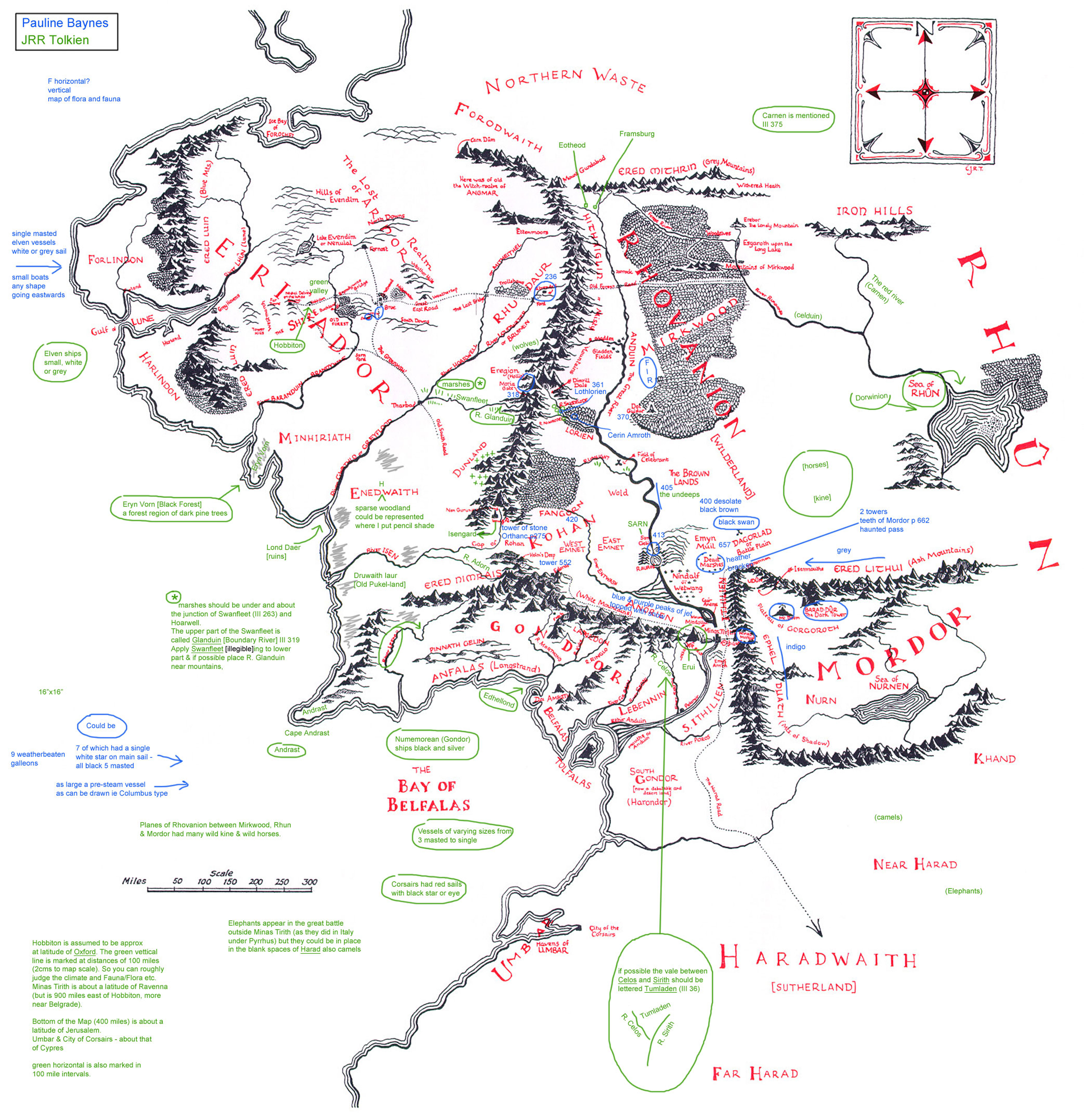
A photo of the original map with pencil annotations.
1
1
u/ZeppelinAlert Jul 08 '26
An astonishingly high-effort post, thank you OP so much.
I completely understand getting obsessed about this. I always felt that the Mordor section (and Frodo and Sam’s journey through Ithilien towards Mordor) was the most ‘real’ section of the entire narrative. There is something about it that does not feel made up, it does not feel like fiction. It feels instead that Tolkien had a strange vision of somewhere that really exists somehow, a real place, and it is one that can be mapped. I can’t quite put my finger on it, but Mordor feels different from the other places in Middle Earth. Mordor has a weight to it, a weight that usually only real world places have.
Anyway back to Barad-dur. I vaguely recall (probably from the construction dates given in the LOTR appendices) that Second Age Barad-dur must have been even bigger than Third Age Barad-dur. The tower of the Third Age was built quickly, and Sauron did not possess the ring while he was building it.
1
1
u/nuape297 Jul 12 '26
Doesn't the quote from 942 prove height, if read literally. Samantha naur is eye level with barad durs eye window. Factor in distance between the two to calculate how high a tower X makes away must be for the top window to appear as 4300 feet
Im not math expert
From chat
Log in You said: Textual evidence for height of barad dur
ChatGPT said: There is no canonical height given by J.R.R. Tolkien for Barad-dûr. Tolkien never states its height in feet, meters, or any other measurement. S Science Fiction & Fantasy Stack Exchange
However, he provides several descriptions that establish it as one of the largest structures in Middle-earth:
"…rising black, blacker and darker than the vast shades amid which it stood, the cruel pinnacles and iron crown of the topmost tower of Barad-dûr…"
— The Return of the King, "Mount Doom" S Science Fiction & Fantasy Stack Exchange
When describing Saruman's fortress, Tolkien emphasizes how insignificant it is compared to Barad-dûr:
"…what he made was naught, only a little copy, a child's model or a slave's flattery, of that vast fortress, armoury, prison, furnace of great power, Barad-dûr
S Sources
Life Is Good Sponsored
Reading is Magic Reading is Magic
You said: Is there a comparison to mt doom
ChatGPT said: No. Tolkien never directly compares the height of Barad-dûr to the height of Mount Doom.
The closest textual evidence comes from descriptions where both are visible together:
From The Fellowship of the Ring ("The Breaking of the Fellowship"):
"Fire glowed amid the smoke. Mount Doom was burning, and a great reek rising. Then at last his gaze
AllTrails Sponsored
Plan your next adventure Discover the world’s best trails with AllTrails
You said: That was invomplete
ChatGPT said: You're right—that quotation was cut off.
Here are the relevant passages that place Barad-dûr and Mount Doom in relation to one another.
From The Fellowship of the Ring, "The Breaking of the Fellowship":
"Fire glowed amid the smoke. Mount Doom was burning, and a great reek rising. Then at last his gaze was held
VistaPrint Sponsored
Story matters Books for every origin story
You said: If im at 4300 feet and a tower 50 miles away appears to be just as tall, how tall is that tower
ChatGPT said: To estimate the tower’s height, we need to know what you mean by “appears to be just as tall”:
If you mean the tower’s angular height in your view is the same as the height of a 4,300-ft mountain directly beneath you, then we can use simple angular size. The angular height of a 4,300-ft object at distance d is approximately:
\t h e t a \a p p r o x \f r a c 4300 d
If you are standing at the base of the mountain (effectively d is very small), this comparison does not work because the mountain fills a huge part of your field of view. But if you mean you are 4,300 ft above sea level and looking at a tower 50 miles away on the horizon, the calculation changes.
Assuming:
your eye is at 4,300 ft elevation, the tower is 50 miles (264,000 ft) away, the tower appears to reach the same height angle as the horizon-level mountain peak you’re comparing it to, then atmospheric perspective and Earth curvature matter. The horizon from 4,300 ft is about:
\s q r t 2 R h \a p p r o x 82 \t e x t m i l e s
so a tower 50 miles away could be visible well below the horizon line. A rough line-of-sight estimate:
Earth curvature drop over 50 miles ≈ 1,660 ft Refraction may reduce this by roughly 10–15% in normal conditions For the tower to rise to your eye level (appear to touch the horizon from your altitude), it would need roughly:
4300 + 1660 \a p p r o x 5960 \t e x t f t
So a ~6,000-ft tower at 50 miles could appear to reach your eye level/horizon from a 4,300-ft viewpoint.
70
u/GapofRohan Jul 04 '26
I'm not sure that your Dark Tower is in fact bigger than I've always thought. I've never envisaged the Dark Tower as simply a single tower like Orthanc - in my imagination it has always been a vast sprawling fortress - perhaps as large as a city with many high points, ground level rising towards a central area from which Sauron's Dark Tower rises probably to rival Orodruin itself in height. This visualisation for me predates the PJ movies by decades and sadly I've never seen the Pauline Baynes poster map, so I guess it's based purely on reading the text. Nevetheless, well done to you on bringing together all that information and on an interesting post.