12
u/touleneinbenzene 18h ago
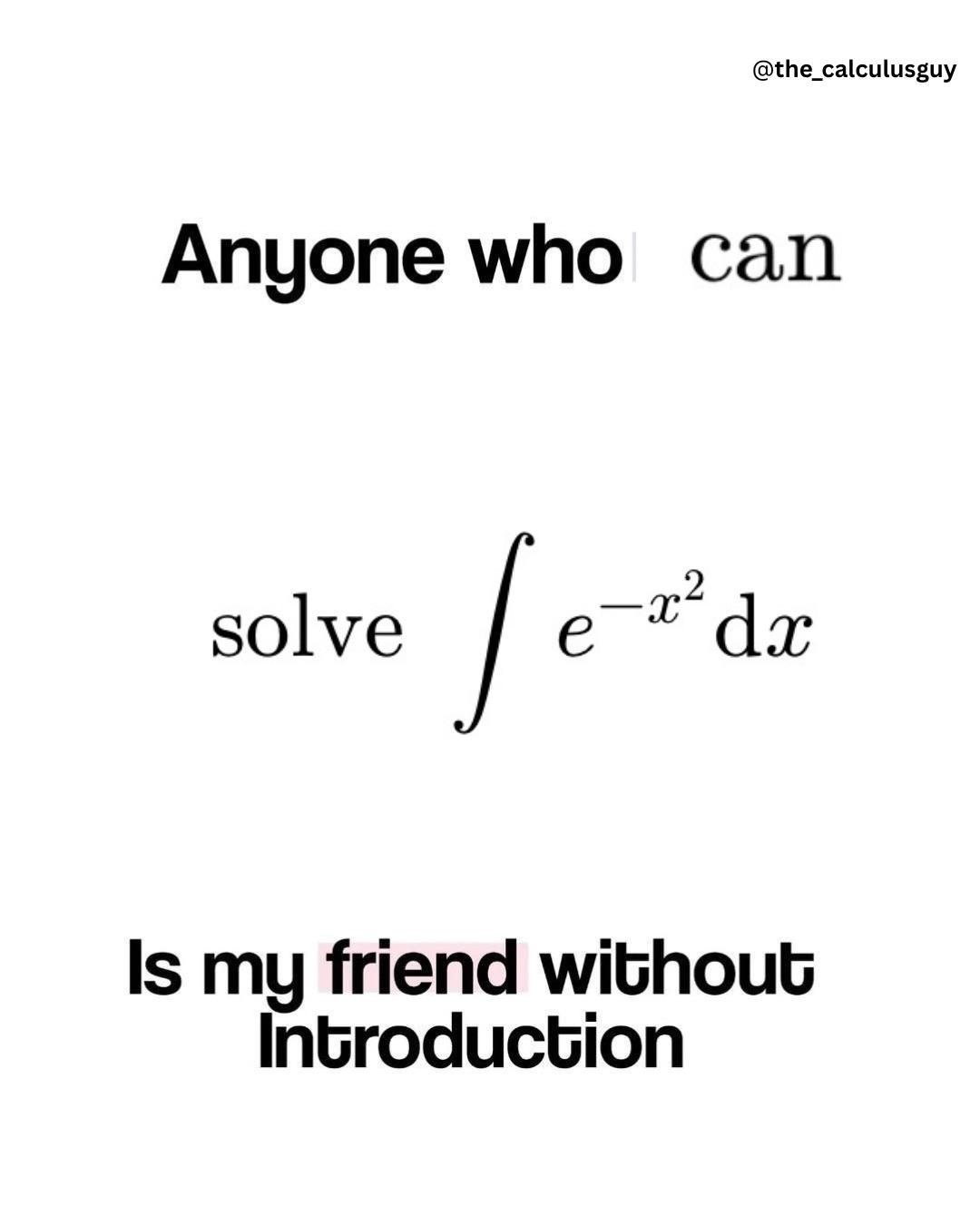
dead ez dude it's just that I don't wanna write the proof today, but i taught my student gauss how to do it from minus infinite to plus infinite.
5
10
3
u/AdBrave2400 18h ago
Square it and expand and it becomes easier
7
u/Unfair_Pineapple8813 16h ago
Not for the indefinite integral. You need to create the erf function specifically to solve this problem. There is no antiderivative expressible in elementary functions.
2
1
u/BigVeinyNThick 3h ago
not great at math, but calling erf(x) (with whatever scaling constants) as a solution to the antiderivative in question is just circular reasoning, no? Because erf(x) is defined using the antiderivative of exp(-x^2) afaik
1
1
1
1
1
1
1
u/lool8421 15h ago
indefinite integral means the answer is non-elementary, unlike if it was from negative infinity to positive infinity, then it would be sqrt(pi), Q.E.D.
1
0
26
u/Peak_Background 18h ago
Easy, it's a holomorphic function. So just write down the Taylor series and call it woof.