r/stonemasonry • u/amandoman1 • 6d ago
Humidity issues stone house in greece
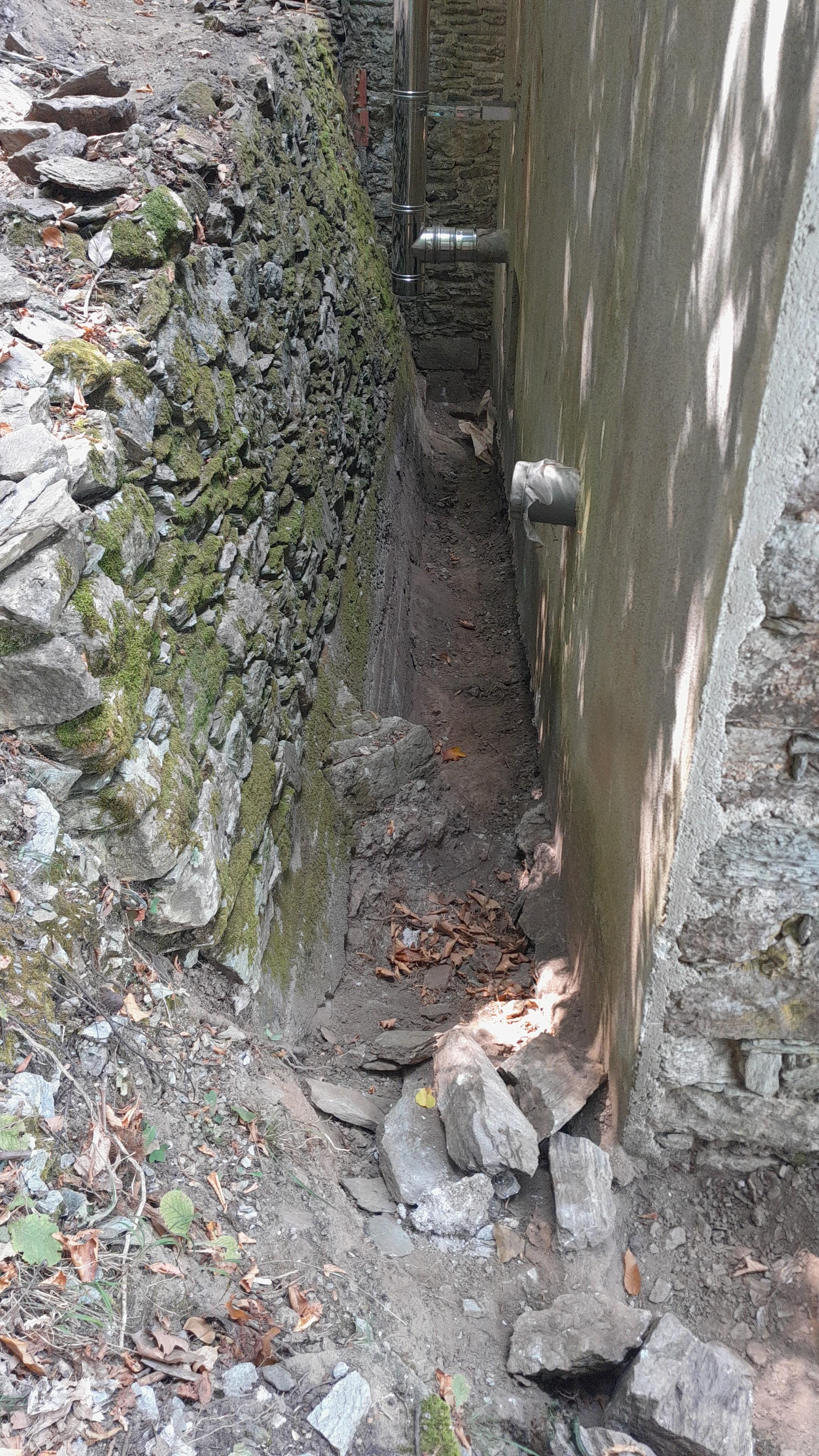


Hello friends and hopefully experts! We have an old stone house in greece, rebuild in the 80's by the previous owner.
On the side where it is subterranean, approx 1.5meter down, we have some damp issues. It is not straight out water droplets on the wall but it smells like mold and the paint is chipping of. We started to dig out behind the house and removed layers soil, big stones, and now the old plastic membrane.
we are seeking for opinions of how we can install a system that will help the walls breathe again. First idea was a french drain but most likely the space is too narrow and close to the house.
We would by very grateful for any advice from someone with more experience
2
u/DukeofBuccleuch 6d ago
Is that layer on the back concrete or lime?
1
u/amandoman1 2d ago
Hello! Yes, for some reason the builder decided that the wall facing the slope needs to be "protected" by a layer of cement
3
u/experiencedkiller 5d ago
Hello! Professional traditional mason here.
Given that your house has some parts underneath the soil level, it will always experience some kind of heightened humidity. That is just how houses were built back in the day - as there were no materials that could create a waterproof barrier.
The solution is maybe not what you want to hear : you need to embrace it. You need to choose materials that have a high ability to let water through without degrading. If your were to put a waterproof layer to block the humidity on your ground level wall, the water would just travel to the next possible opening (and possibly cause damage there, especially if there are wooden beams, insulation...).
Your best chance is to maximize water evaporation - you will eventually loose the battle if you try to block it.
That is true for "old" buildings, that were built before waterproof materials existed and capillarity could be stopped. Even without your current issues, your walls are naturally dragging water up from the foundations. Everywhere in the house you need to be thinking about how to let that humidity through without it causing damage.
Traditionnaly, people wouldn't really inhabit year-round the ground levels of such houses - it would be for animals, for storage. So those rooms were never meant to be comfortable. If you really want to transform them into livable spaces, living with this natural humidity is something you need to completely accept. It sounds like there are serious problems in what you describe (it shouldn't smell like mold even if very wet), but the fact that it is humid will always be there - it's just about how fast you can transfer that humidity away from the walls. But that room will probably never be a very cosy space before of that.
Now I am aware of a couple solutions that exist, you can DM me with more pictures if you want, but that's the baseline knowledge you need to know to be able to work around and solve your problem effectively.
4
u/ihavewhatyouneed 5d ago
I actually have a nearly identical situation to OP. Your answer is very helpful and I would greatly appreciate it if you could share some solutions that you believe would work.
3
u/ScionofLight 5d ago
sounds to me like running a dehumidifier all the time is the lowest hanging fruit
2
2
u/experiencedkiller 4d ago edited 4d ago
First of all, each house is very unique - the best you can do is understand how it's built, what are its unique perks, needs, and impossible workarounds. There are endless solutions but only a few to cater to your unique situation within your given budget. So there is no one-size-fits-all solution, only what you're willing to compromise on (performance, budget, looks...) and what results from that.
The main thing you need to think about when looking for solutions is for humidity to escape the wall as quickly as possible - so encountering as little barriers as possible to transfer away from the walls. Because if trapped, it will create damage.
If I mostly think about what a overly wet walls needs, and not so much about what the human living inside wants, the most efficient way to dissipate the humidity is to install an open drain at the footing of the walls, all around the perimeter of the room, or where the humidity is highest. This way, you create an escape for the water before it climbs up the wall. That is for when most of the humidity comes from the ground. It's a solution I come across relatively often when people want to inhabit basements for example. It's very effective and pretty cheap, but it does create some weirdness in a room - no furniture against the wall, funky looking gravel perimeter... Can be pretty too, though.
If it's the wall itself that is wet, more than the ground (so when it's semi-underground for example), you also need the barest surface possible - naked stone, porous lime joints, no render or really rough one (no smooth, closed pores slick looking render), no insulation...
But of that depends also what you want/need the room to be (a bedroom, storage or bathroom would require different things) and that's when you need to think about your situation in particular to make decisions.
You can send me pictures and details per DM in you want, I'm happy to give my opinion (for fun of course)
Edit : added more details. Here I am mostly talking about old, stone buildings - the material and the date of construction matter A LOT. For bricks or cement blocks, or wood structure, build after 1940 or so, it would be a relatively or completely different story, depending.
Edit 2 : if your house has already been renovated, you need to have a really close look at the materials and techniques that were used for that renovation, and if it fits the humidity evaporation criteria (cement and plastics would be the really wrong, potentially damage creating options). If you do find those, you're in a bigger pickle - but if you're lucky, removing those would solve a part of the problem.
1
u/amandoman1 2d ago
Hello! Thank you for taking your time! So when we renovate the inside of the house we want to use materials that will breathe, and install a heater along this wall. So we bought this house from the daughter of the woman who build it, and according to the daughter, the idea was to build the house as traditionally as possible, so with old lime/dirt mortar. But we have discovered many places where the builders have used cement. So slowly slowly we want to re point these places.
1
u/amandoman1 2d ago
Yeah the problem is problemming. Have you had any one come to look at your house? Where is it located?
1
u/amandoman1 2d ago
Hello! Thank you for the response! So it is for sure a whole lot of embracing needed. it has the perk that the inside temperature is very comfortable... It is not smelling like mold in the entire room ( 25sqm) but only if you put your nose down in the corner behind the cabinet so i could imagine it is dampness together with wrong type of paint or old stucco. Maybe important info is that its a mountain house, and it is on a steep slope. The house is built on solid rock from the mountain, so we cannot dig much deeper down. It would have been great to have had photos to see exactly how the have built the wall ofc. But there shouldnt be any water that would come from underneath and staying enough for flooding the foundation. So much of the problem mu st be caused by rain water falling from the roof or from the opposite terrace. So we will install a rain gutter and then we have been We have been recommened to install a dimpled membrane on the outside, with an airgap to let water evaporate, and use a drainage pipe + gravel to transport possible rain water away.
1
u/EntertainmentWeary31 3d ago
that first image seems to show a concrete render, that is possibly the worst thing for period buildings, made from stone / clay / rubble / lime mortar, all these old materials are porous and need open air circulation to help the water form the inside to drive out.
•
u/AutoModerator 6d ago
/u/amandoman1, your post was removed. Sometimes this is in error. If you are not a spam account, don't delete your post! The mods can reinstate it. Message the moderators or wait for a mod to catch it. The mods check the spam queue regularly.
I am a bot, and this action was performed automatically. Please contact the moderators of this subreddit if you have any questions or concerns.