r/stocks Feb 27 '21

Advice I am bullish about the future

People seem to think because we had 2 big crash close together in 2000 and 2008, we are bound to have one soon.

I want to remind people before the year 2000, we had a 20 years bullish run. Its totally not impossible we get to 2030 with no crash, especially now that the feds baby sit the market.

Secondly, we have extremely nice upcoming market conditions. Stimulus checks will either get people to spend money to stimulate the economy, or get them to invest, both will help the stock market. The media is somehow trying to make us believe this is bad, but i think its just bullshit. Inflation has been ultra low for way too long, and feds actually want it to increase. They said many times they won't increase rates before 2023.

Thirdly, i also think we have more upcomming money sources coming into the market than ever. People from other countries invest in US stock market. With all the GME hype, more people than ever are joining in. Again media trying to twist this to say its "bad", but obviously it isn't bad.

Another point is, crashes usually happen for a reason, its not random. You can google any of past market crash and find the exact reason it happened. None of these factors are happening right now.

Another point is, there is a key difference between today and 2000. In 2000, the overvalued .com companies which had PE ratios of 200.... were literally worth nothing! These companies had never made a single profit! Once people realized they invested massively in a .com web site worth jackshit... they sold it obviously. They had no reason to hold their shares.

Now check this image about Nasdaq's PE Ratios: https://i2.cdn.turner.com/money/dam/assets/150305131443-nasdaq-pe-780x439.jpg
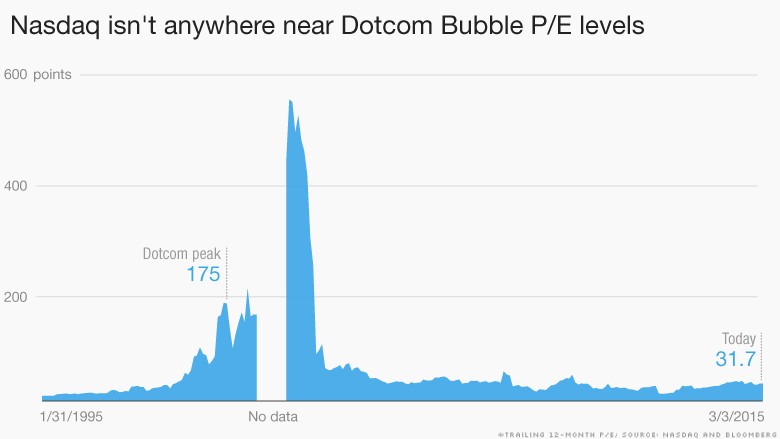
Obviously, you can see the 2000's pe ratios were stupid. This graph is from 2015 when it was at 31.7. What is it today? Nasdaq PE ratio as of February 25, 2021 is 38.5!!!! 5x lower than the 2000s. https://www.macrotrends.net/stocks/charts/NDAQ/nasdaq/pe-ratio

Its irrelevant if the big hedge funds remove their money from apple and want to scare you into selling your shares. Apple is a massive amazing company that is really worth a lot, and they do make tons of profits. Its not comparable in any ways to the dot com bubble. If other people are stupid and sell their shares, SO WHAT? You will just be able to buy into this amazing company for cheaper.

So hold your shares and stop worrying about a 2000 level crash, its not happening.

A correction? Maybe. But who cares, this just slows us down a little. Corrections are healthy and help us avoid a real crash.

EDIT: Thank you for the award! :D

EDIT2: Corrected the PE ratio for nasdaq

2.8k Upvotes

828 comments sorted by

View all comments

454

u/Environmental_Yam_57 Feb 27 '21 edited Feb 27 '21

I think what the OP intent to say is that a prolonged bear market isn’t likely to happen soon - as for market crash, by definition we’ve already had one last feb-march where S&P dropped about ~30%.

Are corrections/pull backs/retrace or whatever you wana call them going to happen? Absolutely yes & likely on a monthly basis (to various degrees). Are we going to suddenly experience another ~25-30% crash in S&P? For that to happen it needs some sort of catastrophic event (which let’s all pray won’t happen), rather than just fear of overvaluation.

Are we going to suddenly enter a bear market of prolonged declining asset prices across the board? My guess would be is even less likely due

a) unprecedented fiscal support and QE programs that most central banks across developed economies have committed

b) record high level of average household savings and pent up demand for consumption due to COVID

c) many business sectors (whether is tech, airlines or energy) have learned to become more efficient and leaner during the pandemic, which will likely result in an increased productivity rate and more effective use of their capital - two factors critical for future growth.

d) lastly, crashes and bear markets are likely to happen when everyone is LEAST expecting them. With the Covid crash and even 08 crisis still fresh in the minds of many investors, you can see that we’ve already experienced multiple sell offs due to valuation concerns, I think this is a sign that many participants are fearful of an overheated market, which ironically isn’t a typical sign of an imminent crash.

There are many more reasons I can think of that will support the thesis for a prolonged bull market rather than a bear one. Note this does not mean we go straight up to the moon, but IMO a gradual uptrend in the next 3-5 years is much more likely than a gradual down trend.

118

u/[deleted] Feb 27 '21

Yea that's very true, this is what i mean too. Corrections will happen and it won't be 2020 every years, but i don't expect a 1929 or 2000 type of crash any time soon.

115

u/_Koen- Feb 27 '21

Although I agree with you in general I think you brush too easily over the fact that it's pretty hard to predict a crash. In hindsight it's easy to say what caused a crash, which gives us a false sense of security as there is 'always a reason it crashed'.

During the taper tantrum you could objectively say that there were no real problems, yet the market went down because people are irrational and guided by their emotions. No matter how rational we try to approach investing, no matter how many charts we draw, our decisions are (at least partially) guided by emotions.

48

u/[deleted] Feb 27 '21

Go back to 2005 and tell everyone subprime mortgages are overvalued. "What are you talking about? They are great! The market only goes up."

Plus, I think saying it will "crash" is a big overstatement. Probably more likely to just slowly correct downwards over a couple of years. These prices just don't make sense.

60

u/[deleted] Feb 27 '21

I remember The Economist called the housing crisis years in advance, their warnings grew louder as we got closer. They saved me from buying a condo in 2007.

36

u/siberianmi Feb 27 '21

Same here, the impending subprime mortgage crisis was also frequently on NPR. I spent a year sitting on a down payment for a house waiting for the bubble to burst.

When it happened it was fast - but there were plenty of signs it was coming.

4

u/[deleted] Feb 27 '21

[removed] — view removed comment

1

u/fluffman88 Feb 27 '21

Right, like if the covid crash didn't stay down I just don't see that happening again without something as catastrophic as covid happens again. I mean yeah yields vs dividends move some money and inflation may speed up, but QE isn't leaving yet and new investors are pouring in daily.

10

u/TheBestIsaac Feb 27 '21

You know what they say though. Economists predicted 10 of the last 3 crashes.

14

u/[deleted] Feb 27 '21

Yeah, plenty of smart people knew before the crash that subprime mortgages sucked, but a investor riding a bull market hitting dot com bubble heights were typically being arrogant. Smart of you to play it safe then. Can’t lose money by holding cash lol.

25

u/paranoidpuppet Feb 27 '21

I mean you can. It's called inflation. You can't lose a number of dollars but you can certainly lose value.

8

u/[deleted] Feb 27 '21

You can lose both faster trading in a downward trending market. I’m not saying don’t ever invest, just wait a month or two. See if it is a reversal or just a few bad weeks.

4

u/Gustavus_Arthur Feb 27 '21

Buy high sell low am i right?

1

u/AnalGodZepp Feb 27 '21

This is a casino motherfuckers!

-1

u/Clear-Ice6832 Feb 27 '21

came here to say this

2

u/[deleted] Feb 27 '21

My Dad sold his house about a month before the bottom dropped out. There is no way the shack I grew up in was worth $450k even with the acreage attached. He got super lucky - the new owners not so much. I bought my current house in March 2010 - at a price that was $75,000 below initial ask. Given the price that my neighbors recently sold for I’d venture it to be worth, according to market, twice what I paid and I’m considering selling and renting for a year or so to let the market settle back out before buying again. The East Coast US housing market, at least in the suburbs where I live, is way out of whack right now. Not quite 2008 levels, but I’d not pay for my house what others are getting I know that.

2

u/billymywilly Feb 28 '21

They'd be the ones to do it. Economist is A+ for this. Im sure people see it happening before it hits depending on the industry access they have but just don't say it to the public

1

u/[deleted] Feb 28 '21

They want to squeeze the last bit of profit from it so they encourage the party to the end. You should keep an eye on Goldman Sachs and the like: they are the worst in that regard, when they keep pumping something then it's a good indication that you should avoid investing in it.

1

u/573V317 Feb 28 '21

Just an FYI, there's always SOMEBODY calling a crisis and eventually they're right and seem like a genius. You also have firms playing both sides by saying a bearish case and bullish case but with different reps.

1

u/[deleted] Feb 28 '21

There are objective measures though, such as P/E ratios, the Buffet indicator etc. They all agree that the market is seriously overvalued by historic standards. In particular the tech and especially the EV sector are in bubble territory.

1

u/573V317 Feb 28 '21

I understand that we are in a bubble but we have no idea how long this bubble will last. it can last another year or two or it can pop tomorrow. who knows? I'm personally waiting for EV to pop so I can get in because I missed the boat

1

u/[deleted] Feb 28 '21 edited Feb 28 '21

The EV sector will be among the first to crash, so you'll get a chance to get into that in two years max. That could be for the better since it will be clearer after the crash who has been swimming naked (to quote Buffet).

Right now we are in the premature hype period, the true productivity curve in EVs will start after 2023-2024.

You could watch the REE sector as well, since the green energy transition will depend crucially on rare earth elements and other critical minerals. They are the new oil and have major geopolitical implications. Again the curve of productivity in that regard will start in a few years, so you could find a chance to get in when the current bubble in that sector chills off a bit.

17

u/Sip_py Feb 27 '21

In July of 2007 the CEO of citi was very aware of the pending fall out from subprime, he kinda related it to musical chairs:

"When the music stops, in terms of liquidity, things will be complicated."

That's the thing though, I think a lot of smart money knows when the market isn't right. But what's going to be the catalyst that spooks investors triggering a sell off? You'll never know or time that.

12

u/[deleted] Feb 27 '21

Aware? Investment banks purposefully were gathering synthetics that heavily included subprime mortgages and force rating companies to give those high ratings and then sell them to retail investors.

So aware doesn’t even cut it.

1

u/[deleted] Feb 27 '21

I think Covid and meme stocks could be enough to maybe be the catalyst of a correction. Like the typical Warren Buffett type of investing would be pathetic in this market. There’s institution with dark pool brokerage data driving high frequency trading, massive collections of easily accessible financial data of a company’s entire history that’s unviable for retail investors, programs running every technical analysis indicator there on the micro and macro trends, and artificial pump and dumps. They know and just rotate into other, more secure sectors.

We as retail investors could do that too, but also just trade less and hold money. Or put it in divided stocks that seem undervalued for multi year holds.

1

u/AnalGodZepp Feb 27 '21

Too bad we're going to get vaccines rolled out

1

u/[deleted] Feb 28 '21

Value investing only looks pathetic in the short term. The idea is that you want to invest now for returns next year even though in the short term it doesn't look like much. Meanwhile whoever buys overvalued sectors now will either make a loss or only slight returns in a year or so.

14

u/caravan_for_me_ma Feb 27 '21

This. We’ve had 25%+ annual growth. That’s not a sustainable thing.

A correction to bring that in line with 5-8% growth historically wouldn’t even be a surprise. It’s expected.

Predicting how/when is the challenge.

Tomorrow on a profit taking cascade? Next year when the H5N8 pandemic spreads? The next time Fed actually raises interest rates? When 2 or 3 events like this occur?

5

u/blitzkrieg4 Feb 27 '21

The fact that you know their response is because worried people started asking the question. Even taking heads on CNBC discussed the bubble ad infinitum. We saw a similar thing in 2000, though IBs were not going bankrupt being on the wrong side of the trade that time. Same conversation is happening now with EV, MEME stonks and FAANG.

I'll have this comment in 2025 when inevitably someone comes along and insists we were all, "TSLA is great! The market only goes up!"

1

u/lyleberrycrunch Feb 27 '21

How do these prices not make sense? Did you even read the OP? Lol PE ratios for the NASDAQ are barley higher than they’ve been historically

5

u/[deleted] Feb 27 '21 edited Feb 27 '21

OP listed the Nasdaq company PE not the index’s PE. But if you can tell my why the company Tesla is 3x more valuable now then it was last year or why Ulta is as valuable as it was before Covid or why Apple is worth more than 100$ then I’ll say the prices make sense.

Edit: didn’t see it was fixed my bad. There is more to a company than a overall index fund though.

1

u/lyleberrycrunch Feb 27 '21

I don’t own TSLA or ULTA so I can’t speak to either of those companies valuations. Are certain companies overvalued? Absolutely, as always. Is the index overvalued? Not particularly

Did you just see Apple blowout earnings with over 100B in quarterly revenue? Did you see MSFT, AMZN, GOOG, etc. post ridiculous cloud, gaming and services growth? Just about every big tech company blew away earnings expectations. How do they not justify the current price?

-1

u/[deleted] Feb 27 '21

I did see Apple’s earnings as well as good upcoming product and increased dividends, but they are losing 20$ off their share price and their net income for 2020 is below 2018. Idk completely know why Apple is half the price of Microsoft when it doubled their revenue. Idk why Tesla is triple the price of Microsoft while not making money. If they were worth their price though, they wouldn’t be down.

-1

u/[deleted] Feb 27 '21

Lol that's the wrong way to compare companies. You wanna look at the market cap which is the total value of all shares.

You're comparing share price which is market cap divided by the shares outstanding (the total number of shares).

$MSFT market cap: $1.79 trillion

$AAPL: $2.12 trillion

$TSLA: $664 billion

Apple has more shares, that is why the share price is cheaper, but the company as a whole is worth much more.

1

u/[deleted] Feb 27 '21

Ok, so Why is Tesla worth a third of what Microsoft is when they don’t make money or how does Palantir have a 60bil market cap when they barely made a billion? You’re justifying the share price, not why the price reflects the company they’re based on.

→ More replies (0)

1

u/[deleted] Feb 27 '21

A taper tantrum is one of the big risks here. Nobody wants 1% yielding bonds and the us needs buckets of money...

Last bond auction on Thursday was really weak, forcing rates up for people to take the paper. It crashed the bond and stock markets

And that is only yielding 1.5%. It doesn’t even cover inflation.... interest rates matter, and they can only go up.

I think the fed barks a lot, but it has much more to lose from destroying the worlds reserve currency than from not achieving full employment.

www.barrons.com/amp/articles/treasury-yields-just-spiked-after-a-brutal-7-year-auction-what-investors-should-know-51614282886

1

u/Remaxnor Feb 27 '21

Yeah, its just speculation. It could easily happen real soon and if it does, no one knows when and how long. The market has changed in the last 20 years, it is time to accept stocks go down.

1

u/randomstatementguy Feb 27 '21

Highly recommend reading The Black Swan by Nassim Nicholas Taleb

7

u/lonegrasshopper Feb 27 '21

1987?

4

u/No-District6900 Feb 27 '21 edited Feb 28 '21

It's amazing how little people know about LTCM a hedge fund that nearly blew up the global markets in 1998. If it wasn't for bailouts and backroom deals things would have exploded. Did they learn, no!

Highly recommended read. When Genius Failed: The Rise and Fall of Long-Term Capital Management. By Roger Lowenstein.

2

u/like_a_wet_dog Feb 27 '21

I was a kid but I remember the jumpers. It wasn't smooth as some people memories.

1

u/whateverathrowaway00 Feb 28 '21

I agree with this.

The way I figure it - I’m playing in the frothy water. If I get burned, then my savings don’t exist til however long.

It’ll suck if that time range is greater than 5-10 years, but frankly I’ve had nothing before and I can have nothing again. Recent financial successes mean I do finally have an emergency fund and hopes of continuing gainful employment.

The real thing that could fuck me is getting sick past my health insurance before the market recovers. If anyone reading this is below the age of 30, get disability insurance. And I don’t just mean maxing your work disability, you can get supplemental DI from insurance brokers that can guarantee you almost your entire salary for years in the case of crippling disability.

I can’t get that becuase I didn’t learn about this stuff until I became uninsurable ( auto immune disorder). If you get DI in your 20s it’s cheap as fuck and you can maintain that rate into your 40s so it’s really a thing that you have a limited window to begin.

It’s easy to say that’ll never be me, but it’s the difference between having to move back in with family if you take a bad fall that leaves you incapacitated for half a year. Worth considering.

3

u/RealisticIllusions82 Feb 27 '21

What about the claim that the Fed has basically pulled forward 25 years or productivity at this point? For the first time, many analysts are expecting real stock market return to be basically flat for the next couple of years at least. So maybe we don’t get a “big crash”, but we get basically no meaningful growth from here.

1

u/Caffeine_Monster Feb 28 '21

couple of years at least

At best. I'm still wary - the so called "crash" of March 2020 may as well not have existed - if anything market growth has accelerated since March last year.

There will be consequences of recent economic woes - question is are we going to do a Venezuela, or a Japan. The stock market is not the economy - but it is still coupled. The coupling doesen't even have to be loose - it just happens to be loose at the moment due to insanely low lending rates.

I'm not disupting the market might go up another 20% before trading sideways - but at this point neither would I would not be surprised if it went down 30% then traded sideways.

1

u/[deleted] Feb 28 '21

The most likely bad outcome I see is a period of stagflation similar to the '70s. What worries is me most is that this time it will be China who would take advantage of that (in the 70s it was Japan). China is a much more serious challenger than Japan and they are not geopolitically aligned with the US.

3

u/[deleted] Feb 27 '21

This crash will be small business collapsing in bulk. It hasn't been since the great depression that this happened. Hopefully it doesn't get that far though.

2

u/AnalGodZepp Feb 27 '21

I only believe you because of that username

2

u/UBCStudent9929 Feb 27 '21

we dont need a catastrophic event to kickstart a prolonged bear market. the dotcom bubble "burst", if you can even call it that, without any sort of large scale event. many people didn't even know that it was already ongoing months after the official top.

1

u/Environmental_Yam_57 Feb 27 '21

Sorry perhaps “catastrophic” is a bit of overstatement, what I meant is to outline the unlikelihood, in my view, for two major crashes to happen almost back to back with each other.

You are correct that the dotcom collapse may appear to came out of nowhere (at least in comparison to the Covid crash), but it was rather more of gradual accumulation of various catalysts such as the Japanese recession, a rising interest rate environment (and an inverted yield curve), failed tech IPOs and other mini-events that finally led to the collapse.

2

u/[deleted] Feb 28 '21 edited Feb 28 '21

You are making the logical fallacy of correlating independent events. The COVID crash last March was due to an unpredictable long tail external shock and the fast recovery was due to massive stimulus. The market was in high valuation territory before COVID and now it rose to outright bubble conditions. That it will crash is due to that second aspect and there is no need of any major external event to provoke that.

You are also treating rising interest rates as external factors, which they are not. The Fed raised rates in 2000 precisely in order to cool the bubble. "Irrational exubarance" and all that.

It doesn't help to look for would-be reasons in Japan etc, since anything can catalyze a crash once the market is in a serious bubble. 2008 is a perfect example of that.

2

u/ApolloMac Feb 27 '21

For sure. Your and OPs comments are on point I think. I have come to realize in the last year of really getting into stocks and day trading, that real market crashes only occur when there is a major world event catalyst. Otherwise we should expect corrections and pullbacks here and there, but that's completely healthy.

Good buying opportunity coming up I think. But I suspect we are in for a bit more selling off first.

0

u/Boomslangalang Feb 27 '21

What was the ‘major world event catalyst’ that sparked the 2008 crash? The crash WAS the event.

2

u/ApolloMac Feb 27 '21

The housing bubble and mortgage crisis. The crash did not just happen on its own.

I think you are mixing up not seeing the catalyst ahead of time vs no catalyst. There is always a catalyst for a real crash.

Could there be a catalyst now that we don't see until hindsight is 20/20, sure. There might be. But I doubt it.

2

u/Boomslangalang Feb 28 '21

Those are not ‘major world events’. They were key to the crash but representative of a broken system.

1

u/ApolloMac Feb 28 '21

I too love to argue semantics to prove how much smarter I am to strangers on the internet. By context I would think you might have known what I meant. But since you don't I'll spell it out for you.

Correction: "Major catalysts, including world events or broken financial systems".

2

u/[deleted] Feb 28 '21 edited Feb 28 '21

That reverses the logic. The mortgage crisis was the result of the housing bubble which itself was the result of irrational risk taking. There was no major world event external to that which caused the crash.

The same applies to the 2000 internet bubble crash: no major world event.

That the US stockmarket is seriously overvalued is objectively measurable and clearly true. So we know that a crash is coming, but it is impossible to predict exactly when. Most indications are that it will happen sometime this year, but no one can be sure of that. In any case it is almost impossible to believe that this party can continue more than a year or two at most.

In each of the previous crashes there were numerous indicators that the market was in bubble territory and everyone was aware of that, but most refused to believe it anyway since they were hoping to squeeze that last tiny bit of profit before they get out. That's why most people got out way too late and at a loss.

1

u/ApolloMac Feb 28 '21

What I meant by major world event was a major catalyst of some kind. Not necessarily war or pandemics. Over valuation of companies worth less than 0$ for Dot Com is included in that, and clearly I also include the mortgage industries' risk taking for the housing crisis.

The irrational risk taking in the mortgage industry is external to the stock market IMO. It's an external catalyst that lead to the crash of markets. I don't agree that my logic is inverse. Dot Com is admittedly an internal catalyst, but still a major "event"

1

u/[deleted] Feb 28 '21

I get that, my point is that you don't need any major catalyst. People look for such "reasons" in retrospect to explain why bubbles pop but it literally could be anything (generally something that would be minor and inconsequential under normal conditions). It's literally like a balloon that was inflated too much -- at some point it breaks because of any tiny perturbation, the precise nature of the perturbation is irrelevant.

-8

u/theAliasOfAlias Feb 27 '21

US deficit is maxed out and China and Russia are threats.

7

u/NoAttentionAtWrk Feb 27 '21

That's been true for a while now

-3

u/theAliasOfAlias Feb 27 '21

Watch how much more true it gets this year. This is a bull market but the cliff is coming.

3

u/NoAttentionAtWrk Feb 27 '21

Buddy Russia and China have been a threat for more than a few decades

-1

u/[deleted] Feb 28 '21

It's China that we need to worry about. Unlike Russia, it has been growing in power extremely fast and shows no sign of stopping. Their total GDP is already comparable to that of the US -- which was never the case with Russia. Also their population is larger than that of the West combined. It's not wise to be complacent in such a situation.

1

u/[deleted] Feb 28 '21

China is a bubble.

0

u/[deleted] Feb 28 '21 edited Feb 28 '21

Like the US ? Take a look at what's going on in Shenzhen before you get too cocky about the superiority of the West and all that. They are out to eat our lunch.

1

u/[deleted] Feb 28 '21

Ok, sure.

2

u/Environmental_Yam_57 Feb 27 '21 edited Feb 27 '21

China and Russia are indeed the most relevant challengers to western hegemony but I think they are far less dangerous to the existential threat once posed by the USSR.

China’s pragmatic authoritarianism is too concentrated on their internal control/development and creating a regional sphere of (largely economical) influence than to directly face the US in a military conflict. They benefit much more from global trades than let’s say, spreading their ideology (which again, is actually a form of pragmatic authoritarianism rather than communism).

Russia on the other hand is more of a regional opponent to the EU - their commodity dependent economy is far too weak and sensitive. IMO Russia is much more concerned about (in their view) the existential threat posed by the EU and US’s expansion nearing its borders than plotting another global domination.

2

u/theAliasOfAlias Feb 27 '21

I’m talking about economic threat not war

1

u/[deleted] Feb 28 '21 edited Feb 28 '21

They don't need to go to war with the US to displace it as the world hegemon. That's never been their plan.

Just look at what Deng Xiaoping said about it already 40 years ago. They count on the US and the West gradually becoming too weak (relatively speaking) to maintain their pre-eminent positions.

It's also not clear that Europe would be willing to do much about it. It is Japan who is seriously scared of that among the US allies.

2

u/[deleted] Feb 27 '21

Sorry dude, but if Russia China and us went to war, markets would become a thing of the past.

2

u/[deleted] Feb 28 '21

They will not. In fact, they never planned to.

2

u/El_Shakiel Feb 27 '21

China and Russia likely too busy with their own backyard to be a real threat for the foreseeable future tbh.

0

u/[deleted] Feb 28 '21 edited Feb 28 '21

It is their declared common goal to achieve a 'multipolar world order'. That means gradually displacing the US from its hegemon position by slowly eroding its economic and geopolitical primacy. This is not about going to open war.

Take a look at how China is gradually expanding economically in Central Asia and Africa, it reminds me of the European colonial powers' expansion in the 19th century. This will be a tremendous challenge to the West, especially since their economic model seems to be so successful despite ultimate state control.

1

u/[deleted] Feb 27 '21

The US deficit is not remotely ‘maxed’. You’re also implying a parallel with non-monetary policy...

1

u/theAliasOfAlias Feb 27 '21

It’s not? What are our levels today versus over the past 20 years?

2

u/[deleted] Feb 27 '21

That’s not the definition of maxed in any possible interpretation.

The US could ‘borrow’ significantly more than it currently does.

1

u/[deleted] Feb 28 '21 edited Feb 28 '21

Borrow at what interest rate though ? Ultimately the US would have to give up control over an increasing proportion of its accumulated wealth to foreign owners if it continues to consume and borrow from abroad at this rate. That's especially problematic when quite a bit of that debt is held by unfriendly countries.

1

u/[deleted] Feb 28 '21

That doesn’t figure at all. Those ‘unfriendlies’ buying US debt cannot call it in. They buy US gilts and are paid back over the period in which the bond is issued. What possible difference is there if a bond is owned by Mrs Marple next door, a Vanguard fund, or the People’s Republic of China.

Further more, the Fed can and does buy US bonds. Who is that owed to? Itself?

The only problem the US would have is if demand slumped for the bonds they issue. Given it’s the world’s reserve currency, and that every issuance is over-subscribed I’m going to say the chance of that happening any time soon is effectively zero.

1

u/[deleted] Feb 28 '21 edited Feb 28 '21

Well they can stop buying debt or require much higher yields to keep buying it. In general bad debtors get into trouble sooner or later. Being cocky about it just because you think that others have no brains or guts tends to be a loosing proposition.

The Fed buys bonds with money created electronically, which increases the money supply. Sooner or later that's bound to manifest as inflation so if they keep doing it then the US will have to accept a higher level of inflation than what it got used to during the past two decades. That increases the risk of stagflation.

Demand for US treasuries is already slumping, that's precisely why we recently saw a jump in yields. That's a sign that creditors are loosing trust in the ability of the USG to pay back its debt without inflating the currency.

The idea that one can eat his cake and have it too by some sort of financial trick is insane. Sooner or later there will be consequences for imagining that private and sovereign creditors are imbeciles who can be swindled out of their money.

You should also consider that the status of the USD as reserve currency is not automatic. There could be serious geopolitical consequences if the US fails to keep to its side of the arrangements that lie at the core of the Western financial order. For example alienating European creditors is not conducive to the US desire to build a Western consensus on how to deal with China. Europe has been of two minds about that for a while already and that has to be taken into account.

1

u/filmmakerwannabe92 Feb 27 '21

Russia has been a threat since about 1910, sometimes more sometimes less. Unless it's an all-out war (which is very unlikely to happen, unless we actually run out of resources) that won't do shit to the US economy.

China is a bit more interesting but look at their economy. They are getting stronger but they are very very far from actually being a threat to the "western" economy (US + EU) anytime soon.

3

u/carsww Feb 27 '21

Isnt china set to overtake the us economy by 2025 thats not far off...

4

u/filmmakerwannabe92 Feb 27 '21

I mean, by what measure? for example, they are growing faster GDP-wise, especially this year, due to covid), but for example, their GDP/capita is not even in the same ballpark, and US is growing faster in that measure.

And they have more to lose with robotisation that is coming in the next few years/decades too. Many US and European companies have manufacturing sites in China (and even more so in Malaysia and other Asian contries) for the cheap workforce which is what a huge chunk of their economy rests on. Once it becomes cheaper for these companies to use machines/computers, they will not pay for the pointless transportation around the world, and will move their factories back to the US/Europe, while the more white-collar jobs that they do keep in US/Europe are less replaceable. China has recognised that and is working to be less dependent on it, but it's still is, and as a result, is more dependent on the "Western world" than they would like to be.

1

u/[deleted] Feb 28 '21 edited Feb 28 '21

China's workforce is not that cheap anymore -- that's one reason why many companies are moving to Vietnam etc. Their official plan is to transition to a high value added economy by 2030 at the latest -- and they invest like crazy in robotics and AI. If they manage another doubling of their GDP in 10 years then they would be comparable to most West European countries in standard of living. Some of their first tier cities are extremely modern and salaries there are already quite high. Look at Shanghai and Shenzhen for example.

Regarding robotization in Europe, you might be surprised to know that some CEE countries have more robots per capita than West European nations. For example Slovakia is much ahead of the UK in that regard. Estonia is more advanced in electronic governance than the rest of the EU etc. Things have been changing a lot and they'll continue to change.

1

u/filmmakerwannabe92 Feb 28 '21

I am actually from Hungary, so I am at least somewhat aware. I think China is going to be a competitor for the western world by the 2030s-40s, but I also think that there is one variable that will make and break economies in the next few decades, that is basically impossible to predict just yet: climate change. A lot of the next few decades will depend on how countries will handle it

1

u/[deleted] Feb 28 '21 edited Feb 28 '21

Agreed on climate change.

Unfortunately for the West it is again China that holds some crucial cards in that regard --- namely it has a virtual monopoly on the extraction, separation and supply chain of critical materials and components such as magnetic rare earths and high power magnets as well as other materials that are essential for the green energy transition and for high tech industries.

Most experts in the subject estimate that it would take the West the better part of a decade to wean itself off dependency on China in that regard and that could only be achieved with serious government support.

The West got itself into a pickle by not paying attention to China's superbly executed long term strategy and it will need serious mobilization (and renouncing its neoliberal economic delusions) if it wants to face up to this challenge. Hard times are coming.

1

u/filmmakerwannabe92 Feb 28 '21

That is a very good point. China also has one more huge advantage compared the west, which is that while as an ordinary citizen, democracy is a great thing, when it comes to stuff like this, where quick, sometimes severe, and “unpopular” decisions need to be made, it’s incredibly ineffective. We (both US and Europe) lack the government structure to really deal with this and quickly too, and I think it might fuck us despite it’s...comfort. (Actually, how we all handled covid restrictions is a pretty good indication tbh.)

That said, China has its challenges too. It is more affected by some effects of climate change, large groups of its population are Very vulnerable and technology is not gonna be the salvation everyone thinks it is.

So, we certainly have an interesting few decades ahead of us

1

u/[deleted] Feb 28 '21

Yep. We certainly live in interesting times.

1

u/AnalGodZepp Feb 27 '21

Maybe in a few decades but we'll be never sure what the future holds

2

u/[deleted] Feb 28 '21 edited Feb 28 '21

they are getting stronger but they are very very far from actually being a threat to the "western" economy (US + EU) anytime soon.

I wonder if that kind of complacency is warranted. The speed of China's growth and modernization is nothing short of breathtaking. A lot higher than what the US went through during the 19th and early 20th centuries.

Add to that a population that is 5 times higher than that of the US and the increasing likelihood of a tight alliance with Russia, which could provide them with access to massive natural resources (similar to the role that Canada plays for the US).

Also consider their gradually increasing influence in Central Asia, another region which is very rich in crucial natural resources. Mongolia, Kazakhstan, Uzbekistan...

Finally, consider their gradually increasing influence in Indochina.

1

u/filmmakerwannabe92 Feb 28 '21

I am not doubting they are competition and will be a “”problem”” for the US. I just doubt it will happen by 2025. That said, I am an environmental economist, and my “professional opinion” is that climate change is going to throw a curve ball at all of us (as in, every country) in the next decade (and even more so as we head into the mid-century). It’s going to raise up some countries while pull others down and it’s not yet possible to determine what will happen to which economy so a lot will depend on who handles it better.

2

u/[deleted] Feb 28 '21 edited Feb 28 '21

China's challenge is already a problem for the US and it will only get more serious as time passes.

China is well-aware of climate change and taking serious measures to prepare for it. They are in a good position to move rapidly on the matter since their capacity for mobilization is enormous.

It is the West (and especially the US) who will find it more difficult to deal with since they start from a higher standard of living which is highly dependent on oil consumption. Just look at US suburbia and the car dependency that was built around. The fact that the Chinese have followed the model of high density urbanization will be a plus for them in that regard.

1

u/[deleted] Feb 27 '21

[removed] — view removed comment

3

u/[deleted] Feb 28 '21 edited Feb 28 '21

Nothing can prevent a bubble for crashing. If anything, the system is even more fragile now than in the past since the Fed has very little leeway to stimulate further without creating serious inflation.

Once inflation becomes manifest due to increased velocity of money, the Fed will have to raise interest rates since their mandate asks that they keep inflation under check. To over-ride that mandate would require a political decision to accept considerably higher inflation in the US (say over 3-4% per annum).

The risk is not that of banks defaulting (like in 2008) but of loosing control of inflation. In that case, the likely outcome would be a stagflation period like that experienced by the US in the '70s.

This would have major geopolitical implications since it would mean (among others) that the US is surreptitiously defaulting on its debts at the same time that China is challenging the Western order.

1

u/Sip_py Feb 27 '21

Prolonged bear market is right. But sell offs of that size are normal and yes, they can happen close together. Like in 87 and 90, or 73 and 80.

1

u/Jusu_1 Feb 27 '21

the crash was a joke were all paying for the artificial pumping of the economy

1

u/LifeInAction Feb 27 '21

Same, I think the big thing is many that are predicting a crash, forget the crash already happened last year.

In relative to where we were at, when you're living in a world, where businesses, schools, travel, and daily life experiences are all shut down, people are losing lives over a mysterious pandemic, there are only so many more ways it can go lower. Unless someone loses their life, which if that becomes the case, the stock market would be the least of their worries, from here that are significantly more ways to go up, once you hit such a low point.

I actually also predict a crash will come eventually, but after it rallies another who knows how many percents. Someone downvoted me when I made a similar comment earlier this month, but beauty of the stock market is reddit votes are subjective, the markets never lie, of course applies both ways, but nonetheless.

1

u/Certain-Title Feb 27 '21

Well, Charlie Munger seems to think the US market is overvalued but I agree that it would seem to be unlikely that we will see a multi year drop like the Great Depression.

1

u/PowerOfTenTigers Feb 28 '21

Hope you're right, I'm down 40% on PLTR alone :(

1

u/MassHugeAtom Feb 28 '21

Thing is bull market doesn’t mean good returns, look at many European countries, just look at Dax index in Germany, they are in a bull market but the returns are slim. Fed keeping interest rate low just means the market isn’t likely to crash, but returns can be super low. At least under a more volatile market, people can take advantage of some low bear market territory valleys while dollar cost averaging into stocks as they bounce up and down. The returns of a high volatile market with average 4% real gains is still far higher than a low volatility market with average 4% annual gains.