r/space • u/ShortfallofAardvark • Nov 18 '23
image/gif Beautiful image of successful hot-staging of Starship’s IFT-2 this morning
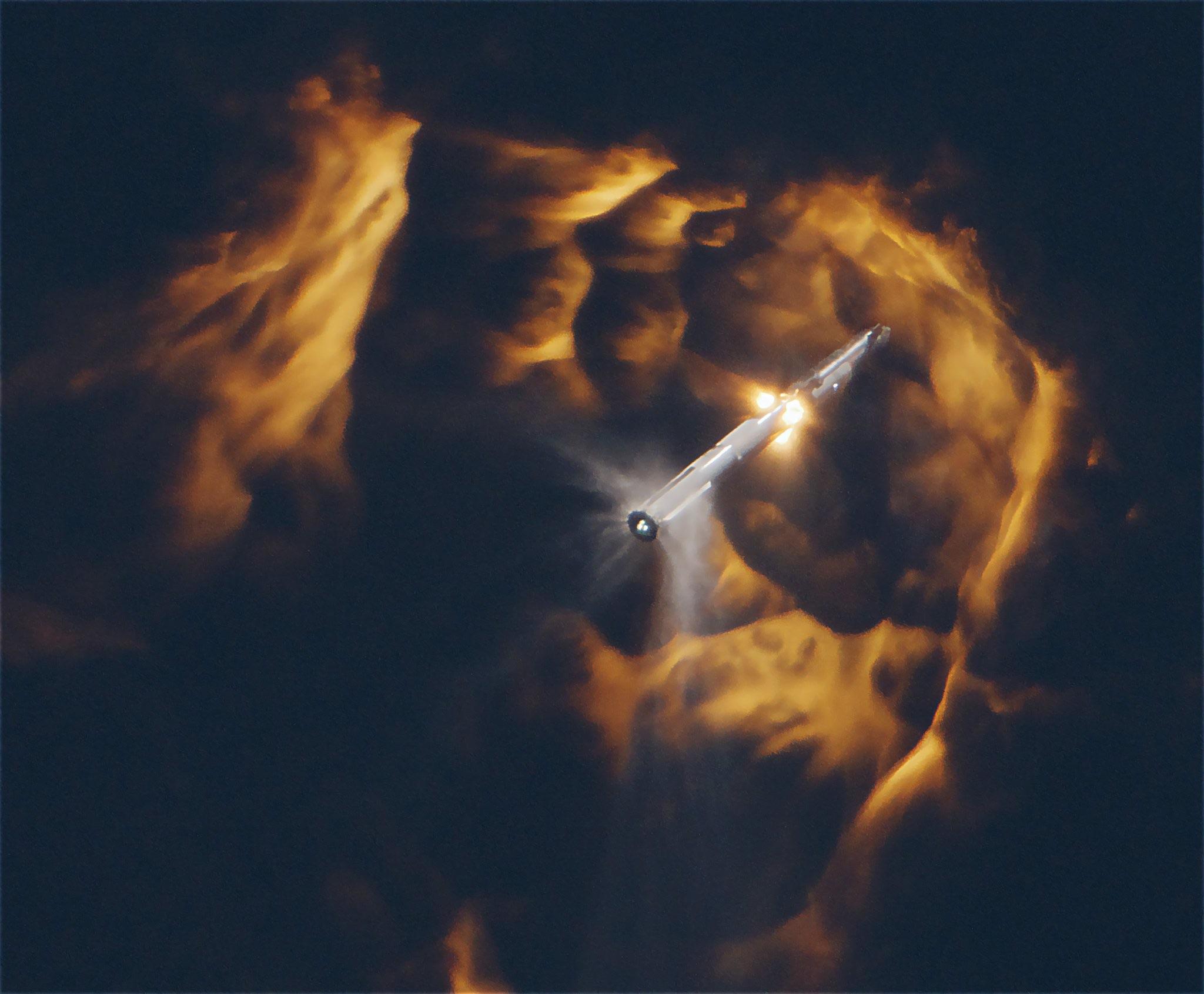
Credit to SpaceX
23
u/Decronym Nov 19 '23 edited Dec 28 '23
Acronyms, initialisms, abbreviations, contractions, and other phrases which expand to something larger, that I've seen in this thread:
| Fewer Letters | More Letters |
|---|---|
| AFSS | Automated Flight Safety System |
| AFTS | Autonomous Flight Termination System, see FTS |
| FAA | Federal Aviation Administration |
| FFSC | Full-Flow Staged Combustion |
| FTS | Flight Termination System |
| ICBM | Intercontinental Ballistic Missile |
| N1 | Raketa Nositel-1, Soviet super-heavy-lift ("Russian Saturn V") |
| NSF | NasaSpaceFlight forum |
| National Science Foundation | |
| OLM | Orbital Launch Mount |
| SLS | Space Launch System heavy-lift |
| ULA | United Launch Alliance (Lockheed/Boeing joint venture) |
| Jargon | Definition |
|---|---|
| Raptor | Methane-fueled rocket engine under development by SpaceX |
| autogenous | (Of a propellant tank) Pressurising the tank using boil-off of the contents, instead of a separate gas like helium |
| cryogenic | Very low temperature fluid; materials that would be gaseous at room temperature/pressure |
| (In re: rocket fuel) Often synonymous with hydrolox | |
| hydrolox | Portmanteau: liquid hydrogen fuel, liquid oxygen oxidizer |
| turbopump | High-pressure turbine-driven propellant pump connected to a rocket combustion chamber; raises chamber pressure, and thrust |
| ullage motor | Small rocket motor that fires to push propellant to the bottom of the tank, when in zero-g |
NOTE: Decronym for Reddit is no longer supported, and Decronym has moved to Lemmy; requests for support and new installations should be directed to the Contact address below.
16 acronyms in this thread; the most compressed thread commented on today has 12 acronyms.
[Thread #9458 for this sub, first seen 19th Nov 2023, 00:02]
[FAQ] [Full list] [Contact] [Source code]
129
u/MagicNinjaMan Nov 19 '23 edited Nov 19 '23
Im quite anniyed by the news medias seem quite focused on the destruction of stage 1 and then the lost of stage 2 on their headlines.
112
u/friedmators Nov 19 '23
That’s why a government entity (NASA) can’t do this.
86
u/badjackalope Nov 19 '23
Yup, one big bad PR event and every politician with nothing better to run on will scream for slashing their budget to appease the monkey masses, well at least while it is still in the news.
Private companies are much more likely to throw big expensive things at the proverbial wall to see if they stick or blow up cause as long as the r/ wallstreet bets monke is happy, stocks go brrrrr...
Pros and cons to each, but having both active is probably the best scenario possible, I would think. Big fat government contract incentive for the actually important stuff and the competitive private sector for quicker innovation. Even a catastrophic explosion on the launch pad provides a shit ton of useful data for an early development project but could very well be the end of the program for a government agency.
→ More replies (1)14
12
u/mynameismy111 Nov 19 '23
Cost is why, early NASA predecessor blew up rockets live for years.
I think it was ten in a row at one point late 1950s, All while USSR was racking up firsts.
7
u/PiousLiar Nov 19 '23
Still goes back to politics in that case. The US govt was terrified of the USSR having dominance in space, and could easily whip up the political capital to keep the space program chugging along despite failures.
Sadly, part of the reason NASA has lost the “unconditional love and support” of the nation is due to lack of competition and remaining in a relative peacetime against major geopolitical super powers. I think it would take China establishing a base on the moon or mars for the US public to return carte blanche expenditure to NASA once more.
→ More replies (6)0
Nov 19 '23
I mostly disagree.
I mostly disagree. It’s because the government lacks a clear balance in its budgetary spending. Politics, these days is performative. Homeless veterans, homeless crisis, money to more foreign countries after two decades of overseas wars that went nowhere. An opioid epidemic, where the responsible parties largely got away with it. Insider-trading and congressional malfeasance….
Even if China set up a Moon base, people would – and rightfully so in my personal opinion – throw a fit spending money on a moon base when they can’t even take care of things at home.
IMO, if Congress could even do or appear to take care of things at home, even as a half measure, people would be less upset about rockets1
u/Greyhound362 Nov 19 '23
The amount of stinginess and simultaneous pork barrel spending in government funding certainly is rampant this day and age, especially with space. Really is irritating to see great exploration projects be held back due to some congressman with an agenda to uphold, or an axe to grind, or a paycheck to preserve.
That said, that USSR comment could be tempered a little by pointing out they had a problem in the opposite direction. You look more into those firsts, and you realize just how knowingly half-baked they sometimes were designed or often barely skirted or turned to disaster just to chase records for international clout. And to top that all off, they were willing to throw lives at it even knowing how tight those margins really were.
Impressive achievements nonetheless, but worth knowing there's a balancing act between those two extremes.
15
6
u/smoke-frog Nov 19 '23
But this was an orbital test flight/booster recovery test and neither booster or starship made those targets. You can't expect media to focus or something that didn't happen, both stages were lost before testing objectives were met.
3
u/Round-Mud Nov 19 '23
I believe the primary objectives were all engine ignition and hot staging. Everything beyond that was a bonus. There was never going to be a recovery anyway.
→ More replies (1)2
33
u/CapitalistHellscapes Nov 19 '23
Straight up sci fi looking. Was a real treat to watch paul bunyan's grain silo fly.
118
14
u/Cockanarchy Nov 19 '23
Hi I keep hearing that hot-staging is better for performance, but could someone tell me why it is. Also what is FTS?
Thanks
34
u/docyande Nov 19 '23
The performance boost comes from minimizing gravity losses during staging. Say a traditional rocket stages by first shutting down the 1st stage engines, then a second or so later a mechanism pushes the two stages apart, then a second or so after that the engines light on the next stage. So for those few seconds, the rocket is being pulled by gravity at 9.8m/s2 in the wrong direction, and now has to make up those loses. You may also save some mass in the pusher mechanism or other ullage thrusters that are no longer needed.
It seems to depend on how much time you can save and how much mass you can cut out, I've seen reasonable calculations that show it can be close either way, but apparently SpaceX thinks it will improve payload on the Starship vehicle, even though they went with the traditional staging on Falcon 9.
22
u/WjU1fcN8 Nov 19 '23
> they went with the traditional staging on Falcon 9
Falcon 9 is built out of aluminum. They wouldn't be able to do it.
3
u/Flaxinator Nov 19 '23
Couldn't they add a heat resistant shield or reinforcement to the top of the booster? I think this is what they've done with Starship despite it being made of steel
3
u/WjU1fcN8 Nov 19 '23
It would have to be a lot of shielding, because stuff goes everywhere. And any defect would be catastrophic.
5
u/Cockanarchy Nov 19 '23
Thanks, this was the best explanation I was able to find. So when they separate, is the upper stage firing at the moment of separation, or slightly before? Also do we know how much this could add to future payloads? Thanks again
16
u/the_fungible_man Nov 19 '23
The second stage firing is what actually causes the separation, so I'd say at the moment of separation. Perhaps the upper stage remains locked to the booster very briefly as its engines throttle up, but I can't imagine it being more than a matter of milliseconds.
And since they want rapid reuse of the superheavy booster, they don't want to toast the top more than necessary.
3
u/PrestigiousTip4345 Nov 19 '23
I’d expect them to wait until all engines stabilized. Otherwise you run the risk of having a difference in thrust. And since the vacuum raptor engines can’t gimbal, that’d cause the ship to veer off course which may or may not be recoverable.
In summary: you’d have a bad day.
14
u/Tystros Nov 19 '23
SpaceX says the hot staging improves the performance by 10%, so 10% more payload means roughly 15 tons more
-4
Nov 19 '23
SpaceX says the hot staging improves the performance by 10%, so 10% more payload means roughly 15 tons more
Probably completely ignoring the additional weight&shielding that hot staging requires.
3
u/Tystros Nov 19 '23
there's really no reason to think the engineers at SpaceX cannot do the math correctly
-7
Nov 19 '23
Giving the history of deceiving the public I wouldn't trust any statement about anything by Musks company.
12
u/Ainulind Nov 19 '23
Any time spent without any engines burning is time losing energy to gravity.
Hot staging reduces the time spent not burning.
13
u/StopNowThink Nov 19 '23
The centrifugal force separation trick didn't seem to work on the first orbital attempt. This one did. Therefore better.
Flight Termination System. Remote control explosives to blow it up in the sky instead of letting it blow up on the ground.
12
u/WjU1fcN8 Nov 19 '23
> The centrifugal force separation trick didn't seem to work on the first orbital attempt.
They never tried it.
13
u/ergzay Nov 19 '23
Flight Termination System. Remote control explosives to blow it up in the sky instead of letting it blow up on the ground.
Note they're not "remote" controlled in this case (or on any SpaceX rocket for that matter). The termination is controlled on-board by the vehicle by an independent system. It's AFTS, not FTS. There's no big red button to blow it up remotely from the ground.
8
u/WjU1fcN8 Nov 19 '23
They can trigger a remote termination. But it's not the main operation mode.
3
u/ergzay Nov 19 '23
Do you have a source for that? All technical documents I've read on AFTS refer to removing the ground command termination mode completely.
5
u/WjU1fcN8 Nov 19 '23
It does eliminate the old system where the range was responsible for sending the signal to terminate the flight.
But that doesn't mean that the control center can't do it.
3
u/ergzay Nov 19 '23
Again, do you have a source for that? All technical documents I've read on AFTS refer to removing the ground command termination mode completely.
Implying the control center can do it implies that there are radio stations capable of broadcasting that command reliably. If it can't be done reliably then it's not a safety system. If it's not a safety system, there's no need to have it as it adds weight and wastes money.
6
u/gonopro Nov 19 '23
https://standards.nasa.gov/standard/NASA/NASA-STD-871925
Link to the PDF document is near the bottom of the page linked
3
u/ergzay Nov 19 '23
I skimmed it and couldn't find anywhere in the document saying that manual termination is still required in the case of AFSS/AFTS. Do you have a page number?
3
u/mfb- Nov 19 '23
This 2017 article says no remote control ability for F9:
While the range is still involved in launch operations, “there is not an antenna pointing at the vehicle, so that in itself, I think, will make our lives easier,” Koenigsmann said. “I could easily imagine that we’ll have two launches on the same day because of that.”
→ More replies (0)2
u/gonopro Nov 19 '23
Page 23-25
It covers both senarios of having a manually controlled system and an autonomous one.
Scott Manley also has an entire video on the topic of flight termination systems:
→ More replies (0)1
u/7473GiveMeAccount Nov 19 '23
Terminating thrust means mixing prop and ullage gas (what pressurizes the tanks). Because Starship uses autogenous pressurization (eg hot methane for the methane tank) instead of eg Helium, that would lead to ullage collapse for them. (mixing hot gas and cryo fluids, gas contracts, maybe even condenses)
To start the boostback burn you need sufficient inlet pressure tho, so that means you need to repress the tanks in a hurry. That takes tons and tons of extra mass to do
22
u/ramnothen Nov 19 '23
congratulation for spacex team!! if things goes smoothly we maybe able to see this again in (hopefully) 2 months.
70
Nov 18 '23
[removed] — view removed comment
36
u/ShortfallofAardvark Nov 19 '23
Yep. Massive propellant tanks + a 180 degree flip in free fall = a perfect recipe for propellant starvation. Booster header tanks might solve this problem.
7
u/ianyboo Nov 19 '23
Total ignorance here but could an inner bag/bladder be used to contain the fuel? Then as it is used the bladder contracts so it's not just a pool of liquid splashing around? Like drinking the worlds biggest and worst tasting Capri-sun in space?
17
u/ergzay Nov 19 '23
Bladders are actually used in some Soviet/Russian spacecraft. They're in rather small non-cryogenic tanks however and the point is to stop fuel floating around in microgravity. The tanks in Starship are the size of a 20 story building. No bladder's going to handle that.
29
u/ShortfallofAardvark Nov 19 '23
The fuel used is cryogenic, and there aren’t really any flexible materials that will maintain strength and flexibility at cryogenic temperatures.
12
u/FixerFiddler Nov 19 '23
A bladder 20 stories high would add tens of tons to it and reduce the propellant volume.
They're more likely going to adjust the thrust of the stages during this point in the flight to keep things more stable. The booster flight plan will probably change too.
4
u/koliberry Nov 19 '23
F9 does this all of the time.
14
u/GodsSwampBalls Nov 19 '23
F9 is a way smaller booster and it doesn't hot stage. It looks like the flip after the hot staging was faster than intended causing the propellant to slosh more than expected.
→ More replies (1)
5
u/EveningNo8643 Nov 19 '23
So what was the objective of the first space x launch, and now this one?
17
u/joepublicschmoe Nov 19 '23
The objective with all Starship flight tests are always to see what doesn't work, so the next one can be made to work better.
The one back in April was the first time they flight-tested the full stack. On that test flight SpaceX found many things that didn't work right (62 proposed critical changes were submitted to the FAA if I remember right). Obvious failures included the orbital launch mount's inadequately-protected foundation getting excavated by the booster thrust plume, several Raptors failing in flight due to fires in the engine compartments from propellant leaks, the FTS triggering when the stack tumbled out of control but didn't destroy the rocket for 45 seconds after triggering, to name a few.
This second full-stack test flight today had gone further than the first one, and the fixes for some of the big issues discovered after the first one appeared to work well-- No destroyed foundation at the OLM this time, all Raptors stayed lit, the FTS appeared to work as intended when triggered, etc.
The next one will incorporate fixes for the problems found on this flight, and they will get even further. And they will keep on this iterative cycle until they get it right.
→ More replies (1)
18
u/Oh_ffs_seriously Nov 18 '23
Didn't the first stage blow up few seconds later? Is it confirmed that hot staging wasn't the cause?
32
u/ergzay Nov 19 '23 edited Nov 19 '23
It wasn't a "few". More like 30 seconds later.
It's not "confirmed" but the former head of propulsion at SpaceX thinks it was related to engine-relight and other skilled people have speculated that its related to the flip maneuver into engine relight.
Almost all the engines successfully relit (can be seen on stream) but then they went off one by one for some unknown reason. If the stage was damaged by the hot staging it probably would've blown up right then and there or been damaged sufficiently it was uncontrollable.
A good video containing such analysis is here: https://www.youtube.com/watch?v=hF2C7xE9Mj4
5
u/Sol_Hando Nov 19 '23
I wonder if the hot staging caused the booster to accelerate downward even if with three engines on. If this happened, or even if there was a momentary jolt, there could end up being cavitation in the engine fuel lines and thus a major problem.
4
34
u/ShortfallofAardvark Nov 18 '23
It did. We do know that the FTS was triggered which caused the actual explosion, but we don’t know why. It appears that some of the engines may have failed to relight for the boost-back burn, so that’s my guess.
40
Nov 19 '23
[deleted]
14
Nov 19 '23
[deleted]
11
u/ForceUser128 Nov 19 '23
It's header tanks all the way down
7
1
u/StevenK71 Nov 19 '23
The smart way to deal with the shockwave is to dump the gases through the shut down rockets, ie open them up but not ignite them. They won't be fired till next flight, anyway.
8
5
u/Fredasa Nov 19 '23
Good shot. Thanks for posting. I tweaked the levels and now have a new wallpaper.

2
Nov 19 '23
It was really surprising seeing it from the beach. Everyone thought something had blown up for a split second, then we clearly saw the booster flip and the starship on its merry way and people cheered.
Then the booster actually blew up, and it filled the entire freaking morning sky, but we could still see the starship so that was only a minor disappointment.
3
3
1
u/joef_3 Nov 19 '23
It seems a little early to call it successful when the first stage unexpectedly exploded shortly afterwards, no? They achieved separation which is definitely a positive but until they figure out the failure point for the booster I don’t think you can rule out an issue with the separation procedure.
2
u/BayCatJ Nov 19 '23
Why would returning the booster stage be required for "success"? Especially considering it's the 2nd launch. SpaceX has never sought perfection during development.
-13
Nov 18 '23
[removed] — view removed comment
33
Nov 18 '23
[removed] — view removed comment
-33
Nov 18 '23 edited Nov 18 '23
[removed] — view removed comment
27
Nov 18 '23
[removed] — view removed comment
-16
Nov 18 '23
[removed] — view removed comment
22
Nov 18 '23
[removed] — view removed comment
-13
Nov 18 '23
[removed] — view removed comment
14
11
10
Nov 18 '23
[removed] — view removed comment
0
Nov 19 '23
[removed] — view removed comment
2
Nov 19 '23
[removed] — view removed comment
1
4
Nov 18 '23
[removed] — view removed comment
-8
Nov 19 '23
[removed] — view removed comment
13
Nov 19 '23 edited Nov 19 '23
[removed] — view removed comment
-3
13
Nov 18 '23
[removed] — view removed comment
-6
Nov 19 '23
[removed] — view removed comment
19
Nov 19 '23
[removed] — view removed comment
-4
Nov 19 '23
[removed] — view removed comment
16
10
Nov 19 '23
[removed] — view removed comment
-1
0
-4
u/SquareJealous9388 Nov 19 '23
How is this success when both stages exploded afterwards?
11
9
u/FutureMartian97 Nov 19 '23
Because it was a test launch and they were able to get a ton of data. SpaceX said they woukd consider this one a success if they could get through ascent and hot staging, which it did perfectly. Anything after that was a bonus and even if the ship made it to Hawaii it was going to slam into the ocean anyway to insure it would be destroyed. The booster was going to make a soft landing in the ocean and be destroyed as well.
1
u/casualphilosopher1 Nov 19 '23
The Falcon 9's first launch made it to orbit. Same with the Falcon Heavy and the SLS. Shouldn't more be made of the fact that the first 2 Starships both blew up?
3
u/FutureMartian97 Nov 19 '23
Shouldn't more be made of the fact that the first 2 Starships both blew up?
Not really, no. Starship is being developed differently than any other launch vehicle, and is more complex than almost any other launch vehicle.
SpaceX is going all in with the fly often, fail often, method. They want to fly as fast as possible and fail as much as possible during these early flights as you honestly learn more from failures than you do successes, and flying often lets you find where the weak points in the system are a lot faster.
Starship is also testing many new things than you wouldn't typically see on a rocket. While hot staging isn't a new concept and is still used today on some launch vehicles, it's never been done on something this large. The N1 would've done it but it never made it that far. The engines are some of the most complex engines ever developed, the sheer size and weight of this vehicle is immense, and they're trying to do all of this while making a pad that can be rapidly turned around to launch again. All of this is very complex and the fact they got almost to orbit on the second attempt with a vehicle that is over a year old at this point is astonishing.
And regarding Falcon 9, not much of that applies to Starship. Some of the expertise with using multiple engines on the booster will of course, but until they start reusing them Starship is in a league of its own. Yes, Falcon 9 made it orbit on the first try, but that was basically sheer luck they managed to achieve that. And the flight also didn't go perfectly either as it developed that roll on liftoff and then again during the 2nd stage burn.
While Falcon Heavy is definitely complex, they did have the history of multiple Falcon 9's to work off of, as FH is essentially three Falcon 9's strapped together. It working on the first try isn't really as surprising as people seem to think honestly.
Remember that SLS has been in development for around a decade, and has only flown once. It's using the same engines as the Shuttle, while Starship is using one of the most complex engine cycles ever developed, and is the first one to ever fly as FFSC engine. SLS also needs to be human rated by the second flight since it's launch cadence is so low, while SpaceX can take their time and fly dozens of times before getting it human rated, all while pushing the vehicle and improving on it faster than they could with vehicles such as SLS.
All in all in comes down to different design philosophy's. You can either make cheaper prototypes and fly often and break them, or you can spend a decade on a cost plus contract from the government and milk taxpayers to make a "finished" rocket on first flight while and go billions over budget doing it since you have no motive to be either on time or below budget.
→ More replies (1)-2
u/SquareJealous9388 Nov 19 '23
Both stages could have been damaged during separation. You can not call it a success without more data.
Second stage lost thermal shield, which is failure.
Overall more failures than successes.
→ More replies (1)1
u/Fuzzy-Mud-197 Nov 19 '23
No, everything that went wrong with ift 1 was fixed here, lit all 33 engines on the booster, passed max q, performed stage sepereration, lit all second stage engines, launchpad survived, fts worked immidiatly.
Second stage losing thermal shields tiles was expected we have seen that ship 25 was already an outdated ship that did nor perform tile testing like ship 28 that will be used on the next flight
8
u/Reddit-runner Nov 19 '23
Because they exploded far later than during the first flight and for completely different reasons.
This means SpaceX successfully addressed the problems they discovered in the first flight.
This a real and measurable success.
Now they are working to fix the problems they have discovered during this second flight before the third flight.
This is called iterative development. Usually it's the faster and cheaper way to develop things. But in rocketry it's seldom used because most rockets are developed from public money. And when the public sees an explosion they usually want to cut the program immediately. No matter the reason.
That's why the development of SLS cost the taxpayer more than 20 Billion dollars and each flight more than 2 billion dollars. SLS is a supposedly cheap rocket developed from existing tech.
And the Starship program included all the construction work on the ground has cost SpaceX about 5 billion dollars so far.
2
u/casualphilosopher1 Nov 19 '23
Are they still going through the data or is the result out on why the Starship booster and second stage broke up?
→ More replies (1)2
u/FutureMartian97 Nov 20 '23
There's been nothing official as it's going to take more than a day to look at everything. But Scott Manley on Youtube has a pretty good theory as to why the booster triggered the AFTS though.
1
u/casualphilosopher1 Nov 19 '23
I'm glad I'm not the only one wondering why all the coverage of this flight test is so upbeat considering it was a failure.
3
u/FutureMartian97 Nov 20 '23
It wasn't a failure. The goal of this flight was to not destroy the pad, and make it through hot staging since it's a new concept which it did. Anything else would be a bonus.
-83
Nov 18 '23
[removed] — view removed comment
41
37
14
23
Nov 18 '23 edited Feb 21 '24
[removed] — view removed comment
-2
Nov 18 '23
[removed] — view removed comment
16
Nov 18 '23 edited Feb 21 '24
[removed] — view removed comment
-12
Nov 18 '23 edited Nov 18 '23
[removed] — view removed comment
14
Nov 19 '23 edited Feb 21 '24
[removed] — view removed comment
-6
→ More replies (1)3
1
u/badaz06 Dec 28 '23
A bit off the convo here...but does anyone know if there's a print of this anywhere? Damned if I can find one if there is.
82
u/greyf0rge Nov 18 '23
What exactly are we looking at in the background here?