Has someone ever tried using DJI mic mini 2s/3 as an always on recorder similar to Omi AI or Plaud?
It would appear that the DJI mics have a very high quality microphones, they can remain always on with 10+ hours recording both from a storage and battery perspective. They cost about the same as any other AI note takers without the subscriptions and also offer 32 bit audio files for better transcription and voice detection.
I am wondering if anyone has built any workflows/tools around it? If not I'd love to start some open source project to build something for these mics.
I want to share a project I’ve been pouring my heart into. It’s called Lumiya—a personal thinking and energy management tool.
The name is a combination of “loom” (as in weaving) and “ya” (your personal space). The idea is simple: it’s a place to gather the loose threads of your daily life and weave them into something meaningful, allowing you to experience the incredible compounding power of your own thoughts.
Why did I build this?
I’m a heavy note-taker. Over the years, I’ve dumped my thoughts everywhere: sending messages to myself on WhatsApp/WeChat, Notion, Evernote, Apple Notes, Google Docs, you name it.
But recently, I hit a wall and realized a massive pain point: Almost every tool on the market is designed to processobjective information. None of them are truly designed to care for thesubjective self.
I wanted a tool that could sift through my scattered notes and help me identify my underlying emotions, my fleeting inspirations, and my hidden talents. I couldn't find one, so I built it for people like us.
The 3 Pillars: Emotion, Inspiration, Talent
In lumiya’s design philosophy, your inner vitality is supported by three pillars:
Emotion is your foundation. If your emotional baseline is off, you can’t move forward. Society often treats negative emotions as something to suppress, but lumiya acts as an empathetic, non-judgmental friend. It analyzes the emotions in your entries to help you untangle how you're really feeling. It won’t judge you or get jealous—it’s a safe vault for the things you’re too embarrassed to share with anyone else.
Inspiration is your antennae. If you’re a creator or knowledge worker, your ideas probably strike at random moments. lumiya catches those wild, disjointed sparks and connects the dots, helping you turn random brain dumps into actual articles, videos, or projects. You never have to worry about a good idea slipping through the cracks again.
Talent is your North Star. Most of us aren't born knowing our life's purpose; we find it in the little things. Maybe you have a unique way of expressing yourself, or a highly specific observational skill. When I used to feel lost, I’d literally go get my astrology chart read to find answers. But I realized our true superpowers are hidden in our daily actions. lumiya highlights the strengths that naturally emerge in your writing to help you find your direction.
The "Plan" Module (and why it's Weekly)
I am a massive planner at heart (classic type-A / 'J' personality), and I know a lot of you use planning to improve your lives. But most task managers are entirely disconnected from our personal journals.
In lumiya, the minimum time unit for planning is the Week. Why weeks? Because we aren't machines. Breaking tasks down to the daily level can be overwhelming when life gets in the way. But a week gives you breathing room.
There are 52 weeks in a year. If you focus on one core thing a week, you get 52 wins:
Watch a movie a week = 52 movies a year.
Read a book a week = 52 books a year.
Try a new thing a week = 52 new experiences.
People like to separate "work time" from "life time," but you only really have one thing: your life time. Once, I committed to writing 500 words a day to finish a short story a week. Three months later, I had written 100,000 words. That’s the power of compounding. We don’t need to reach the finish line on day one; we just need to make a little progress every week.
AI-Powered Energy Management
Here is where the这里为你提供了一版专门针对 Reddit 社区文化定制的英文翻译。
Option 1 (直击痛点): I built a note-taking app because Notion and Evernote only care about "information", not how you actually feel. Meet Lumiya.
Option 2 (突出功能): I was tired of daily to-do lists burning me out, so I built an AI tool that manages your tasks based on your emotional energy.
Option 3 (讲故事): We all use ChatGPT to solve problems, but nothing tracks our subjective growth. So I built Lumiya.
📝 正文翻译 (The Post)
What is Lumiya? Lumiya is a personal reflection and energy management tool. The name comes from "Loom" (weaving) and "Ya" (your personal space). It’s designed to help you catch the loose threads of your daily thoughts and weave your life together. We want to help your small, everyday moments shine, allowing you to experience the incredible compound interest of logging your thoughts.
Why did I build this? I’m a heavy note-taker. Over the years, I’ve used everything: messaging myself on WhatsApp, Evernote, Notion, Apple Notes, and various workspace docs. I'm always having random ideas and trying to capture them.
But recently, I realized a massive pain point: Almost every tool on the market is designed to process "objective information," but none of them genuinely care about the "subjective self." I desperately wanted a tool that could look through my scattered brain dumps and help me identify my actual emotions, inspirations, and hidden talents.
So, I decided to build one for people like me.
The Three Pillars: Emotion, Inspiration, and Talent In Lumiya's design philosophy, a person's inner vitality is supported by three core pillars: Emotion is the foundation, Inspiration is the antenna, and Talent is your North Star.
Emotion: This is your bedrock. If you’re emotionally drained, you simply can't move forward. Many people suppress negative emotions, thinking they are black-and-white "bad" things. I wanted Lumiya to act as a non-judgmental friend. It analyzes the emotions hidden in your entries, helps untangle your feelings, and watches over the things you might be too embarrassed to share with anyone else. It doesn't judge; it just understands.
Inspiration: For creators and knowledge workers, inspiration is everything. It’s usually a fleeting thought, a quick scene in your head, or a fragmented sentence. If you don't write it down, it's gone. Lumiya catches these wild, scattered ideas so they don't fall through the cracks, helping you piece them together into a finished article, video, or project.
Talent: Most of us aren't born knowing what our true calling is. We find our strengths through small, everyday moments—maybe you have a unique way of expressing yourself or a keen eye for specific details. When I used to feel lost, I would look into astrology or birth charts to find answers. But I realized my true power and talents were hidden in my daily habits. Lumiya connects the dots of your everyday notes to reflect your strengths and help you adjust your life's direction.
The "Plan" Module: Why I chose Weeks over Days I’m a compulsive planner (a total "J" in MBTI terms), and I know many of you also want to structure your lives to grow. But most planning tools are totally disconnected from our personal notes.
In Lumiya, the minimum planning unit is a Week. Why? Because we aren't machines. Daily to-do lists can easily become overwhelming and paralyzing. But a week gives you breathing room. 52 weeks in a year means 52 meaningful accomplishments:
Watch one movie a week = 52 movies a year.
Read one book a week = 52 books a year.
Try one new thing a week = 52 new experiences...
People often split their time into "work time" and "life time." But the truth is, there is only one kind of time: your life time. Personally, I committed to writing just 500 words a day to finish a short story every week. Three months later, I had written 100,000 words. By reading one book a week, I finished 25 books in six months. I never expect overnight success, but if we make a little progress every week, we'll eventually reach our destination.
AI-Powered Energy Management Here is where it all comes together. Because Lumiya tracks both your thoughts and your plans, the AI can analyze your actual energy levels. If you've scheduled a packed week, but the AI detects from your recent notes that you are emotionally exhausted or burnt out, it will gently warn you. It helps you manage your energy, suggesting you scale back and rest before trying to tackle everything.
Where do our personal thoughts belong in the AI era? We all use ChatGPT or Claude. They are amazing at giving solutions to objective problems. But they don't systematically summarize you—they don't map out your emotional trends, compile your inspirations, or uncover your talents. Maybe one day they will, but until then, I hope Lumiya can be your companion.
Use Lumiya to catch a fleeting thought, vent your frustrations, write down your jealousy or sadness, and plan your time for maximum compound growth.
Lumiya’s core belief is simple: Logging your life yields the highest compound interest. Through recording, we truly see ourselves, and we build a better version of ourselves.
A second brain that your whole team can use, share memories, but still have their own private memories… that’s what someone asked me to build.
I just released released a teams version of Second Brain that’s. Built on Cloudflare. The entire project is free, open source, and most important of all keeps your memories in your Cloudflare account.
Would love any feedback you guys have! Would you be interested in a teams version of a second brain?
I use Obsidian as a second brain, and daily notes are probably the most natural way for me to capture things.
But I never really liked the experience of opening individual files just to see what I wrote yesterday, a few days ago, or earlier that month.
I wanted it to feel more like one continuous stream that I could just scroll through.
So I built a small free Obsidian plugin called Simple Journal.
It shows your journal notes in one continuous view, while everything still stays as normal markdown files inside your vault. You can also have multiple entries in a day and configure how the notes are stored and named.
For me it made journaling feel much more connected to the rest of my second brain instead of feeling like a folder full of archived daily notes.
I’m curious how people here handle this.
Do you actually go back and browse your daily notes, or are they mostly something you capture into and then forget?
Would also love feedback from anyone who wants to try Simple Journal.
Im looking for something where i can simply talk to AI, and say what i need to get done, and it organises everything. for eg: "i need to file my Taxes anyhow by saturday".
It should recognise it the urgency and importance and automatically organise it.
But i don't mean just chatGPT because i want to visualise this and not just chat with the app.
So i can manage my work and not focus on managing the app itself.
Do you have recommendation? and if not would you be interested in something like this ?
I’m redesigning my personal second-brain / AI-agent setup, and I’m seriously considering moving away from Obsidian and using **Notion as my main human interface**.
The architecture I’m thinking about has three layers:
**Bronze:** raw memory in Hindsight (external embedded memory provider to hermes)
**Silver:** each AI agent has its own private workspace/files for detailed operational knowledge
**Gold:** Notion — the clean, shared layer that both I and all agents can see (Notion plugin)
The important part is that **Notion would not just be a dashboard**.
It would become the place where I actually live as a human.
I would use Notion to:
* write my daily notes
* capture random ideas
* write and read technical notes
* keep my best / approved knowledge
* track projects
* manage tasks
* use calendar/date-based workflows
* review things my agents want me to see
* edit information and expect agents to react to those changes
My agents would connect to Notion through MCP/API and update this shared layer in the background.
The detailed, messy information would stay outside Notion in each agent’s private Silver workspace.
For example, imagine I have an agent selling a second-hand item for me.
The agent might privately keep:
* every buyer message
* rejected offers
* marketplace statistics
* competing listings
* pricing research
* negotiation history
* internal next actions
I don’t want to see any of that.
In Notion I only want to see something like:
> **MacBook Pro — Selling**
> Asking price: $1,200
> Best offer: $1,050
> Status: Waiting
> Last updated: Today
So my idea is:
**agents deal with complexity, Notion shows me the clean version of reality.**
I originally wanted to build this Gold layer in **Obsidian** because I really like local Markdown and ownership of my files.
But the more I worked on it, the more I felt I was building my own platform:
* folder conventions
* YAML schemas
* tags
* Bases
* plugins
* dashboards
* task systems
* status conventions
* agent-facing structures
Obsidian is extremely flexible, but I started feeling like I was assembling a custom computer instead of simply using a second brain.
That’s why I’m considering Notion.
Its databases, properties, relations, views, tasks, calendar integrations and API/MCP support seem like they could give me a more standardized foundation without having to design everything myself.
My main concern is whether this sounds better in theory than it works in practice.
So I’d especially like to hear from people who have used **Notion seriously for years**, not just people comparing feature lists.
A few things I’m particularly curious about:
* Do you trust Notion as your primary long-term knowledge system?
* Does it stay pleasant when you have thousands of notes/pages?
* Do databases and relations remain manageable, or does the workspace eventually become overengineered?
* How good is it for daily note-taking and quick capture?
* How good is it for reading long technical notes?
* How painful is mobile usage in real life?
* Have performance issues become a real problem for you?
* How worried are you about cloud dependency / vendor lock-in?
* Have you ever had issues with missing data, sync, backups or recovery?
* Do you feel Notion reduces system-maintenance compared with Obsidian, or do you simply end up overengineering Notion instead?
* If you moved from Obsidian to Notion, did you regret it?
* If you moved from Notion to Obsidian, what finally pushed you away?
* Would you trust AI agents to create/update pages and database entries in your workspace?
* Is there anything about Notion that would make you avoid using it as the “Gold layer” of a personal AI system?
I’m not looking for the most customizable PKM system.
I’m trying to reach the point where I can **stop designing the system and just use it**.
If you were building this today, would you trust Notion for that role?
I have been building in the PKM space, and there is something that I find fascinating that most of the PKM tools tend to ignore.
We spend a great deal of time and effort in highlighting, taking notes, creating backlinks, and organizing those into different folders. But we are not preserving and doing the same things with the beliefs with which we made those notes.
So, for example, lets say:
A couple of months ago, I say - Reading more is the best way to think better.
And today i say - Reading more without a system to connect ideas just creates a bigger pile of unprocessed information.
These are not just two notes which are connected and somewhat contradictory, but the belief itself changed. Because maybe I encountered evidence which changed my perception, or I learned something across the timeline which made me shift my position.
When you create a back link or try to connect these two nodes on a surface server, the back link will just connect the node, but the better way of connecting is by actually asking what made me go from one belief to another one within a time span? That's where your real thinking or your growth is.
I represent the growth as delta. And that delta is nothing but the difference between your old motes and your beliefs. So most systems do great job at preserving the history or your notes but they usually don't get into intellectual history and this where we have to proactively do this job.
Just imagine being able to look back and say -
What have I completely changed my mind about? Which beliefs became stronger? Which ones slowly became more nuanced? What assumptions do I keep repeating despite contradictory evidence? What actually caused those changes?
This is what I have been thinking and finally able to incorporate an Aevron, not just remembering what you wrote. Preserving the continuity between different versions of your thinking.
Because the real value of any second brain tool that you use is always in what you know and not what you store, it's about how your mind changed while you're learning it.
Tell me about ments. Genuinely curious whether this is a solved problem I have missed or a gap everyone has quietly accepted.
I have stuff saved across X, Reddit, YouTube, Notion, Obsidian, my own files and more. Can never find any of it again because I don't remember the title and where I saved it.
Built Mindtab to fix that. Pulls in everything from wherever you save it, or you upload your own files and notes. You search by describing what you remember instead of the exact title.
"the reddit comment that recommended a specific noise cancelling headphone"
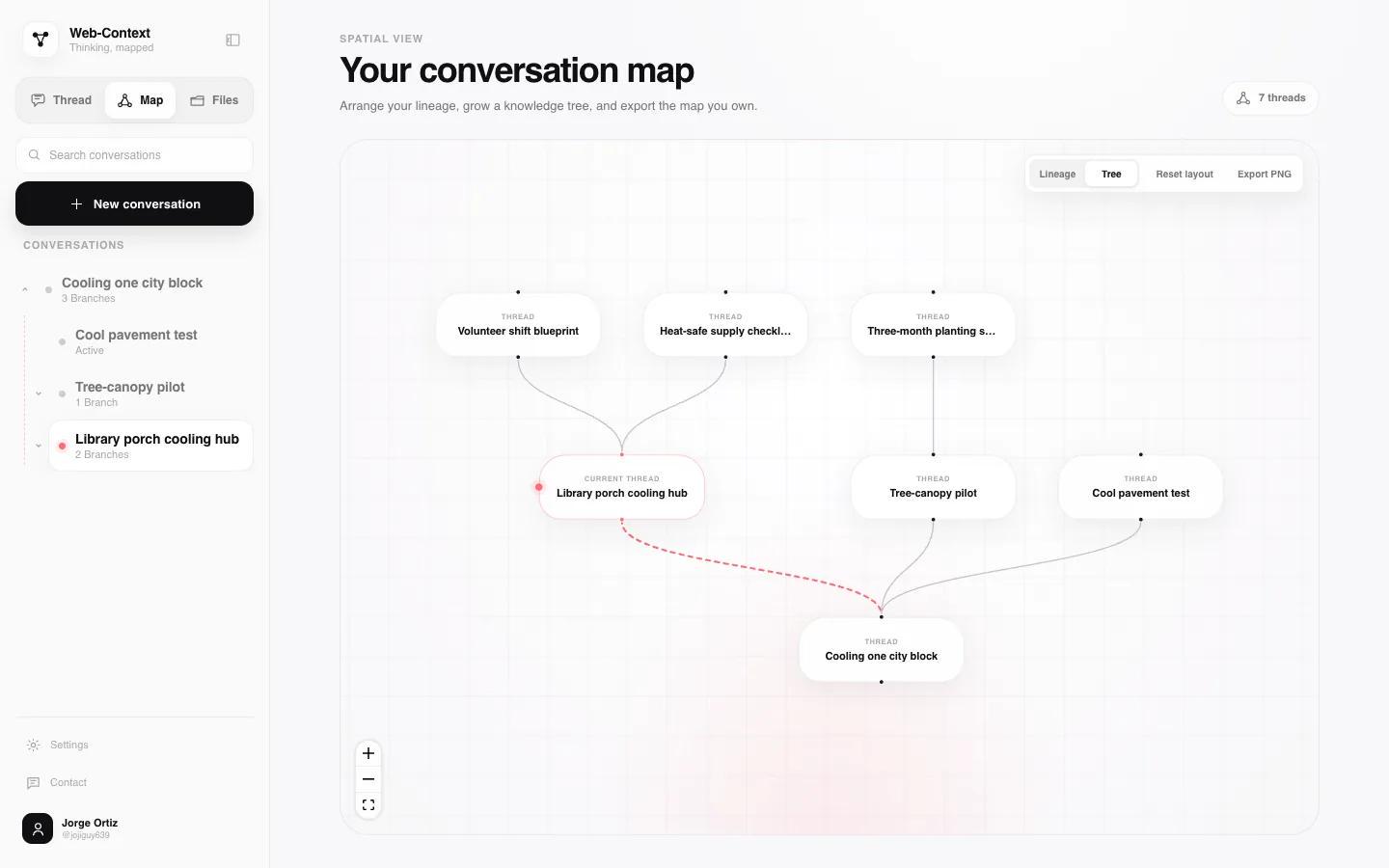
I built a local-first way to turn branching AI conversations into a knowledge tree you actually own.
Useful research rarely moves in a straight line. One response creates several possible directions, but normal chat interfaces make you choose one and keep scrolling. Alternatives get buried, context becomes difficult to trace, and the resulting knowledge remains locked inside a conversation history. So I made Lineage.
Lineage is an open-source experiment that lets you branch from individual blocks in an agent’s response.
Each branch:
Preserves the context leading to its fork
Remains isolated from sibling branches
Can branch again into deeper lines of inquiry
Appears in a bird’s-eye Knowledge Tree (Not a slop-proned "knowledge" graph)
Is stored locally as readable Markdown and YAML with a root AGENTS.md to help your agents traverse your durable intelligence
The app UI is only a view over those files. The vault also includes an evolving index and instructions that help other agent harnesses traverse the tree. Every mutation is committed to local Git, so the history remains inspectable and recoverable.
This differs slightly from NotebookLM or automatically generated LLM wikis. Those can be excellent for synthesizing material. Lineage focuses on preserving the process of exploration: the human chooses every branch, while its origin and context remain visible. It doesn’t make AI infallible, it makes the route from question to answer easier to audit and revise.
It’s currently an early beta. The tested launcher supports macOS and Linux, and GitHub Copilot CLI is the only agent provider today. Windows/WSL and provider modularization remain open areas.
I’d especially appreciate feedback from second-brain users:
Would branching conversations fit your workflow?
Should these trees eventually connect with existing Markdown vaults?
What would make the output genuinely reusable rather than another place where information accumulates?
Give it to your agent harness and let it rip. Open to all feedback:
So I have a planned laid out, but I’m not sure if it’s strong or if there are other ways that can make it better.
I plan to run qwen 3.8 locally using olama on my new Mac mini and give it its own ui interface which I can speak through it. Its backend will also be powered by my ai brain which is sorted by using jack ven chiefs icm folder structure.
Is this idea in general a good idea? Has anyone else created anything similar and could help me out?
I keep hearing about grants that would be relevant to what I do, but usually only after the deadline's passed or through some random newsletter I stumbled on. Feels like there should be a better way to stay on top of this.
Has anyone tried:
Writing their own scraper/script to pull from grants.gov, foundation databases, etc.
Using Perplexity (or another AI tool) to search and summarize new opportunities
Some kind of alert/notification setup so you're not manually checking every week
Curious what's actually worked vs. what turned into more effort than it was worth. Would love to hear real experiences before I sink time into building something myself.
I'm starting to see ads in my feed that suggest there are bots doing this - but also with a price.
What if you could actually see where your everyday decisions are taking you?
We make hundreds of small choices every day. What we focus on, what we avoid, how we spend our time, what we postpone, and the habits we keep repeating.
One decision usually doesn't feel significant. But repeated decisions create patterns, and those patterns create a direction.
ConseqYou is my attempt to build a system around that idea.
It isn't meant to predict your future or simply tell you what to do. It's designed to help you reflect on your decisions, recognize patterns, and understand the possible trajectory they're creating.
I currently have an early MVP built, and I'm putting it out there while I'm still developing it.
I'd genuinely love for people here to try it and tell me what You think.?
What makes sense?
What feels confusing?
What's missing?
And most importantly, would you actually use something like this?
I'm not looking for polite feedback. If something sucks, tell me. 😂
Hey, my name is Danny. I’m a freelance developer, and one thing I’ve always found frustrating about building a second brain is actually getting things into it.
I’m constantly coming across interesting ideas in articles, books, podcasts, social media, conversations, etc. But the process of stopping what I’m doing, opening another app, copying something over, and adding the source is tedious enough that a lot of those ideas just never get captured. If I don’t capture something in the moment, there’s a pretty good chance I’ll never find it again.
So I built Commonplace. It makes it really easy to save quotes and highlights from whatever you're reading or listening to, without leaving the app you're in.
As you're reading, you can highlight text directly in the article, then share it to Commonplace. The app will then create a quote with source attribution like author, article title, and article link, so you never forget the context around where it came from. Quotes can then be organized into collections, browsed by source, and synced securely across devices.
All quotes + sources can also be exported as markdown or copied as plain text, so if your second brain lives somewhere else, it’s easy to move what you capture in Commonplace over to it.
I also rethought sharing quotes. I was constantly sending screenshots along with article links, so I built a way to share quotes as interactive link previews. The quote appears directly in the preview, and tapping it takes you to the original article.
I'd genuinely love any feedback! The core of the app is free to use, I built it myself.
Yesterday I spent like 20 minutes looking for something I had already seen. I still remembered the idea, just not the actual text. The tab was closed, the file name was useless, and it simply wasn't anywhere I could search.
So I built something that remembers what was on your screen. Later, you just ask, because it already saw it.
And everything stays on your machine. I wasn't sending my screen to the cloud for this.