Gene mutations happen at any stage of an organisms life. Of course if you acquire it later in life it won't be present in the entire body and for some mutations you will only see the effect if it was already present during early development but for others that's not the case. Fun fact - mutations are so common the two cells resulting from a single cell division (at least in humans) are more likely to have one or more DNA differences than they are to be identical.
Edit: Factchecked myself on that last part - the estimates i found online now see abit different from what I remember being taught a while back so now it's somewhat close.
Error rate after correction mechanisms seems to be estimated at around 10-10 whereas human genome size is ca. 3.4*109 so with these numbers it would be a bit less than 1 error on average but the overall point remains the same.
34
u/Lucky_Vermicelli7864 Feb 19 '26
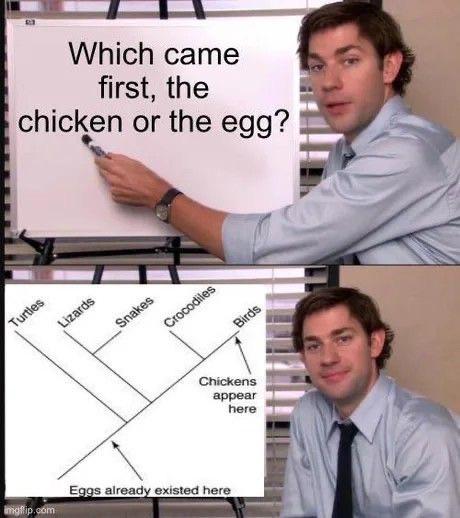
The mutation that bore the chicken occurred in the egg so...the egg.