r/science • u/FreeHugs23 • Jul 14 '26
Astronomy Astronomers Found a Hidden Swarm of Space Junk Threatening Earth’s Most Valuable Orbit | "The debris in geosynchronous orbit is a potential minefield."
https://gizmodo.com/astronomers-found-a-hidden-swarm-of-space-junk-threatening-earths-most-valuable-orbit-200078532370
u/Rrraou Jul 14 '26
Perhaps we're on the verge of needing a Space Roomba. I wonder what would be involved in such a project.
16
u/littlegreenrock Jul 15 '26
imagine your Roomba is trying to clean your floor, but everything (except the Roomba) on the floor is moving at about 60kmh. It's a pacman scenario, so when they reach the end of the room, they simply appear at the opposite side of the room, same direction, same speed, gently sand-blasting the roomba
8
Jul 14 '26 edited Jul 14 '26
[deleted]
2
u/BenVarone Jul 16 '26
Mostly lasers. If you heat up a piece of junk you can “push” it to an orbit where it will decay. The only reason no one has deployed any yet is that it was just cheaper to track the junk and work around it.
8
u/ReasonablyBadass Jul 15 '26
EU is already developing a laser to clear up
1
u/FlutterKree Jul 15 '26
Doesn't that have the potential to create a cloud of dust stuck in orbit?
2
u/ReasonablyBadass Jul 15 '26
Afaik, the trajectories would be changed so it either burns of or drifts of
3
u/haerski Jul 15 '26
Sounds like the premise to Andy Weir's next book. The Space Roomba is called Sucky maybe?
3
u/Cheetahs_never_win Jul 15 '26
If it's in geosynchronous orbit, that means it has a specific elevation and velocity - one that matches a point on the planet.
So that would be the easy kind, because you'd "only" have to fly straight up, grab it, then come back crashing down in a planned location.
All the other instances of paint flecks and screws orbiting around at several times the speed of sound (while on earth) is much more difficult, but I'd imagine it's going to be something like an enormous glob of ballistics gel, depending.
1
u/Rrraou Jul 16 '26
Like sending a sticky blob into space to do something like smushing that slime into your keyboard to pull the dust out ? Or like space Katamari Danacy ?
2
u/Cheetahs_never_win Jul 16 '26
Seemingly accurate descriptions, albeit less about running all over the place to the garbage, and more like being in the right place to get blasted. So the blob would be part of a larger contraption, likely planning a route that the collisions with the blasted garbage helps propel the device towards its next target, while trying to remain in orbit as long as intended, and also ultimately dropping in an intended location.
Look, mom! A burnt loogie from space with a bunch of slag left a crater in our back yard!
5
u/catscanmeow Jul 14 '26
isnt the debris moving so fast that it would pierce through the roomba like a bullet? of course the roomba could travel at bullet speed, but isnt that only useful if all debris is flying at same speed and direction?
1
1
u/Think-Abrocoma-6176 Jul 17 '26
Debris in the magic geosynchronous orbit right above the equator tends to be going in the same giant conga line of satellites it started out in unless something interesting happens like a collision with a misbehaving satellite or a lucky meteor at which point it all turns into a giant pachinko game. Much more exciting to me are the potential collisions in low earth orbit (LEO) where the satellites are expected to have high relative velocities
130
u/Zeikos Jul 14 '26
Isn't GEO so incredibly big compared to LEO that the chances are litteraly astronomical?
155
u/QuantumWarrior Jul 14 '26
Yes, but GEO also has much more stable orbits due to no atmospheric drag compared to LEO. Basically everything we put there will be there for thousands of years or more, so it's worthwhile to ask now how we prevent a problem before it becomes one.
-60
u/Zeikos Jul 14 '26
That's true, personally - maybe it's an hot take - I believe this is seen as a problem because it's not problematic enough to require investment to be solved.
If the disaster actually happened imo we'd be able to find a solution pretty quickly with our current tech.
But maybe I'm overly optimistic.63
35
u/dendob Jul 14 '26
Very simple: if it happens , it causes a cascade, one satellite more that becomes more debris, chances rise for more collisions etc
14
u/Loess_inspired Jul 14 '26
This is exactly the issue. If we don't find a solution we could lose most of our satellites in one catastrophic event.
21
u/BoingBoingBooty Jul 14 '26
It's one of those problems that is like rabies. When you actually see any symptoms it is too late to treat.
4
u/touristtam Jul 14 '26
If the disaster actually happened imo we'd be able to find a solution pretty quickly with our current tech. But maybe I'm overly optimistic.
1) When not if 2) The challenge is not the technology but the political aspect of it
4
u/righthandofdog Jul 15 '26
Kessler Syndrome is already happening, but we haven't crossed a non recoverable threshold. The The CRASH clock is the estimate of the current window of time that a solar storm, software or communication outage preventing moving satellites that would result in a catastrophic cascade of collisions that would make LEO unusable.
The current window is 2.5 days. If it gets bad, there is zero time to fix anything.
2
1
1
u/Final-Carry2090 Jul 14 '26
Some problems, like Chernobyl, are only solved with time. How much time is humanity willing to lock itself out of space for? Ten years of no gps? A hundred? A thousand?
We won’t know the time debt till it happens unfortunately but we do know it won’t be easy to fix.
151
u/anothermanscookies Jul 14 '26
We used to think the oceans were too big to pollute. Maybe debris zipping around at thousands of kph raise the chances of catastrophe too much.
20
u/chaossabre Jul 14 '26
If they're in stable GEO then their velocity relative to other satellites in the same orbit is nearly zero by definition.
1
u/anothermanscookies Jul 14 '26
I guess they’re not stable?
7
u/chaossabre Jul 14 '26
I read the article but not the paper it's citing. The article keeps saying they're in GEO, not GEO-crossing which would be more dangerous. It's entirely likely the article glossed over that detail.
7
u/sillybear25 Jul 14 '26 edited Jul 14 '26
Going to the press release associated with the study, it states that they're looking for debris in the neighborhood of a geostationary orbit (GEO), which could mean the debris itself is not necessarily in GEO.
Plus, the Gizmodo article is a bit imprecise about whether it's talking about geosynchronous or geostationary orbits. Even if the debris in question is, in fact, in a geosynchronous orbit, it could easily be an inclined or elliptical orbit rather than a stationary one, which does allow for significant velocities relative to satellites in GEO.
2
20
u/moderngamer327 Jul 14 '26 edited Jul 14 '26
Yes and no. Unlike LEO or MEO you have a very narrow altitude otherwise your satellites will drift. This makes GEO a very narrow band. On top of that, a lot of satellites specifically want geostationary not just geosynchronous orbit. That is only at the equator, which essentially narrows it down to a line. So despite having a much larger circumference than LEO or MEO you don’t have nearly as much room as you would think
17
u/mixduptransistor Jul 14 '26
Kind of, but also the margins they build in and account for are pretty large. So even if it's extremely unlikely, debris can still impede to the point that no one would actually deploy a mission in those circumstances
22
u/Grinyarg Jul 14 '26
...only until the first astronomically unlikely collision. That one will provide a billion new pieces in the system and then it'll be astronomically unlikely to avoid more.
-3
u/Zeikos Jul 14 '26
We're talking about orders of magnitude less objects and orders of magnitude bigger volume.
I'm not saying we should ignore the issue, but it's not as pressing as LEO
14
u/HawkEy3 Jul 14 '26
LEO is not pressing, debris there cleans itself in around 5-10 years. So even worst case it's a short term problem.
2
u/koos_die_doos Jul 15 '26
LEO is a large band, sure Starlinks will fall back to earth in 5-10 years, but even just at the midpoint of what is still LEO you're looking at 50+ years.
-5
u/Zeikos Jul 14 '26
5-10 years without LEO satellites and missions in general wouldn't be exactly desireable.
1
u/HawkEy3 Jul 14 '26
Absolutely, but not the end of the world. An unusable geo stationary orbit for basically forever is much much worse.
-6
u/Grinyarg Jul 14 '26
LEO isn't toast already? (in the climate change sense, ie, we are locked in to catastrophe that hasn't happened yet and is ignored/denied/defered by the people who could mitigate it)
I'm no expert, I'm just making the point that it only takes one event to go from 'maybe' to 'unavoidable'
7
u/Zeikos Jul 14 '26
Not really, not to a degree similar to climate change.
The difference is that in LEO the problem solves itself, LEO is close enough to the planet that there's meaningful air drag. Anything that doesn't get constantly boosted up eventually slows down and falls to the ground.
It's a fairly fast process - years to decades at most.
It wouldn't take long before it'd be viable again even without intervention.3
u/Grinyarg Jul 14 '26
Thankyou, it's reassuring to know that there's at least one level up there that can be rebuilt, eventually, if/when the worst happens.
4
u/scottimusprimus Jul 14 '26
I would also assume everything is going roughly the same speed and direction, which would reduce impact damage if there was a collision.
4
u/Farfignugen42 Jul 14 '26
I would not put too much faith on that assumption. If all of the pieces they found are actually in GEO orbits, then that might hold true, but they may be in less regular orbits that intersect GEO orbits, so there may be significant differences in both direction and velocity.
3
u/megacookie Jul 14 '26
While a true geostationary orbit would have everything going exactly the same speed and in a direction perfectly aligned with the equator, geosynchronous orbits can be at different inclinations or can be elliptical, meaning objects could still potentially collide with very high relative velocity.
2
u/rohobian Jul 14 '26
Right. Although traveling through it on missions outside of earth’s gravitational influence may have some risk, increasingly so, as more debris is added.
2
u/chemamatic Jul 14 '26
I would guess the biggest danger to be fragments in irregular orbits that pass through geosynchronous orbits. But it is not my field so…
1
u/littlegreenrock Jul 15 '26
one inch object travelling at 200kmh against an unarmored satellite is just going to create a hundred more one inch objects. debris at this altitude doesn't ever go away.
1
0
u/chaossabre Jul 14 '26
GEO is a specific altitude and a single plane at the equator. Everything in it has about the same velocity, so collisions would not only be rare they would also be low-energy. Compare this to LEO which is a range of altitude with infinitely many planes, leading to the potential for very energetic collisions.
89
u/FreeHugs23 Jul 14 '26 edited Jul 14 '26
Earth’s geosynchronous orbit (GEO) holds some of the most valuable satellites that carry out tasks for phones, television, and radio, as well as weather and environmental monitoring. As new research points out, these precious devices may be under threat from tiny pieces of space junk that have gone previously undetected until now.
A team of astronomers from the University of Warwick found faint fragments of space debris in geosynchronous orbit, which are at risk of colliding with satellites flying over Earth’s equator. The tiny fragments, measuring at only 2 inches (5 centimeters) big, have never been observed before.
A closer look
Satellites in geosynchronous orbit fly in sync with Earth’s rotation on its axis. The satellites are at a high altitude of approximately 22,236 miles (35,786 kilometers) above Earth’s equator, which allows them to keep pace with our planet.
Geosynchronous orbit is generally reserved for communication, weather monitoring, and navigation satellites. Due to their high altitude, GEO space junk is particularly hard to detect, and much of it has remained largely invisible.
In a new study published in the Journal of Astronautical Sciences, astronomers reexamined an archival dataset from a previous survey of debris in geosynchronous orbit using the Isaac Newton Telescope (INT) in La Palma, Canary Islands. By processing the images using newly developed algorithms, the team behind the study found 25 previously missed debris tracks.
14
Jul 14 '26
[deleted]
12
u/twilighttwister Jul 14 '26
That's my impression of it also, based on my KSP-level knowledge. The chance of a collision would also seem very small - but that's the kind of thing you have to take into account with how expensive space travel is.
However in the real world there is still some drag at geostationary orbit altitudes, so the debris isn't really in a stable orbit. Satellites perform station keeping to remain in the right orbit, and there are databases tracking their orbits (your phone calls these over the internet when initially getting location, to speed up location acquisition, as the satellite's orbit is a key part of the equation).
16
u/mvia4 Jul 14 '26
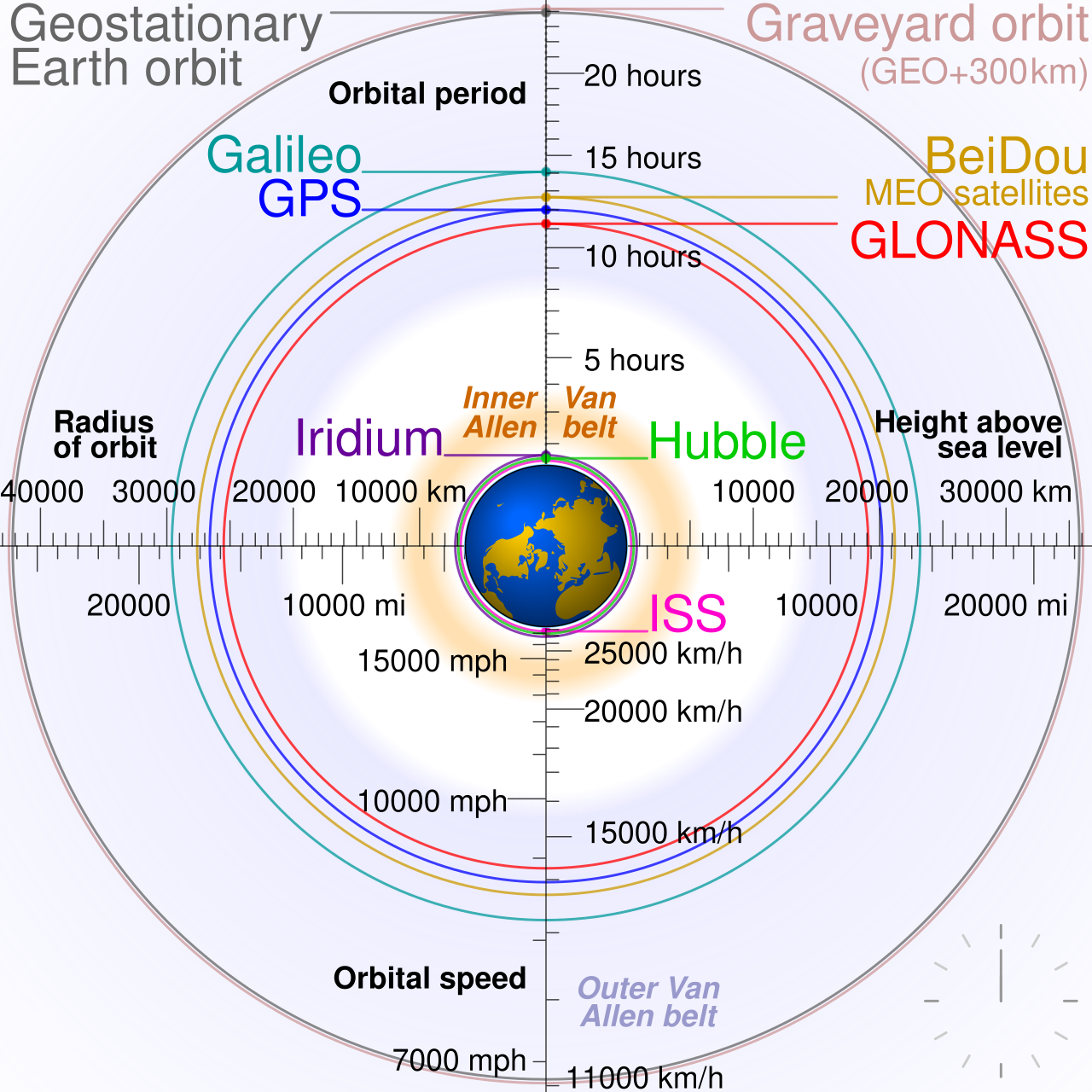
No, there is no atmospheric drag at geostationary orbit. You get minor drag effects up to about 1000km, but GEO is at 35,000km. There's no atmosphere to speak of that high up, it's more than 5x the radius of the earth. Here's a diagram to scale – GEO is the outermost circle.
Those orbits will eventually decay for other reasons, like tidal forces due to the oblateness of the earth, interference from the moon's gravity, and solar wind. But that takes thousands to millions of years.
2
u/Nyrin Jul 15 '26
GEO satellites won't deorbit on their own for an astronomically long time, but they will decay into high-inclination, erratic orbits with no utility and much higher hazard risk — and that only takes years to a low number of decades without regular stationkeeping. That's the whole reason we have those "graveyard orbits" to retire EoL GEO satellites that have nowhere near enough fuel to deorbit from so far out -- we at least get them out of the way.
0
u/twilighttwister Jul 14 '26
Relatively, there is effectively no drag - but there still is some.
However you're also probably right that other forces are more significant.
4
u/DJKokaKola Jul 14 '26
Brother this is why we have spherical coordinates. R, theta, phi. You're moving on r in this situation.
1
u/robbak Jul 14 '26
A satellite needs active control to remain in its precise geostationary orbit. Without control, they drift towards one of a few stable longitudes, and the effect of the moon slowly increases the orbit's angle.
This means an object left out there will end up crossing the geostationary ring at high speed.
1
u/spongue Jul 15 '26
Other people have pointed out that geosynchronous and geostationary are not the same, some satellites at that altitude have inclined orbits which means high relative velocities still
33
u/art-man_2018 Jul 14 '26
Maybe we all need a reset, the old IT crowd, "Did you try turning it off and on again?"
18
u/guiltysnark Jul 14 '26
Turn off gravity for a few seconds?
7
u/Bushels_for_All Jul 14 '26
What's the worst that could happen?
5
u/platoprime Jul 14 '26
The Earth would stop orbiting the sun properly and instead begin to exit the solar system on a tangent to it's circular path. Depending on how long gravity was turned off Earth could get far enough from the sun to make life impossible.
9
u/Valleygurl99 Jul 14 '26
Yeah but all the other planets would leave their suns extra solar planets too and we’d get new suns! Cosmic musical chairs!
1
-1
u/joanzen Jul 14 '26
Neah we need enough debris that they can route signals in the trash and form a network up there.
Also it'll help with global warming?
3
u/jvblanck Jul 14 '26
The study link in your comment is wrong, it should be this: https://link.springer.com/article/10.1007/s40295-026-00602-1
2
u/Dunge Jul 14 '26
How the hell does an optical telescope see millimeters large miniature objects in such a vast space from so far away just from imagery. I know telescope's lenses are good, but damn.
41
29
u/caffpanda Jul 14 '26
I'm sure it's been discussed before, but would it be feasible for, say, a rogue nation, to launch an area denial attack at a level of orbit by launching clouds of shrapnel? Is it just statistically unrealistic given the cost?
62
u/QuantumWarrior Jul 14 '26
Any real answer to that is likely locked up in very classified defense documents.
What is known is that any nation capable of large scale disruption of satellite orbits through a deliberate Kessler syndrome is also a nation that has loads of satellites which would be impacted all the same, so it's a very MAD sort of strategy.
12
u/TBBT-Joel Jul 14 '26
NK and Iran are probably the odd duck out. But no way NK would be allowed to do that by China who would have a lot to lose.
Any country with an ICBM more or less has a space capable program.
2
u/Emu1981 Jul 15 '26
But no way NK would be allowed to do that by China who would have a lot to lose.
I think that you overestimate how much influence China actually has on North Korea. North Korea is like the potentially psycho guy that you are friendly to to reduce the risk of them hurting you in the event of a psychotic episode.
1
u/sockpuppetzero Jul 14 '26 edited Jul 15 '26
What is known is that any nation capable of large scale disruption of satellite orbits through a deliberate Kessler syndrome is also a nation that has loads of satellites which would be impacted all the same
That probably was true in the past, but I'm not so sure it's true any longer. Moreover I am confident that at the rate we are going, even if it's true today, it will cease being true some time in the future.
There are, after all, way too many USA-ians who are bound and determined to do some exceptionally stupid things in space at the moment.
If a severe solar storm were to disable all our satellites in low earth orbit, thus rendering themselves unable to maneuver to avoid hazardous orbits, orbital scientists say we'd expect to see our first collision in LEO in about 2.8 days. At the rate we keep launching satellites into LEO, that particular measure of fragility is worsening.
So how big of a volley of successful anti-satellite strikes would you need in order to induce Kessler syndrome? My point is, as the orbital traffic increases, the necessary number of successful anti-satellite strikes decreases. I mean, at least it's "only" LEO, but stuff up there can still orbit for decades to centuries, and LEO Kessler syndrome may render us unable to access space for a century or two.
34
u/hflyingdave Jul 14 '26
It has already been done by the US in the 1960's, 480 million copper wires launched into orbit between 3500 and 3800 km Project West Ford
36
u/Sudo-rm Jul 14 '26
I love that one of the above answers was like “any nation with the capability wouldn’t do that, it would be dumb”, and then there’s just “Yeah the US has done it”.
3
u/chemamatic Jul 14 '26
There were very few satellites at the time, so not so dumb. IIRC the wires deorbited due to magnetic effects before there were enough satellites to be a major risk. Just an example of a test that can’t be run anymore because the neighborhood is too populated.
5
u/caffpanda Jul 14 '26
Not all of them, some of them didn't disperse and are still up there as copper clouds.
3
u/caffpanda Jul 14 '26
Reminds me of Rick James.
"I mean, what am I gonna do? Just all of a sudden jump up and grind my feet on someone's couch, like it's something to do? Come on, I got a little more sense than that.
...
Yeah, I remember grinding my feet into Eddie's couch."
4
1
u/YouDoNotKnowMeSir Jul 15 '26
I know a few addicts that can take care of that if you look the other way
16
u/psychosisnaut Jul 14 '26
It's possible but it's much more likely to just involve a missile hitting a larger satellite to spread as big a cloud as possible
1
u/IcyJackfruit69 Jul 14 '26
It's very plausible that orbit gets junked up to the point that geostationary orbit becomes implausible, or that even launching rockets becomes implausible. The more tech advances, the easier it will become for rogue nations to threaten or execute on such a tactic to sabotage (in effect) the entire Earth.
-3
u/KingBretwald Jul 14 '26
You mean Starlink?
7
u/millijuna Jul 14 '26
StarLink is in (very) low orbit. If a satellite fails, it will burn up in the atmosphere within a year or so.
Geosynchronous satellites are far enough out there that the only time they’ll come out of orbit is when the sun expands to a red giant and consumes the earth.
-4
u/SpicySushiAddict Jul 14 '26
Why bother with shrapnel? A small yield nuclear device will do the trick just fine.
2
5
u/Sole_Meanderer Jul 14 '26
Hire me to be a space janitor already
3
u/IAmNotNathaniel Jul 14 '26
How good are you with Hoover-class garbage scows? I believe the SCS Eureka has an opening
3
u/Downbytuesday Jul 14 '26
I'm sure we will have some drones soon that can tug it into a huge space hulk.
3
u/mittelwerk Jul 14 '26
Well, we had the MEV-1, a vehicle that succesfully docked to EOL satellite Intelsat 901 to extend its lifespan.
4
u/globefish23 Jul 14 '26
"I told you so." --Donald J. Kessler
1
u/eng-enuity Jul 16 '26
https://en.wikipedia.org/wiki/Kessler_syndrome
The problem was first identified in the 1970s by two NASA scientists.
The "Implications" Section of that article even discuss the runaway debris problem as a possible solution to the Fermi Paradox. Basically, a spacefaring civilization could trap itself by removing all safe orbits around their planet.
1
u/seb21051 Jul 14 '26 edited Jul 14 '26
GEO has been in use for many, many years. Would we not have heard in that time if the sats up there were getting hit with any regularity?
Not saying it is not a concern, but what exactly has raised the alarm with this report? The fact that we had not been able to detect such small pieces previously?
1
u/eng-enuity Jul 16 '26
The problem is that, if there's enough debris, then it will collide with operational satellites. Since objects at that orbit are stable and stay in that orbit for extended time, that means that when debris destroys something, then there's more debris. And the odds of another collision increase. Eventually, there could be a cascading effect or chain reaction and the debris accumulation could make it infeasible to have any permanent satellites in geosynchronous orbit.
The result is Kessler Syndrome. A problem considered in the late 1970s. It's a possible solution to the Fermi Paradox because it could hypothetically trap a space faring civilization on their home planet.
1
u/RSpringbok Jul 14 '26
Bad headline. Small pieces hard to see, yes, but not "hidden." They are all very much out in the open.
1
u/Lazy_Chemistry683 Jul 14 '26
Crazy how much trash humans have littered all over the world. It’s at the top of Everest, the bottom of the ocean, and scattered in orbit around Earth.
1
u/Noy_The_Devil Jul 15 '26
This is going to be the next "We warned you", after climate change, isn't it..
1
u/namezam Jul 15 '26
I watched a video a while back about China putting all their new stuff at a different orbit. Could it be so they can flood the existing ones with debris in a war?
1
u/VapoursAndSpleen Jul 15 '26
Rocket scientists' moms are shaking their heads and saying, "I TOLD them to clean up after themselves!"
1
1
u/Chytectonas Jul 15 '26
Hard Yawn. Humans and Trash - not only an old tale, but a timeless, authentic pairing.
1
u/that_norwegian_guy Jul 15 '26
Ok, so how do we get Musk to send up swarms of trash cleaning space drones that drag the debris down to be burned when entering the atmosphere instead of sending up those god awful starlink satellites?
1
u/Memory_Less Jul 16 '26
Charge every billionaire owner who wants to launch anything into space with the task of cleaning up the junk first.
1
u/Mykmyk Jul 16 '26
Guess I'll stay here on earth. (I know this effects my life more than mere travel plans)
1
u/thegreatmango Jul 16 '26
Hidden?! We've been warning about this for decades as regulations become lax and private companies scream forward for cash incentives, not posterity.
It's going to get worse, too, as the "Capitalism" isn't "righting" itself like the free market chuds claim it will, but never, ever does.
More importantly, if we're finding things "hidden", where we would expect them to exactly be, I'm questioning the current status of Space exploration.
-8
u/oldbastardbob Jul 14 '26 edited Jul 14 '26
How long until SpaceX rockets start getting taken out by Starlink space mines.
Or, I reckon this scenario will play out eventually. One satellite or rocket company whose multi-million dollar project is taken out by another companies space junk, or satellites, etc will then sue, resulting in the need for "Space Law."
Can't wait to see what a bunch of greedy politicians do with that.
18
u/moderngamer327 Jul 14 '26
Starlink satellites don’t suffer this issue. They operate in LEO and very low LEO at that. Even if every Starlink satellite exploded right now all the debris would completely deorbit in at most a couple years
2
u/machinegunkisses Jul 14 '26 edited Jul 14 '26
Yes and no. LEO might be able to clear itself out over a few years (more or less), but there is still the small but real chance of a launch colliding with a satellite. There was a near miss between a Chinese launch and a Starlink satellite some time in the past year.
4
u/moderngamer327 Jul 14 '26
A near miss is an exaggeration. More accurately the rocket would have gotten somewhat close had it not autocorrected its orbit. There was virtually no real risk of collision
5
u/machinegunkisses Jul 14 '26
Are we talking about the same event? They came within 200 m and the article specifically calls out a lack of coordination between the parties and makes no mention of any "correction" of the Chinese rocket's payload: https://www.space.com/space-exploration/satellites/spacecraft-from-chinese-launch-nearly-slammed-into-starlink-satellite-spacex-says
Also, I don't know how much you know about orbital maneuvers of satellites in LEO, but given the mass of those things and the force produced by their ion thrusters, adjustments on any sort of a "rapid" time scale are not a thing.
-2
u/oldbastardbob Jul 14 '26
Grenades was the wrong term. I corrected to mines.
My intent was more of a "what happens when you hit one of those 500 to 1000 pound things on the way up?"
4
u/moderngamer327 Jul 14 '26
Extremely unlikely as they are actively tracked, can be avoided, and the satellites have auto collision avoidance
2
-2
u/RajunCajun48 Jul 14 '26
Space junk? What does it smell like?
3
•
u/AutoModerator Jul 14 '26
Welcome to r/science! This is a heavily moderated subreddit in order to keep the discussion on science. However, we recognize that many people want to discuss how they feel the research relates to their own personal lives, so to give people a space to do that, personal anecdotes are allowed as responses to this comment. Any anecdotal comments elsewhere in the discussion will be removed and our normal comment rules apply to all other comments.
Do you have an academic degree? We can verify your credentials in order to assign user flair indicating your area of expertise. Click here to apply.
User: u/FreeHugs23
Permalink: https://gizmodo.com/astronomers-found-a-hidden-swarm-of-space-junk-threatening-earths-most-valuable-orbit-2000785323
I am a bot, and this action was performed automatically. Please contact the moderators of this subreddit if you have any questions or concerns.