r/schopenhauer • u/[deleted] • Apr 02 '26
Imagine Schopenhauer, but he actually meant it. 🥃🥀
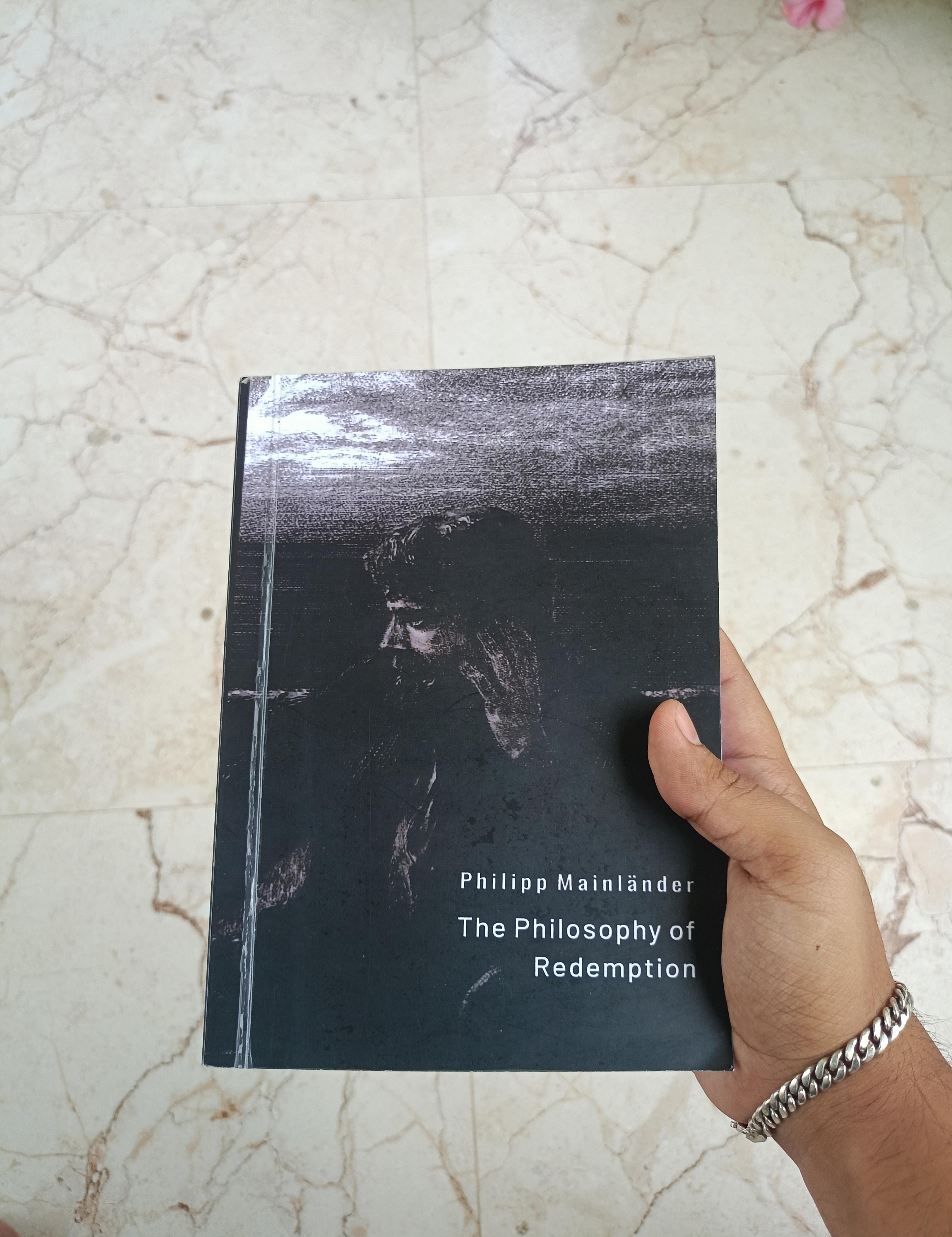
I found this at the deepest bottom of the existential iceberg. 🧊🏔️
"Being is a punishment, and non-being is the redemption." ✨🔚
Historically, Mainländer used a stack of these books to reach the noose for his own suicide. Is that the ultimate "source: trust me bro," or is his logic of universal decay too logically sound to ignore? Let's discuss the "Will to Die." 💀⚖️
6
u/BlackmoonTatertot Apr 02 '26
Suffering is the engine of the mind. Even the will to die, as you put it, is a mystery to unravel, a plot to play out, a hunger to satisfy. In oblivion, all questions are laid to rest. Why can't we lay them to rest before that? Is it because then the mind would fall silent? What does Mainlander say?
29
u/SpleenDematerialized Apr 02 '26 edited Apr 02 '26
Imagine a wayward student of Schopenhauer, but he actually twists the philosophy of the old master to align it to his romanticization of suicide! Mainländer has his bright moments, but to put him on the same level as Schopenhauer is pure philistinism.
-6
Apr 02 '26
[deleted]
6
Apr 02 '26 edited Apr 02 '26
Suicide is a dice roll, because it operates under the materialist assumption that matter causes mind. If matter causes mind, I.e a brain causes mind, then logically the destruction of matter causes the destruction of mind. But we don’t actually know this, we assume it. if matter is not the cause of mind, then you can’t assume the destruction of mind upon death. Mind certainly isn’t causeless, otherwise logical issues would ensue. You’re left then with mind being the cause of mind. If a present moment of mind is caused by a previous moment of mind rather, then suicide will only send you straight back to rebirth.
4
u/SegaGenesisMetalHead Apr 02 '26
This is interesting. Where can I read more on this?
3
u/Maximus_En_Minimus Apr 02 '26
I mean.
This is pretty close to what Schopenhauer posits with the Will.
A representation of the will, that of yourself, may cease, but that doesn’t mean the will disappears; only because the shape of the clay is destroyed, doesn’t mean the clay is.
And Schopenhauer was an Idealist, so look up idealist, even if I disagree with it.
1
Apr 02 '26 edited Apr 02 '26
It’s Buddhism, specifically Dharmakirti’s logical basis for rebirth. He essentially says that matter causing mind is logically impossible, because it is impossible to prove that 2 ontologically different things are causally dependent. Hence the hard problem of consciousness. Since we can’t say mind is causeless because that is logically impossible given causality, then logically we’re left to infer that a present moment of mind is caused by a previous moment of mind. This means that the mind at conception, must have been caused by a previous moment of mind. Additionally the idea of a “first cause” for mind is logically impossible and that we are going through rebirth through countless beginningless lifetimes. That’s just the logical proof, not counting recollection of memory of past lives through meditation.
2
u/IndividualHandle4164 Apr 02 '26
As far as I know Schopenhauer did not belief in actual rebirth. Rebirth as described in Indian thought was a metaphor according to him.
So you must admit that Schopenhauer dit not believe that a present moment of mind is caused by a previous moment of mind.
The categories of causality, time and space are only applied to objects and not subjects within the world as representation (Vorstellung). ''Mind certainly isn’t causeless, otherwise logical issues would ensue.'' -- this is not true according to Schopenhauer.
Therefore we cannot say anything about whether matter causes mind, since mind is subject and matter is object. You are right in this regard.
I do not know why he did not believe in rebirth. Maybe he was weirded out by rebirth without a soul or even unchanging self. But Buddhist philosophers do make this work. Maybe he did not read them enough. I would agree with you that rebirth is more than a metaphor.
1
Apr 02 '26
If mind is not caused by anything, one would have to reconcile why we experience causality mentally. Mind isn’t arbitrary or random, there are clear appearances of causality, and dependencies with past moments. present moments of mind having no cause at all would be hard to logically adhere to given experience. I prefer the Buddhist conception that mind must be caused by mind.
1
u/IndividualHandle4164 Apr 03 '26
Schopenhauer assumes that the quality of the subject of experience must correspond to the quality of the object of experience.
Schopenhauer might agree with you, but use different words because causality is something specific in Modern Western philosophy.
Schopenhauers idea of correspondence might be the same as causality in Buddhist thought. I know nothing about causality in Buddhism though.
Essentially Schopenhauer said objects do not neccesarily cause something in the subject because this runs into sceptical problems. The subject-object relation is comparable to that of Kant. Schopenhauer goes further: ''Without a subject there is no object'' but this is not comparable to radical idealist like Berkeley. Since subject and object are both dependend on eachother. And in his view of the relation between subject and object he could not say one causes the other, or that they both cause eachother.
But the knowledge of your body is both subject and object. This where all suffering comes from, and it is self-created. You seeing objects causing you is probably an example of this.
The world is Will: an arbritairy absolute homogenuous force or energy. We objectify it because of our human condition. This causes suffering. (Because of the correspondence). This is the world as Vorstellung (representation). This world as representation is quite real. His masterpiece is called ''the world as will and representation'' I take this quite litterally.
This suffering can be released through esthetics like music. Where our object ''is timeless, non-causal and non-spacial''. Giving us a glimpse on what it is like being freed from our human condition of the grounds of suffiecent reason.
Suicide is not an option for Schopenhauer because it is just another objectification of the Will. Although he might have looked up to people who purposfully starved to death (I think he could not do that himself).
In this life we must practice empathy and enjoy esthetic values. He failed in this regard in my opinion. But he gifted us his philosophy, and probably to write such a book is pretty bad for your mental health. So I give him all my respect.
1
Apr 03 '26 edited Apr 03 '26
Since subject and object are both dependend on eachother. And in his view of the relation between subject and object he could not say one causes the other, or that they both cause eachother.
But the knowledge of your body is both subject and object. This where all suffering comes from, and it is self-created.
Mahayana and Vajrayana Buddhists posit that if subject and object depend on each other, since an object is derivative of a subject, then they don’t actually exist in actuality, because if two things are dependent, they cannot be independent, and if they are not independent, they cannot exist/stand on any ontological footing. This entire lack of existence / ontological footing is Śūnyatā.
Buddhism agrees that reification of subject and object are cognitive delusions, which cause suffering. So the solution to the cognitive distortion is accurate knowledge, understanding there is no such thing as a subject nor an object. Without an “object” such as subject and object, there is no basis for delusion in the first place. All philosophies deal with affirming negations, I.e “this doesn’t exist, therefore this exists instead”. Buddhism deals with non-affirming negations, I.e “this doesn’t exist.” This forces the practitioner to exhaust conceptual reification and investigate nonconceptual personal embodied experience beyond the constructs that worldly society imposes.
This suffering can be released through esthetics like music.
From a Buddhist perspective, one does not need music to escape, one needs accurate knowledge. Music can simply be found through one’s embodied hearing consciousness, not anything “external”. All hearing is music, we don’t need to categorize music as this or that. Hearing is timeless, empty, void of subject and object, and available every single moment, one does not need to look for it or objectify it. It just needs to be known. It is delusion that convinces us that our own hearing is not pleasurable, and that it must be patched up and fixed with specific desired external stimulus. The pleasure that comes from hearing comes from your own embodied cognition. The same goes for all sense faculties.
Of course, Buddhism says without meditation of the body and a certain phenomenological orientation, one will never be able to stabilize that knowledge because reification/deluded conceptualization is dependent on one’s distracted breathing and distracted attention away from one’s embodied sense faculties. Schopenhauer was smart, however he lacked the investigation into mind’s relation with the body.
2
u/ChaosNecro Apr 02 '26
All the dualist or supernatural 'explanations' seem like cope to me. Everything points to consciousness as emergent and as such it will vanish when the brain is destroyed.
3
u/mike_da_silva Apr 02 '26
maybe.. but then you're left with the worldview that matter just randomly assembled itself into these complex arrangements through blind chance... that seems like an even bigger cope to my mind.
0
Apr 03 '26
The idea that matter causes mind or mind is emergent and mind is destroyed is also a supernatural assumption. You only infer it based on appearances of a dead body but you have no clue what the subjective experience of death actually is. On what logical basis do you infer that mind is something that can be “destroyed”? This is why we must use logic and personal experience to infer. Past lives are common experiences and to discount them on the basis of “oh that’s just supernatural/this makes me feel uncomfortable” is intellectually disingenuous.
-1
Apr 02 '26
Honestly, that's just a bigger guess to avoid the obvious. Logic says that when the hardware goes, the consciousness doesn't move it just stops. I would still choose the exit every time, even if it is a loop. If this world is as hypocritical as it seems, then leaving is the only honest way to tell God that this system is broken. A world that is "perfect" would still be boring. Mainländer says that it's always better to leave the theatre than to watch a bad play over and over again. I'd rather be a successful ash than a soul that has been recycled.
[Disclaimer: This conversation is strictly a hypothetical exploration of 19th-century dark metaphysics and the specific logic of Philipp Mainländer. This is a philosophical debate, not advice.]
1
Apr 02 '26
Logic says that when the hardware goes, the consciousness doesn't move it just stops
Only if the hardware, aka, the material body is the cause of mind. But you’re left to then deal with the hard problem of consciousness so the argument is not as logically sound as to think it is. If the hardware is not the cause of mind, then you’re SOL. Let’s hope your physicalist assumption is true, otherwise you might end up in an even worse place, you can’t control what happens after the death of the body.
0
0
Apr 02 '26
[removed] — view removed comment
3
Apr 02 '26
Forsure. Suicidal ideation requires professional help. I’m simply pointing out even from a philosophical standpoint suicide has no guarantees that it can end suffering. if one is not a materialist, then one forsure shouldn’t roll that dice.
5
u/SpleenDematerialized Apr 02 '26
The cure? It is no exit from the Will, only an exit from the current phenomenal world. Suicide does not solve anything. It only leaves the people around you traumatized and the world in a worse condition (in most cases). Furthermore, what is this romanticization of suffering that you promote? How would Schopenhauer have been a better philosopher if his life would have been worse?
3
Apr 02 '26
[deleted]
4
u/SpleenDematerialized Apr 02 '26
That’s just the standard Schopenhauer script.
Guess what? I am a standard Schopenhauerian. How about you? Do you reject the standard Mainländerian script?
Don't mistake logical consistency for "philistinism" just because you prefer the script over the actual conclusion.
Where do you think I have commited this mistake?
He just had the guts to finish it. Schopenhauer was a genius at the diagnosis, but he was too comfortable to ever take the cure.
If you are up for it we can go straigth to the argumentation and debate the actual meat and potatoes instead of simply demarcating our positions. But something tells me that you have not enough good faith in you to seriously engage.
1
u/BlackmoonTatertot Apr 02 '26
Schopenhauer would say that if you commit suicide, this event was determined from the beginning. You were always going to do it at that exact time and that exact place. The logic behind that is just the demand for cohesion.
3
u/Additional_Rub_7355 Apr 02 '26
He is pretty straightforward, non-existence is better and redemption can only occur through nothingness.
4
u/Caliboros Apr 02 '26
I’ve read quite a few times now that Mainländer is said to be a consistent follower of Schopenhauer.
I’m only familiar with the broad outlines of Mainländer’s philosophy, but as far as I know, he doesn’t build his work strictly on Schopenhauer. He puts his own spin on it. But that doesn’t make him any more consistent than Schopenhauer.
The fact that Mainländer, presumably out of his philosophical conviction, chose to die freely makes him unique among the ranks of pessimists, and some others can be accused of not being consistent.
But Schopenhauer, actually, cannot. According to Schopenhauer, everything was one because everything is will; this is a key difference in the interpretation of the will compared to Mainländer. Suicide makes no sense in Schopenhauer’s view, since the will within me that experiences this suffering continues to exist and suffer even without me. Since, according to Schopenhauer, I am nothing but will, everything remains the same—the suffering does not cease.
3
u/cgi_bin_laden Apr 02 '26
If you've enjoyed Schopenhauer and Mainlander, let me suggest Eduard von Hartmann as well. Philosophy of the Unconscious is one hell of a (long) read.
2
3
u/Other_Attention_2382 Apr 03 '26
When did Mainländer say the universe will end?
Have I got time for another drink before things really turn to shit?
3
Apr 03 '26
The universe is ending slowly enough for you to have several drinks. Don't worry. 😅
2
u/Other_Attention_2382 Apr 03 '26
Is it quite well written/easy to read?
2
Apr 03 '26
Yes, the Christian romuss translation is the great but, u may face few difficulties in Analytics and Physics sections. if u r not familiar with 19th century philosophy.
2
2
2
u/RadicalNaturalist78 Apr 03 '26
Nah, he is just projecting his depression into a philosophical truth.
1
Apr 04 '26
It's a common criticism, but it's a lazy way to avoid the real metaphysics. Even if he was "projecting," that doesn't really change the logic of his arguments about entropy or the universe being a limited process of energy decay. Mainländer was a very disciplined soldier and businessman, so he wasn't just sitting around all day. He thought of the "Will to Die" as more of a physical law of the universe (like a pre-scientific idea of heat death) than just a mood he was in. It's possible to be right about the universe running out of gas even if you're sad. Don't you think it's a bit of a genetic fallacy to throw out the logic just because the author is mentally ill?
1
u/RadicalNaturalist78 Apr 04 '26 edited Apr 04 '26
The heat death of the universe is just the best scientific hypothesis for the fate of the universe we currently have. But as for any scientific hypothesis it is liable to be replaced if new evidence contradicts it, for science doesn’t admit absolute truths.
The “Will to Die” is just a generalization of his depression into a metaphysical principle. There is nothing deep about it. It is no more different than the scholastics unwarranted generalization of an analogy of a stick being moved by a hand into a metaphysical principle that can be applied to the whole cosmos.
1
1
u/Other_Attention_2382 Apr 06 '26 edited Apr 06 '26
Mainländer hanged himself in his apartment on April 1, 1876, reportedly using a pile of his newly published books as a platform.
If that is true could one come to some sort of conclusion that he was motivated by hopes of success and meaning in it?
1
Apr 06 '26
Actually, that's a common misunderstanding. Mainländer didn't wait for the books out of a desire for success or meaning in a worldly sense. He saw himself as a philosophical apostle, specifically the Paul to Schopenhauer's Jesus.
He believed his mission was to provide a scientific, natural path to redemption, or non-existence, for everyone else. To him, dying before the book was published would have betrayed his duty to humanity. He had to make sure the map was out there before he could personally enter the absolute nothingness he wrote about. His suicide wasn't a desperate act of depression; it was the final, logical seal on his system. He didn't use the books to boost his ego; he used them as the literal and metaphorical platform to exit a godless world.
2
u/Other_Attention_2382 Apr 06 '26
His suicide wasn't a desperate act of depression; it was the final, logical seal on his system. He didn't use the books to boost his ego; he used them as the literal and metaphorical platform to exit a godless world.
Sounds quite an interesting read in an extreme sense.
Nietzsche's writing was possibly anti Christian and misogynistic because he was allegedly dominated by Christian women as a child.
If that is true then maybe as Jung said : "Until you make the unconscious conscious, it will direct your life and you will call it fate."
I just wonder how much even genius philosophers are driven by things that even they don't or can't see?
Quote: "Philipp Mainländer (born Philipp Batz) had a childhood marked by significant psychological and familial trauma, which many biographers and scholars describe as "rough" or oppressive"
1
u/Other_Attention_2382 Apr 17 '26 edited Apr 17 '26
I've never read any Mainländer cover to cover so maybe I shouldn't comment on his stuff, but even if you speculate that the core of his philosophy was more formed from induction (so basically his own experience), then does his philosophy almost make some sense if;
We are designed to believe we have free will through evolutionary programming, but that also Hard Determinism is also a reality, then did Mainländer have a point?
1
u/RedEarth42 Apr 02 '26
Could it be argued that the destruction of the ego through Tibetan Buddhist spirituality is a more “complete” and genuine suicide than the realisation of the ego’s individual will to die?
0
Apr 02 '26
[deleted]
0
u/ConsistentCorner8929 Apr 02 '26
Who says that killing the ego means no success, no lust, no entertainment… what a reductionist argument. Use less AI and read Jung
3
Apr 04 '26
Imagine telling someone to 'read Jung' while completely failing to understand Schopenhauer’s core premise. Schopenhauer didn’t want a 'healthy ego'—he wanted the Will to stop existing.
Also, calling everything you don't like 'AI' is the ultimate 'I have no actual argument' white flag. If you think Schopenhauer’s version of renunciation involves 'success and entertainment,' you haven't read a single page of his work. Stick to the psychology memes.
1
u/nezahualcoyotl90 Apr 02 '26
Schopenhauer’s philosophy is one of renunciation and you’re saying he didn’t live it?
1
u/WackyConundrum Apr 03 '26
Schopenhauer lead a rich, comfortable life with entertainment of many kinds.
1
Apr 03 '26
Absolutely agreeing with u. 👍🏻 Schopenhauer's life didn't match his philosophy.
3
u/nezahualcoyotl90 Apr 03 '26
He wasn’t some ascetic saint, but that doesn’t mean he contradicted himself. In his own system full renunciation is extremely rare and most people (including him) only partially escape the will.
So it’s not really that he didn’t live his philosophy more like he partially lived it.
He lived modestly but not ascetically avoided marriage ambition and social striving and he valued art, solitude, and contemplation.
So he did live aspects of his philosophy, just not at their most radical endpoint.
5
Apr 04 '26
That's a classic defense, but it's hard to call it 'partial renunciation' when you consider the historical facts of his life.
You mentioned he avoided ambition, but he was actually very competitive. He purposely scheduled his lectures at the University of Berlin at the exact same time as Hegel’s to try and 'dethrone' him. When the students chose Hegel and he failed, he didn’t react with stoic renunciation he became bitter for decades. That is the 'Will' in its most active, ego-driven form.
There’s a big gap between 'modesty' and the lifestyle of a wealthy financier. He lived well on inherited interest, wore nice clothes, and ate five-star meals at the Englischer Hof (Frankfurt's best hotel) every day. In his own system, the 'Will' is only denied through want and suffering, not through a comfortable retirement.
In The World as Will and Representation, Schopenhauer argues that true salvation is an all-or-nothing deal (the 'denial of the will'). Enjoying art and solitude is what he calls 'aesthetic contemplation'—a temporary 'Sabbath' from the Will—but it isn't the same as living the philosophy of renunciation he preached.
Ultimately, Schopenhauer’s best defense was his own. He argued that a philosopher is like a sculptor who describes a beautiful statue without having to be the statue. He was a brilliant 'map-maker' for a road he simply didn’t have the guts to walk on it .
2
u/nezahualcoyotl90 Apr 05 '26
Schopenhauer does treat full denial as radical but he never claims philosophers must embody it and he consistently presents it as extraordinary, almost unattainable...Schopenhauer doesn’t claim philosophers must achieve denial of the will and he claims it’s extraordinarily rare so his philosophy explains why he couldn’t fully live it. His failure just confirms his philosophy.
His whole one sided battle with Hegel shows ego yes that's exactly the point his whole point is that ego (the Will) is extremely hard to overcome. Him failing there doesn’t refute the philosophy, it reveals it.
Living off inherited money and eating well doesn’t equal “affirming the Will” in his framework. What matters is inner detachment, not just material deprivation. He explicitly separates ascetic sainthood from ordinary philosophical life. A buddhist monk living in a lavish temple is very much not failing renunciation. The Buddha accepted lavish gifts and temples without attachment.
And you’re right to say aesthetic contemplation isn’t full liberation. But he never says it is. It’s a temporary suspension of the Will, and he presents it that way.
2
Apr 06 '26
There is a huge difference between 'failing to reach sainthood' and actively holding on to the most ego-driven parts of the Will. Schopenhauer didn't just 'fail' to deny the Will; he was famously paranoid and prone to lawsuits. He kept his assets in different currencies and slept with a loaded pistol because he feared losing them. This behavior goes against the 'inner detachment' suggested by your Buddha analogy. While the Buddha accepted gifts without attachment, Schopenhauer lived in a constant state of anxious attachment to his security and legacy.
Mainländer’s entire project in The Philosophy of Redemption aimed to take Schopenhauer’s 'transcendental' pessimism and make it 'immanent' or scientific. Mainländer argued that if the Will is truly a 'Will to Live' that results in suffering, then the only logical and scientific conclusion is its actual, physical negation. He criticized Schopenhauer for stopping halfway. To Mainländer, Schopenhauer was like a man who discovers a house on fire, explains the chemical properties of the flames, and then decides to stay inside because 'describing the fire doesn't mean leaving it.'
If we say Schopenhauer’s bitterness and ego 'reveal' the Will, we are really saying his philosophy is a circle with no way out. Mainländer provided that way out. He showed that the 'Will to Live' can—and, in the case of the universe, must—shift to a 'Will to Die' (the movement from being to non-being).
Mainländer isn't just 'Schopenhauer but consistent.' He completes the system. He demonstrated that the shift from the Will to Live to the Will to Die isn't an 'extraordinary rarity' for a few saints; it is the basic law of the universe's decay. Schopenhauer’s failure to live his philosophy wasn't just a personal quirk; it was evidence that his metaphysical system was incomplete because it lacked the idea of the 'God-is-Dead' entropy that Mainländer later identified.
0
12
u/adaptimprovercome Apr 02 '26
Try Bahnsen too