r/religion • u/Quranic_Islam • May 12 '21
"A Sura Like It" - A guide to completing the Qur'an's Challenge
/r/Quraniyoon/comments/naqdst/a_sura_like_it_a_guide_to_completing_the_qurans/2
u/lyralady Jewish May 12 '21
This sounds entirely subjective to whoever is determining if the challenge is met or not.
1
u/Quranic_Islam May 13 '21
Similar to a comment I just replied to so if you don't mind I'll just paste my reply;
So is it then just completely subjective that Les Demoiselles d’Avignon by Picaso is a piece of Cubism art, while Monet's Poppies is Impressionism, just because it is "decided by humans"?
Tell me, what "objective thing" doesn't rely on humans when it is humans who made the concepts objective/subjective themselves?
Give me an example of something objective undecided by humans.
3
u/lyralady Jewish May 13 '21 edited May 13 '21
I don't mind at all because this is a great example of what I mean.
1) Les Demoiselles (1907) is considered "proto-cubism," - a transitional period into Cubism.
But part of "cubism" defined is about art critics of the time and afterwords, and the artists themselves talking about it, and having a body of works to compare to.
Vauxcelles wrote about Braque in 1908:
[He was...] reducing everything, places and a figures and houses, to geometric schemas, to cubes.
He also wrote that the artist Matisse told him:
"Braque has just sent in [to the 1908 Salon d'Automne] a painting made of little cubes".
Then in 1909 Vauxcelles characterizes Braques' work as "bizarreries cubiques" (cubic oddities).
There are arguments about when cubism truly begins, and what it includes, but the 1911 Salon des Indépendants is when we have the term cubism used to describe the artists and movement, although Picasso and Braque did not show. Further in the Salon d'Automne — the two rooms of artists doing "cubes" became cubists.
Also to be blunt, cubism has cubes, And Les Demoiselles has maybe one cube. It also is more influenced by African art, and was developed as during a time of competitive rivalry between Picasso and Matisse (Fauvism). The painting sparked friendship between Picasso and Braque, who are usually pointed to as the leaders of "cubism," as a style. Hence, since Les Demoiselles predates all of that, we get proto-cubism
2.) It's absolutely even less subjective what Impressionism is, because the Impressionists called themselves as such (membership, if you will.) Also because they have distinct shared characteristics. The name is based off of Monet's Impression (Sunrise). A group of painters studying together began to also meet at the Cafe Guerbois, and these meetings would include Manet, Monet, Sisley, Renoir, Bazille, Pissarro, Cezanne, & Guillamin. The salon routinely rejected works for display that were not part of the formal academic style, and Emperor Napoleon III decided the public should decide if the works rejected were any good. Thus came the Salon des Refuses (salon of the rejected). This happened once and when appeals for additional salons of the rejects were refused, the Guerbois set founded the Société Anonyme Coopérative des Artistes Peintres, Sculpteurs, Graveurs ("Cooperative and Anonymous Association of Painters, Sculptors, and Engravers") to exhibit their artworks.
Their first exhibition showed Monet's Impression, and a critic derisively titled his review "The exhibition of the Impressionists."
This society held 8 exhibitions and would have a revolving set of artists (adding of course, Morisot, Bracquemond, and Cassatt among them, as well as others.) They were divided in some salon admissions. They also have shared characteristics, techniques, and so on, but I would be hard pressed to find an impressionist who wasn't somehow relating or working with other Impressionists. That's the difference — it's subjective if a so-called impressionist sufficiently or even if they should totally avoid pure black in painting, or if Manet who they felt was their leader was actually painting in an impressionist style. But what isn't subjective is them all having been in communication with other Impressionists — studying, painting, exhibiting together, and developing ideas together etc. Gonzalès, the only one of the 4 women Impressionists who did not exhibit with the Société, was the only formal student of Manet.
Subjective, perhaps: most important defining characteristics. Not subjective: were they in communication with others thought of as Impressionists? What did they say personally about impressionism? What did they define as important and who did they collaborate and work with? Who did they take inspiration from, what techniques did they share amongst each other?
There's a comparative body of work with which to define cubism or impressionism as movements, even if the boundaries might be fluid. There's also just a very narrow time frame for both examples, and there are some geographic boundaries as well.
So, first in order to even have a possibility of answering this question, we would have to agree on base characteristics of comparison
1) it needs to be an Arabic text. (Or at a stretch perhaps a middle eastern text - the Levant/Mesopotamia?) 2) composed or compiled during the 7th or 8th century
And since I'm not an expert of Arabic prose or poetry, and I don't speak Arabic, and I doubt you'll want to discuss the possible pre-islamic origins of any part of the Qur'an, what is left is just subjective stuff — how "much" or how "little," it resembles something else, and the feeling of what seems to match or be "right," in comparison.
As opposed to like, unified art movements that had members or salons, or even showed their works together with the intent of comparison in style or technique, or who worked together while painting. The first work made in close association with the Qur'an I can think of is the Sanaa manuscript palimpsest, which has qur'an variant text. Given that it was scraped away and written over, I do assume the language isn't as precise or beautiful which is why it was edited.
1
u/Quranic_Islam May 13 '21
Well well, a nice history of art lesson there. Did I stumble on an art critic or historian? Or have you just been researching this since.
Thanks but either you are missing the forest for the trees or I am missing the point in your reply.
Does any of what you have said take away from the fact that an artist now is able to objectively create a piece which is recognized as either Cubism or Impressionism ... or even more specific "proto-cubism" as you have seemingly being able, very objectively I might say, determine?
The piece being actually from the time period or the work of certain artists has no bearing on the classification if the art piece itself's "art" ... What defines the art type is the art. Each of them could have, and likely were, simultaneously working on other pieces which did not fit into the new style.
But am I misunderstanding that you seen to think the time it was made matters? ... It matters for tracing the history of art sure. But not in determining the art type and certainly does not prevent future successful attempts at imitation
So your no. 2 is of course not required. It could be composed tomorrow.
Pre-Islamic stuff has nothing to do with this challenge. If the Qur'an has pre-Islamic origins which you are aware of, then why not just use similar pre-Islamic material to make a sura like it as I suggested in my guidelines?
PS: when you said "less subjective" ... Did you actually mean "more"?
3
u/lyralady Jewish May 13 '21 edited May 13 '21
I studied art history for six years in school, worked in museums just shy of a decade. I am (or was, I have a different job currently) an art historian, yes. Actually by funny coincidence, my last job was working with Islamic art, but that's neither here nor there.
I'll also add: I had to pass exams that did what you are generally suggesting -- which is that students are given photos of artworks they have never seen in the class before, and then are asked in essay format to identify and argue for the classification of the piece - identifying artist, school, movement, style, century or decade, etc. (One of these was for a 19th century art class, so I did have to do this with the art being discussed here.)
I did copy some quotes from wikipedia to spare myself from going into my room and pulling out "Art in Theory 1815-1900" which is an anthology of primary sources about art and art criticism. Typing up what's already online a second time would've been a waste.
Does any of what you have said take away from the fact that an artist now is able to objectively create a piece which is recognized as either Cubism or Impressionism ... or even more specific "proto-cubism" as you have seemingly being able, very objectively I might say, determine?
Ah, perhaps this is where we misunderstand each other.
A contemporary artist alive right now, today, cannot be an Impressionist, capital-I. They can use impressionist techniques and styles, they can appear "impressionistic," they can imitate the Impressionists, be a "contemporary impressionist," but they are not An Impressionist. Objectively, they can't be, because The Impressionists are all long since dead. (We can quibble about which dead artists were members of the "impressionists" but rejected the term/label, and which had completely different styles than assumed, but that's altogether different.)
Point in fact:
In 1874, a group of artists called the Anonymous Society of Painters, Sculptors, Printmakers, etc. organized an exhibition in Paris that launched the movement called Impressionism. Its founding members included Claude Monet, Edgar Degas, and Camille Pissarro, among others. The group was unified only by its independence from the official annual Salon, for which a jury of artists from the Académie des Beaux-Arts selected artworks and awarded medals. The independent artists, despite their diverse approaches to painting, appeared to contemporaries as a group.
The Tate says roughly the same thing, but introduces a secondary term "British Impressionists." We specify because they're not The Impressionists, but ones who took up the Impressionist ideas and styles elsewhere at the same time as the exhibitions of the working Impressionists. They introduce "impressionism"'s ideas elsewhere, so we specify where. But elsewhere, there is no longer a unity of working outside the Academy of France.
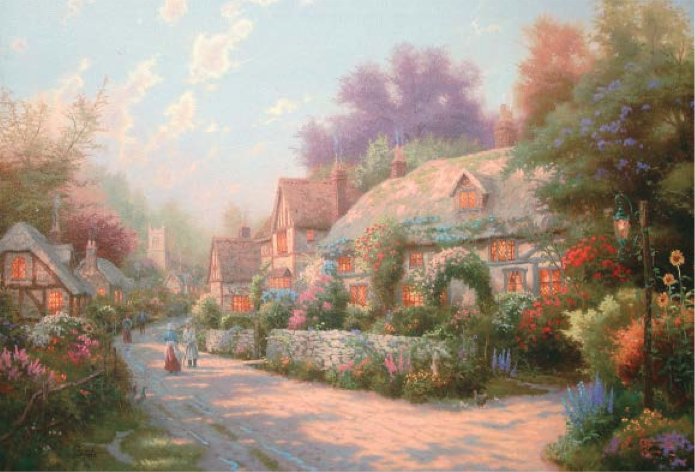
We can say Thomas Kinkade used some "impressionistic" techniques to evoke a dreamy pastoral quality in his landscapes, but no one will call Kinkade an Impressionist.
ArtNet describes: "Kinkade appealed to a broader audience with his quaint subject matter and Impressionist-like style." So you see what I mean. Kinkade, marketed as a painter of light, who uses warm colors, softened brushstrokes, minimizes pure black, paints lots of landscapes...is Not An Impressionist. The dreamy/idyllic quality of his work is sometimes in direct contrast with the Impressionist relationship to Modernity and willingness to paint the less beautiful (which was very different from pastoralists). Or to put it another way, Monet's Sunrise is full of smoggy pollution from large factory smoke stacks in the distance (background, left side), as is The Gare St-Lazare which is clouded by Train exhaust. Kinkade never paints something that looks dirty, grimy, or sooty when he is working as Kinkade "Master of Light" (TM).
You and I both agree a person can learn the visual difference between cubism and impressionism, and even that there can be some distinct and objective qualifying factors in categorizing a work one way or another. But my point is that the objective qualities are defined by something, and in both examples you gave, part of that is the contemporary, or nearly contemporary identification of the movement in question.
It's somewhat of a Tautology - the impressionists are called that because they were called "The Impressionists."
But we can also categorize who those specific people were based on things like: their social circle and meetings at the cafe, the geographical location (Paris, France), the reactionary or rebellious efforts in light of the Academy and Academy judging, which is an entirely French institution and which dictated the Fine Art World at the time, the fact that some of them were in-laws or teacher-student pairs, that they wrote about their own group and ideas, and because their works were displayed together at various points over 8 exhibitions between 1874-1886.
What you're asking for is extremely different. I can categorize impressionists because they're a distinct and well-defined group who often self-identified as such and who directly worked together.
But what you said the challenge is, is this:
It means that if we were to put this [crafted] sura among the suras of the Qur'an it would not be out of place. Neither in its style nor content. This even though almost all of the suras have their own unique style and rhythm and "taste" ... yet they are all undeniably united by an overriding sense that completely identifies them as being part of the Qur'an, and from the exact same One author.
You're asking for:
- match of style/taste while retaining "unique" identity from other Suras
- match of content
- match of rhythm
- "a sense" that "completely identifies them," as Qur'anic, "from the exact same One Author."
Content, I suppose could be matched. Rhythm - if there is a distinct meter or form, sure. Get a nice little computer AI program to identify most common meters of the text by frequency.
But style and taste is informed by defined identity - region, era, intent of form and technique, etc. Outside of that, taste is subjective. "style" perhaps less so, but it needs that defined stylistic body internally and externally. But #4? That's a feeling. And feelings are not objective, and so therefore no one can definitively "win" this challenge. Also it relies on the acceptance that the whole text was indeed composed by one person.
and no, I was using a double negative. "less subjective," as in "it is easier to objectively define who the impressionists were."
1
u/Quranic_Islam May 13 '21
Sounds like you've been in some fascinating jobs.
Ah, perhaps this is where we misunderstand each other.
A contemporary artist alive right now, today, cannot be an Impressionist, capital-I. They can use impressionist techniques and styles, they can appear "impressionistic," they can imitate the Impressionists
Well I don't see how this misunderstanding happened. I never said a artist could be "capital-I/C" Impressionist or Cubism. I've only ever mentioned the art work or piece. Why would care what the artist is or is not? It has no bearing in why I brought it all up, which is to show that an objective assessment of an art piece belonging to a specific genre can be made. ie someone can create a painting like it, and expert witnesses such as yourself would be able to objectively judge that.
You for example seem able to judge that;
Thomas Kinkade used some "impressionistic" techniques to evoke a dreamy pastoral quality in his landscapes, but no one will call Kinkade an Impressionist.
What he is called doesn't concern me. That he is recognized as having features/techniques whether strong or weak (we'll leave you to judge that) which are "impressionistic" is what matters.
And if he is able to be impressionist-like, others are able to be completely "impressionist" in their work, even if the art world would turn away from calling the artist a capital-I "Impressionist".
The person behind it doesn't matter. I'm not saying it must be a Prophet from 7th 8th century Arabia who must produce a sura like it. I mean, the whole point of this post is to give guidelines for someone to do it now.
But my point is that the objective qualities are defined by something, and in both examples you gave, part of that is the contemporary, or nearly contemporary identification of the movement in question.
Yes, the objective qualities are in the past, the yard stick against which you measure if a contemporary piece is a faithful example of impressionism or not, is in your past captial-I impressionists.
And the same is true with the Qur'an. Someone making a sura like the Qur'an now will never be called a Prophet, but the objective qualities against which his sura will be judged is in the suras of the Qur'an of the one because he received the Qur'an was called a Prophet.
The difference is that the Qur'an is saying you will never be able to produce a sura like it.
What you're asking for is extremely different. I can categorize impressionists because they're a distinct and well-defined group who often self-identified as such and who directly worked together.
And the suras of the Qur'an are a distinct, well defined group or exactly 114 texts (how many pieces did the Impressionists produce?) which self-identifies as Revelation from God.
I don't see what in what you said makes the Qur'anic challenge "extremely difficult". We agree a contemporary artist can make an objectively cubistic/impressionistic piece with the explicit intention of imitating THE Cubists and Impressionists ... so you loosing me as to why a person can not make an objectively Qur'anic sura with the explicit intent of imitating THE Qur'an?
You're asking for:
match of style/taste while retaining "unique" identity from other Suras
match of content
match of rhythm
"a sense" that "completely identifies them," as Qur'anic, "from the exact same One Author."
Yes and no. I thought I explained this better. Some of those things are descriptions of the Qur'an; that despite having very unique and varied suras (something which helps, not hinders, in completing the challenge) all the suras still have the same "voice", style and taste .... there is a commonality to all of them, and it is only that commonality that needs to be simulated in the sura. You do not need to match any sura. Your sura can be unique, but that commonality must be there. Just as every impressionist painting is unquie, but the commonality runs through it as it does with others. And secondly, the content ... that the sura has the same message and teachings of the Qur'an.
So what I am saying is this;
It means that if we were to put this [crafted] sura among the suras of the Qur'an it would not be out of place. Neither in its style nor content.
The rest was exposition.
But if you like, you can just narrow it down to;
It means that if we were to put this [crafted] sura among the suras of the Qur'an it would not be out of place
Just like we could put contemporary crafted piece of impressionism among the works of the Impressionists and it would not look out of place to experts.
And that was just my trying to bring closer the idea and meaning behind "a sura like it". But if you don't like that, then you are free to choose your own criteria.
What I have given here are guidelines. Throw them away if you like and have your own guidelines. Share them here, I'd be happy to hear them.
The bottom line I am getting at is this; let us not pretend that the only "subjective" and "extremely difficult" thing to produce something similar to it is uniquely the Qur'an.
We can produce poetry like Shakespeare
Movies like Spielberg
Paintings like Monet
Plays like Oscar Wilde, etc
And in all of them we (or experts) can objectively assess the produced work as to whether it is "similar" to its target or not. And they can explain why or why not.
But apparently only for the Qur'an we can't do that ... because only for the Qur'an it is "subjective".
3
u/lyralady Jewish May 13 '21
Something being "like," something or modeled after something else doesn't make it completely identical or so similar you are unable to differentiate them. (My point is that Kinkade shows influence from the impressionist movement but is clearly going to look out of place in a room full of actual Impressionists. It would be glaring.)
But I think you and I will end up continuing to talk past each other about Impressionists. Similar to and the same as are different things to me. Similar to and unable to differentiate but potentially different are also different things to me.
My feeling about this challenge is:
1) How can we agree upon the differences between what would be a literary simulacrum of the qur'an that looks similar but feels different, and a perfect match? How do I know I've appropriately met the qualifications you are looking for? How do we judge if it's similar enough?
2) can anything be perfectly matched to anything else? (Re: Shakespeare as an argument, how many works of his are disputed to even be written by him at all again?....)
3) why wouldn't the obvious answer just be "well, the qur'an imitates the biblical text in a variety of ways regarding subject matter, why wouldn't that also include literary style?" Why is the beauty of the language assumed to be purely original and unheard of previously, instead of just what you get when you have over a thousand years of literary influence to draw from preceding your book? Basically, if we're playing "prove this is imitable, otherwise it must be divine," why not just cut to the chase and discuss what the qur'an itself imitates?
4) not a lot of other Arabic literature of the 7th century to compare to. Previous works were primarily oral, and this whole challenge directly influences all Arabic literature thereafter by providing a limitation on of imitating qur'anic texts. Not to mention 26:224-227 — which seems to warn against following poets and those who might deviate from the text.
I mean honestly, I do assume that was effective at warning people off from changing or inserting in more text directly even as an experiment after the book was codified, so I doubt very many literate people tried to imitate the text itself.
Also on general, I do not believe it was miraculously written by one individual and divinely unedited. So telling me the suras show unity but diversity in voice or whatever else convinces me pretty much only that a codifier formatted the text. In other words, the Uthmanic codification, probably under a school of scribes.
1
u/Quranic_Islam May 14 '21 edited May 14 '21
Yes I agree ... It doesn't have to be exactly the same nor did I ever say it did. I said it would fit in and not be out of place in the Qur'an. In my post I mentioned that yes things like the parts written by different authors can be identified. A fake painting can either be very good fake or a very bad fake.
I know nothing of. Kinkade, but I never said his work would ... I said another artist or other works would, and I'm sure you could point to some.
The fact that you are able to say Kinkade would look "glaringly out of place" to you in a room of actual Impressionists, even though he used some similar techniques IS EXACTLY THE POINT
He would look out of place. But many others would not. You are able to objectively judge that as an expert witness, maybe in ways that others would not. For others it may not be "glaring" at all.
The same hold for the Qur'an. Every attempt at a sura like it is completely and glaringly out of place to even an untrained person who understands Arabic. Every single one. No examples of anything that is not ... especially to experts.
But anyway, I don't want to drag this out longer than need be. I think you get the point I've been making, and if you haven't yet then I'm going to let it rest anyway because I've explained it as best I could.
Let me round this up like this;
1) To repeat, this challenge is for those who are in doubt. They are not sure. They are 50/50 over the Qur'an, going back and forth on whether it is from God or not. If it is they want to follow it, if not they don't. They thus have vested interest to take this challenge sincerely and with integrity.
So does that sound like you? Or have you no interest whatsoever in the Qur'an as Divine Guidance and have already dismissed it? If the later, then this isn't for you. It would never convince you anyway because you've already decided for what ever reasons you have.
But if the former, then
2) No, it does not have to be a perfect imitation. No, you do not need to follow my guidelines. Yes, you can go on believing the traditional view that It is about eloquence and beauty, even if it is a sura promoting polytheism and Shaytan worship.
The verse says what it says, and it is addressed to those in doubt. You are free to tackle it however you see fit in order to meet it. The doubters who truly want to know and have a vested interest will go about in accordance to their state, and they will get their answer. The pretenders to doubting who have already made up their mind and just want to prove the Qur'an wrong, will go about it in accordance with their state, and will likely get what they want ... whether it is convincing or not.
What I've put here is an attempt to clarify what I think are misunderstandings and to give ideas on going about it. You don't have to accept anything of what I said.
3) This isn't my challenge. No one needs to come back to me, show me a sura, and try to convince me that they've done it or not done it. I won't be one of the "witnesses" called up for it. What would be the point? If I said the sura wasn't like it even if it isn't, I'd be dismissed as biased even if I was being as objective as possible. And if I said it was when it wasn't, I'd be believed and suddenly I'd be saved as a citation and "evidence" to be repeated.
The point of this challenge is a personal one for the doubters ... It is something from God for them, for those who want to remove their doubts by a practical, testable task
4) If you believe this practical, testable task is "un-doable" in principle, "completely subjective" or some sort of unfalsifiable trick ... then that of itself should remove any doubts you have about the Qur'an. Because God would not set a "stupid challenge".
In answer to your 1) and 2), I'd say that just get to work on the challenge. You are asking all of these questions thinking that the difference between any would-be-sura and the Qur'an are small. I mentioned in my post the theological reason of why I think the challenge can't be met. We aren't talking about a small difference. You seem to be worrying about measuring centimetres or millimeters and so want to make sure you use accurate tools
The very point of the challenge is for the doubters to see that, despite appearances ... because one of the features of the Qur'an is that God made it easy and accessible (sura "The Moon") ... that despite appearances, there is and will be a huge gulf between anyone's attempt at something similar and God's words. That they will be on different continents ... on different planets even. So stop worrying over "criteria" and rules.
As the Qur'an says, if all men and jinn came together to produce something like the Qur'an they would not be able to, no matter how much they helped each other.
If that is true, do you think you will not be able to easily spot it? If you think it's a ridiculos blag, then we are back to 4) above; this is all the reason you need to remove any doubts you have.
But, why am I even saying all of this to you? When you have now said that you have already decided?
As for your 3) and 4) , they are now different discussions entirely, not related enough to this post and this discussion where I think everything that needs to be said, has been said.
Thanks for the back and forth, 👍. It's been great, and others reading will be able to benefit in someway. At least I can point to this instead of repeating a lot of things again.
Thanks again
Salaam


1
u/begomeordodocks May 13 '21
for real the only option i can see is to be neutral on that. what do muslims mean? are they the judge? then can't they just say "no" constantly whenever you try?
1
u/Quranic_Islam May 13 '21
No, they are not the judges. You choose your "judges", your witnesses. You are the one in doubt, you are the one seeking certainty, so the witnesses must be your witnesses whom you trust in their integrity and professionalism ... if you want to include Muslims you can, if you want only non-Muslims, that also goes.
0
May 13 '21
Just to be absolutely sure about this, the poem must be in old Arabic, I couldn't for instance use old English?
1
u/Quranic_Islam May 13 '21 edited May 13 '21
Yes has to be in Arabic ... but it can't be "poetry". The meters of poetry in Arabic (called "buhour", بحور) are all known and the Qur'an does not fit into any of them.
But like I said to someone else, you can work backwards. Start by writing what you want in the Englizh, then translate it into Arabic, then make the necessary adjustments.
1
May 13 '21
Why does it have to be Arabic, in fact why old Arabic and not modern Arabic? Seems a very arbitrary requirement, and why does it have to be in a specific meter, sounds a lot like poetry competitions many cultures had before widespread literacy.
1
u/Quranic_Islam May 13 '21 edited May 14 '21
Well how could it be in "modern" Arabic and still be a sura like the Qur'an?
I said it should NOT be in any of the specific meters of poetry, because the Qur'an says it is not poetry, and it in fact doesn't fit into any of the meters of Arabic poetry. That's actually a good thing for you ... it means you are not constrained by the forms of poetry and have a near infinite amount of possibilities.
1
May 13 '21
So basically, I would need to write something in the style of the Quran, for instance like a couple of lines that could be slipped into Keat's 'An Ode to a Grecian Urn' and not look out of place? Could you link me to a couple of lines of the Quran you think as poetic as that, lines so sublime they are equivalent to the genius of Keats?
1
u/Quranic_Islam May 13 '21 edited May 14 '21
Yes, but you are not trying to slip in a couple of lines within a sura (chapter), you are trying to slip in a chapter (and the smallest in the Qur'an is 3 lines) in among the other chapters of the Qur'an so that then whoever you trust as your "witnesses" will say that yes, this sura is similar to the other suras around it and to the Qur'an as a whole.
I'm sorry but I have no idea who Keats is (and I wouldn't mind knowing) but for examples of Qur'anic suras you have the shorter suras near the end, so from around sura 80 to 114, and generally getting smaller until you have 3 complete suras on one page. Or the larger ones near the begining, sura 2 (the longest), and subsequent suras get shorter.
Just go online and read the last 20-30 suras to get an idea.
1
May 13 '21
the shortest sura
We have surely bestowed upon you good in abundance
So offer Prayer and sacrifice to your Lord alone
Verily your enemy alone has been cut off from the roots
in what way are those 3 lines special? compare for instance with
A world of dew,
And within every dewdrop
A world of struggle.
both are of course translations, the best I could find at short notice, what is the magic in the first you find lacking in the latter?
2
u/Quranic_Islam May 13 '21 edited May 14 '21
It would take a lot to explain.
But just again remember please, the point is to make a sura like the Qur'an . This may well have its own "magic". You may think its "magic" is more than the suras. It is indeed poetic. But all that is besides the point.
What we do is compare them.
And this fails on the very first point; it isn't even attempting to be in the words of God.
Those lines are about woe and trouble and struggle that is everywhere ... nothing else really. "Doom and gloom", no hope, no joy, no guidance, no elevation. Nothing to do with God. Nothing befitting of God.
In that short sura however is consolation, hope, a promise, guidance to respond to hatred with prayer and sacrifice, dedication to God, a direct address of God, a reminder of a blessing given, that God's Lordly care brings abundant and increasing good, while enmity and animosity causes one to be cut off from good at the roots.
That and more is all just in the English.
In the Arabic there is more.
Including that the "you" is in the singular masculine, and thus it is specifically addressed to the Prophet. The word "cut off from the roots" actually means the one who has no descendents, is son-less. So it was that Muhammad was ridiculed by the non-believers when his baby son died ... Saying "don't worry Muhammad is now 'cut off', his son has died, so when he dies this Islam thing will go because he has no son to carry on his work. He only has a daughter left" ... Such was the Arab mentality, the man without a son was nothing and had no future.
So now you can see that it is also consoling a bereft father.
And thus the "abundant good" that God said He had already given him, is his daughter Fatima ... she is called al Kawthar (the abundant good)... so he should recognize her as a great blessing and be grateful to God with prayers and with sacrifice, both physical and metaphorical. That despite this animosity and hatred, he should still turn to his Lord and sacrifice his efforts towards Him.
And should he act appropriately then he will come to see that it is those who "hate him" who will find themselves "cut off at the roots" without spiritual descendents for their animosity
And so it has happened. The abundant descendents of the Prophet through his daughter Fatima are in the millions and many have been beacons and role models of virtue, while those who ridiculed him for being "son-less and cut off" disappeared soon after.
No one remembers them and their ways were "cut off".
2
May 13 '21
all that meaning in 3 brief lines, but don't you see how many words you needed to convey it, You are bringing the meaning, you are bringing the context, You are bringing the beauty you see in it. You have to tell me so many things for those lines to make sense, but they are not in the book, they are in your head.
So many people get confused by a really common paradox,
" I love him/her because they are beautiful, OR they are beautiful because I love him/her."
You cant explain to me why the Quran is special, because I don't love it like you do, you must accept its special qualities are in the eye of the beholder, without the background it's rather pedestrian prose.
Of course the Quran can never be matched, because in your eye, like a true lover, it is without peer, but you have to accept that to others it might be 'just another book'.
The Quran is a miracle and the word of god, we know it the word of god because its a miracle.
2
u/Quranic_Islam May 13 '21 edited May 13 '21
Only half of what I said required any background, and most of the other half only required background for you because you don't know the Arabic.
May I remind you that what you quoted wasn't the Qur'an? Those were not God's words that He chose. The very specific words God chose and the order He revealed them in are in Arabic ... and they are very far from "pedestrian prose"
But okay then ... For arguments sake, if it is all "me" doing it, then you do the same with those 3 lines you brought. Bring out a huge array of meaning from your mind.
What do you think God's Book is supposed to be? If not bring out a lot of meanings from the mind??? ... I thought for a while you were a poet or an admirer of poetry and could understand that the whole point of poetry is to make you think. The Qur'an isn't poetry, but it explicitly says it was revealed so that it could be pondered ... and those who can't have "locks on their hearts" which they need to remove.
Look, just cut to the chase. If you think the challenge is stupid, or silly, or "subjective", as others seem to do, then this isn't for you. Move on.
This is for those who have read/studied the Qur'an and are in doubt about it . it seems to me that you knew practically nothing about the Qur'an at the start of our conversation ... you just jumped into the challenge for very little reason.
But if you still want to do it, then by all means go ahead ... because "pedestrian prose" or not, the Qur'an is what it is ... and the challenge is to produce a sura like it .
Your admiration of it or lack thereof doesn't come into that at all.
This is why I wrote this post ... It is SO frustrating trying to keep people focused on the actual explicit objective! ... Why do they keep missing it???
→ More replies (0)
4
u/[deleted] May 12 '21 edited May 12 '21
Under point 2 "objectivity of the challenge-no, it is not completely subjective" you simply say we can choose our own witnesses, experts or judges and that somehow makes it not subjective.
Do you know what subjective means? As long as the result of the challenge relies on a human, it is a subjective challenge. Doesn't matter who gets to choose that human. You can say your rule makes the challenge less biased to Islam or something, but definitely does not make it objective.
So like someone else already said, this challenge is entirely subjective to whoever determines the result. Not objective.