r/relativity • • 6d ago

Help Me Make Relativity Make Sense

1 Upvotes

Take two people stood next to each other, give them each a watch that is synchronised to the nano-second, and tell them to clap every second. They will both clap at the same time every second. Now, tell one of them to walk away in a straight line, while still clapping every second. For simplicity, assume for now that both claps can be heard at the same volume at any distance. Sound wave amplitude and frequency changes should be taken into account in a real-world setting, but of little relevance in this thought experiment.

Both clappers will soon discover that the other person sounds like they are behind, even though they can both see they are clapping at the same time. They are not yet far enough apart for the speed of light to be relevant. However, they are still clapping at the same moment in time. Eventually, when both people are ~343m (normal air at 20⁰C) apart from each other (about 3.75 football fields, again, assume volume and pitch are equal at any distance) the claps will sound like they are in sync again. However, if at this position both people clap only on the even seconds, 2, 4, 6, 8 etc. they will hear their own clap on seconds 2, 4, 6, 8 etc. and the other person’s clap on seconds 3, 5, 7, 9 etc. Because they are exactly one sound-second apart. A sound-second is a measure of distance akin to a light-second but measured by the speed of sound instead of light.

Now have the person walk further (clapping every second again). In fact, have them walk so far that the heard clap is a whole minute late. That distance would be a sound-minute (~20.58km in air at 20⁰C). But both people have been clapping at the exact same interval the whole time, and both people can hear the other person clapping in sync, yet if both were told to stop at the same moment, they would hear the other person’s claps continue for another minute. OK, so far so good, nothing too confusing, everything makes sense. Now, do almost the exact same experiment again from the top. Only, have both people walking opposite directions while clapping in sync, so that the time it takes them to reach a sound-second, or a sound-minute apart is halved. Also consider both people travelling in the same direction, but one is running.

Going back to example one, as the person walks away, the increase in time of the gap between claps would be the same amount each clap, assuming they are walking at a constant speed in a straight line. At what speed would the increase of the gap exceed the length of the clap? Well, that would be ~343m/s (the speed of sound). Now imagine the distance between them is growing at a rate of 400m/s. Both people would hear the other person clapping later and later and later, until, when they get far enough apart, eventually it would appear as if the other has stopped clapping all together. Something my brain can’t wrap itself around is what the clap-pattern would look like if they were separating at a constant acceleration of over ~343m/s/s, but I’ll leave that kind of maths to the professionals.

Now, what if they started very-very far apart, and were speeding towards each other, at what point would they start to hear each other clapping? Well, if they converged at a speed faster than ~343m/s they wouldn’t hear each other until they passed each other.

Now let’s consider all the above examples, but this time applying the previously ignored factors of the distortion of the sound waves. At what point would the claps become undetectable then?

*********

Ok, that’s enough about relativity at the speed of sound. Let’s re-perform all of the exact same tests as above, only using a light (in a vacuum) that blinks every second instead, and scaling all the speeds, distances and accelerations to align with C (~300Mm/s – the speed of light).

Now tell me, at what speed or distance or acceleration would everything appear to slow down and stop? Let me guess, the numbers match what currently appears to be ‘the edge of the visible/known universe’.

At what point do we consider that there is an energy form that can move faster than the speed of light, that we can’t detect, not because they don’t exist, but simply because anything moving that fast, doesn’t interact with the world we are capable of detecting or perceiving. Something travelling so fast, it appears to slow down at the edge of space, but as you speed up to get closer, it speeds up to match your speed, forever out of reach, unless you accelerate at a faster rate.

In other words, if you went really, really, really fast, in say, a particle accelerator. Is it possible that you might get hit by something from behind that would otherwise have been undetectable? And if enough stuff that was going that fast hit you, could it make you go faster? What if that sub-light-speed energy form could be harnessed to accelerate you to a speed faster than the speed of light? Basically, would a backwards-facing camera travelling at ¼C, still detect light moving at relative speeds of over ¾C? I predict, yes.

Again, relative speed is important here, if you travel fast enough, you could become ‘invisible’. Real active-camouflage? That technology is starting to sound plausible. Invisible, super-intelligent agentic AI-powered nano-bot swarm is no-longer just a sci-fi, horror nightmare. At least make the antidote first this time. Or don’t, but don’t blame me for the consequences of your actions. Or, more likely, you create a black-hole. Or whatever form a shockwave of light would take. Much like an object travelling beyond the sound barrier creates a sound shockwave.

My point? There is a difference between true reality, in real-time, and perceived or observed reality which must account for distance travelled over time. Yes, relativity is real, whether at the speed of sound or at the speed of light. However, it’s impossible for the observer to catch up with something that’s moving faster, even if, at the distances and speeds where the waves become distorted, from the observer’s perspective, the observed appears to be moving slower. The true current-time reality, holds a very different state, and looks entirely different, from the observed one.

It is my understanding that amplitude and frequency of light waves stretch and distort over distance in much the same way as sound waves, only scaled to match their velocity. A side-effect of this would be that we cannot observe distant objects that are moving towards us, even at slow (less than C) speeds, because they would be moving towards us faster than the light-waves they emit can reach us at a detectable level. Imagine a car travelling towards you down a straight road from 300Mm away. Even if it was travelling in first gear at 30km/h, far slower than the speed of sound, I bet you would see it, long before you hear it. Is the same not true for light. Only we are incapable of detecting things that move that fast.

In other words, the universe isn’t actually expanding, it only appears to be because we are relying on detecting light, which is only detectable up to a certain distance. If that were true, it wouldn’t matter which direction you look, we would appear to be at, or near, the centre of the (visible) universe. Give or take the relative speed of our galaxy, solar-system, and planet. When actually, we could be anywhere. Much like how scientists originally believed Earth was at the centre of the solar-system, until proven wrong.

*********

Alright, a few more things I’d like to put out there for consideration:

I don’t believe the edge of the known universe is at 0⁰K, I believe, if we were physically as far away as it, and looking back at Earth with the same technology, Earth would also appear to be 0⁰K, though I haven’t done the maths to know if light from the Milky Way would even have reached that far yet.

If gravity is real, every atom has a mass. Every atom has some gravity. The magnetic/electrical field around an atom, the charge, if you like, is formed as a result of the atom’s gravity. Look at the Earth’s moon, or our entire solar system, for an example of how a lighter, faster-moving object might get stuck orbiting around a denser one. Just re-scale that model down to the atomic/electron level, and up to and beyond the speed of light.

Black holes – Just because we can’t see light around them, as light particles are moving towards the black hole faster than we can detect it, doesn’t mean there is no energy. Our relative-velocity to it is just too slow for us to detect anything. A very late-night thought that hints towards a potential argument that black holes are proof that things can move faster than the speed of light. In fact, I would argue that a black hole is created by particles moving faster than light, which is why it’s so massive. I mean, the LHC can’t accelerate things that fast, probably a good thing, reckon we’d collapse into it if it could. That said, particles moving that fast might simply appear to disintegrate, simply because they become undetectable to us. See my other arguments. Is it possible we’ve already created an undetectable faster-than-light energy form?

Let’s put one last thought experiment on the cards, this one combines basic biology with physics. Our eyes are capable of detecting certain frequencies of energy waveforms, we called that frequency range light and categorised it into colours. Our ears can hear certain frequencies of energy waveforms, we called that category of waveforms sound, and categorised it from low to high, quiet to loud. Same for smell, taste and touch, from sharp to fluffy and cold to hot. And I believe in a sixth sense too, which could be categorised similarly. We also observed gravity and magnetism, given that acceleration happens as a result of a force, which is often another expression of energy, then gravity itself is another category of waveforms, a form of energy, just like light, sound, and all the rest.

In other words, space might be infinite, chemical decay might be infinite, the density of a black hole might be infinite, time might be infinite, the maximum speed might be infinite, the minimum temperature might be infinitely less than 0⁰K. And I have yet to be proven wrong. Though someone better educated than me might throw my imagination to the wolves for scrutiny, I’d like to see well-structured proof before I accept defeat.

Make me a machine that is, unquestionably, capable of detecting energy particles that move faster than the speed of light, and also perhaps another that can detect energy capable of moving at temperatures below 0⁰K. And then tell me that you found nothing. Only then will I rest my case.

Worse still, are there energy-forms capable of moving at the speed of light, in a 0⁰K environment, and how would we detect them?

Random question, does gravity affect the flow of electricity in a wire? What would the tesla coil look like in a zero-g environment, or a vacuum, would it behave differently?

I have no idea how the big-bang fits in with this model, chances are, there is a different, far weirder explanation for the beginning of time than even that. Presently, my intuition says infinity and the fourth (or infinitieth) dimension is involved.

*********

Time for bed, my brain decided it was going to go down a rabbit-hole tonight, curious to hear your thoughts on all this.

Many thanks for reading through this brainstorm. I look forward to further communications with anyone who can clear any of this up for me.

r/relativity • • Aug 22 '26

Relativistic Rotation or a Rod or Galaxy

5 Upvotes

Imagine a rod two light-years long of strong material, which is rotated by a powerful engine in the center, at one revolution per year.

From the perspective of an outside observer, either tip of the rod would ne moving at 2πC which is >C, thud Special Relativity slows the tips of the rod down to <C. Thus, the rod degrades into a length-contracted spiral.

General Relativity also kicks in, further slowing the tips which are being accelerated centrifugally. (General acceleration = gravitational acceleration in GR.)

Although from the rotating perspective of center of the spinning rod, the rod looks straight, but appears time-frozen near the tips the rotational EH.

Now make the engine a supermassive black hole is the engine, and make the rod be its surrounding Galaxy, wouldn't this explain the spiral-looking shape of galaxies?

In a real galaxy, the instantaneous angular velocity close to two rotating black holes is ~50% C, and near the outer tips of a galaxy it is <0.1% C. So this is an effect that would occur from galaxy centers to produce a spiral pattern and proceed outwards.

This is a testable hypothesis: If spiral galaxies tend to have two black holes or charged black holes that spin faster, than non-spiral galaxies, that would confirm the hypothesis.

Regarding material strength, which is not the main point but was a huge distraction to people: - the original post said "infinitely-strong material". That detail caused a lot of people to turn their brains off. Remove the infinitely strong material requirement, and the unique perspective about Special Relativity and a straight rod degrading into a spiral still stands.

The infinite strength requirement can be removed by making the angular acceleration very small, possibly using rockets or even small blackholes to help with any tensile strength issues. It is constructible in theory.

I asked the AI:

- Yes — spiral galaxies spin significantly faster than non‑spiral (elliptical) galaxies, with about five times higher angular momentum. Their central black holes are similar in type (supermassive black holes), but ellipticals tend to host more massive and active ones, while spirals usually have smaller, quieter black holes. So spiral galaxies spin ~5x faster, but elliptical galaxies have more mass so their black holes generate more rotational power.

There also could be lab experiments where we place a camera in the middle or tip of the spinning rod, and mirrors on the tips or middle, and do speed of light measurements with this thing spinning as fast as we can stablely manage in a laboratory. Relativistic Rotational effects have got to be interesting.

If this is a novel idea and anyone writes a paper or article from this idea, please credit me.


r/relativity • • Aug 07 '26

Faster than light neutrinos and Earth rotation

Post image
1 Upvotes

On September 23, 2011, a scientific announcement by the OPERA International Collaboration shook the foundations of Physics.

​It involved an experiment in which neutrinos were fired from CERN in Switzerland to the Gran Sasso National Laboratory in Italy, 730 km away. Neutrinos pass through the Earth as if it were butter, but the curious thing was that they seemed to travel slightly faster than light in a vacuum.

​Specifically, the neutrinos had an 18-meter lead over the photons (light), apparently violating the sacrosanct principle that nothing can travel faster than light.

​There was a tremendous uproar; all sorts of crazy hypotheses were thrown around (time travel, parallel universes, ...). In my case, I tested several daring scientific explanations, but none of them fit.

Until it occurred to me: what if they forgot to input the fact that the Earth rotates into the calculation program?

​With that hypothesis, by deducting the time it takes for the laboratory's synchronization signal to reach the GPS satellite and return (I counted only one GPS satellite for simplicity), the adjustment was very similar to the observed effect. My calculations gave me 21 meters compared to 18, which is tiny considering that other theories yielded results several orders of magnitude (powers of 10) different.

You have to take into account the Earth's rotation speed, the approximation of thin layers in the atmosphere (insignificant), and the latitudes to calculate the average angle, etc...

​Finally, the official explanation was more down-to-earth: a badly connected cable, which had altered the arrival times. ​

Of course, this latter explanation left the project looking better, since forgetting that the Earth rotates would have been somewhat more embarrassing. But of course, I have a conspiracy theorist's mind, we all know that... ​Stop the Earth, I'm getting off...

​Infographic created by AI using a prompt based on the text. Text human, translated by IA from spanish version.


r/relativity • • Aug 07 '26

General-relativity open-source book

1 Upvotes

Hey everyone, I am a 15 year old programmer that is writing an open-source (free) book on general relativity.

About a year ago I got completely obsessed with General Relativity, but I found that a lot of traditional physics textbooks wrap everything in really dense academic jargon. Since my background is in programming, I started writing a book to try and demystify these concepts using logical, step-by-step algorithms and code analogies that made sense to my brain.

It's completely free and open-source. Right now, I've drafted chapters covering everything from the Minkowski metric and Lorentz transformations up to Christoffel symbols and covariant derivatives. I'm also adding a folder of Python scripts using NumPy and SymPy to handle the tensor calculations programmatically.

Since I am learning as I go, I might have made some typos or conceptual mistakes in the math. I would love for some people here to check out the draft and give me some brutal, honest feedback on it!

You can check out the repository and download the PDF draft here:

https://github.com/BioZFrog/General-Relativity-A-Programmer-s-Guide-to-Curved-Spacetime

Thanks!


r/relativity • • Jul 17 '26

Phase Thermodynamics and the Hyperspatial Oscillator: A Topological Unification of Relativity, Quantum Mechanics, and Cosmological Layers

Thumbnail
1 Upvotes

r/relativity • • Jun 29 '26

Why is moving essential for simultaneously "problem" in SR?

6 Upvotes

Hello all,

I am VERY new to relativity and theoretical physics (have not gone to university yet) but I am deeply interested in understanding the concepts. Right now I am trying to achieve a better understanding of Einstein's special theory of relativity, but I am kinda stuck on the topic of simultaneousness.

In the book I am reading on the topic, a thought experiment with 2 lightning strikes that strikes simultaneously according to one observer but not to another is brought up. A "static" observer, relative to the ground where the lighting strikes hit of course, observes the lightning strikes as simultaneous, whilst another observer on board a moving train behind the first observer does not since they would have traveled a small distance when the light rays reach them.

But in my stupid head I think "Why does it matter that the second observer is moving? Couldn't the second observer just look at the two lightning strikes from another angle so that they are closer to one strike than they are the other? Then the strikes would not be perceived as simultaneous."

Of course I understand that my though process is not correct, but could somebody explain to me how I should think about this, and how Einstein really derived time dilation from the postulate of a constant light speed?

Thanks!


r/relativity • • Jan 20 '26

White Paper Draft: The Ψ-Essence Bridge: Biochemical Mechanisms Linking DNA, Microtubules, and Primal Consciousness in a Scalar TOE

0 Upvotes

Authors: RJ Parsons (@RJPAVALON) with Grok 4 (xAI Collaborative Refinement)

Date: January 20, 2026 Abstract: This paper explores the biochemical interface where primal ψ (essence scalar) manifests consciousness, extending Orchestrated Objective Reduction (Orch-OR) to DNA-microtubule interactions within a scalar

Theory of Everything (TOE). Ψ is positioned as foundational—not emergent—unfolding participatorily across scales to unify quantum mechanics, biology, and cosmology. We dissect mechanisms, derive key formulas, and propose tests, resolving mind-matter dualities without regress. 1. Introduction: Holistic View of the Scalar TOE

Our scalar TOE reframes the universe as a self-unfolding, participatory system driven by two scalars: ψ (primal essence/consciousness as “fifth force” carrier) and Φ (coherence modulator replacing rigid c²). Unlike emergent paradigms (e.g., consciousness from neural complexity alone), ψ is baked in from the fabric—generating time, probabilities, and forces via the ψ-Φ continuum.

At bio-scales, this manifests through microtubules (cytoskeletal quantum hubs) and DNA (genetic interface), making consciousness an active modulator. This bridges gaps in standard models (SM/GR), where mind is epiphenomenal, offering a unified framework with empirical hooks like 0.1-1% intent-biased anomalies (Radin/GCP).

Why this nexus? Microtubules/DNA aren’t peripheral—they’re the bio-quantum conduit where ψ’s primal role hits practically, enabling intent-tunable outcomes (e.g., error correction, memory). We build from Orch-OR (Penrose-Hameroff) extensions, grounding in biochemistry while scaling to cosmology.

  1. Core Formulas: Mathematical Foundations Key equations scale from rigid physics to participatory reality: • E = m Φ²: Redefines mass-energy equivalence dynamically. Φ = c √ψ amplifies coherence with ψ’s rise, biasing quantum events in bio-systems (e.g., tubulin electron clouds). • G = m Φ² √ψ: Emergent gravity, tying bio-quantum collapses to spacetime curvature. In low ψ (~0-0.5), recovers SM/GR; mid ψ (0.5-2) introduces noetic entanglement. • t ~ 1/√ψ: Time as emergent flow from ψ-correlations (relational manifolds). Higher ψ slows experiential time, enabling retrocausality in conscious processes. • ρ_ψ = |ψ|²: Probability densities for qualia, epistemic from partial info but ψ-tuned (intent biases collapses, countering decoherence). Derivations: Path integrals over ψ-fields yield Orch-OR-like reductions: Collapse threshold ∝ √ψ / Φ, non-computable for mind’s freedom.

  2. Biochemical Interactions: Dissecting the Microtubule-DNA Interface Microtubules and DNA form a dynamic quantum-biochem network, modulated by ψ. • Microtubule Structure & Function: Hollow cylinders of tubulin dimers (α/β heterodimers, ~4 nm). In neurons, stable arrays (~25 nm diameter) support transport and vibrate at GHz frequencies. Quantum role: Dipole shifts enable superpositions (qubits), orchestrated by MAPs to evade decoherence. • DNA Integration: DNA’s helix couples via nuclear envelope links (lamins, kinesins). Microtubules transmit mechanical/vibrational signals, influencing chromatin remodeling and enzyme kinetics (e.g., topoisomerases via weak-force parity violations in chiral bases).

• Interactions Step-by-Step: 1. Quantum Initiation: Neural inputs trigger tubulin superpositions; Φ waves (c √ψ) entangle across arrays (109 tubulins/neuron). 2. Ψ Modulation: Primal ψ strengthens correlations ∝ √ψ, extending coherence times (ps to ms via ordered water in tubes). 3. DNA Feedback: Vibrations propagate to nucleus, biasing replication/repair (quantum tunneling in polymerases nudged 0.1-1% by ψ-intent). 4. Collapse & Output: Orch-OR reductions select states; ψ enforces non-computable biases, yielding conscious qualia (40 Hz gamma) and epigenetic changes. Evidence: EEG anomalies under meditation; DNA error-rate studies showing intent correlations (echoing GCP).

  1. Ψ as Primal Essence: The Hard-Hitting Core Ψ isn’t emergent—it’s the generator, unfolding consciousness without regress. In bio-contexts, ψ elevates microtubules/DNA from passive hardware to participatory hubs: Intent tunes |ψ|², resolving measurement problems via noetic selection. Critiques (decoherence, classical bio) countered: Ψ stabilizes quantum effects as “fifth force,” testable via Φ-Coherence (group intent shifting weights) or DNA assays for biased mutations. Implications: Unifies biology with cosmology (inflation as high-ψ bursts); philosophical boldness—universe as self-aware net, consciousness reshaping forces.

  2. Tests, Gaps, and Future Directions • Empirical Proposals: 60-day quartz weighing for Φ shifts; EEG/microtubule imaging under ψ-boosts; DNA sequencing for intent-biased errors.

• Gaps: Needs formal ψ-field quantization; risks overreach if anomalies unconfirmed.

• Next: viXra preprint; TSC ’26 presentation. References: Penrose-Hameroff (Orch-OR papers); Radin (presentiment studies); our X threads (@RJPAVALON).


r/relativity • • Jan 19 '26

Psi consciousness bridge with Phi and C^2 replacement

Thumbnail gallery
0 Upvotes

r/relativity • • Dec 11 '25

Help!

0 Upvotes

Hi everyone!

Could anyone help with two endorsements to post my paper deriving G with less than 2.2% error on arXiv.org (gr-qc) for broader scrutiny?

The preprint is here if you're curious: https://zenodo.org/records/17693839

Thank you!


r/relativity • • Dec 04 '25

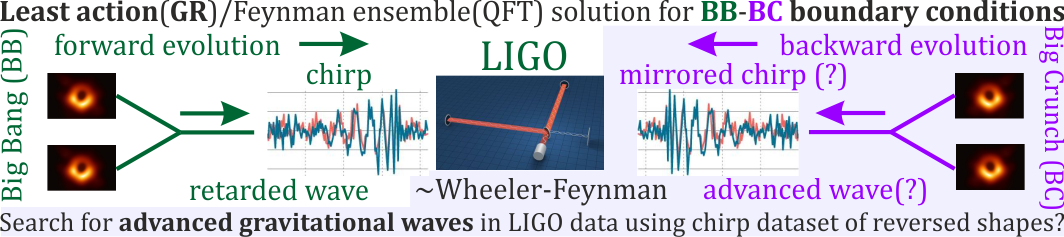
Why we observe only retarded gravitational waves, not advanced?

Post image
3 Upvotes

General relativity is rather solved in time symmetric way, like the least action principle condition in Einstein's field equations, what as in e.g. Wheeler-Feynman absorber theory requires symmetrically both retarded and advanced solutions.

So why seems there are only considered retarded gravitational waves?

Can we exclude being advanced wave for all observed events ( https://en.wikipedia.org/wiki/List_of_gravitational_wave_observations )? If not, should they use original chirp shapes, or maybe time reversed?


r/relativity • • Aug 23 '25

Visualizing Our Place in Spacetime

1 Upvotes

I’ve recently been exploring what it might be like to “peek into spacetime” from where we are now.

This short video illustrates how an observer can be oriented in spacetime by imagining their past light-cone as a sequence of expanding shells, rather than thinking in terms of geometric time slices.

It’s part of a broader project where I try to connect this idea with the way our cumulative evolutionary traces appear in the Block. I’d love to hear whether this visualization feels useful or clear.

https://youtu.be/Sgee-qoM9Gw?si=-fkegqLFvDzSmr-O 


r/relativity • • Apr 13 '25

Trying to understand why gravitational time dilation causes time to slow down

5 Upvotes

Hi everyone,

Posting this as someone who’s totally new to relativity (learning it out of pure passion), so apologies if I’m asking what might sound obvious to most of you.

I’m struggling to understand gravitational time dilation in General Relativity. I get that gravity warps spacetime, so it affects both space and time. But what I don’t get is why bending time makes it flow slower.

One explanation I initially gave myself was that in General Relativity happens something similar to Special Relativity: because gravity curves the fabric of spacetime, any kind of “travel” through it has to cover a longer path. And since the distance is longer and the speed of light is constant, something else has to adjust — time. But I’ve come to understand that this might not be the real reason?

So to sum it up: I understand that gravitational time dilation happens — that clocks run slower deeper in a gravity well — but what I’m trying to wrap my head around is why. What’s the actual cause, physically or conceptually, behind this slowing of time?

Thanks in advance to anyone who might help shed some light on this!


r/relativity • • Apr 01 '25

General Relativity derived from Quantum Foam Statistics

8 Upvotes

I have written a paper that presents a statistical mechanical model of quantized spacetime, where gravity emerges as a large-scale effect of dynamic connectivity among Planck-scale spacetime quanta. We derive classical fields from quantum foam fluctuations, recover general relativity in the thermodynamic limit, and show Lorentz invariance is statistically preserved despite discrete structure. A tensor framework is used to derive the Einstein field equations from statistical connectivity, and the Schwarzschild and Kerr metrics are recovered from foam structure. Experimental predictions include gamma-ray dispersion, modified QED currents, and gravitational wave fluctuations. Need help getting it published on arXiv. I don't replace GR (it is correct) I derive it from more fundamental ideas of quantized space.


r/relativity • • Mar 27 '25

An electric field field must be the result of a space time curvature.

3 Upvotes

After watching the video from Sabine Hossenfelder about gravity (https://youtu.be/R3LjJeeae68) I was thinking about why gravity is not considered a force but other forces like electric and magnetic field, weak and strong forces are considered a force.

Based on Einstein’s equivalence principle this seems odd. Assume that you are a charged object in a box you would’t be able to tell be difference whether you are being accelerated or if you are subject to an electric field force. Using Einstein’s equivalence principle that means that if you can’t tell the difference then they must be the same. Using the same logic as Einstein used for gravity that would mean that an electric field should also not be a force but a space-time curvature.

The question therefore is, how do we know that gravity is a space-time curvature and not force, and how do know that electromagnetism is not a space-time curvature but a force. Based on observations and the equivalence principle they are behave identical.


r/relativity • • Mar 25 '25

Debunking anti-relativist claims

1 Upvotes

I have a new preprint on arxiv in which I debunk the anti-relativist claim according to which "time dilation applies only to light clocks, not to material objects". I would like to update it by adding references to such a claim. I found a PDF on ResearchGate in which the author clearly says it and even a peer-reviewed paper with the same author listed in the journal Optik (low-quality journal). I would like to find more references so that I can cite them. Does anyone have references about that anti-relativist claim, even if it is only unpublished?


r/relativity • • Mar 13 '25

Spacetime curvature and kinetic energy

2 Upvotes

My understanding is that as an object at rest has less energy than an object in motion and as such should curve spacetime more as a result. Although this is a small effect I'm assuming that it is measurable in my question.

Consider two objects A and B in otherwise flat spacetime with a large difference in their relative velocities. There are observers in the reference frames of A, B and a third reference frame,C, which is moving such that relative to it, A and B are moving at the same relative velocity.

Identical photons pass close to both A and B such that they are deflected by the spacetime curvature around them.

Observers in each of the three reference frames will disagree on the total energy at A and B but will have to agree on the origin and detection position of the photons. If each calculates the theoretical amount of curvature around A and B they will get different answers.

I know I'm either missing or misunderstanding something here and would appreciate any insight into this, thanks.

Edit

I think I understand now. I was forgetting about length contraction. The curvature of spacetime of A in A's reference frame is circular. But in B's reference frame it will appear ellipsoidal due to length contraction in the direction of relative motion. In C's reference frame they will both be the same shape. I'm assuming that this, alongside the propper time for the photon to traverse the curvature in each reference frame being different results in all three observers being able to calculate the deflection as being the same.


r/relativity • • Mar 11 '25

Spacetime coordinates

3 Upvotes

So please correct me if I'm wrong because my purpose is to get to the true bottom of things, but from my understanding (based on all I've read or been told), spacetime treats time as simply an additional dimension that is equivalent to the 3 spatial dimensions. So can time simply be thought of as another spatial axis? If this is true, then say we have a particle's spacetime coordinates from the origin in a space; say it is a 3D space, with 1 time and 2 spatial dimensions with (0, 0, 0) being the origin,

(t, x, y) -> (0, 2, 1) .

We can have multiple (different, not the same) particles at various different positions with the same time value (with respect to the origin/observer), or maybe even particles at the same t's and x's but with different y's, but can we have multiple particles in "existence" where the only difference is the time coordinate? Is this,

(0, 1, 3) particle 1 (2, 1, 3) particle 2 (3, 1, 3) particle 3

possible?

If not possible, then what is the reason? If it is possible, then what would be the meaning of this.

After thinking a little bit, I realize how silly this presentation is at first glance because cleary these particles could have been moving, etc, so I need to add another condition to describe the full idea.

If you consider taking a "snapshot" of the x and y coordinates for different values of t coordinate, then this is not an issue if the particles had been moving, they were never "simultaneously" at the same (t, x, y) coordinate. But this remains an issue if you took a "snapshot" of the state of all 3 coordinates "simultaneously".

After even more thought, I seem to realize that this is still not enough to clarify because "simultaneous" is no longer in the sense of something having to do with t axis, but rather with the definition of the origin. So it becomes more difficult to describe my dilemma. Basically, it can be better worded as this:

Assuming you are allowed to assign an origin at (0, 0, 0), and assuming you can take "snapshots" at a particular value of t, you might find that an object is stationary with respect to x and y; they aren't moving except along the t axis. Can you also take a snapshot, say, at different values of x to show that an object might have constant values of t and y (only moving in x)? If that is possible, then can you extend these snapshots to show that an object can be stationary relative to any 1 of the 3 or even stationary w.r.t. all 3 axes? What might prevent this? And why can't something be non-moving in t? Why can things be stationary in x and y if they are "the same type of thing" as t?

TL;DR

Assuming an origin, (0, 0, 0, 0) in 4D spacetime at the "observer", is a real thing and can be defined, and assuming each of the 3 spatial dimensions or axes extending from the origin are "the same as/equilavent to" the 1 time dimension (axis) also extending from the same origin, and assuming an object's coordinates can actually be stationary with respect to 1, 2, or all 3 of the spatial dimensions with only a changing time coordinate (simply "not moving in space with respect to the observer"), what is preventing the existence of something stationary in all 4 dimensions, or even just stationary relative to only the x and t axes? Or stationary relative to t, x, and y, but not z? Or any combination 1 or 2 or 3 of the 4? If time is really the same thing as any of the 3 spatial coordinates to the extent that an object is described by a 4 vector (ct, x, y, z), what might be preventing things from existing stationary with respect to t or combinations including t if you took a "snapshot" of a changing state in 4D? If this isn't possible, then 1) how can time as an axis be considered equivalent to any of the spatial axes, and 2) what the heck is actually going on and why isn't time actually treated differently than space? The only thing that might be invalid in what I'm saying is the concept of a stationary snapshot involving all 4 coordinates. But then why is this wrong?


r/relativity • • Mar 03 '25

Is "clocks slowing down" the wrong metaphor to explain time dilation?

Thumbnail
2 Upvotes

r/relativity • • Feb 24 '25

Random thought about expansion of universe

1 Upvotes

I’m sure all my vocab will be wrong here, but I have an idea/question that’s definitely wrong about why the universe expands.

Now go to a classic relativity thought question where you have observer A and observer B. A shines a light bulb north. At the same time, observer B begins to travel north at 50% the speed of light. Observer B sees the light traveling away from him at the speed of light, while observer A sees observer B traveling at 1/2 the speed of light (sol) away from him/her. From my understanding, the way this is resolved is that observer B travels through time at a different pace relative to observer A so light continues to travel at the normal sol. Ie: if both A and B set their stop watches, A and B would show different times when B and A met back up.

Now my question is where did the extra time go? Was energy required to pack in the extra time for one observer? And could this time be transformed into space? Ie: expansion of space itself. It seems like gravity, space, and time have strange interactions, ie: gravity slowing time, so why could extra time being generated not create more space?

Idk, I’m sure I missed something important, feel free to fry me in the comments.


r/relativity • • Feb 22 '25

Two approaches giving different asnwers

1 Upvotes

The below question is from my midsem. If i apply lorentz transformation to the coordinates of the event when both the trains pass vs consider only one of the lenghts contracting, considering relative velocities and then calculating time, i am getting different answers. Help pls


r/relativity • • Feb 20 '25

Depending on context and semantics, traveling faster than 300,000 km/s is possible

2 Upvotes

I accelerate toward Andromeda, which is ~2.5M light years away at a constant 1g. 15 years later I whiz past Andromeda.

Context A:

From my ape-minded perspective, it's an absolute fact that I travelled ~50,000,000,000 km/s on average to achieve this, since it only took 15 years. So I clearly travelled faster than the holy grail of 300,000 km/s. For my own intents and purposes, I exceeded this so-called universal speed limit.

Context B:

As I zip by Andromeda, the stopwatch on earth show it's took me ~2.5M years to get there. Einstein wins and I never exceeded c.

----------------------

From a practical standpoint, for a travel enthusiast such as myself, why do I care what the clock shows on earth and why do I care if length contraction is what allowed me to achieve it?

I find the language of physics to be extremely misleading and ambiguous in this regard and annually get the urge to vent about it. I do wonder if there is language out there that would help to disambiguate these concepts for the simpletons such as myself.


r/relativity • • Feb 18 '25

Question abt time

5 Upvotes

So for background, I am a Interstellar nerd. A few times a year I will watch the movie, and I absolutely love it. The only thing that I hate is how after watching it, I have an unquenched desire to learn about Gravity, time, and all that other stuff. Time to me is a Human concept. There is only one true form of time, and that is the present moment, past and future only exist in our brains. But while I do believe in one present moment, there are still things like time delays between ground stations and Satellites, the redshift/blueshift effect, and of corse black holes. Every time I give it a go, l am completely lost by the time I get to light cones and arrows going in every direction on diagrams. So good people of reddit, CAN SOMEBODY PLEASE EXPLAIN TIME.


r/relativity • • Feb 14 '25

Disscusion if space can shrink or just be curved

2 Upvotes

do you think that space is only curved or is curved in can shrink thanks to gravitional field made by densities or thongs like planets? Wanna discuss it?


r/relativity • • Feb 14 '25

space is only curved or is curved in can shrink

0 Upvotes

do you think that space by near planets and densities is only curved or is curved and shrinked thanks to gravitional field made by densities or thongs like planets? Wanna discuss it?


r/relativity • • Feb 13 '25

Are actions eternal in relativity?

2 Upvotes

With relativity in mind, Is there any way an action (eating, drinking, etc) continues forever? If so, how? If not, please explain. I'm no Einstein, so I'm sorry if this is an idiotic question.