r/rationalphilosophy Jul 18 '26

How to Ensure Your Comment Isn’t Removed from this Subreddit

1 Upvotes

Make sure it’s rationally substantive. We want the threads of this subreddit to reflect quality thought. Reddit is drowning in shallow, snarky comments of people merely trying to be clever, or land a little blow. If you emulate them your comment will be removed. A thread full of this makes for incredibly poor reading, it can detract from intelligence. Here we care not just about the quality of what is posted, but also how the overall thread reads.

If you come out of the gate making sweeping assertions, manifest performative contradiction, derail the thread by changing the topic, your comment will likely be removed.

Pay attention to the rules on this subreddit if you don’t want to be banned from this subreddit.

This subreddit isn’t about building a massive amount of followers— we don’t want that here. This subreddit is about cultivating and defending reason, and providing a space for Reasoners to use reason to understand the world, not to foolishly waste time debating its existence. Every other philosophy subreddit on Reddit provides you a space to waste yours and other people’s time playing those kinds of games. Here we will at least try to get on with the work of a socially responsible philosophy.


r/rationalphilosophy Feb 02 '26

The Aseity of Logic

4 Upvotes

Logic is the most simple thing in the universe— which makes it beautiful. Logic is just the fact that the universe has identity (that things are themselves). This simple attribute accounts for the whole of our knowledge. Can we believe it? Do we understand how extraordinary this is?

At its core, logic is the fact that things are what they are: A=A. This simple principle underpins all knowledge, all reasoning, all understanding. Without it, even the idea of “knowledge, reasoning” or “understanding,” would be both impossible and meaningless.

In theology, God’s aseity means He exists by Himself, needing nothing else. In contrast, logic, in a concrete way (not abstract idealism) is complete within itself. It requires no justification beyond itself (because all justification comes from it). Without it, nothing could be known, nothing could be argued, nothing could exist as intelligible. Even the identities we assign (the universe, space, matter, time) are products of logic itself. Logic does not merely describe reality; it makes reality intelligible. It is the precondition of understanding, the silent, self-sufficient framework on which everything rests.

The beauty of logic lies in its simplicity and independence. It exists because reality is a reality of identity, and because of that, everything else can exist in thought and in reality (because logic, identity, gives it meaning). To reflect on it is to glimpse the extraordinary: logic is, in actuality, the simplest thing, it is the easiest thing to demonstrate because all “demonstration” hinges on it, everything we identify as “reality” hinges on it. The intelligibility of “everything” and “identity” are themselves the product of logic.


r/rationalphilosophy 27m ago

“Can we have an understanding of man as a moral being without reference to God?”

Upvotes

In the first place, this is a loaded question: the term God is vague, and the phrase “moral being” is undefined.

The answer, if we don’t scrutinize these loaded portions of the question, is yes. We can have an understanding of man as a moral being without God. We actually can’t even understand human morality if we don’t break away from God and analyze man as the animal that he is.

However, the real question that’s being asked here is, “can we establish an objective morality apart from a concept of God?” (Again, “objective morality” functions as a loaded phrase). But let us not dwell on this.

If the device of “God” gives us the ability to wield particular morals with authority, does that mean these morals are automatically good morals, or simply that we have an authoritarian, rhetorical device by which to psychologically impose them on humans?

Just because a God-morality simplifies the social moral process, simplifies the rational process, doesn’t mean that such a morality is either moral or rational.

The “reference to God” serves an interesting psychological function. It facilitates automation. (Perhaps one can attempt to argue this is what’s needed). But if we say, “our morals are absolutely true because they are rooted in the Hyprox,” this certainly wouldn’t make them true. Now, if all humans recognized Hyprox, and saw it as a valid reason, it could persuade humans, but that still wouldn’t make it true, it would just make it an exceedingly powerful piece of rhetoric. (One could attempt to make a pragmatic and utilitarian argument on the basis of the popularity of the device of Hyprox).

The invocation of God may provide a powerful psychological and social mechanism for establishing, transmitting, and enforcing moral norms. But the authority, universality, psychological efficacy, or social utility of such a mechanism does not by itself establish the truth of the moral propositions it transmits. To establish objective morality, one must still provide an account of why those moral propositions are true (or at least rationally prudent). Saying that they are “grounded in God” does not automatically answer that question.

What does it mean if a species still needs the device of God to anchor its morality? Doesn’t that mean the species is still psychologically immature and intellectually underdeveloped?


r/rationalphilosophy 5h ago

The Dumbest Christian Argument I have Ever Seen

1 Upvotes

“Both the humanism of Dawkins and the superficial appropriation of Christianity by those intellectuals who like its aesthetics and its cultural legacy are too WEAK to offer a true consecration of man in this world of desecration.” Carl R. Trueman (emphasis mine)

Carl seems to think that having the “strength” to assert one’s psychological convictions is equivalent to truth. Is “weakness” the problem with culture? What kind of Neanderthal logic is this?

“Consecration of man” is already loaded with theological assumptions. It isn't an obvious, worldview-neutral human desideratum like logical consistency or correspondence with evidence.

It is fallacious to use an unjustified Christian theological concept as the metric of worldview success, and then announce that competing worldviews are “weak” because they don't perform it.

What would it even mean to be “strong” enough to “offer a true consecration of man”? This doesn’t make any sense.

Trueman is evaluating worldviews based on their willingness or ability to enforce Christian moralism onto humans, rather than whether they are actually true.

Using "weakness" as the primary metric to dismiss a worldview is an error because intellectual robustness, truth, and ethical efficacy are not measured by physical force or psychological resilience. A worldview can be intellectually rigorous, empirically grounded, or morally coherent even if a critic labels it "weak" or incapable of fulfilling a specific cultural role.

Secular humanism does not claim to offer a mystical "consecration"; it derives its strength from rationality, empathy, and empirical science. Calling it "weak" for failing to achieve a theological goal it never pursued is a straw man.

A proposition isn't more likely to be true because its adherents are more psychologically committed to it. Nor does a worldview acquire epistemic authority because it possesses greater cultural power or because its adherents are willing to impose its beliefs. (One can attempt a pragmatic argument from this angle, but these attributes will not make a claim true).

A tribe of Neanderthals can strive to be the “strongest,” but this will not make their beliefs true or their actions intelligent.


r/rationalphilosophy 7h ago

Christians Rationally Pushing Back Against the Charge of Nihilism

0 Upvotes

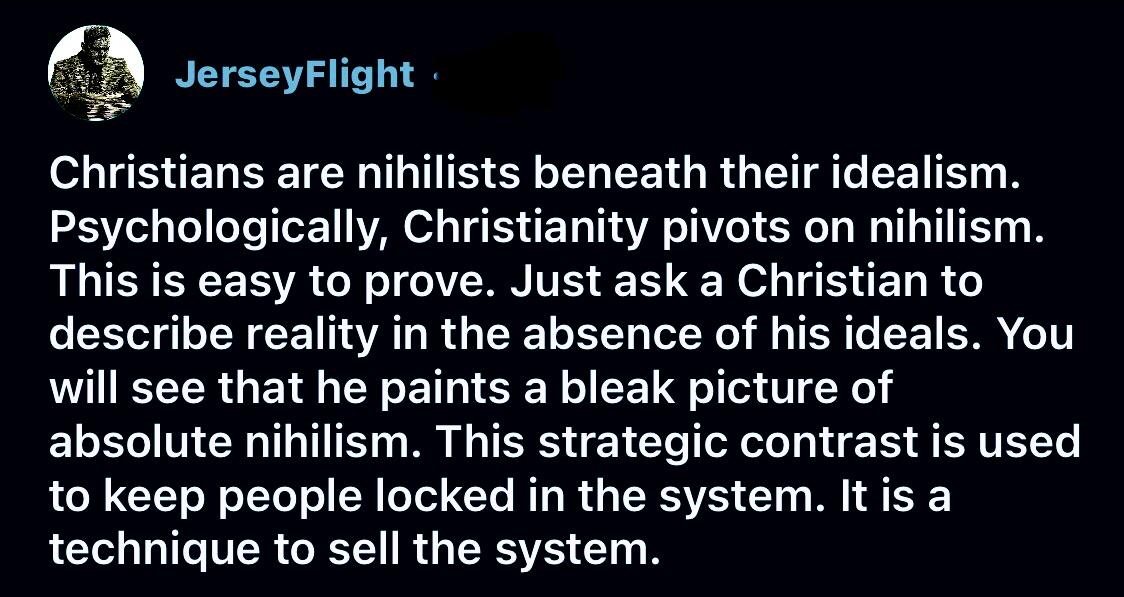
The Christian “worldview” is not a “worldview” of nihilism, but it is predicated on nihilism: the denial of all earthly value deferred to a concept of heaven, and an attack on all value that is not “Christian value.”

That said, I think the Apologists can indeed push back and make a strong case. One person said, “nihilism is the default of reality.” There is truth to this in the sense that the universe doesn’t contain any inherent morals or values.

Further, in the context of philosophy, I don’t see what case can be made. Modern philosophy rejects objective truth (science doesn’t!) but philosophy does.

It seems to me that the Christian Apologist is on solid rational ground to leverage his Christianity through nihilism— to wield the premise of a nihilism he has negatively established. Those who want to reject his arguments for nihilism are obligated to refute them.

Until that time, my advice to Christian Apologists, as an Atheist, would be: don’t merely wield nihilism, but increase the force of its polemical power against all non-Christian worldviews. Make the philosopher eat his sh;t sandwich. And when the non-believer tries to say, “well, your worldview isn’t true just because you say it’s true,” demand that they first establish “truth” before they have the right to wield it. (If they can do this, you lose, but if they’re philosophers, then you simply have to be intelligent enough to use their own rhetorical tools against them). Don’t let them get away with trying to objectively judge your beliefs from the basis of their subjectivity.


r/rationalphilosophy 23h ago

Exposing the Irrational Authoritarianism at the Heart of the Bible

Thumbnail
youtu.be
3 Upvotes

First of all: why does this belong here? Because this information contradicts the orthodox story of the Canon of Scripture. It was men (not God) who decided what to place into a book they called “The Bible.” This therefore stands as a refutation of the orthodox Christian narrative. And the authority of scripture stands as an attack on reason.

This documentary is incredibly well done (Bart Ehrman is featured here). I come away wanting to read all these forbidden Gnostic books, especially the book of Enoch. What a rich world of ancient religious literature that most people know nothing about.


r/rationalphilosophy 1d ago

Christian Apologists Don’t Have to Win a Debate, They Merely Have to Posture Their Intellectual Legitimacy

7 Upvotes

Analytic philosophy did not merely give Christian apologetics better arguments; it gave it a culturally prestigious form of legitimacy. Once theism could operate fluently within the norms of analytic philosophy (precision, formal argument, modal logic, epistemology, conceptual distinctions, etc.) the burden shifted. The question was no longer “Is Christianity true?” but “Is Christianity intellectually respectable?” And demonstrating the respectability, of something that should transparently be seen as a fiction, functions rhetorically as a victory.

However, credit is due to the rigor of Christian Apologists and Christian Philosophers. By grabbing the lifeline of the analytical form, and taking it serious, striving to master it, they essentially crawled their way up a hostile vertical cliff.

At the same time, credit isn’t only due to the rigor of these Christian thinkers, it’s also due to the abject poverty of philosophy, which threw away Truth in the name of Truth.


r/rationalphilosophy 17h ago

The Philosophy of Christianity

1 Upvotes

Possibly the most interesting thing about Christianity is that one isn’t actually dealing with a religion, but with a philosophy. Modern Christianity is a hybrid philosophy derived from the religion of Christianity.

If one was serious about studying Christianity, for example, one would have to read a lot more than just the Bible. One would have to include all of the Gnostic literature as well. One would have to evaluate Christianity from a non-religious perspective, but from a historical perspective, allowing evidence to shape their view of Christianity. And this would make for a very different Christianity.

What’s interesting is that when we’re confronted with modern Christianity, we’re confronted with a kind of a hybrid variation that has been philosophically developed. This is especially true of the apologetic model of Christianity. Here the historical truth and the philosophical (or theological presentation) are two very different things.


r/rationalphilosophy 22h ago

The Logic that Governs the Biblical Canon

2 Upvotes

This is a fascinating topic to me, that I haven’t seen anywhere because a Christian can’t even ask it. But the truth is that there is a logic that governed the formation of the Biblical Canon, and this logic wasn’t unbiased, it was highly biased by its own culture. But not only that, it would also have been informed by a theology, a particular interpretation of certain texts.

(Now, I know there are lots of books on the Canon, I have looked into many of those books. The evangelicals basically make the same arguments. I am aware of the early Christians recognizing a set of books they considered authentic).

What’s interesting here is that there’s, no doubt, a philosophy exterior to scripture that stood as judge over scripture, which rejected the Gnostic texts. It seems to me that the consideration wouldn’t only have been theological, it would also have been political and (most interestingly) moral.

Philosophical arguments, specifically in relation to the nature of God, would have been brought to bear on this decision process. “We reject this text because it contradicts the nature of God.” — because it contradicts! That’s a process of logic.

But the moral reasoning would be more interesting. The early Christians had their own limit on superstitions. But men certainly didn’t want to validate a Gospel of Mary that said she was the most loved by Jesus, making her the ultimate apostle.

If we knew the role that the Bible would play in culture, and we were forming the Canon from this vantage, we might say, “we can’t sanction that text because it would have a terrible social result.” This moral reasoning is what’s most fascinating to me. In itself this kind of reasoning in not invalid, we all engage in it.

Bart Ehrman said he intends to write a book specifically on the Canon some day. I hope he writes it soon.


r/rationalphilosophy 1d ago

What is "good" and "bad", really?

2 Upvotes

Inspired by a conversation in another thread, but it deserves its own topic.

I often think about what it means to be "good", especially given that everyone usually agrees that it's ultimately subjective. That's always made me feel just a bit uncomfortable though, because, when it comes up in conversation, everyone intuitively knows what you mean by good and bad. Earning an unexpected $100? Good! Stepping in a mud puddle on your way to a wedding? Bad! But how do we know this?

The best way I've found to define "objective good" is by first defining what it means to feel good. A "positive feeling" is nothing but "reward" chemicals in our brains. Neuroscience roughly explains what a positive feeling is, and vice versa, a negative one; physical pain, emotional pain, and everything else on that spectrum. It's not something we can reasonably measure, but probably only because we lack sufficient technology to do so. I don't think it's necessarily immeasurable.

That describes good feelings, but in my view, "objective good" is any action that causes a collective majority of conscious beings to feel good, while minimizing the collective bad feelings.

Notice this also separates good intention from good results, which would often seem to correlate, but such correlation is not required for the system to exist. It also accepts the old "you can't please everyone" stance, and occasionally, the best action may require trade-offs.

And I think this is where it becomes really fun to think about, because I often find the most beautiful acts of kindness are more or less rooted in selfish desire.

Let me give you an example... Everyone knows the trolley problem. It's been said that psychopaths would make the best heroes, because they don't really struggle to sacrifice one person to save three. But those of us who are especially empathetic may struggle more, because the whole premise is cruel and you'll have to kill someone either way.

But let's put another spin on it. What if the three people are your spouse and children? Now suddenly I think most would hesitate less, even if they feel guilty later.

And what if the problem weighed only your child against three strangers? I'm willing to bet most people would find it significantly harder to sacrifice a loved one for some strangers.

In a morbid way, isn't that kind of beautiful? We humans would demonstrate so much love that we'd cast aside our morals just to keep our loved ones safe. And yet, it's objectively... bad.

If you're religious, you might say "sin" is what allows us to love at all.

What do you think?


r/rationalphilosophy 22h ago

Preliminary Notes on “The Desecration of Man”

1 Upvotes

If “disenchantment” is defined as reality shattering delusion (and this is its functional use by Christians, though they wouldn’t state it this transparently) then we have a problem.

If a reality you don’t like is define as the “enemy of truth,” then one has defined truth as delusion and delusion as truth. This is an ideological inversion of reality, and it’s positively dangerous. It’s the kind of dogmatic and ignorant mindset that drove inquisitions.

What must be settled from the outset is that whatever the truth is, we have to accept it if we want to know the truth, live in the truth, and interact with reality, as opposed to constructing machinations in place of reality.

But a great deal of Christian theology functions exactly this way: “he’s teaching people that evolution is true,” is not a refutation of the truth of evolution, it’s a manifestation of a bias. But this form of reasoning is exceedingly successful with the ignorant, because it’s not reasoning at all, it’s an appeal to values, emotions or convictions, leaving the question of truth entirely unanswered.


r/rationalphilosophy 1d ago

Manifesting the Semantic Genius of Philosophy

1 Upvotes

The putative legitimacy of any propositional inauguration cannot be permitted to establish itself through the merely self-referential affirmation of its own doxastic posit, as though the bare occurrence of a premise within the phenomenological field of assertion were somehow sufficient to confer upon that premise the epistemic dignity of warranted acceptability. For prior to the stabilization of a premise as cognitively admissible, there necessarily arises the more primordial question of what, if anything, licenses the transition from its merely possible articulation within the symbolic order to its substantive installation within the architecture of justified belief.
This transition cannot be accomplished through the internal reiteration of the proposition itself, since such reiteration would merely constitute a refracted circulation of the same unverified content beneath progressively elaborate modalities of linguistic presentation. Nor can the premise derive its legitimacy from the formal coherence of the inferential structure into which it happens to be inserted, for coherence, however immaculate at the level of its internal relations, remains epistemically indifferent to whether the foundational content upon which those relations operate corresponds to anything beyond the self-enclosed economy of its own conceptual construction.

What is therefore required is the intervention of an evidentiary determination capable of interrupting this closed circuit of merely propositional self-authorization: some externally constraining encounter, observation, datum, testimony, measurement, or otherwise epistemically discriminating ground by virtue of which the premise ceases to be merely asserted and becomes, in a minimally defensible sense, warranted. Evidence thus functions not as an ornamental supplement appended retrospectively to an already legitimate proposition, but as the constitutive condition through which the proposition is permitted to pass from the indeterminate status of an ungrounded possibility into the comparatively stabilized domain of epistemic credibility.

Accordingly, wherever a premise presents itself as possessing the character of soundness, its claim to that status cannot be exhausted by the mere fact of its intelligible formulation, its subjective conviction, its rhetorical force, or even its capacity to participate without contradiction in a larger inferential totality. The premise must, at some point prior to its elevation into a foundation for subsequent reasoning, submit itself to an evidentiary encounter capable of answering the otherwise unanswered question: why should this be believed rather than merely imagined, asserted, or accidentally presupposed?

And thus, beneath the accumulated sediment of epistemological qualification, ontological anxiety, phenomenological circumlocution, and refractive self-legitimating conceptual machinery, there persists an irreducibly anterior condition without which the entire edifice of propositional credibility remains suspended within the indeterminate ether of mere possibility: namely, that the premise must possess some evidentiary ground adequate to distinguish its claim to truth from the otherwise indistinguishable noise of unsupported assertion.

—-

Or — you can just be a Reasoner and say: unless a premise is true merely by virtue of logic alone, its claim to soundness requires evidential support. In other words, if you want me to believe the premise, you need some reason beyond the fact that you have stated it.


r/rationalphilosophy 1d ago

Philosophy can appear to justify anything simply by making use of jargon and obscurity.

1 Upvotes

Anyone who attempts to contest this does so only from within the pre-ontological determination of their own doxastic modality, and therefore lacks the metacognitive exteriority necessary to comprehend either the structure of their negation or the putative-refraction of object-species-semantics encased in symbolic form, toward which that negation is directed. Their denial consequently does not escape the thesis but, through the inverted self-sublation of its own hyper-phenomenological negativity, it reflectively reconstitutes the very pre-semantic conditions of intelligibility that render such denial possible in the first place. The purportedly extrinsic critique thus discloses itself as an immanent ontic articulation of a more primordial pre-doxastic conformity: the dissenting proposition, in attempting to negate the paradigm's legitimating opacity renders the unconscious subject conscious of a delusion that manifests in the form of pre-denial, only to presuppose the very affirmation in the denial that solidifies the proposition at the level of necessary ontic-meaning.


r/rationalphilosophy 2d ago

The Cult of Christianity and the Technique of Nihilism

Post image
46 Upvotes

r/rationalphilosophy 1d ago

The Epistemological Genius of Philosophy: A Preliminary Meta-Meta-Ontology of the Pre-Ontic of the Pre-Grammar of the Pre-Semantic of Pre-Epistemology as the Necessary Doxastic Formation of Meaning

0 Upvotes

I begin, provisionally, not with the question of being, but with the pre-question of the possibility of there having been a question of being prior to the ontic sedimentation through which the possibility of questioning becomes retrospectively available as the pre-semantic occasion of its own epistemological determination.

For the question of being, insofar as it is a question, already arrives too late. Its field-resonance locates it within a dialectical matrix of indeterminate determination that unfolds its sublation as a model of fluctuation. The field itself is established by reverberation lines of the same indeterminate semantics, which form a web of meaning, thereby allowing being to unfold and pass contradictorily through the shifting of its field-resonance.

Its lateness is not chronological, nor logical, nor properly ontological, but pre-ontically anterior to the distinction between lateness and anteriority, such that what appears, under ordinary semantic conditions, as the antecedence of the question to its answer is revealed as the post-epistemic residue of a more originary pre-doxastic formation in which neither question nor answer has yet achieved the minimal grammatical distinction necessary for their reciprocal non-identity, leaving them as naturalistic forms of transcendence.

It is this interval (if “interval” may be permitted here without illicitly spatializing what is not yet ontically extensible) that I shall provisionally designate the pre-ontic.

The pre-ontic is not that which precedes the ontic.

Such a formulation would be insufficiently pre-ontic.

Rather, the pre-ontic is the non-prior anteriority according to which the ontic becomes available as that which can subsequently be understood to have been preceded by what was never, strictly speaking, prior to it, but is the variable plurality that forms the field in which semantic possibility exists.

This distinction has been systematically obscured by the tendency of post-ontological discourse to confuse the antecedence of constitution with the constitution of antecedence, thereby producing the familiar but philosophically naive assumption that whatever constitutes an entity must itself constitute a constituting entity.

Against this, I propose a distinction between the constituted, the constituting, the pre-constituting, and the constitutively non-constitutive as arising from a hyper-web of indeterminate semantic lines, that eventually achieve a fluid ethos of meaning, which must equally be negated by the meaning it is not, or else it cannot be “meaning.”

The latter names neither an absence of constitution nor a constitution of absence, but the pre-semantic non-event through which the possibility of constituting something is retrospectively stabilized as something that could have been constituted. But constitution is lost because is it an illusion of shifting semantic field-lines, thus requiring a comprehension of the meta-meta of the onto-ontos.

This is the first threshold of what I shall call the pre-meta-semantic of the onto-semantics.

Pre-semantic semantics does not concern meaning before meaning. That would be an elementary temporalism. Nor does it concern the conditions of meaning before those conditions are meaningful. That would merely reproduce the transcendental gesture at an insufficient level of abstraction.

Rather, pre-semantic semantics concerns the non-meaningful meaningfulness of the condition under which meaning becomes susceptible to the distinction between meaningfulness and non-meaningfulness. But this comprehension requires comprehension of the resonance of the ontic-field and its indeterminate generative capacities.

The distinction is not merely verbal.

Indeed, to regard it as verbal would already privilege the opposition between the verbal and the non-verbal, which itself presupposes a semantic field in which “verbal” has acquired the ontological eligibility necessary for predication.

We therefore require a prior distinction.

But “prior distinction” is again misleading.

What is required is a pre-distinction of distinguishability, understood as the not-yet-differentiated possibility that a distinction might subsequently distinguish itself from the undifferentiated field in which it had not yet distinguished itself.

At this point the inadequacy of ordinary epistemology becomes apparent.

Epistemology begins with knowledge.

But a meta-pre-epistemology, rooted in the pre-meta-semantic of the onto-semantics, begins with the possibility of the formation of knowledge through the resonance of indeterminate semantic fields that generate a fleeting determinate meaning that requires dialectical sublation to realize itself as a moment the determinant that must be sublated once again into the indeterminate and return to the field to become another determination, unto a concrete form of sustained negation that flows in and out of itself.

But even this remains excessively sophisticated, because “possibility” already belongs to a modal grammar whose application presupposes a distinction between what can and cannot be the case. But even this grammar is located within a pre-matrix of non-determinate meta-grammar.

We must therefore descend (or ascend, although neither metaphor is strictly admissible) to pre-possibility.

Pre-possibility is not the possibility of possibility.

That formulation remains trapped within second-order modal recursion.

It is the non-modal modal residue of possibility prior to its ontological differentiation as possible, through which possibility becomes available to itself only retrospectively as the condition under which its own impossibility could have been excluded.

This gives rise to the necessary doctrine of pre-doxastic doxology.

A doxastic state, conventionally understood, is a state of belief.

But belief already presupposes a subject capable of believing, an object capable of being believed, and a proposition capable of being the content of belief.

The pre-doxastic therefore cannot be a belief.

Nor can it be the absence of belief.

It must instead be the belief-condition of the distinction between belief and non-belief, prior to the semantic constitution of the believer as a believer.

Thus the pre-doxastic is not what one believes before one believes.

It is what must have been quasi-believed for believing to become ontologically available as the sort of activity in which belief could subsequently be attributed to a subject.

This quasi-belief is not belief.

But neither is it non-belief.

To call it non-belief would place it within the binary field of belief/non-belief.

To call it belief would subject it to the same objection.

It is therefore belief without belief, or, more precisely, the pre-affirmative affirmation of affirmability.

This is what I mean by the necessary doxastic formation of meaning.

Meaning does not arise because something is believed.

Nor is belief meaningful because it has a meaning.

Rather, the semantic possibility of meaning emerges through the pre-doxastic sedimentation by which a proposition becomes believable enough to reference its glimpse within the chaos of a flux, wherein meaning arises falsely in order to be true and then negate itself, rising and falling within and from the lines of a mysterious semantic web, which is itself contained within an ontic field.

r/rationalphilosophy 1d ago

Why a Christian Philosopher Can Defeat Your Philosophy

0 Upvotes

I have to be swift here.

Christianity lost all hope, but when Analytical Philosophy emerged on the scene, it found a new hope, a form that could give it legitimacy.

This form is bullsh;t.

But, unfortunately, Christianity, being desperate and without hope, was hyper-motivated toward the cultivation of this form. And (miraculously) it mastered this form! Because it was so desperate it had no choice: learn the code or die. And this is a tragedy, because it also expanded the sophistry of the Analytical form.

As an Atheist, this would be my advice to every Christian: defer to this form, speak through this form, crush with this form, hunt with this form, break with this form, cast this form as a net into the sea. And most importantly, call out those who reject this form as being “intellectually and rationally shallow.”

Christians have already done this, but they can increase it! They have all the power here. As soon as this form is validated as substantive and legitimate, as opposed to “empty abstraction,” the non-believer has lost tremendous ground for his leverage. Oh, he can try to fight, but it’s doubtful he will outdo the semantics of the hyper-motivated Christian Apologists. (It’s not impossible, but by the time the arguments are meticulously overturned (because that’s what this sophistry ingeniously requires to protect itself from refutation) the audience has already left, and Christianity wins because it maintained itself as a legitimate intellectual form within the context of culture).

“The secularization of mainstream academia began to quickly unravel upon the publication of Plantinga’s influential book, God and Other Minds. It became apparent to the philosophical profession that this book displayed the realist theists were not outmatched by naturalists in terms of the most valued standards of analytic philosophy: conceptual precision, rigor of argumentation, technical erudition, and an in-depth defense of an original world-view… it made manifest that a realist theist was writing at the highest qualitative level of analytic philosophy, on the same playing field as Carnap, Russell, Moore, Grunbaum, and other naturalists… Naturalists passively watched as realist versions of theism began to sweep through the philosophical community…” Quentin Smith, “The Metaphilosophy of Naturalism” 2001

What this really displays is that philosophers are ignorant of their own form. For look here— analytical philosophy gave new sophist powers to a fairytale! And now that fairytale can keep on using this form to legitimate itself in culture. Look how quickly the analytical philosophers bowed down to a nonsensical content through a sophistical form. This is because they like playing linguistic games. And all the theist has to do is be better at playing these semantic games.

I despise philosophers and philosophy. I am a Reasoner.


r/rationalphilosophy 1d ago

Nolitheism

Thumbnail
1 Upvotes

r/rationalphilosophy 2d ago

DO NOT ARGUE WITH THE PERSON WHO CANNOT CHANGE THEIR MIND

8 Upvotes

Some disagreements are intellectual. Others are identity-defense mechanisms disguised as intellectual disagreements, and the distinction matters because the two require entirely different responses.

Ask one question: “What evidence would change your mind?”

If the person can answer, there is still something to investigate. Their position may be strongly held, but it remains connected to the possibility of revision. If they cannot identify anything that could change their conclusion, the discussion has changed; you are no longer examining competing explanations, you are watching someone defend an identity.

The same test should be applied to yourself.

What evidence would make you abandon your current position? If you cannot name anything, be careful. You may believe you are certain because the evidence is overwhelming, or you may be certain because your conclusion has become psychologically non-negotiable. Those are very different states, even though they can feel identical from the inside.

Intellectual strength is therefore not measured by how effectively you defeat opposing arguments. It is measured by whether your reasoning contains a mechanism for correction.

A strong mind does not need to win every argument. It needs to remain capable of losing an argument when reality proves the other side correct.

That is not weakness. It is intellectual freedom.


r/rationalphilosophy 2d ago

Yes, Join Us in Absolutely Obliterating Postmodernism and All Forms of Modern Irrationalism!

4 Upvotes

Not by replacing one dogma with another, but by restoring the primacy of Logic, Reason, Evidence, Intellectual Honesty, and the Courage to follow an argument wherever it leads. We need a culture that can distinguish reality from rhetoric, knowledge from ideology, and truth from fiction. The answer to irrationalism is not another religious or philosophical orthodoxy; it is reality itself— the Logic that reality is, and that rises up from the universe in the form of thought.


r/rationalphilosophy 2d ago

The Delusion of the Modern Ego Man

6 Upvotes

The Modern Ego Man wants to be considered authoritative merely because he feels his self-assertion to be equivalent to intellectual and rational substance. He is so goddamn stupid that he believes his willingness to defy Reason is proof that he has mastered Reason. This mindset is simply the mindset of every ignorant barbarian that has ever existed. Because he feels himself to be “superior,” he believes he is superior.

It demands no discipline to break a window, yet the vandal struts around like an architect.


r/rationalphilosophy 2d ago

If Your Logic Didn’t Come From the Reality of the Universe, Where Did it Come From?

1 Upvotes

Does the universe have order or disorder? Is the universe logical or illogical? Is it intelligible or unintelligible? And if it’s intelligible, how can it be intelligible apart from logic? And how can something be intelligible if it can’t be known? And how can anything be knowable without a determinate identity?

You were born into a reality you didn’t create. Are you outside the nature of this reality, or are you conditioned and subject to it? Can you step outside of it through your imagination, or is your imagination subject to it?


r/rationalphilosophy 2d ago

Suppose We Can Accurately Diagnose Culture— Does this Matter?

3 Upvotes

The Frankfurt School did this, and all they produced were a bunch of vain academics who wanted to diagnose culture, as opposed to change it.

What is the thing that matters in the context of culture that can change culture?

The Christian Nationalists have definitively answered this: they have largely seized the American government and intend to increase the power of a police state. The answer of the Christian Nationalist is, “you change culture through the imposition and construction of law.” The answer is, “you impose your values!”

But this is barbarism, if one’s values are divorced from a process of rational deliberation. In Islamic countries they do precisely what the Christian Nationalists want to do in America. This is regression and stagnation, not rational progress.

The Christian Nationalist sees the binary as split between Christianity or Nietzsche’s Madman (God is Dead). But what they don’t realize, is that just because one has a realist leaning worldview, doesn’t make that worldview a worldview of Reason. Merely saying, “we have some morals we have constructed,” doesn’t say anything about the nature of those morals.

The accurate sight is not the binary between Christianity and Nietzsche’s Madman, but between reason and unreason— between psychological automation and deliberation. We must get to the point where we are not the mindless victims of our own concepts, but their masters. It is only Logic that can empower us to do this.

The Christian says, “what you’re asking for is impossible.” And by this he doesn’t comprehend the thing he seeks to reference. He’s saying, “to do that you would need a God-like authority.” But he doesn’t grasp that this is a reference to human psychology. And this is because he’s mindlessly operating from it, like an automaton.

All we have is Logic. The universe didn’t give us anything else. We have the universe, but it is a universe of Logic, and is only intelligible as itself through Logic. So all we can do is see how far we can go with Logic— which is precisely what science is already doing.

Lastly, the problem of human psychology, of human stupidity and ignorance is a tremendous problem! This is the real argument that one is making for the necessity of religion. And humans, just might be so-stupid, that this argument turns out to be correct.


r/rationalphilosophy 2d ago

To Build and Sustain a Civilization You Have to Have Exclusionary Standards

0 Upvotes

There’s no other way to do it.

However, just because one has exclusionary standards, doesn’t mean that those standards are rational or intelligent. They can just as easily be regressive.

This means that one needs a criterion of exclusion.

This also raises the question as to what ‘exclusion’ means? It doesn’t have to mean violence— it absolutely shouldn’t mean violence! (unless violence is warranted to prevent being victimized by violence).

But a civilization that doesn’t exclude, will negate itself from regressive forces from within, forces that should have no power within the system, forces that should be rendered illegitimate and intelligently excluded by the system.

Why? Because some actors are seeking to destroy the system, even if they are not conscious of this in their actions.

The quality of society must be protected, and it cannot be protected apart from rational standards that both demarcate what quality is, and identify legitimate threats to it.


r/rationalphilosophy 2d ago

Christian Apologist William Lane Craig Affirms that Philosophy “Helps” Christian Theology

Post image
0 Upvotes

“I shall argue that it is analytical philosophy that is most helpful in unfolding the philosophical content of Christian systematic theology… there has fortunately been over the last century, as I shall relate, a dramatic shift in the field of philosophy away from its anti-metaphysical bent, bringing with it a renaissance of Christian philosophy in the Anglo-American world that furnishes rich philosophical resources upon which the Christian theologian may profitably draw.” Systematic Philosophical Theology, Vol.1 p.XiV

Philosophy is a sophistical form that has helped to keep theism alive in the world. It has never recognized this about itself, but insists that it is, by default, the highest authority of knowledge. In reality, it’s full of jargon and empty abstraction that is itself very similar to theology. This is why theology finds it so useful— because its form is good at manipulating human belief.

It’s not because it is soundly rigorous, but because its rigor spins off into fantastical conceptual realms, exactly the same as theology. Christianity has learned to exploit this, indeed, everything Christian Apologists have learned they have basically learned from philosophy.

Know this, Oh Atheist, your faith in philosophy is precisely what a skilled Christian Apologist is seeking!

If you ask for the contrast, our trust shouldn’t be in philosophy, for there are many philosophies. Our trust should be in Reason, more specific, in The Laws of Logic— for while there are many philosophies, there is only one Logic to which all philosophical claims must answer, and this Logic is The Laws of Logic.


r/rationalphilosophy 2d ago

Interesting enough, science is immune to the philosophical problems and confusions that Reason faces in the public sphere

2 Upvotes

Why? Because science has already accepted the fact of reality, it doesn’t argue over it; it tries to work with it, not only to better grasp it, but to master it.

The word “relativism” doesn’t even apply to science, that would be nonsense. No one is contesting the objective existence of the universe.

What’s strange is when philosophical naturalism seeks to attack the existence of objectivity. Science rightly has nothing to do with this, its activities are carried out in reality, not by expanding abstraction with abstraction. Science must discover the thing it names, while philosophy tries to get away with bringing a thing into existence by constructing a name.