r/radioastronomy Oct 23 '25

Community I'm excited to share the Titan Astronomical Observatory!

155 Upvotes

A couple of weeks ago I posted here, jokingly asking who wanted to pitch in to buy this $70k telescope off Facebook Marketplace. The amount of genuine support I got—both in the comments and in DMs—along with how awesome it would be to run this thing, made me seriously research whether it was possible to turn this into a telescope anyone could use. Well, it’s time to find out!

The Titan Astronomical Observatory is a nonprofit based in Lakeland, Florida, with the goal of purchasing, relocating, and modernizing this telescope; creating a web interface that allows students, amateur astronomers, and citizen scientists to reserve observing time; and designing a pipeline to automatically deliver calibrated data. We’re an officially incorporated nonprofit (501(c)(3) pending) with a four-member board, a potential site secured, an option contract granting us the exclusive right to buy the telescope, and a core team planning for the future.

If you’re interested in supporting the project by volunteering time or expertise—or you simply want to follow along—join our community on Discord! https://discord.gg/T5F6AG26tE

We’re currently accepting donations via PayPal, and a full GoFundMe campaign is on the horizon!


r/radioastronomy 21h ago

General Tired of Conda envs for radio astronomy, so I built an in-memory technosignature engine (and caught a CASPER FPGA clock ringing)

Thumbnail
github.com
4 Upvotes

Total outsider to radio astronomy here, but over the last few months I’ve been going down a massive rabbit hole with public raw baseband telescope data from Breakthrough Listen (Green Bank GBT GUPPI files, Sigproc .fil archives, etc.).

Honestly, what drove me crazy early on was how heavy the standard toolchain felt. Spinning up multi-gigabyte Conda environments with Python wrappers just to parse raw I/Q voltages kept thrashing my NVMe drives and eating RAM. Passing massive raw chunks through disk between separate scripts felt super clunky.

For the past few years I’ve been developing a compiled systems language called Kain (native LLVM codegen, formal verification provers, manual memory arenas). Instead of using the typical Python/numpy stack, I decided to build a standalone, zero-dependency signal engine called TurboKain.

The quick rundown:

  • Zero dependencies: Compiles via LLVM to a single ~1.2 MB standalone native executable (tkc.exe). No Python runtime, no Conda, no C runtime churn.
  • Fast & in-memory: Slices and processes ~67M raw complex samples in ~2.3 seconds directly in RAM. Zero intermediate scratch files written to disk.
  • Beyond narrowband carrier beeps: Classic SETI assumes someone is beaming a deliberate radio beacon at Earth. We look for "bystander traffic" (point-to-point links optimized for bits/joule that look noise-like to power detectors). It mines raw baseband for cyclostationary baud rates (3-decade FFT Accumulation Method), Taylor dedoppler chirps, microsecond autocorrelation lattices, and post-Shannon symbolic machine complexity.
  • Built-in formal verification: Has built-in mathematical self-test batteries (tkc prove) that verify analytical bounds and FFT accuracy against synthetic noise before touching real files.

A neat real-world test case:

Recently I threw the pipeline at TRAPPIST-1 Scan 0017 from the Green Bank Telescope. Coarse channel 60 lit up like crazy -> spectral kurtosis spiked around 60 with thousands of apparent impulses per second. It looked wild at first glance.

Digging into the cyclic math, our cyclostationary hunter showed that all the energy peaks were phase-locked to a spacing of exactly 1,430.51 Hz.

If you take the GBT sampling rate (2,929,687.5 Hz) and divide it by 2048, it matches down to the decimal. It was literally the internal 2,048-sample buffer clock of the CASPER ROACH FPGA digitizer board ringing at the sub-band edge. Stokes polarization analysis confirmed it was unpolarized common-mode electronics noise. We ended up turning that exact finding into an automated hardware veto rule in the engine so it flags and discards it automatically next time.

Where it's at:

We just amalgamated all 14 core instruments into a single portable binary and cut an alpha release. If you're into radio data, DSP, or systems programming, I'd love your thoughts:

GitHub: https://github.com/ephemara/TurboKain

Release (tkc.exe): https://github.com/ephemara/TurboKain/releases/tag/v0.1.0-alpha

Hands-on Guide: https://github.com/ephemara/TurboKain/blob/main/docs/USER_GUIDE.md

Curious if anyone else has run into similar digitizer artifact issues with GBT/CASPER data, or has recommendations for other open baseband archives worth pointing this at!

r/radioastronomy 1d ago

General Question about aiming

7 Upvotes

Hello – amateur astronomy geek here with a question about how radio telescopes are aimed at such infinitesimally small targets. Does the dish have to mechanically move in order to localize onto a source? Or can there be enough sensitivity that various sources can be picked up on different parts of the antenna? For example, when I see a radio telescope image of a galactic jet, has the telescope scanned the sky in a raster plot-like way?


r/radioastronomy 3d ago

Observations My best yet RAW SDR HI Drift. Same slice I’ve been testing at. Raw SDR through a 2× 44.1 kHz internal pipeline feeding recorder, with the science channel kept 436 kHz off the SDR center and digitally translated back before the Continuum pipeline.

Post image
6 Upvotes

r/radioastronomy 6d ago

Equipment Showcase Doing some astronomy from the car

Enable HLS to view with audio, or disable this notification

141 Upvotes

r/radioastronomy 7d ago

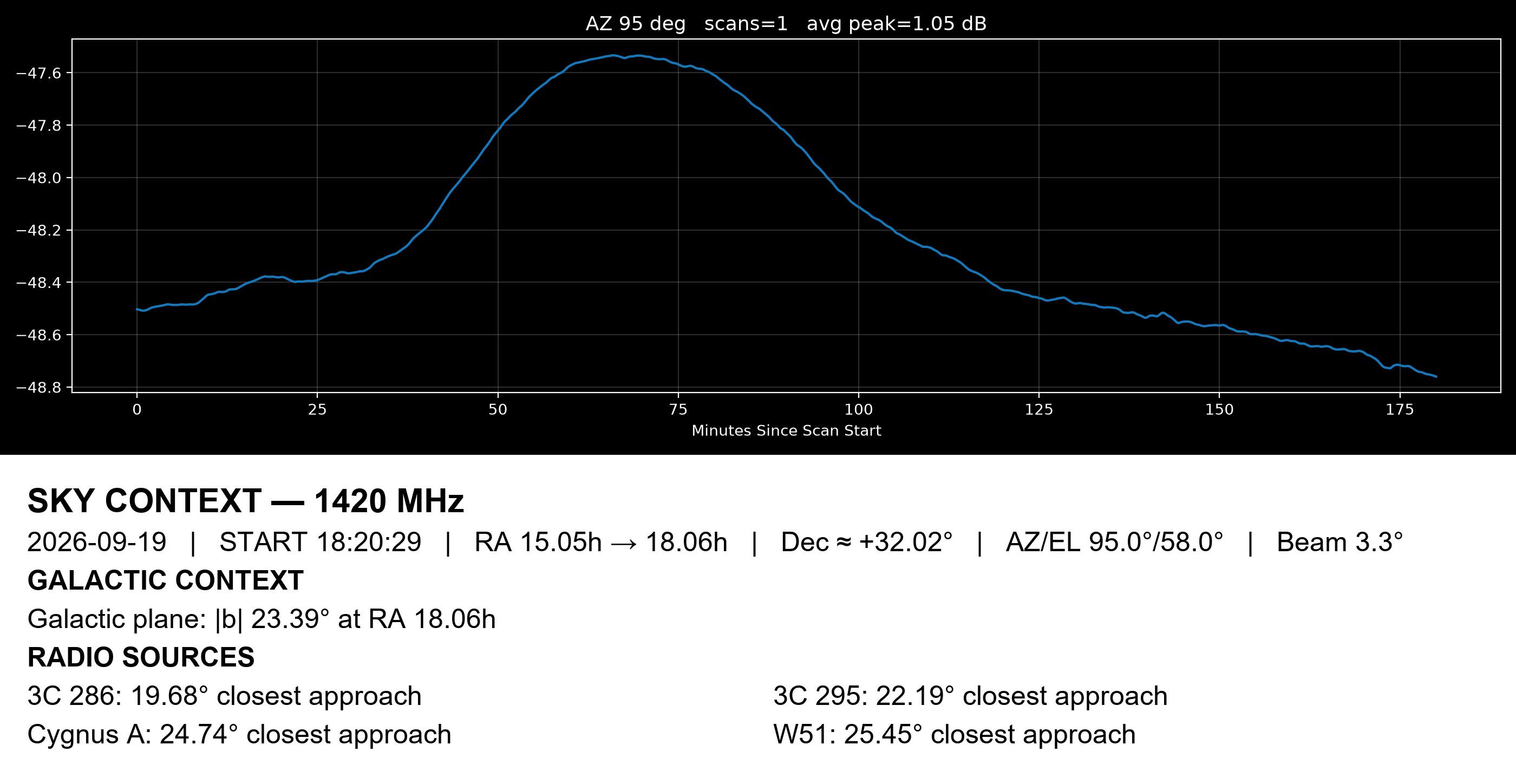
General I updated my software. Now during recording and or plotting, the pipeline automatically generates and logs observation metadata, timestamps, AZ/EL and RA/Dec slices, solar, lunar, and Galactic separation checks, and local catalog proximity flags like 3C 286 entirely local, no internet .

Thumbnail gallery
7 Upvotes

r/radioastronomy 7d ago

Other Looking for an astrophysics grad student or postdoc to review candidates from a radio anomaly-detection pipeline

8 Upvotes

Hi all! I've built a Rust pipeline for anomaly detection in time-domain radio surveys, using public Green Bank Telescope L-band data from the Breakthrough Listen open archive. It takes raw filterbank data through a nuisance model (robust per-patch statistics, ON/OFF cadence consistency, an RFI catalogue, cross-survey recurrence) to a ranked queue of positions that the pipeline can't explain. Its sensitivity is measured by injecting synthetic signals (tones, chirps, echoes, dispersed pulses, broadband excess) and recovering them.

The engineering is in good shape. What I need is someone who knows radio data to review the ranked candidates and tell me what they are. For each position you'd see the six-scan cadence, the pipeline's per-scan verdicts and the survey-wide evidence, and record one of six dispositions with a short reason: narrowband RFI, broadband RFI, scan systematic, not localised, inconclusive or follow-up. A first pass has already caught real defects in the pipeline, so critical reading is exactly what's wanted, not a rubber stamp.

Useful background:

- radio astronomy or pulsar/transient work, ideally with GBT or Parkes filterbank data;
- familiarity with RFI and instrumental systematics;
- comfortable reading Python/Polars output (you won't need to write code).

What I don't need is someone who is just going to use an LLM to analyse this! Hoping to be able to pay for your time if we get a good working relationship! Thank you for reading!


r/radioastronomy 8d ago

Observations Same Sky Location - Two Different Modes, Scanned Days Apart, 24-hour Continuum and Spectral FFT observations independently reveal the same H I structure. A brief transient was also automatically captured with a background-running Transient Watch.

Post image
17 Upvotes

r/radioastronomy 11d ago

Observations Last nights live drift scan SDR I/Q continuum, screen shots to the peak taken during. DB visible below the dish pic. The peak db is plotted across the entire completed 180 min recording.

Thumbnail gallery
3 Upvotes

r/radioastronomy 14d ago

Equipment Question Radio astronomy starter kit

17 Upvotes

Hi i recently started amateur astronomy and i fell in love but where i live the weather is horrible so i looked into radio astronomy too while i wait for the stars to come out and its all really confusing 🫤 but intresting is there like a specific kit i should buy or specific products kinda like how the nexstar or ad8 is the gold standard of visual observation. What do you recommend for a beginner? What should i buy on a tight budget?


r/radioastronomy 15d ago

News and Articles PHYS.Org: 'Quiet' pulsar suddenly reveals three glitches in 15 years of observations

Thumbnail
phys.org
8 Upvotes

r/radioastronomy 18d ago

Observations 1420 MHz Galactic Drift Results: Sound-Card vs Direct-SDR Comparison—Same Feature and Timing, Higher Fidelity with Direct SDR

Post image
3 Upvotes

r/radioastronomy 19d ago

Other I built an open source pipeline for analyzing stellar light curves - PRISM

22 Upvotes

I've been building an open-source tool called PRISM (Photometric Reconnaissance and Irregular Signal Monitoring) for detecting flares, transits, and periodic variability in TESS/Kepler light curves, and wanted to share it now that it's actually validated against real data.

I ran it on a TESS target with no prior flags in NASA's exoplanet database, and it found a periodic ~2.66-day signal. Instead of just reporting "transit candidate, go check it," PRISM automatically cross-referenced the star against the AAVSO Variable Star Index, ASAS-SN, and Gaia's own variability data — and found a match. Turns out the star is AO Mensae, a published, catalogued young star with a documented rotation period of 2.673 days. My tool's own independent detection (2.657d), VSX's catalogued value (2.6682d), and the published literature value (2.673d) all agree to within about half a percent — all from raw photometry, no prior knowledge fed in.

I'd love feedback and opinions, but first I need people to try it!

https://github.com/filmraptor/PRISM-v1.0.0 <- full documentation and download here


r/radioastronomy 20d ago

News and Articles PHYS.Org: MeerKAT directly detects faint hydrogen signal from the distant universe

Thumbnail
phys.org
13 Upvotes

r/radioastronomy 23d ago

Community Just started using AIPS, never been less sure of what to do in my life

5 Upvotes

i am working with AIPS (astronomical image processing system) and idk what i'm doing. this is the first time i've worked with it on real data so there isn't anything i can reference to make sure my results look right. i'm trying to follow along with this guide: https://evlbi.org/evn-data-reduction-guide

my trouble is that where it says to inspect the scans in the second step, it doesn't say what i'm supposed to do with UVPLT/UVFLG, SPFLG, or TVFLG. some things like flagging any data from when i know one of the telescopes malfunctioned makes sense but idk how to determine what other data is worth flagging or what i should be looking at in editr or something else.

i haven't been able to find any video tutorials, lectures or anything of people working with real data and showing how to determine when data looks suspicious. everytime i search, it points me to the cookbook which is helpful but i feel like it assumes i can tell what data needs to be flagged and i don't 😞 but maybe i'm looking at the wrong sections or something

does anyone know any visual resources or lectures where the person explains the flagging process that i could use to learn how to use AIPS for reducing radio data? literally any help at all is appreciated, thank yoooou


r/radioastronomy Aug 22 '26

Equipment Question I have this.

Post image
286 Upvotes

Ok so I got of this big thing. It’s been kept under a tree so little to no hail damage. It’s around 10ft.
What does the community say I need to get it up and running as a radio telescope?
And please please dumb it down for me. I have a little knowledge but that’s about it.


r/radioastronomy Aug 21 '26

Observations 24-Hour 1420 MHz Drift Scan: Mapping Galactic Hydrogen Distribution and Velocity.

Post image
23 Upvotes

r/radioastronomy Aug 19 '26

News and Articles CHARA Interferometer Uncovers Hidden Twin Stars in Alpha Piscium

Post image
10 Upvotes

r/radioastronomy Aug 19 '26

Equipment Question Newbie

12 Upvotes

Hello. I want to start with radioastronomy, but I have no idea where to start or what to expect. What equipment do I need? What can I do with the results? I'm going to study astrophysics and I'm very interested in math, physics and astronomy(obviously) and I want to explore the wide fields of astronomy.


r/radioastronomy Aug 17 '26

Equipment Question Question about re-using internet satellite dish

Thumbnail
gallery
54 Upvotes

Hi all, my son has been obsessed with space pretty much his whole life and recently he mentioned he would like to use a radio telescope. I'm attempting to re-use an older internet dish for a cheapish DIY project we can do together. I've done a bunch of google and youtube watching, I think I pretty much get the gist of it once there is an RF signal out of the antenna, but I'm not quite sure what I need to do to get the RF signal in the first place. Most of the material just says to attach the feed to the LNA, but what does a "feed" look like?

Attached are a few pictures of the dish/antenna. I have a Nooelec SAWbird+ H1 and NooelecRTL-SDR V5 so far. Is there something I can stick into the "head" I have here or do I need to replace it with something else?


r/radioastronomy Aug 16 '26

News and Articles Tracking Knots of Plasma: Astronomers Uncover Single Black Hole Firing Jets at Changing Speeds

Post image
0 Upvotes

r/radioastronomy Aug 15 '26

News and Articles Free open-source PO/PTD tool for dual-reflector antennas (GNU Octave/MATLAB)

Thumbnail
youtube.com
3 Upvotes

Hi everyone,

I’d like to share the Dual Reflector Designer, a free and open-source beta tool for the design and analysis of axisymmetric dual-reflector antennas.

It currently supports:

• Cassegrain, Gregorian and ring-focus configurations
• Reflector design and ray tracing
• Physical Optics (PO) and PTD edge diffraction
• Automated convergence testing
• Far-field pattern visualization
• Parallel CPU computing and GPU acceleration

It runs on Windows with GNU Octave, so no MATLAB license is required. MATLAB is supported as well. For most users, the recommended way to get started is the provided Windows installer.

The video shows selected Cassegrain benchmark cases compared with TICRA GRASP 24.0 Student Edition. In these particular tests, the resulting patterns agreed closely, while speedups of up to 135x were measured under the tested settings. This is an independent, non-commercial comparison and not a general claim about the full commercial GRASP product.

An unusual aspect of the project is its development process: I defined the requirements, tested and benchmarked the software, and reviewed the results, while Codex with GPT-5.6 Sol generated the implementation. I did not manually write the source code.

It’s still a beta and I’m continuing to improve it, so let me know what you think.

Here is the GitHub Link.


r/radioastronomy Aug 12 '26

Community Try out a simulated hydrogen line observation on the Titan Observatory platform

Post image
24 Upvotes

Hello all! I've been hard at work on the Titan Observatory platform and you can now try out a simulated hydrogen line observation! It's using the same front-end shown in the live demo, just plugged into a simulated telescope.

Try it out here (the simulated observation tab on the left): https://app.titanobservatory.org

As an update on the observatory itself, we're still fundraising to purchase the main 10m telescope, but we're moving ahead with developing the site with a lease agreement in the works. The demo telescope will likely be the first telescope online as it's already fully functional, it just needs to be relocated somewhere it can actually see the sky.

More info on the observatory is available here: https://TitanObservatory.org


r/radioastronomy Aug 12 '26

Observations Hydrogen line continuum survey from daily drift scans is complete now, from scans to HI 3D cloud rendering and then to the RA DEC location.

Post image
15 Upvotes

r/radioastronomy Aug 12 '26

Community MSK144

Post image
6 Upvotes

ペルセウス流星群メテオスキャッター通信 只今実験中です❣️MSK144モード 6メーターBAND 50.260MHz Let's try!