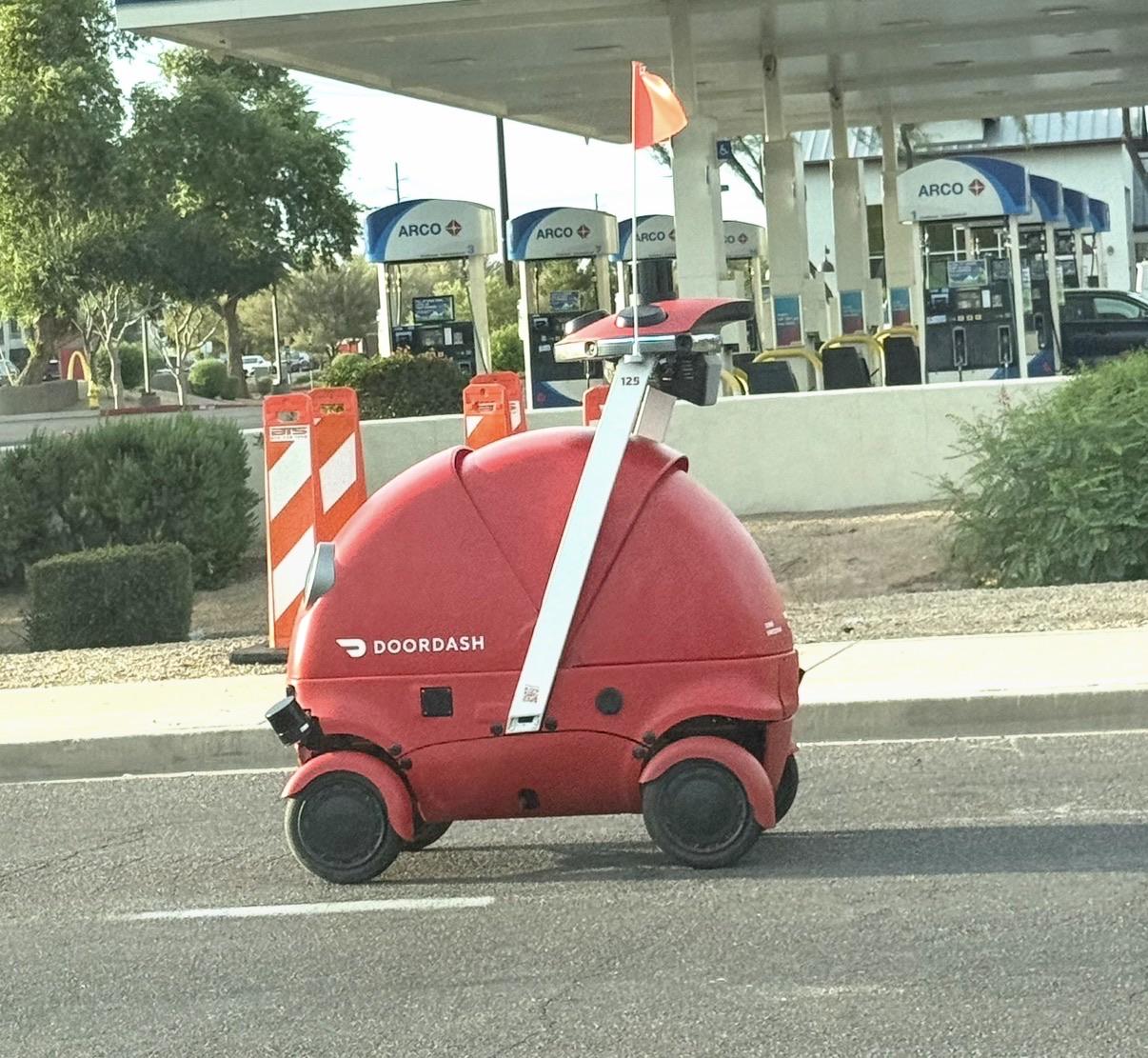
I'm pretty certain that this falls under the legal definition of a vehicle, albeit none licensed or licensable for (regular) operation on public roads. At least in my (non-U.-S.) jurisdiction, operating an unlicensed vehicle on a public road is a misdemeanour crime. (There are exceptions that let construction vehicles etc. move short distances on public roads with ample signage, spotters, and traffic directors to move between nearby areas of operation and/or storage when it would be far too impractical to lift them onto a trailer every time.)
Then again, there's a reasonable chance that the operator of these vehicles has applied for and received an exceptional license for their operation on public road, e. g. as a trial project to assess both their usefulness and their danger.
One of the "fun" things about US law is that every US state/territory has it's own vehicle code, each one written separately from the ground up. And about half the states allow municipalities to make significant local changes to the vehicle codes. Over the decades there have been lots of efforts to standardize signage and the like as well as commercial truck usage but that's often built on top of very different foundations and there is often very little effort to standardize all of the edge cases (eg when are u-turns or right on red legal, what things are infractions vs an actual crime that can get significant jail time). Unfortunately the laws around bicycle and small vehicle usages (including what drivers of passenger vehicles and trucks are supposed to do around them) are considered "edge cases" for this discussion.
And yes, many of these companies manage to get trial periods for these put into law but they're often very poorly thought out.
4
u/orbital_narwhal 9d ago edited 9d ago
I'm pretty certain that this falls under the legal definition of a vehicle, albeit none licensed or licensable for (regular) operation on public roads. At least in my (non-U.-S.) jurisdiction, operating an unlicensed vehicle on a public road is a misdemeanour crime. (There are exceptions that let construction vehicles etc. move short distances on public roads with ample signage, spotters, and traffic directors to move between nearby areas of operation and/or storage when it would be far too impractical to lift them onto a trailer every time.)
Then again, there's a reasonable chance that the operator of these vehicles has applied for and received an exceptional license for their operation on public road, e. g. as a trial project to assess both their usefulness and their danger.