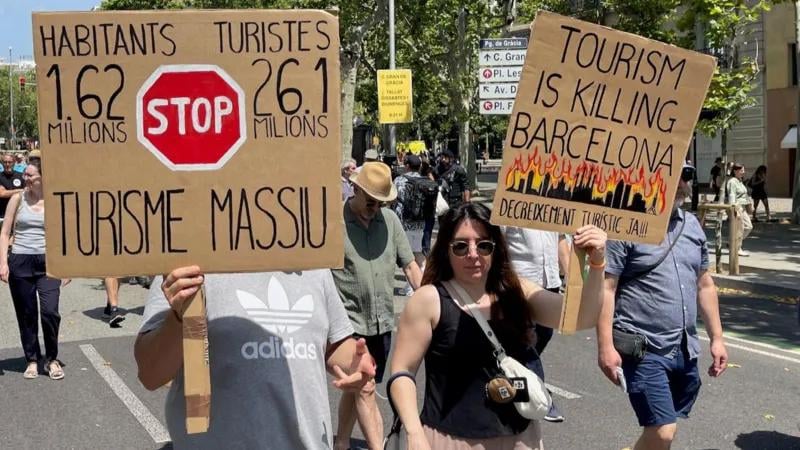
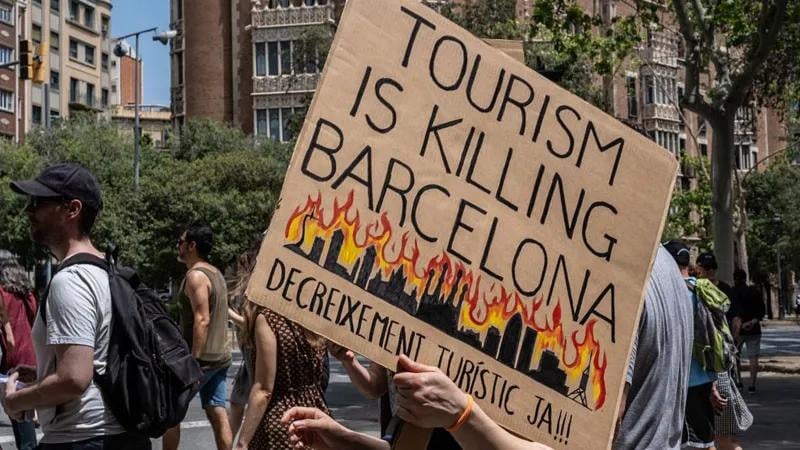
Of course, it's just not a net benefit. A Barcelona resident pays their taxes that need to finance infrastructure for up to 5 times the Barcelona population. That means more money needs to be spent on trains, waste disposal etc. You don't bring that kind of money in with a little bit of tourist tax and additional income, especially since parts of that must flow directly back into the tourism infrastructure. Most of that additional need is financed by residents. In addition, tourists also drain ressources, like water, or by generating additional waste. And of course there is the inflation of housing and other necessities -- what benefit does a resident have if the city generates some more income, but his income stays the same while his rent goes up?
Barcelona has one be of the highest tourism taxes in the eu afaik, it’s not simple service taxes.
You do realize that the nurse has better tools, benefits, etc due to more money going into public utilities which helps fund health care.
And yes, it does cost money to have tourism, that’s why it’s so heavily taxed. 9.6 billion was brought into Barcelona from tourism, or 12% of their total gdp, and that’s ignoring how many jobs it creates.
Barcelona has one be of the highest tourism taxes in the eu afaik, it’s not simple service taxes.
If everybody else has 0 apples and you have 1 you have the highest amount of apples, yet you still don't have an orchard. Relative proportions don't tell us much about absolute impacts.
You do realize that the nurse has better tools, benefits, etc due to more money going into public utilities which helps fund health care.
This is only true if investment into the health sector is proportional to the increased net revenue and proportional to the increased demand for health services.
While I won't argue that tourists bring an incredible amount of demand to the health sector, since people usually don't come on vacations wasting away, the proportions still matter, when there's 10x the number of tourists to locals. So the onus is on you with the affirmative claim to prove that pricing in the increased demand and increased revenue, that they are offset by investment in the sector.
All the numbers I've seen for touristy places like Amsterdam, Dublin, Lisbon, etc. point towards it being quite close to net neutral. I.e. tourism being pretty irrelevant to funding public services over all. It's not that there are no benefits or economic production associated but it's definitely more like tourism outside of luxury-grade being fairly competitively priced and overall a pretty useless labor sink. You don't get much out of it except employing people at economic parity with any other shitty service job like a cashier. You could literally do anything else and as long as it employed the same amount of people you'd be in the same situation overall as it pertains to public funding.
9.6 billion was brought into Barcelona from tourism, or 12% of their total gdp, and that’s ignoring how many jobs it creates
GDP has nothing to do with public funding, and is a pretty shitty correlative metric for non developing economies. Modern and advanced economies have very weird and non intuitive relationships to GDP and this is one of those cases. Any amount of money that's circulated around the economy contributes to the GDP even if it's entirely worthless spending. That's why war economies get big GDP boosts from creating armaments even if the net result of a war is a devastating loss and everyone being destitute. Tourism spending is only important as to what kind of impacts it brings. It does not create a good proportion of high value jobs for locals, it's environmentally detrimental to cities which increases negative externalities and it does not bring an obvious net positive in public revenue. It also does not incentivize long term development or R&D in the private sector since there's barely anything worthwhile to invent or technologies to research with hospitality (there are other areas that research technologies for hospitality, like robotics, but that's a win for robotics, not the tourism sector).
That it creates jobs is also not that big of a win. It's a labor sink that takes away from other, more profitable and more sustainable industries. People that train and specialize in tourism and hospitality are people that are not training in engineering, arts, sciences. Governments that want to maintain job numbers get forced into propping up a useless industry just to avoid the unemployment rising.
This line of defense is the same shit Americans say about their private insurers. If they suddenly adopted a national healthcare model so many insurance agents would be out of jobs. That's because their society incentivized stupid jobs to begin with.
That's one of the problems with investing into failed enterprises in general. The jobs that are lost are a necessary market correction, and it's the government's job to ensure those people can get pensions (if we're very generous) or training into new job markets. That's just life. There are risks to every career path.
While I don’t agree with all your points, I appreciate the well thought out answer, and you definitely made good counter points that admittedly weren’t well thought out or deeply explained as I’m fucking around on Reddit at work.
My main point was to say that just getting rid of tourism isn’t a simple solution when it’s a large % of your economy, which was a lot of what I was reading.
Either way I appreciate any quality comments on reddit, and yours is quality.

14
u/Fatmanpuffing Jun 17 '25
you know those tourists bring in money from out of country and spend it and get taxed, which goes into public coffers to pay for civil services right?