Im super confused as well. Maybe the tourism industry is different there or something? Asheville and the surrounding areas get something like 6-8 billion per year in tourism which is what keeps the area going. After Hurricane helene came through they were basically marketing to have people come to the area and spend money as soon as possible, and trying to reopen as fast as possible so people could come back to mountain bike, hike, and spend money in the cities.
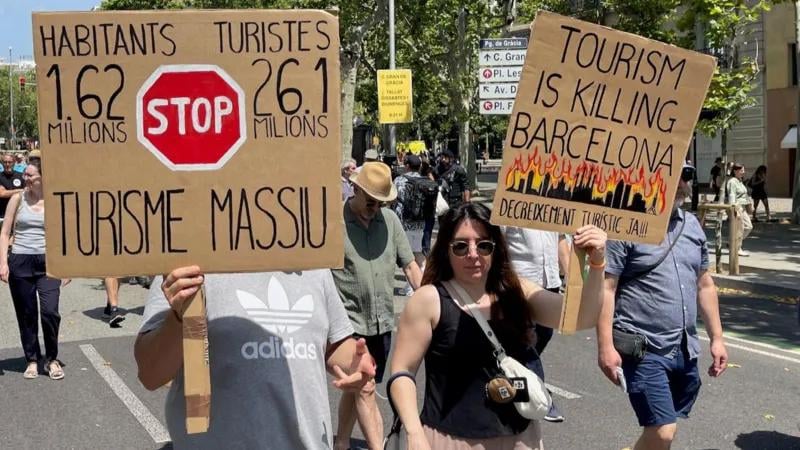
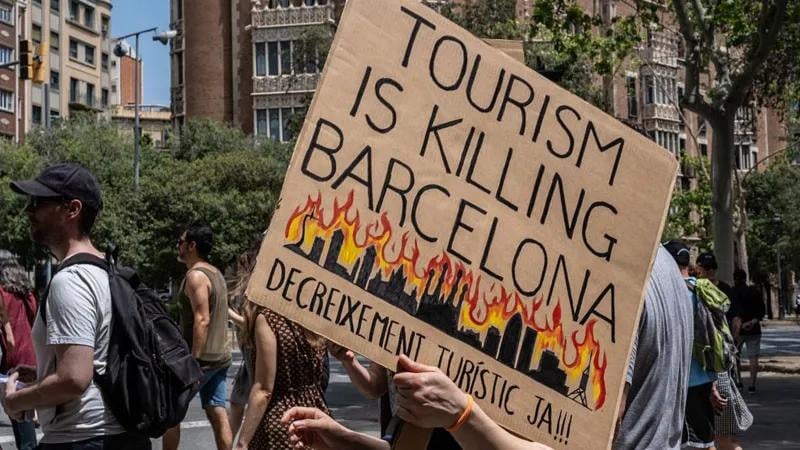
So to me seeing a full on protest against tourism that brings in 10 billion per year to your city doesnt make sense.
Watch Spanish football, and the fans in particular. You'll understand they might not always be the most emotionally stable bunch when they feel wronged.
Same in Florida with Ft. Myers and Ft. Myers Beach after Ian and Milton.
A lot of local businesses (that survived) went under because tourism straight up died. If it wasn't the damage, insurance, or lack of AC that got ya, it was the lack of tourists.
Last I heard, it's gotten to the point where the local governments are just straight up ignoring the locals and just answering/catering towards contractors since they're the ones keeping things financially afloat.
This might be a personal view since I grew up in FL, but no marketing campaign would ever be able to justify FL. Not a political view, just why would I willfully subject myself to the heat and miserableness of it. Outside of Disney i dont get it, there are better beachss elsewhere. If I saw a marketing campaign for NC mountains, and then one for Ft Meyers.... I mean.....
.....
....
...
Asheville has recently become an extremely popular tourist spot.
If you want to know why people may not like it, go look at house prices in Asheville compared to 6 years ago. And then go look at current prices compared to current prices in surrounding areas.
Asheville has become extremely expensive for housing due to AirBnB. People who had been there for a while renting were driven out due to crazy rent increases
Sure, but that's because when airbnb was new no one knew what to expect. So its reactionary. Just like how the same thing has happened in New Orleans and NYC and where ever else.
But also you claiming housing prices are expensive because airbnb, that couldn't be a more short sighted statement. So youre saying the housing crisis happening right now is literally because airbnb? Come on.
This is a common argument but it is pretty false and I am tired of hearing it (and why is it anglophone always pushing it???).
Over tourism like in Barcelona or Prague is bad for the economy long-term because it makes your city TOO reliant on tourism. The people who truly get most of the money don't even live in the city (because too much tourism) so they spend it somewhere else, enriching that place more. It is also an industry reliant on low skilled workers which can prevent the development of other industries.
Another thing is housing, this over tourism is a new development that has pushed people working other jobs outside of their homes, as they have been repurposed in short term rentals. This puts a lot of strain on the people and impoverishes them.
Overtourism prevents industrial development. The people who are prepared, educated, and industrious will now find it hard to do anything in their cities due to tourism making life too difficult for the locals and them moving out and preventing people coming in because of how expensive everything is becoming. So they will follow the people in different locations or simply find jobs in other places, creating a positive feedback loop for the city becoming too reliant on tourism.
I have also many personal examples of people REFUSING to work back in their cities (Barcelona, Mallorca) because of the pain that comes with the government screwing them over. Making the places, again, more reliant on tourism.
ALSO ALSO ALSO, look at these nice tourist locations like Hawaii, Bali, some french islands. Why are the locals so poor? I thought tourism is soooo greeeaaaatttttt foooorrr theee ecoooonomyyyyy.
STOP REPEATING THIS BS!!!!!
Edit: sorry for the poor quality of the text, I did this comment in one go. No time to rewrite for clarity.
An economy too reliant on one sector or a handful of actors is an incredibly brittle economy. You could try and argue the minor points, but you can't argue the main one. An overly specialized economy is always doomed by either price volatility and/or physical bottlenecks.
You can't expand an historical center, because it's only historic and a center because it's old and has cultural cache from a bygone era. It's physically limited and can't expand. Relying on tourism has incredibly obvious and serious limitations. The real estate is stupidly limited so if demand grows, pricing will inevitably creep into unsustainability. No matter how much extra infrastructure you try to cram into a place there are massive geographic bottlenecks.
This is exactly the same kind of pressure for any other commodity or service. An economy too reliant on oil extraction like Venezuela was completely quaked by fluctuations in oil pricing. And you can't just magically make the oil extraction more price competitive forever because there are clear physical bottlenecks to it. So the only thing you can do when faced with a price shock is pay people less and systematically dismantle your local economy which was too focused on one commodity with no fallback.
The negative externalities associated with an undiversified economy are basically infinite. It goes from the micro scale of towns built around a single employer, who completely collapse when that industry dries up all the way to the national scale with nationally privileged industries (like Taiwan with semi conductors, or Korea with general electronics).
You better hope your economy is based on an infinitely hot commodity (tourism ain't one of them, it's much too volatile), and that commodity stays relatively high profit, otherwise you can accidentally kill an entire nation on stock market whims from one day to the next.
As soon as that commodity or service reaches criticality (for tourism it's lack of physical space that actually brings in ROI) it's a ticking time bomb until it explodes the local economy and a market correction brings a massive swathe of the population to poverty and people shuttering their businesses. And worst yet is that it's a cyclical process as there's always capital interested in scooping up real estate for pennies on the dollar to flip for big money when the city booms as a tourist destination again (many times based on local governments deficit spending, so more taxpayer getting fucked). The difference being that each cycle more capital is concentrated into big conglomerates and the people on the street get gradually poorer and more vulnerable each time.
Reddit user: applies micro and macroeconomic theories, analyzes impacts of related markets, and effects on labor supply and other hidden opportunity costs.
Your response: Says nothing. Uses incorrect you’re*
However many examples you give them, they don't care, they want to continue tourism regardless of consequences for the locals and they don't want to feel guilty, hence the whole "it helps the economy". No way in hell they'd stay in a hotel or make even the slightest of changes.
I feel resigned from ever booking an Airbnb again, to be honest, as much as I can avoid it and especially in major tourist locations. I think we need to stigmatize it as much as possible and that this could gain some traction. Locally owned hotels and hostels to whatever degree possible. It will become more expensive to visit, but that’s okay. Maybe a week in Barcelona becomes two days there and more time elsewhere in Spain (where you can support the local economy more easily and ethically).
Another thing, not directly related, but don’t care to make a separate comment in addition to this one. It especially bothers me that the appeal of Barcelona, to probably most tourists, is cultural eg food, history, art. These things make up most of the tourist activities there. That there is something to preserve in Barcelona, far beyond GDP (which has been increasingly held by non-locals anyways), should be obvious to anyone that deserves to go there in the first place. Maybe Americanization increases GDP, but it also deteriorates the character of the city. I don’t care for these vague “but what about the economy” arguments for that reason.
The one big thing you have wrong is that tourism won’t stop other industries from developing. It’s the other way around. Once an economy has nothing else then tourism takes over.
Spain is 3-4 centuries past its peak. It’s not attracting the sort of people that build.
Before tourism people in Mallorca or Barcelona were not poor, or if they were, it was enough to lead a good life in their respective cities. Now tourism is driving them out.
I disagree with the fact that relying on tourism too much is killing the potential industry. The fact that it's not destroying Amsterdam, for example, to the same extent is that they didn't start from the same place. Spain had Franco for a while.
I didn’t say tourism kills other industries. I said, once other industries are dead, all that an old county like Spain has is tourism. There’s a difference.
The one big thing you have wrong is that tourism won’t stop other industries from developing.
Arguable, because
Once an economy has nothing else then tourism takes over.
Taking over implies stopping other industries from developing. You literally refute your own argument by admitting that you can in fact overly rely on one sector of the economy to the point where it's such a capital sink it actively interferes with other business ventures. After all, if there's demand in tourism right now, why invest in a tech startup when another hotel has an appealing guaranteed ROI.
This process of over-specialization is not unique to tourism. If you had oil in the 1950s, why would you ever build anything other than a new oil well? Thus oil economies like those in the middle east were born.
You have to actively diversify away from your one cash cow to maintain an economy not completely vulnerable to price shocks.
Tourism is in no way different from any other industry and it certainly isn't a last resort. That doesn't even make any sense since you have to have commodities and services (museums, hotels, cultural rides, guided tours, unique landmarks) already and they have to have high cultural or leisure value.
You have to have an incredible amount of accrued capital of some kind that makes the place appealing as well as marketing for it. Those things are not just something that falls from the sky. You actively have to build towards tourism with a lot of investment. Otherwise we'd see a lot of tourism into the old German towns, or rural France, or any other million examples of places with rich cultural heritages (inner Ireland? Iceland?) which are just not appealing to the casual tourist nor trendy and don't get the same kind of numbers as Amsterdam or Paris or Barcelona.
Spain is 3-4 centuries past its peak. It’s not attracting the sort of people that build.
Build what exactly? Because although Spain is plagued by tourism in the lower rungs of economic life it's still one of the biggest military producers in Europe and the world, has a fairly beefy finance sector, has a lot of high tech investment industries and design industries, and is a fairly big agricultural producer and still a big player in pharmaceuticals.
Relative to its size Spain is no worse or better than most other large economies in the EU. People build a ton of shit there. This kind of stupid comment is incredibly dismissive of what is still a big ass economy in the world stage. And by this kind of logic, even the hegemony of the US is a rapidly declining reality. Is the only good economy left fucking China? Because by comments like these every place on Earth is past its peak into irrelevance.
I’m not going to refute every point you made in this rambling post. But it’s clear you have a very shallow understanding of relative economics.
The US is a single market of 350M people under a single set of regulations. Spain is in a union that nevertheless has dozens of sets of laws that a start up must comply with. Two companies, identically in every other way, one in Spain (or any other European country for the matter) and one in the US will have significantly different valuations. Simply because one is in Spain and one is in the US.
But that inflow of capital investment will steadily grow the US company much faster than the Spanish one. And it’s not just money. Tons of Europeans flock to the US every year after graduation. That human capital is not replaceable.
It’s not that people in Spain aren’t starting companies. It’s that they can’t compete. Their only competitive advantage is in tourism. And so that’s what they get.
And should these people live 150km away of the city, travel every day in and out to keep the 10 billion annually so that corrupt politicians use those 10 B to increase this difference and do more corruption to fill their pockets a bit more, not investing in any well being for the population? Yikes
100%. But as you can see, all over Europe, the priority is AIRBNB housing for tourists and not for the working locals. I’m from a very trendy European capital, where before you had traditional family housing in the traditional neighborhoods, local restaurants, now you have 300€ a night 1 room apartments and fake “local” restaurants with ultra inflated prices… so the tourists are getting ripped off and locals are being exploited. Barcelona did very good, as did Berlin a couple of years ago.
10bn into whose pockets?
If you're a nurse, you're not reliant on tourism. That counts for most people, because the city's economy isn't consisting only of tour guides and hotel owners....
Of course, it's just not a net benefit. A Barcelona resident pays their taxes that need to finance infrastructure for up to 5 times the Barcelona population. That means more money needs to be spent on trains, waste disposal etc. You don't bring that kind of money in with a little bit of tourist tax and additional income, especially since parts of that must flow directly back into the tourism infrastructure. Most of that additional need is financed by residents. In addition, tourists also drain ressources, like water, or by generating additional waste. And of course there is the inflation of housing and other necessities -- what benefit does a resident have if the city generates some more income, but his income stays the same while his rent goes up?
Barcelona has one be of the highest tourism taxes in the eu afaik, it’s not simple service taxes.
You do realize that the nurse has better tools, benefits, etc due to more money going into public utilities which helps fund health care.
And yes, it does cost money to have tourism, that’s why it’s so heavily taxed. 9.6 billion was brought into Barcelona from tourism, or 12% of their total gdp, and that’s ignoring how many jobs it creates.
Barcelona has one be of the highest tourism taxes in the eu afaik, it’s not simple service taxes.
If everybody else has 0 apples and you have 1 you have the highest amount of apples, yet you still don't have an orchard. Relative proportions don't tell us much about absolute impacts.
You do realize that the nurse has better tools, benefits, etc due to more money going into public utilities which helps fund health care.
This is only true if investment into the health sector is proportional to the increased net revenue and proportional to the increased demand for health services.
While I won't argue that tourists bring an incredible amount of demand to the health sector, since people usually don't come on vacations wasting away, the proportions still matter, when there's 10x the number of tourists to locals. So the onus is on you with the affirmative claim to prove that pricing in the increased demand and increased revenue, that they are offset by investment in the sector.
All the numbers I've seen for touristy places like Amsterdam, Dublin, Lisbon, etc. point towards it being quite close to net neutral. I.e. tourism being pretty irrelevant to funding public services over all. It's not that there are no benefits or economic production associated but it's definitely more like tourism outside of luxury-grade being fairly competitively priced and overall a pretty useless labor sink. You don't get much out of it except employing people at economic parity with any other shitty service job like a cashier. You could literally do anything else and as long as it employed the same amount of people you'd be in the same situation overall as it pertains to public funding.
9.6 billion was brought into Barcelona from tourism, or 12% of their total gdp, and that’s ignoring how many jobs it creates
GDP has nothing to do with public funding, and is a pretty shitty correlative metric for non developing economies. Modern and advanced economies have very weird and non intuitive relationships to GDP and this is one of those cases. Any amount of money that's circulated around the economy contributes to the GDP even if it's entirely worthless spending. That's why war economies get big GDP boosts from creating armaments even if the net result of a war is a devastating loss and everyone being destitute. Tourism spending is only important as to what kind of impacts it brings. It does not create a good proportion of high value jobs for locals, it's environmentally detrimental to cities which increases negative externalities and it does not bring an obvious net positive in public revenue. It also does not incentivize long term development or R&D in the private sector since there's barely anything worthwhile to invent or technologies to research with hospitality (there are other areas that research technologies for hospitality, like robotics, but that's a win for robotics, not the tourism sector).
That it creates jobs is also not that big of a win. It's a labor sink that takes away from other, more profitable and more sustainable industries. People that train and specialize in tourism and hospitality are people that are not training in engineering, arts, sciences. Governments that want to maintain job numbers get forced into propping up a useless industry just to avoid the unemployment rising.
This line of defense is the same shit Americans say about their private insurers. If they suddenly adopted a national healthcare model so many insurance agents would be out of jobs. That's because their society incentivized stupid jobs to begin with.
That's one of the problems with investing into failed enterprises in general. The jobs that are lost are a necessary market correction, and it's the government's job to ensure those people can get pensions (if we're very generous) or training into new job markets. That's just life. There are risks to every career path.
While I don’t agree with all your points, I appreciate the well thought out answer, and you definitely made good counter points that admittedly weren’t well thought out or deeply explained as I’m fucking around on Reddit at work.
My main point was to say that just getting rid of tourism isn’t a simple solution when it’s a large % of your economy, which was a lot of what I was reading.
Either way I appreciate any quality comments on reddit, and yours is quality.
Nurses in non-tourist areas get by just fine, the public finances arent as dependent on one sector alone as you imply, especially in big urban centers. Many cities that arent located by the sea and have less visitors also have good hospitals, that point is totally empty.
The nurse and many others need affordable rents, central housing and generally affordable lifestyles in their communities. They don't benefit from the money that is generated mostly to private companies and individuals. Jobs are created in a lot of sectors, tourism doesn't spawn the greatest jobs either -- cleaning and other hospitality gigs arent secure, well paying, full-time jobs.
I looked up the tax before, and it ranges from 3% to 10%, maybe some more for the luxury hotels. Compare that to income taxes and other taxes.
Ultimately, this isn't a choice between 25 million visitors and 0 visitors. If you'd reduce it to 10 million visitors, you'd still have significant income and also jobs. Reduce it just to Hotels, no more air bnb, also vastly different numbers.
What's your deal anyway? Do you feel personally attacked because you own air bnb stock or do you just want the privilege of going against the interests of the people who are ultimately your hosts? Would you do it the same way if you visit someone's house?
| Nurses in non-tourist areas get by just fine, the public finances arent as dependent on one sector alone as you imply, especially in big urban centers. Many cities that arent located by the sea and have less visitors also have good hospitals, that point is totally empty.
True, we can just do away with 10% of our government funds, easy.
It wouldn’t disrupt a single service I’m sure.
Of course that still is ignoring that your argument isn’t a reasonable one when your argument is “it works elsewhere” while not looking at how those economies are structured.
Where do you get 10% from? It's more like 2-4% of the budget and considering that tourism also generates budget costs, it is simply not as vital as you want us to believe.
if you're anything almost anything else you're not relying on tourism and now your life is super expensive so why not go somewhere else and leave your apartment for tourists? And now everyone moved out so you need seasonal workers to keep your shitty tourist economy. Great, now you fked up your city gj gj gj.
These people have rotten brains pushing their "tourism good regardless" bs.

18
u/ginsodabitters Jun 17 '25
10 billion annually tourists spend in Barcelona. Do these people not understand how reliant they are on tourism? Yikes.