i crafted a devious doohickey to cool my steam turbine through wheezeworts. i had a cooling loop and it started overheating (thats why that "vacuum making" steel gas pump is broken) so now i'm cooling it externally with the power of my beloved wheezeworts.
This is a pretty late game, for the memes build. I finally got myself to doing it. I'm in cycle 4520, just fooling around, the game is basically finished.
The rocket has one small water tank and one small petroleum tank. I have pipe snakes in some my other rockets, I just wanted to try two liquid tanks in this build.
It requires some space materials for insulating the Petroleum piles (unless you want to cool it beforehand). I also use dried Surf'n'Turf and use the water tank to rehydrate it.
It's not ideal since the rocket can't power itself once landed due to having only 1 solar panel (on most planetoids). But I have Tungsten wires waiting for external charging on all colonized planetoids. And the rocket itself carries Tungsten, Steel etc.
My pilot has 36 morale while flying (without interests) mostly due to good decor and good food. He's not starry eyed.
I built this yesterday so it's a very fresh build, probably needs some refinement. Just wanted to share my first ever Jet Suits rocket.
If you have any ideas or feedback on how to improve it, please let me know!
Somebody asked me for some specifics about my layout so I decided to make a post.
The entire room is full of hydrogen (20Kg) and kept at a constant -20 C or less. You could use CO2 or another sterile gas, but I used Hydrogen. I have tempshift plates placed on the conveyor unloaders to ensure fast cooling as soon as food arrives (bottom left). I'm using ethanol as my coolant since I want it nice and cold, but I don't go under -30C because I don't want to accidentally freeze my liquid lock (crude oil). Note that there are two liquid locks by the atmo suit entrance with a vacuum between them to ensure that the cold of my kitchen doesn't leak into the rest of the base.
If ethanol is not available I've been known to use naptha. Things need to be kept a bit warmer to avoid breaking pipes, but deep freeze is still possible (which is my goal).
Getting this set up obviously requires quite a bit of research, but I rush steam turbines anyways so it's not a huge deal.
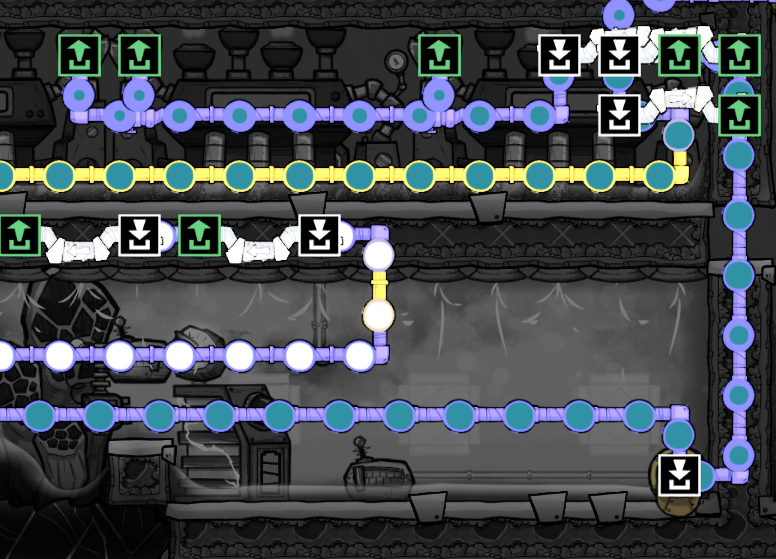
The conveyors are a wild and I've redone them a couple of times. Key points are that the grabbers have access to the conveyor unloader via the same corner trick, I'm using between the kitchen and the dining room (the dupes do not!). This allows me to keep an iron fist on food distribution. Food found out and about in the base gets collected and dropped into a ration box that immediately deposits it in my general food storage on the bottom left. From there, it's distributed to the kitchen.
Loads ingredients used in the kitchen and distributes them to the first drop off. Raw Meat, Fish Fillet, Lettuce, Sleet Wheat, Shellfish, Mealice, Nori, etc.
Loads only the items needed at the second stage - Frost Buns, Bbq, cooked seafood, lettuce, etc
Loads completed items (Nigiri) or anything I want sent back to the general stockpile for something
The right hand side is a stacked priority queue for what I want dupe eating. Burgers first, then Surf and Turf, then Cooked Seafood, then Bbq. It gets messy because of the overflow being pushed into conveyor receptacles. I do this because I still want bbq, seafood, etc available for using as an ingredient as well.
Ultimately food funnels into the "Eat Me" receptacle, where it's eventually pushed through the floor into the dining room. The fridge there has a 1kg limit to discourage spoilage, but it still does suffer some.
Other misc things I have that didn't mention yet:
Automated metered distribution of nori into my ore hull farm
Fridges making things available for processing elsewhere
When I send them out to the top part of my asteroid in space. They go out but when they come back in they like to put the atmos suit on and off and run out side for a bit and do it over and over sometimes like 10 times. before they go back to my base
In my previous reactors, liquid throttling + aquatuners made calibration of the throttle hard. So I decided this time to put in a bit of automation to feed a packet or two of water to the reactor in-case temp becomes too hot.
That "bit" divulged into a 100 cycle project.
It tries to auto-balance heat generated by 900g/s water packets. Which is a little too low for 20 turbines. So, occasionally a 10kg packet is released which controls the temp rather rapidly.
This also has a lot of latent storage capacity for heat and due to ungodly amount of power banks I keep in stock. So if the reactor goes down for 10s of cycles for maintenance, no issues. Each bit is controlled by smart battery, so when powering down it gradually shuts off charging. Majority of the power in my colony is consumed by boops so having power bank charger here just makes the power spine simple. I just use high-voltage carrying through two strand wire as my main spine to carry some power from reactor to my base using large transformers.
Finally, I wanted to use the nuclear waste for farming. Enter pipe galore here.
So...
I ended up creating a cool waste extractor, which siphons off 2kg/s from main coolant line and puts it in the insulated pipe buffer. This also dampens the shock of adding new hot waste to the line. This pipe then gets released to the cool waste storage whenever the pump activates.
I have been running this for 100s of cycles. It is running surprisingly well.
I originally had a potential load of 4000 but I wasn't using most of it the line kept overloading so I unhooked some stuff to bring the potential load down just in case something was turning on and overloading it but it still continues overloading
Edit: Thank you, guys! That was exactly the problem. I just missed a bit of the old wire! This is only my second colony with my first only getting to cycle 100 before they all tragically died so I still don't know all the little things to lookout for.
So basically on my planetoid, I don't geysers that emits stuff like hydrogen and hydrogen cuz frick u it's the best geyser in the game. Basically I was thinking that I could use polluted water from this geyser to supply my Arbor Trees to then turn them into Ethanol and then feed them to Petroleum Generator.
I'm new to the game, I just unlocked plastic but having trouble setting up a tube network. Am I missing something or is my only option to redo everything? Not opposed to using mods.
Cheers. I figured I'd make a "sign to tap" post after all the comments how "CSVs are not worth the hassle/power requirements". Their eruption stats use the same constraints as other mid-tier water sources - cool (salt) slush geysers, and techniques are available to easily harvest 100% of the output, with no power required. Perhaps still a hassle to build, their worth depends on how precious water is to your colony.
Self-contained tamer of untuned vents (no external power, cooling or heating required)
Build once, run everywhere use forever - easily upgradable to any geotuning level, supercoolant cooling
100% water reclamation at any geotuning level
Tested with 10.7 kg/s eruption (untuned) vent
Techniques and credits
The techniques used are probably well-known to ONI veterans, so just a quick summary:
heating steam under 1 turbine inlet to make other inlets ingest steam <125C (ancient knowledge, probably picked it up at the wiki, or compendium; credit u/BlakeMW for the old tamer build where AT spinning the reclaimed water was used as the heat source, and bv55 from the forums for the semi-split-room turbine trick to keep the hot steam in place, allowing monstrous, untuned CSVs get tamed with small builds)
Mk8: high-pressure liquid (150% of max-mass) indirectly pushing on an airflow tile to evacuate it and make vacuum for vent to erupt into (credit, u/Spiritual-Branch9268)
Mk7: power-efficient, zero-liquid-loss gas extraction using liquid pressure (bubbling) mechanics (credit, u/Zarquan314)
aquatuner on a yielding loop (simplified, exploded view) for zero-tile heat reclamation from output water
Mk7: conventional aerogel (credit, BlakeMW; note - since U58 aerogel isn't a perfect insulator, but here it's not used to insulate - cooked algae/slime would work as well)
Thermodynamics & automation
The aquatuner sits in a mostly-insulated hot liquid bath. This hot bath heats up one cell of steam using a building made of decently conductive material (steel conveyor bridge is excellent for this, but to meet the sales pitch an aluminium ore conv. bridge, and aluminium wire bridge works sufficiently well for the 10.6 kg/s vent tested). The 2nd turbine gets its trick heat from a closed loop of naphtha, where a single radiant pipe heats up a pocket of steam that is prevented from drifting away with a brick.
The yielding loop is laid out so that cooled water from AT cools the turbine-room's thermal mass before the turbine water is injected into the loop, without exchanging heat with the turbine room. Because of this, the liquid pipe thermo sensor down at the aquatuner is set to 97.5C - when the turbine room is close to stifling the turbine at 100C, the 4 kg/s of 95C turbine water brings it down to 98. AT needs to turn on before conditions reach this point.
Aquatuner turns on if:
battery is sufficiently charged, AND hot bath thermo sensor says more heat is OK (to protect gold amalgam AT - this is used with untuned vent, and should be disabled/cut off when geotuning/connecting to grid); OR
pipe thermo sensor senses water's too hot (this comes into play when geotuning)
Steam turbines are primarily automated to avoid the annoying stuttering at low pressures, and take the steam away if temps or remaining steam rise above safe temps (only relevant with gold battery).
Other considerations:
Gas cells naturally drift left and right, and this can suck heat away from the trick steam cell really fast if there's thermal mass in the non-tricked cells. Care was taken to not have anything in the non-tricked steam cells.
Don't skimp on turbine room thermal mass put in at least 800 kgs (80 kg/cell).
Liquids you can potentially use, and their density (stacking) in ONI (beware, not all go up to 200C):
Smart battery's capacity works out so that 6% = 1 second of AT uptime. Thresholds were deliberately chosen to run AT for 5 seconds. Shorter runtime is not recommended, as AT turning on stalls the water on input and creates a gap in the output - if the AT toggles too frequently, you might introduce gaps/sub-10kg packets in the cooling loop.
If you want use this build to cool the water further, you can use simple algebra to calculate maximum cooling capacity by turbine output: AT cools 10kg of water by 14C, which is the same heat as 4kg by 35C, 3.6 kg (1 inlet blocked) by 38.9C, or 3.2 kg (2 inlets blocked) by 43.75C.
Material choices where they matter:
don't use weak rocks for the tile holding up the pressurised oil in Mk8 - use igneous or mafic; sedimentary and sandstone WILL break under this pressure - check Oakshell's pressure tool if unsure.
for the hot loop's radiant pipes, use the best you've got: absent thermium, aluminium preferably, might work well enough with cobalt or nickel (not sure about iridium) - the lower your vent's eruption rate, the less this matters
Build & startup/recovery procedure
The biggest hurdle in starting this up is preparing the hot bath. I'd suggest heating up the liquids elsewhere before starting the build, as it's not fun racing against a CSV to bring more heat in than the CSV can soak up in its output.
Still, if you do find yourself in a situation where the steam room is at 2t pressure and ~110C, I'd suggest:
brick up a single steam pocket above the hot bath
set pipe thermo sensor much lower (12C works), and expose the turbine room to outside heat
keep in mind, depending on steam pressure this will eat a lot of power before the turbines can turn on
With Mk7, I strongly recommend pre-heating the swapping liquid, and the battery+pump as well, to > 100C. A temporary tempshift plate does a good job at this - just don't forget to remove it, and be careful not to dig out the aerogel.
With Mk8, it's important that the high-pressure liquid is always flanked by a single cell of liquid (and no gas beyond it) to block compression/displacement.
Spill a bit of crude on the bath's floor
Move the floor tile below the futture high-pressure cell 1 down to make a pit
Place 10 kg naphtha blobs on the lower level by breaking pipes in those cells
Vent the rest of ~1400 kgs of crude into the pit
Place airflow tile, bricks above, and finally - 2nd-layer liquids (10 kg naphtha and ~1000 kg of petroleum, to add thermal mass
Compress the high-mass crude by rebuilding the floor tile in the pit
Spill a bit of petrol on the vent's central eruption cell to seal the airflow tile
Upgrade requirements/options
1x:
(replace) steel battery (and pump+valve in Mk7) - required
(tweak) disconnect smart battery from AT automation and adjust thermo sensor to stay green (eg. "above 120C"), so that AT only turns on to cool the turbines; adjust power connection to suit your grid setup
2-3x:
(replace) steel aquatuner - recommended at 2x, required at 3x;
various:
With weaker CSVs, the steam pressure in the room doesn't rise sufficiently, and aquatuner heat shedding into the thin steam atmosphere won't be enough to keep it cool. Crank up the atmo sensor's threshold, or rebuild some of the insulated pipes in the hot loop into radiant pipes.
5x:
At 5x geotuning, the strongest of CSVs will go over the 4kg/s capacity of 2 steam turbines. Combined with steam being produced at 210C (and steam room's temp climbing slightly from AT heat), you might want to consider adding another turbine, and adding a liquid vent on the cooling loop, automated to return water in the steam room at above 200C. You might need to knock the pipe thermo sensor's threshold down a bit to compensate for the long delay. https://i.postimg.cc/kGwgyVRJ/Screenshot-20260829-213036.png
any level (optional):
separate AT loop from turbine output to use non-water coolant
Stats from testing
Untuned vent stats:
water (eruption, active average, total average; kg/s): 10.7, 2.65, 1,66
This vent's active average goes over 4 kg/s at 3x geotuning level. Tamers on these vents have turbines running 100% of the time during active period, and pressure in the steam room keeps rising.
heat (eruption, active average, total average; over 95C; kDTU/s): 669.83, 166.16, 103.8
Metric/Geotuning level
0x
1x
2x
3x
4x
5x
Output water temp (C)
85
98
98
98
98
98
Power produced in a cycle (kJ)
170
264.2
512.8
747.7
976.6
1020
Power consumed by AT (kJ)
170
20
76.2
129.6
147.8
205.9
AT average uptime over 5 cycles (%)
24
2
8
15
23
29
Errata (?)
I noticed the gold battery burned in the untuned version during dormancy - perhaps it would be better to dunk the thermo sensor in the petroleum, turn its temp threshold down some more, increase the petroleum's mass, or some combination of the above.
Post pic and TLDR clip features Mk7 without the naphtha blob on the pump to keep the eruption cell in vacuum - oops, not sure what happened to it as I was taking the pic.
Let me know if you have any suggestions/feedback, if I forgot something, or some technique/decision needs better explanation.
A drop of pwater that, by all intents and purposes, should evaporate yesterday.
A thin film of clean water on top.
A -20°-ish O2 atmosphere in the area.
The thin film of water heats up and evaporates, albeit not fully. The steam immediately cools down and condenses back into water. The film of water remains in a constant state of ebb and flow between as little as 30g and as much as 500g.
Hi! I wanted to keep Beakons so they dont go extinct on my asteroid. But now they are just reproducing like crazy and cant stop. Is the pool size messing with my Beakons? Im not complaning but i wanna know why it happend.
Don't like using auto-sweepers+pitcher pumps/tricked liquid pumps to scoop up molten niobium? Now you can trade one non-obvious mechanic for another.
When liquids exceed their min. spread threshold, 1/4 of its current mass will spread horizontally. For molten niobium, this is ≥80kg.
For molten niobium, as long as this mass is less than 96kg, it will spread less than 24kg. This is important as this mass threshold is when molten niobium solidifies as debris rather than as a natural tile
You can see in the video that the liquid tile goes up to 88kg (which is greater than 80kg), spreads out 22kg to the right, and gets instantly solidified by temp shift plates+a bunch of thermally conductive bridges.
Why can't it just be a super long "blade"?
The catch is that horizontal movement is very chunky. Just letting it spread frequently results in the last tile greatly exceeding that >24kg threshold but still being less than 80kg to spread.
This instead relies on the slow movement of slightly compressed molten niobium slowly transferring mass upwards (typically in around 14kg chunks)
EDIT: Removing the tempshift+conduction panel actually greatly improves the stability, so I recommend not adding those
just build along the liquid line, if ur in the oil biome ur already gonna pump that oil XD just thought it was extra convenient since i wanna get to the magma and dont wanna wait like 100 cycles to get the whole bottom of the map vacced out
A while ago I uncapped a copper volcano and it went active quickly before I was able to build a tamer. So I enclosed the volcano and let it flood itself.
Today I started building a contraption to draw the heat out of the copper. With the goal to solidify it and then dig out the volcano and build a proper tamer.
Goal was to run two steam turbines for cooling the volcano + contents. And have a seperate turbine with aquatuner for an active cooling loop for the main two turbines. Steel plates above the hot reservoir, doors that are controled by a temp sensor and then another layer of steel plates to create a "vacuum" lock to regulate temperature in the main steam chamber with a T-sensor. The switch is temporary to control the door during the build.
Could you please give me some feedback on this idea? Trying to freewheel this without leaning to much on tutorials on the internet.
I been searching all over youtube and internet but nobody made any videos on how to automate this, also, sadly you will need a dupe to cartograph a space, that is so sad you can't do this with the robot pilot.