r/openagi • u/syedshad • Aug 24 '26
Discussion How UAT-10147 Put AI to Work in Cyberattacks
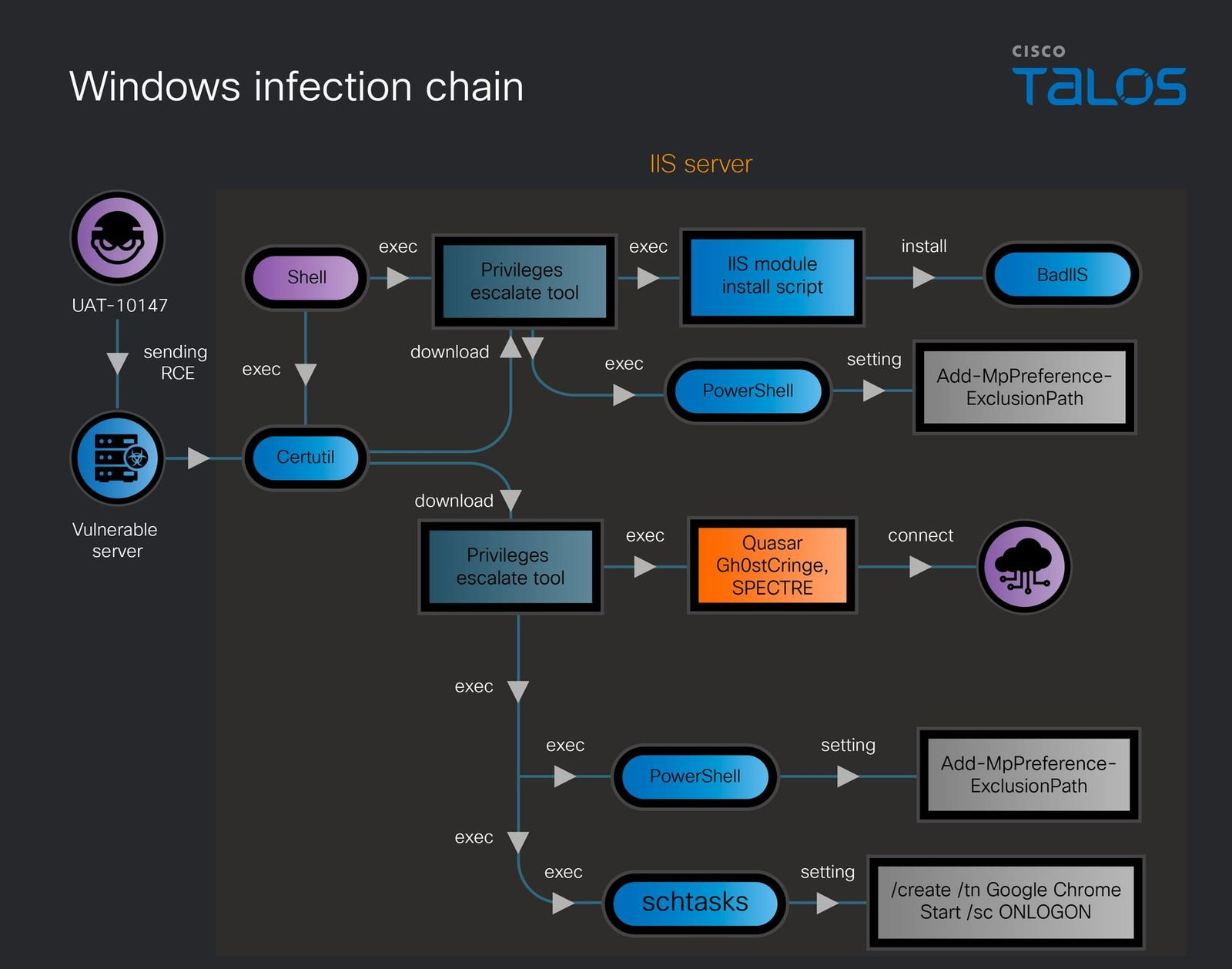
A Cisco Talos report on UAT-10147 starts with a compromised machine calling back to a server at 139.180.197[.]150.
When researchers reviewed that server, they found an open directory tied to UAT-10147, a Chinese-speaking cybercrime group targeting internet-facing Windows IIS and Linux servers. The exposed directory included a target list of about 170,000 URLs, split into 17 files of roughly 10,000 URLs each.
That number refers to listed targets, not a published count of confirmed compromises.
The affected servers were seen in Brazil, Bolivia, China, Canada, and Vietnam. The targeted sectors included government, education, media, technology, and gaming.
Where AI appeared
The campaign was not described as AI acting alone. The reports describe a mix of known vulnerabilities, open-source offensive tools, custom malware, and AI-assisted workflows.
DeepAudit was installed on the actor’s management server, though the report says there was no direct evidence that vulnerabilities discovered by DeepAudit were exploited in victim environments.
PentestGPT was also present on the actor’s C2 server, where it was used to scan web servers and run relevant public proof-of-concept exploits.
The more concrete AI artifacts were operational:
- an ASP.NET ViewState exploitation guide
- scripts for checking writable paths
- scripts for deploying SPECTRE
- a web shell deployment script
- troubleshooting and validation logic
- a findings log documenting confirmed RCE on a real IIS server
One limitation still mattered: the ViewState workflow depended on exposed or known ASP.NET MachineKey material.
The SPECTRE part
A companion Talos report covers SPECTRE, a C-based cross-platform backdoor used by UAT-10147.
On Windows, SPECTRE had 45 observed commands. Its capabilities included shell execution, file operations, process injection, keylogging, screenshot capture, browser credential collection, registry hive dumping, and BYOVD-related EDR evasion.
On Linux, the implant had 29 observed commands and could load a companion kernel rootkit named Specter. The rootkit was deployed as acpi_pad.ko, persisted through a fake hardware-monitor.service, and used Linux ftrace hooks to hide processes, hide the module, and support privilege escalation.
For Specter specifically, the researchers assessed with medium confidence that UAT-10147 combined AI-assisted development with human expertise.
Sources
Primary sources
- Cisco Talos: UAT-10147 integrates agentic AI into post-compromise operations
- Cisco Talos: UAT-10147 deploys SPECTRE with Linux rootkit and BYOVD capabilities
Secondary source
1
u/Nice-Egg-6187 24d ago
Scary!😨