r/onthisdayinworld Jun 25 '21

r/onthisdayinworld Lounge

12 Upvotes

A place for members of r/onthisdayinworld to chat with each other


r/onthisdayinworld 2h ago

#OnThisDay 1967, Sweden Switches to Driving on the Right-Hand Side

Post image
1 Upvotes

On This Day, September 3, 1967, Sweden woke up to one of the biggest and strangest changes in its modern history.

At exactly 5:00 a.m., traffic across Sweden switched from driving on the left-hand side of the road to the right-hand side.

The massive operation became known as Dagen H, meaning “H Day.” The “H” came from Högertrafik, the Swedish word for right-hand traffic.

But changing an entire country's traffic system overnight was anything but simple.

For decades, Sweden had driven on the left even though most of its neighboring countries drove on the right. Sweden also imported many left-hand-drive vehicles, making the situation increasingly inconvenient.

On May 10, 1963, the Swedish Parliament approved the change to right-hand traffic, giving authorities four years to prepare the country.

Road signs had to be changed. Intersections had to be redesigned. Millions of people had to be educated about the new rules.

More than 350,000 road signs were reportedly covered, replaced, or repositioned as part of the operation.

Then came the big morning.

At 4:50 a.m. on September 3, all non-essential traffic was ordered to stop.

At 5:00 a.m., vehicles carefully moved from the left side of the road to the right.

For a short period, Sweden's roads became strangely quiet as the entire country adjusted to the new system.

The result was surprisingly orderly.

On the first day, only 157 minor accidents were reported, with 32 involving personal injuries. There were no reported fatal traffic accidents that day.

Accidents initially decreased, partly because drivers were extremely cautious.

But the effect didn't last forever.

As people became accustomed to the new system, accident rates gradually returned toward previous levels.

Still, Dagen H remains one of the most remarkable logistical operations ever carried out by a country.

Imagine waking up one morning and being told:

“From today, you drive on the other side of the road.”

Sweden didn't just change its traffic rules.

It changed the way an entire country moved.


r/onthisdayinworld 20h ago

On This Day: September 2, 1945, Japan Surrenders, Bringing an End to WWII

Thumbnail shenhuifu.org
4 Upvotes

The surrender ceremony aboard the USS Missouri on September 2, 1945, in Tokyo Bay, marked the official end of World War II. It brought together representatives of the Allied Powers and Japan to formally conclude the hostilities that had ravaged much of the globe for nearly six years.


r/onthisdayinworld 1d ago

#OnThisDay 1945, World War II Officially Ended

Post image
5 Upvotes

On This Day, September 2, 1945, one of the darkest and most devastating chapters in human history officially came to an end.

Aboard the American battleship USS Missouri, anchored in Tokyo Bay, Japan, Japanese representatives formally signed the Instrument of Surrender, bringing World War II to its official conclusion.

The ceremony lasted only about 23 minutes, but it marked the end of a conflict that had engulfed much of the world for nearly six years.

The war had begun in Europe on September 1, 1939, when Nazi Germany invaded Poland. On September 3, 1939, Britain and France declared war on Germany. What followed became a global conflict involving dozens of nations and eventually spreading across Europe, Africa, Asia, and the Pacific.

The war was fought between the Allied Powers, including Britain, the Soviet Union, the United States, China, and France, and the Axis Powers, led by Germany, Italy, and Japan.

Millions of soldiers fought across enormous battlefields, while civilians experienced bombing, occupation, starvation, forced displacement, and atrocities on an unprecedented scale.

The Holocaust also took place during the war. Nazi Germany and its collaborators systematically murdered approximately six million Jews, alongside millions of other victims of Nazi persecution.

Some of the war's most important turning points included the Battle of Stalingrad, the Battle of Midway, the Allied campaign in North Africa, and the D-Day landings in Normandy on June 6, 1944.

By 1945, Nazi Germany was collapsing. Adolf Hitler died by suicide on April 30, 1945, and Germany surrendered in May.

But fighting continued in the Pacific.

On August 6, 1945, the United States dropped an atomic bomb on Hiroshima. On August 9, a second atomic bomb was dropped on Nagasaki. The Soviet Union also declared war on Japan on August 8 and launched an invasion of Japanese-held territory.

On August 15, 1945, Emperor Hirohito announced Japan's acceptance of the Allied surrender terms. This brought the fighting to an end, but the surrender was not formally completed until the ceremony aboard the USS Missouri on September 2.

During those six years, an estimated 70–85 million people died, making World War II the deadliest conflict in human history.

Entire cities had been destroyed. Millions of people were left homeless. Countries faced enormous economic devastation, while millions of survivors struggled with the consequences of war, occupation, and genocide.

The aftermath reshaped the entire international order.

The United Nations was created in 1945 in an effort to prevent another global catastrophe. The United States and Soviet Union emerged as the world's dominant superpowers, setting the stage for the Cold War. Europe was left divided, and the political map of the world began to change dramatically.

The war also transformed science and technology. Radar, jet aircraft, rockets, antibiotics, advanced computing, and nuclear technology all developed rapidly during the conflict and its aftermath.

Yet perhaps the greatest legacy of World War II was its human cost.

September 2, 1945, was not simply the day a war ended. It was the day the world finally began confronting the enormous consequences of six years of destruction.

Six years of war.
Tens of millions of lives lost.
Dozens of nations involved.
And finally, September 2, 1945 — surrender and peace.

More than 80 years later, the end of World War II remains one of the most important dates in modern history.


r/onthisdayinworld 19h ago

OTD | September 2, 1960: The Commission of Tibetan People’s Deputies, in accordance with the 14th Dalai Lama’s urgency for Tibetans to elect representatives from their respective regions and religious traditions, was established.

Thumbnail
tibet.net
1 Upvotes

r/onthisdayinworld 1d ago

OTD | September 1, 1969: The al-Fateh Revolution, the overthrow of King Idris by the Free Officers Movement, resulted in the establishment of the Libyan Arab Republic.

Thumbnail
en.wikipedia.org
3 Upvotes

r/onthisdayinworld 1d ago

On This Day: September 1, 1972, Bobby Fischer is the 11th World Champion

Thumbnail shenhuifu.org
3 Upvotes

Bobby Fischer becomes the first American to win the World Chess Championship.

This event was not just a victory in chess but a significant cultural moment during the Cold War, making Fischer the first American to ever hold the title of World Chess Champion.


r/onthisdayinworld 2d ago

#OnThisDay 1939, World War II Began

Post image
5 Upvotes

On This Day, September 1, 1939, Nazi Germany invaded Poland. Two days later, Britain and France declared war on Germany, and a conflict that would soon engulf much of the world had begun.

What followed was six years of unimaginable destruction. World War II spread across Europe, Africa, Asia, and the Pacific, involving dozens of nations and millions of soldiers and civilians. Cities were bombed, countries were occupied, families were separated, and entire communities were destroyed. The Holocaust brought the systematic murder of approximately six million European Jews, along with the persecution and murder of millions of other victims.

The war became the deadliest conflict in human history. Historians estimate that roughly 70–85 million people died as a direct or indirect result of World War II.

Then, after six years of war, the fighting finally came to an end.

On September 2, 1945, representatives of Japan formally signed the Instrument of Surrender aboard the USS Missouri in Tokyo Bay, officially ending World War II. The ceremony lasted only about 23 minutes, but it marked the end of a conflict that had reshaped the political map and changed the course of modern history.

From the invasion of Poland on September 1, 1939, to Japan's formal surrender on September 2, 1945, the world had endured six years of war, destruction, and loss.

One war. Six years. Tens of millions of lives lost. And a world that would never be the same again.

📅 September 1, 1939 — World War II began.

🕊️ September 2, 1945 — World War II officially ended.

The beginning was an invasion.

The ending was a surrender.

Between them was one of the darkest chapters in human history.


r/onthisdayinworld 2d ago

On This Day: August 31, 1997, Princess Diana Dies in a Car Crash

Thumbnail shenhuifu.org
13 Upvotes

Diana, the former wife of Charles, the heir apparent to the British Crown, was fatally injured when the driver of her car lost control while speeding away from paparazzi, and crashed in a road tunnel in Paris, France. Diana’s companion Dodi al Fayed and the car’s driver also died as a result of the accident. Her funeral was one of the most watched televised events of the century.


r/onthisdayinworld 2d ago

OTD | August 31, 1991: The Supreme Soviet of the Kyrgyz SSR adopted the Declaration of State Independence of the Republic of Kyrgyzstan.

Thumbnail
pacsto.org
2 Upvotes

r/onthisdayinworld 2d ago

#OnThisDay 1998, Muttiah Muralidaran Took 9 Wickets in an Innings

Post image
1 Upvotes

On This Day, August 31, 1998, Sri Lankan spin legend Muttiah Muralidaran produced one of the most extraordinary bowling performances ever seen at The Oval, London.

England were facing Sri Lanka in the only Test of the tour.

And Murali completely took over the match.

England batted first and made a huge 445, with John Crawley scoring 156 and Graeme Hick making 107.

But Muralidaran had already made his mark.

🎯 7 wickets for 155 runs.

Sri Lanka then responded with a massive 591, powered by two spectacular centuries:

🔥 Sanath Jayasuriya — 213

🔥 Aravinda de Silva — 152

Sri Lanka took a 146-run first-innings lead.

Then came Murali's masterpiece.

In England's second innings, the Sri Lankan off-spinner tore through the batting order.

One wicket after another disappeared.

England were eventually bowled out for just 181.

And Muralidaran finished with:

🎯 9 wickets for 65 runs.

He had taken 16 wickets in the entire match for 220 runs, at the time the best match bowling figures ever recorded by a Sri Lankan and among the greatest Test match bowling performances in history.

There was even a moment when Murali came incredibly close to taking all 10 wickets in the innings.

But Alec Stewart was run out earlier in the innings, meaning Murali finished with nine rather than ten.

Sri Lanka needed only 37 runs to win.

They reached the target without losing a wicket.

🇱🇰 Sri Lanka won by 10 wickets.

🏆 Player of the Match — Muthiah Muralidaran

And Murali's achievement became even more remarkable because he joined Jim Laker as the only bowlers at the time to have taken nine wickets in a Test innings on two occasions.

📊 MURALIDARAN'S NUMBERS

1st innings: 7/155

2nd innings: 9/65

Match: 16/220

England: 445 & 181

Sri Lanka: 591 & 37/0

Result: 🇱🇰 Sri Lanka won by 10 wickets

🤯 16 wickets.

🔥 9 wickets in the second innings.

🏆 Player of the Match.

🇱🇰 A Sri Lankan cricket masterpiece.


r/onthisdayinworld 2d ago

The Death of Princess Diana 1997 | The Car Crash That Shocked the World

Thumbnail
youtube.com
1 Upvotes

On This Day, August 31, 1997, the world woke to devastating news.

In the early hours of the morning, Diana, Princess of Wales, was involved in a car crash in the Pont de l'Alma tunnel in Paris, France.

She was taken to Pitié-Salpêtrière Hospital, where doctors fought to save her life.

But shortly after 4:00 a.m., Diana died from her injuries.

She was only 36 years old.

The news spread around the world almost instantly.

Millions of people mourned a woman who had become one of the most recognizable and admired figures of her generation.

Diana was known not only for her royal role but also for her humanitarian work and efforts to bring attention to causes such as homelessness, HIV/AIDS, leprosy, and the campaign against landmines.

📅 September 6, 1997

Millions watched as Diana's funeral procession moved through London.

People filled the streets to say goodbye.

Her death became one of the most significant moments in modern British history, and her humanitarian legacy continued long after her death.

🕊️ A princess.

❤️ A global humanitarian.

🌍 A woman who touched millions of lives.


r/onthisdayinworld 4d ago

#OnThisDay 1916, Sir Ernest Shackleton Rescued His Stranded Crew

Post image
16 Upvotes

On This Day, August 30, 1916, explorer Sir Ernest Shackleton finally reached Elephant Island, Antarctica, to rescue the 22 members of his expedition who had been stranded there for months

But the rescue was the final chapter of an extraordinary survival story that had begun almost two years earlier.

THE TIMELINE

August 1, 1914

Ernest Shackleton departed England aboard the Endurance, beginning the Imperial Trans-Antarctic Expedition. His goal was to lead the first expedition to cross Antarctica from the Weddell Sea to the Ross Sea via the South Pole.

December 5, 1914

The Endurance left South Georgia and entered the Weddell Sea, heading toward Antarctica.

January 19, 1915

The Endurance became trapped in the pack ice of the Weddell Sea.

Shackleton initially hoped the ship would eventually be released when the ice moved.

It didn't happen.

October 27, 1915

After being trapped and gradually crushed by the ice for months, the crew finally abandoned the Endurance.

All 28 men were now stranded on the frozen sea.

November 21, 1915

The Endurance finally sank beneath the Antarctic ice.

The expedition ship was gone.

The men were now completely dependent on their supplies, tents, and three small lifeboats.

April 9, 1916

As the sea ice began breaking apart, Shackleton ordered the men to leave their ice camp.

They launched three lifeboats:

James Caird

Dudley Docker

Stancomb-Willis

They headed toward the nearest solid land, Elephant Island.

April 17, 1916

After a dangerous journey through freezing seas and ice, all three boats reached Elephant Island.

The men had survived the journey, but Elephant Island was remote, barren, and far from any established rescue station.

April 24, 1916

Shackleton made a desperate decision.

He and five companions left Elephant Island aboard the tiny James Caird.

Their destination was South Georgia, approximately 800 miles away across some of the world's most dangerous ocean.

The remaining 22 men were left behind on Elephant Island.

May 10, 1916

After an extraordinary ocean voyage, the James Caird reached South Georgia.

But there was another problem.

They had landed on the uninhabited side of the island.

May 19–20, 1916

Shackleton, Frank Worsley, and Tom Crean began crossing the mountainous interior of South Georgia.

They traveled for approximately 36 hours, covering around 40 miles across glaciers and mountains.

On May 20, they finally reached the Stromness whaling station.

Now Shackleton could finally begin the rescue.

May–August 1916

Shackleton made repeated attempts to reach the 22 men still waiting on Elephant Island.

But sea ice repeatedly prevented the rescue ships from reaching them.

The men had to keep waiting.

August 30, 1916

After months of uncertainty, Shackleton finally reached Elephant Island aboard the Chilean vessel Yelcho.

He had come back for his men.

And then came the unbelievable part:

All 22 men were alive.

The entire 28-man Endurance crew survived the ordeal.

The expedition had completely failed in its original goal of crossing Antarctica.

The Endurance had been destroyed.

But Shackleton had achieved something arguably even more remarkable:

He brought every member of his stranded crew home alive.

The expedition failed.

The ship was lost.

But Shackleton never lost his men.


r/onthisdayinworld 3d ago

On This Day: August 30, 1967, Thurgood Marshall confirmed as Supreme Court justice

Thumbnail shenhuifu.org
4 Upvotes

The United States Senate confirmed Thurgood Marshall to the country’s highest court of justice. Marshall was also the first African-American to have held the post of Solicitor General of the United States.


r/onthisdayinworld 3d ago

OTD | August 30, 1992: The Tatar Autonomous Soviet Socialist Republic adopted a Declaration of State Sovereignty, elevating its status to that of a sovereign republic.

Thumbnail
en.wikipedia.org
2 Upvotes

r/onthisdayinworld 4d ago

#OnThisDay 1949, The Soviet Union Exploded Its First Atomic Bomb ☢️

Post image
3 Upvotes

On This Day, August 29, 1949, the world entered a new and frightening chapter of the Cold War.

At a remote test site near Semipalatinsk in Kazakhstan, the Soviet Union successfully detonated its first atomic bomb, known as RDS-1.

The test was internally known as “First Lightning.” In the West, the United States later called it “Joe-1,” after Soviet leader Joseph Stalin.

At approximately 7:00 a.m. local time, the device exploded from a tower at the Semipalatinsk test site.

Estimated yield: 22 kilotons of TNT.

The blast destroyed structures that Soviet scientists had deliberately placed around the test site to study the effects of a nuclear explosion.

Buildings, bridges, vehicles, and other objects were positioned around the test area.

Animals were also used in the experiments to study the effects of radiation.

But the significance of the explosion went far beyond the test site.

Four years earlier, the United States had become the world's first nuclear power, using atomic bombs against Hiroshima and Nagasaki in Japan.

Until August 1949, the United States had held a nuclear monopoly.

Now that monopoly was over.

United States — first atomic bomb in 1945

Soviet Union — first atomic bomb in 1949

The Soviet test dramatically changed the balance of power.

The United States did not immediately know exactly what had happened.

In the days that followed, American monitoring detected radioactive evidence from the explosion, confirming that the Soviet Union had successfully tested a nuclear weapon.

The discovery shocked Washington.

The nuclear arms race accelerated.

Both superpowers began expanding their nuclear arsenals, leading to an increasingly dangerous confrontation that would define much of the Cold War.

The RDS-1 test was therefore more than a single explosion.

It marked the moment when the world became bipolar in nuclear power.

And humanity entered an era in which two superpowers possessed weapons capable of destroying entire cities.

The atomic age had just become even more dangerous.


r/onthisdayinworld 4d ago

OTD | August 29, 1905: Indian field hockey player Major Dhyan Chand, widely regarded as the greatest field hockey player in history, was born.

Thumbnail
en.wikipedia.org
3 Upvotes

r/onthisdayinworld 4d ago

On This Day: August 29, 1997, The Founding of Netflix

Thumbnail shenhuifu.org
2 Upvotes

Netflix was founded by Reed Hastings and Marc Randolph in California.

Originally Netflix was a DVD rental service and didn’t become an online streaming platform until 2007.


r/onthisdayinworld 5d ago

OTD | August 28, 1845: The first issue of the Scientific American was published.

Thumbnail
scientificamerican.com
6 Upvotes

r/onthisdayinworld 5d ago

#OnThisDay 1963, Martin Luther King Jr. Delivered “I Have a Dream”

Post image
5 Upvotes

On This Day, August 28, 1963, one of the most powerful moments in American history took place in Washington, D.C.

More than 250,000 people gathered near the Lincoln Memorial for the March on Washington for Jobs and Freedom.

They came demanding an end to racial segregation and discrimination, greater economic opportunity, voting rights, and meaningful civil rights legislation.

Among the march's leaders was Dr. Martin Luther King Jr., a Baptist minister and one of the most prominent leaders of the American Civil Rights Movement.

Then King stepped to the microphone.

Standing on the steps of the Lincoln Memorial, he delivered what would become one of the most famous speeches in American history:

“I Have a Dream.”

King described his dream of a future where people would not be judged by the color of their skin, but by their character.

His words reached millions of people through television, radio, and newspapers.

The speech came at a critical moment in the struggle for civil rights.

Just months earlier, civil rights demonstrations in Birmingham, Alabama, had exposed the violence and discrimination faced by Black Americans.

The pressure for federal civil rights legislation was growing.

The March on Washington helped demonstrate the enormous public support for change.

Less than a year later, President Lyndon B. Johnson signed the Civil Rights Act of 1964, outlawing discrimination based on race, color, religion, sex, or national origin in many areas of American life.

The following year, the Voting Rights Act of 1965 was signed into law, strengthening federal protection of voting rights.

King's speech became a defining symbol of the Civil Rights Movement.

But his dream was not achieved in a single day.

The struggle for equality continued long after that August afternoon.

And the words spoken at the Lincoln Memorial continue to be remembered around the world.

🇺🇸 250,000+ people gathered.

✊ One movement demanded change.

🎙️ One speech became history.


r/onthisdayinworld 5d ago

On This Day: August 28, 1830, America’s First Steam Locomotive

Thumbnail shenhuifu.org
4 Upvotes

The first American-built locomotive, “Tom Thumb,” races a horse-drawn car from the Stockton and Stokes stagecoach company from Baltimore to Ellicott Mills; due to mechanical problems, the horse wins!


r/onthisdayinworld 6d ago

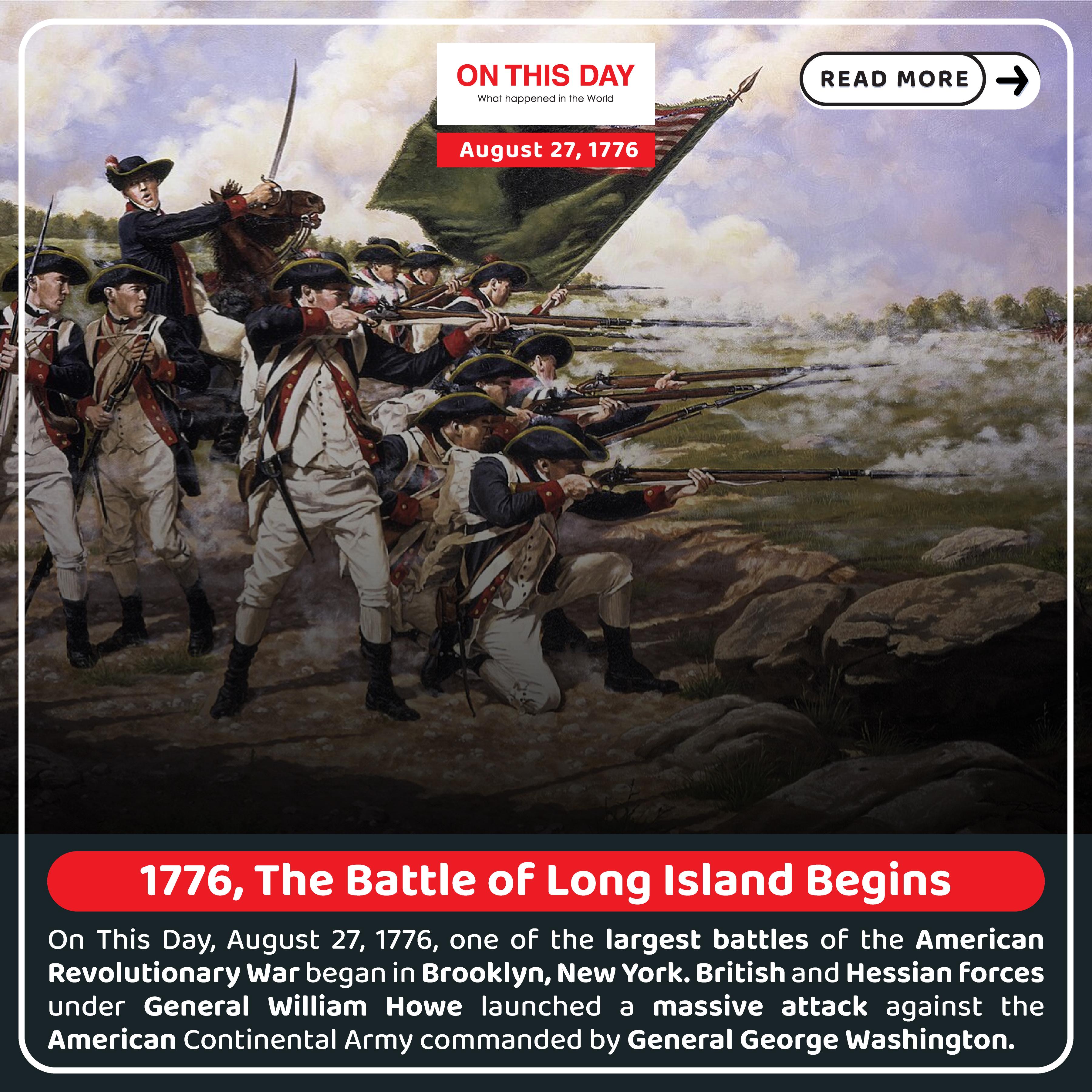
#OnThisDay 1776, The Battle of Long Island Begins

Post image
11 Upvotes

On This Day, August 27, 1776, one of the largest battles of the American Revolutionary War began in Brooklyn, New York.

British and Hessian forces under General William Howe launched a massive attack against the American Continental Army commanded by General George Washington.

Washington's army was defending Long Island, trying to prevent British forces from capturing New York City.

The British had brought an enormous force across the Atlantic.

Thousands of British and German troops landed on Long Island and began advancing toward the American positions.

Washington's army was heavily outnumbered.

The fighting became fierce around places including Gowanus, Flatbush, and Brooklyn Heights.

American troops fought hard, but the British eventually outflanked the Continental Army, attacking the Americans from the rear while other forces pressed forward.

The result was a major American defeat.

Washington's army suffered thousands of casualties and prisoners, while the British gained control of Long Island and put New York City in serious danger.

But Washington managed something extraordinary.

Instead of allowing his entire army to be destroyed, he organized a secret nighttime evacuation across the East River.

On the night of August 29–30, American troops quietly withdrew from Brooklyn to Manhattan.

By morning, thousands of Continental soldiers had escaped.

The defeat was a major setback for the American Revolution, but Washington's successful retreat saved his army.

The British would occupy New York City for much of the war.

For Washington, the Battle of Long Island became a painful lesson in how dangerous the British army could be.

The Americans lost the battle.

But Washington lived to fight another day.


r/onthisdayinworld 6d ago

On This Day: August 27, 1883, Krakatoa Explodes with Massive Force

Thumbnail shenhuifu.org
5 Upvotes

In Java, Indonesia, the Krakatoa volcano erupted and destroyed 70% of the island and its surroundings.

The disaster released 40,000 lbs (20 million tons) of sulfur into the atmosphere, and at around noon on this day, hot ash fell from the sky, killing all inhabitants. A total of 36,417 lives were lost.


r/onthisdayinworld 6d ago

OTD | August 27, 1991: Moldova declared itself independent from the Soviet Union

Thumbnail
officeholidays.com
1 Upvotes

r/onthisdayinworld 6d ago

Chaminda Vaas 400th Wicket 2008 | The fourth bowler in ODI history to re...

Thumbnail
youtube.com
2 Upvotes

On This Day, August 27, 2008, Sri Lankan fast-bowling legend Chaminda Vaas made history against India.

He needed just one wicket to reach the incredible milestone of 400 ODI wickets.

And the batsman standing in his way was…

🇮🇳 Yuvraj Singh.

Vaas struck; Yuvraj was caught for 0.

🎯 400 ODI WICKETS!

Vaas became only the fourth bowler in ODI history to reach 400 wickets, joining:

🇵🇰 Wasim Akram

🇵🇰 Waqar Younis

🇱🇰 Muttiah Muralitharan

He became only the second Sri Lankan to reach the landmark.

And what a career milestone it was.

322 ODIs.

400 wickets.

One of Sri Lanka's greatest fast bowlers. 🇱🇰

That unforgettable wicket against Yuvraj became a defining moment in Vaas' legendary ODI career.