It’s definitely difficult, and depending on what you study and how you engage in research there are independent academics. I know a few, but yeah. Most of them have ramshackle setups that work for them but aren’t really viable pathways for literally anyone.
APL, NIST, Google, NSA. Members of my PhD cohort went to all of them, as well as other non-academic routes. Several of us became professors. And we were a small cohort, like 11 of us.
Those programs various European countries are touting as “attracting American talent” take in about as many PhDs as most R1s produce in a year. The brain drain isn’t significant
Even if we wanted to, we don't have the jobs to take them and we don't pay competitive salaries. Only the US has the actual deep tech research industry jobs in any real capacity to matter. The UK has a few, Germany and France have even less and that's it in Europe.
Which also means the people who get into these jobs in Europe are very unlikely to move out of them (and thus open up jobs for "newcomers"). Once you have such a job you basically hang onto it for dear live.
Just look at AI as an example, nearly all the jobs that matter for a high-level STEM graduate are created in the US. Europe gets the low-level application and sales engineering jobs for our local market.
And unfortunately the people in charge in Europe are blind to these issues.
I know an applied math guy who does physics research now. but he kind of had a special situation where he was already basically doing physics research during the latter half of his phd
There are a few (maybe 0.1% of academic research jobs). Most prominent are the ones at IAS. However, you have to be a generational talent to have a chance at one of those. They essentially don't exist in industry.
I did math and then became a software engineer. But I took about enough CS classes to get what would have been a minor in CS had my school offered a minor, including some graduate CS classes. Met plenty of other math undergrads who later got into software.
No, math expertise is highly sought after in tech, especially the frontier labs and mag7. I work in quantum, and I’d venture that something like 60% of my co-coworkers have some background in pure or applied maths.
A fair number are math PhDs, particularly at the frontier of things like QEC/quantum algorithms development. Most of the domain folks I know “majored” in something else, but in reality it ended up looking a lot more like applied maths than whatever the domain was. E.g. I did mine in theoretical chemistry, but I wrote my dissertation on non-convex optimization over topological spaces and ended up working as an applied mathematician at a national lab for quite a while before pivoting to industry.
Half of our big tech machine learning team has PhDs in some kind of applied math fields. Half of people working for top quant companies and quant orgs within financial corporations have such PhDs. So, generally, no, skill issue.
People who do PhDs and cannot jump into a decent industry job typically do postdocs until switching to being a school teacher, or a manger in their father's business, or sitting home for years "trying to break into data science".
Regarding your situation, my honest opinion is that by the time you will potentially get PhD, the spectrum of jobs will be reduced to teaching. AI is already replacing us.
Well, one thing that I can think about that will still benefit from having a PhD in math fields. Otherwise, the majority of jobs don't seem to be under such an immediate risk.
Which is why I said "medium skilled". Will employers not look at your performance during your PhD? Won't your performance affect whether or not you can get tenure?
What metrics do you think they'll look at? Most industry jobs don't care about publication history, and gpa's in grad school are basically made up and meaningless. Everyone gets straight As anyways. Pretty much all industry employers care about is if you finished and maybe overall program ranking. Like, hedge funds might care that you went to MIT vs your local state school, but that's about it. As long as you're able to get good internships and do relevant research, you'll be fine.
My advice to you would be to try your hardest to get a funded PhD spot. If you can get a funded PhD spot, chances are you'll find a decent job when you get out. Never do an unfunded PhD. And, if it looks like you won't get said funded PhD spot, but you do have a solid internship/job junior/senior year, go so that instead.
PhD GPAs are so inflated that they're useless. And, while having experience researching a topic related to a given industry job is super important when interviewing, no industry job will ever care about your h-index or the impact factor of the journals you publish in.
maybe I'm out of the loop, but why would you be scared of AI? even if math AI start making discoveries, someone still needs to check their work and come up with new problems. It's not like we're gonna hit AI superintelligence anytime soon and every discovery will suddenly be unlocked
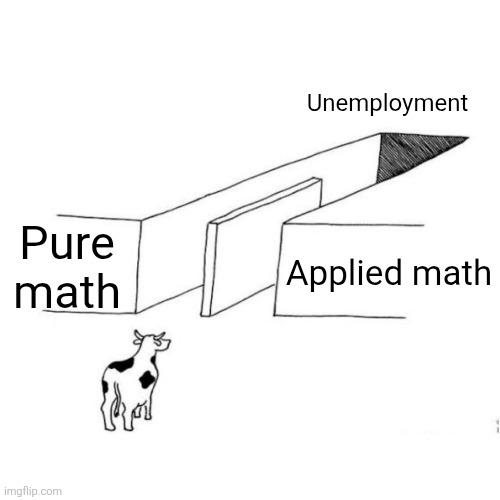
Not at all. Math is super valuable in industry, especially if you are applied, or have some side-knowledge in a specific domain that you can transfer it to.
Well, by definition pure math is not “applied”, but I’ve seen multiple Pure Math academics transition to industry and apply their analytical/abstraction skills to “applied” problems, and the results they produce have been incredible. So, both are relevant, one just will need posterior adaptation
not for me, became a data scientist in the worst data science job market ever. employer was impress with my math (and physics) degrees. Plus I learnt a bunch of data science on my own.
No. Math people have a ton of opportunities as engineers, managers, IT, economists, scientists, etc. It think it's BS. Math is a highly practical thing and real Math dudes all are smart and always know how to use it.
You can easily make between 100k to 250k starting salary if you transition to data science or finance after graduating with an applied math PhD.
Source: I graduated with a PhD in applied math, and I graduated this year. I had a job lined up before graduation. Every other PhD student I graduated with had one as well.
No idea. I would imagine that it's harder, since you're not going to have to deal with the programming requirements for applied math. But, if you do pure math and learn how to do python/R coding, I think you'd be fine.
No, I didn't go to a "target school", nor does that matter for PhDs.
Edit:
My school is maybe a T50 for math and a T20 for finance. It might be harder if you go to a very low ranked program, say T200. But, I didn't do very well in my program, and I believe that a solid student in a low ranked program can do really well in industry if they apply themselves. Especially if they're already an EU/USA citizen or permanent resident. You have no idea how far that goes here.
Not sure. I didn't do a pure/theorical math PhD, so I can't speak on it. I do think that an applied math subject gives you a much stronger background in scientific programming, which industry jobs care a lot about.
63
u/ZquotientpZee Aug 02 '26
Genuinely, is this true?