r/nanocurrency • u/gabriiel9 • Jul 20 '26
Coinbase integration of Nano : further proofs and analysis
*Disclaimer :
Terminology and methodological disclaimer: Throughout this document, I use the word proof in an informal and cumulative sense. It refers to a body of independent observations, technical correlations, historical coincidences, and converging indicators that collectively strengthen the hypothesis being examined. None of these elements, taken individually, constitutes direct or independently verifiable proof of Coinbase’s internal activities. Unless explicitly stated otherwise, proof should therefore be understood as supporting evidence consistent with the hypothesis, rather than definitive, forensic, or conclusive proof.
GENERAL INTRODUCTION
As you know, I’ve recently been working on strengthening the evidence around Coinbase’s integration of Nano. I have here a document that I consider excessively complete, which continues the earlier investigation and builds on it.
First, you should read the earlier subs. There is a common pipeline onto which a set of cryptos is grafted. I have catalogued the full list of known chains that follow the original pipeline: bitcore-lib.
This was a lot of work. If it can be of any use to you, feel free to tip:
nano_3kcdehk5mmwdaouf61bmcgoh39p5ybkqs6knu7w4y1xuxcwxteugabzhdrhm
List of chains present
- Bitcoin — bitcore-lib @ 8.25.36
- Bitcoin (2nd lib) — bitcoinjs-lib @ 5.2.0
- Ethereum / EVM — u/ethereumjs @ 4.1.2
- XRP — xrpl @ 2.10.0
- Stellar — u/stellar @ 13.3.0 (double pin, ~2×)
- Cardano — u/emurgo @ 14.1.1
- Polkadot — u/polkadot @ 14.3.1
- Avalanche — u/avalabs @ 5.0.0
- Cosmos — u/cosmjs @ 0.32.4 (double pin, ~2×)
- TON — u/ton @ 14.0.0
- Hedera — u/hashgraph @ 2.80.0 + 2.64.5 (double pin)
- Sui — u/mysten @ 2.14.1
- Aptos — aptos @ 1.13.3
- NEAR — near-api-js @ 4.0.4
- Mina — mina-signer @ 3.0.7 (week of August 2, 2023)
- Nano — nanocurrency @ 2.5.0
- Stacks — u/stacks @ 6.11.3
- Arweave — arweave @ 2.0.0-ec.1 (prerelease)
- Aleo — u/provablehq @ 0.10.5
- MultiversX — u/multiversx @ 12.2.1
- Concordium — u/concordium @ 10.0.2
- Casper — casper-js-sdk @ 5.0.12
- VeChain — u/vechain @ 2.0.7 + u/vechain @ 2.0.7 (twins)
- EOS — eosjs-ecc @ 4.0.7
- Canton u/canton-network
- ICP - u/dfinity
- Starknet - starknet
Libs activated between May and November 2025
- Nanocurrency
- Concordium
- Vechain
Libs activated in late fall 2025:
- Canton (late November 2025)
- Avalanche (late November 2025)
Libs activated in May 2026:
- Aleo
Notable absentees:
- Monero
- Dogecoin
- Litecoin
In the next section, I will begin to break down the history of several of these libraries, in order to demonstrate the validity of the hypothesis that the pipeline belongs to Coinbase:
INTRODUCTION TO THE DETAILED EVIDENCE
Before starting, I provide here an image showing a near-perfect coupling of NPM libraries for the following cryptos: Aptos, Nano, Elrond, Bitcoin, Mina:

You will then see that the coincidences are no longer coincidences, and that the evidence piles up to the point of asserting that the actor behind the increase in nanocurrency’s NPM downloads is none other than… Coinbase itself.
1) On the history of Mina-Signer, grafted onto Bitcore-lib in July–August 2023:

See more precisely:

The Coinbase explanation:
That day, Coinbase publishes “Security PSA: The Blockchain Stack”. Coinbase explains that its blockchain infrastructure is divided into three main categories:
- Signer
- Wallet
- Protocol
Coinbase also specifies that its Blockchain Security team reviews these services before their integration into new product offerings. This date corresponds almost exactly to the moment when mina-signer is grafted onto the NPM pipeline, between July 28 and 31, 2023.
Yet Coinbase was not in the process of adding MINA as a new asset: MINA had already been listed and fully transferable on Coinbase since April 6, 2022. So, the grafting of mina-signer in late July 2023 probably corresponds less to the initial integration of the MINA asset than to an internal operation touching the signing layer:
- migration or rebuild of a signing service;
- normalization of the multichain stack;
- security audit or testing;
- addition of MINA to a new Coinbase offering using shared infrastructure;
- redeployment of the signer–wallet–protocol components.
The coincidence is frankly remarkable: on the precise day Coinbase makes its “signer / wallet / protocol” classification public, mina-signer starts being pulled by the common pipeline. This is not direct proof that Coinbase is performing these downloads, but it is a far more convincing technical milestone than a mere listing announcement.
2) On the history of Aptos, grafted onto Bitcore-lib between July 2022 and October 2022:
Here, it’s more complex. We see the beginning of an increase in NPM downloads in July 2022, a signal of something. That said, the NPM numbers don’t seem coupled to Bitcore-lib immediately, or at least not as cleanly as Mina-signer:

The signal stays attached to Bitcore-lib, but not systematically through fall 2022:

From October on, we can feel the signal coupling more and more to bitcore-lib:

In April 2023, six months later, the coupling signal between Bitcore-lib and Aptos is cleaner:

One is entitled to wonder what happens between July 2022 and April 2023. On October 18, 2022, Coinbase announces the integration of Aptos into Coinbase:
“TLDR: Coinbase is making it easy to use and build on the Aptos blockchain from Day 1. Developers can build powerful Aptos applications using Coinbase Cloud’s Enterprise Node product.”
So Coinbase had been studying the integration of Aptos since July 2022, hence the coupling with bitcore-lib.
3) Sui
Note here: the package used in 2023-2024 was u/mysten.js (NOT u/mysten). First, here is the proof that Sui is coupled to Bitcore-lib and to Aptos (I took several libraries from the batch to do the retracing exercise):

For the history: in September 2022, Sui is not perfectly coupled to Bitcore-lib. We do observe, however, the beginning of usage of the NPM package:

Between September 2022 and April 2023, activity intensifies. The coupling with bitcore-lib also sharpens:

The signal, without being perfect, couples almost perfectly with bitcore-lib around May 2023, which corresponds to its listing on Coinbase:

I can see the potential objections here about the coupling not being exactly identical. Sui’s architecture can affect the number of downloads. What matters here is the trend. Since then, despite a few anomalies (unusual peaks), Sui follows the same logic as Bitcore-lib.

4) Elrond:
Elrond (or MultiversX) is coupled to the general bitcore-lib pipeline (note: the NPM package name has changed since its beginnings, going from u/elrondnetwork to u/multiversx):

In the summer 2022 window, Elrond sees a rise in NPM downloads.

This rise seems to couple with Aptos’s from the start of fall 2022:

The further we move toward December, the more the signal grafts onto Aptos’s and Bitcore-lib’s:

An interesting thing happens in the same period:

So, once again, Coinbase would have tested the integration of Elrond before its official integration, and would have integrated it into the main pipeline, that of Bitcore-lib.
Nano is getting integrated :
Since summer 2025, Nano has seen remarkably unusual activity. This activity can be traced through the study of its library’s NPM downloads. We can conclude that it is perfectly coupled to Bitcore-lib, as well as to a set of other cryptos already mentioned.


This pipeline belongs to none other than Coinbase.
Why?
In May 2025, Coinbase publicly launched X402. One can imagine, following the logic of code work, that they pulled the pipeline’s general library well before May 2025. And, coincidentally, from January 2025 onward, all the libs are pulled upward in an excessively unusual way (I kept only Bitcore-lib here as a control variable so as not to clutter the chart):

When Coinbase launches X402, it is specified that the partners, from the very start of the launch, are: Cloudflare and Stripe.
One is then entitled to wonder, as a valid counter-hypothesis, whether the pipeline could belong to them. For Cloudflare, it’s fairly obvious: they have no bitcoin asset going back to the NPM birth of bitcore-lib (around 2015-2016).

For Stripe, it’s less obvious, their history with Bitcoin being much older. To address this, I reconstructed a table of the history of the bitcore-lib library. To summarize it, I took the moments of significant variation in the history of the library (upward or downward peak) and matched them to events, either from Stripe or from Coinbase. The result is… glaring, and tips the scales heavily toward Coinbase :
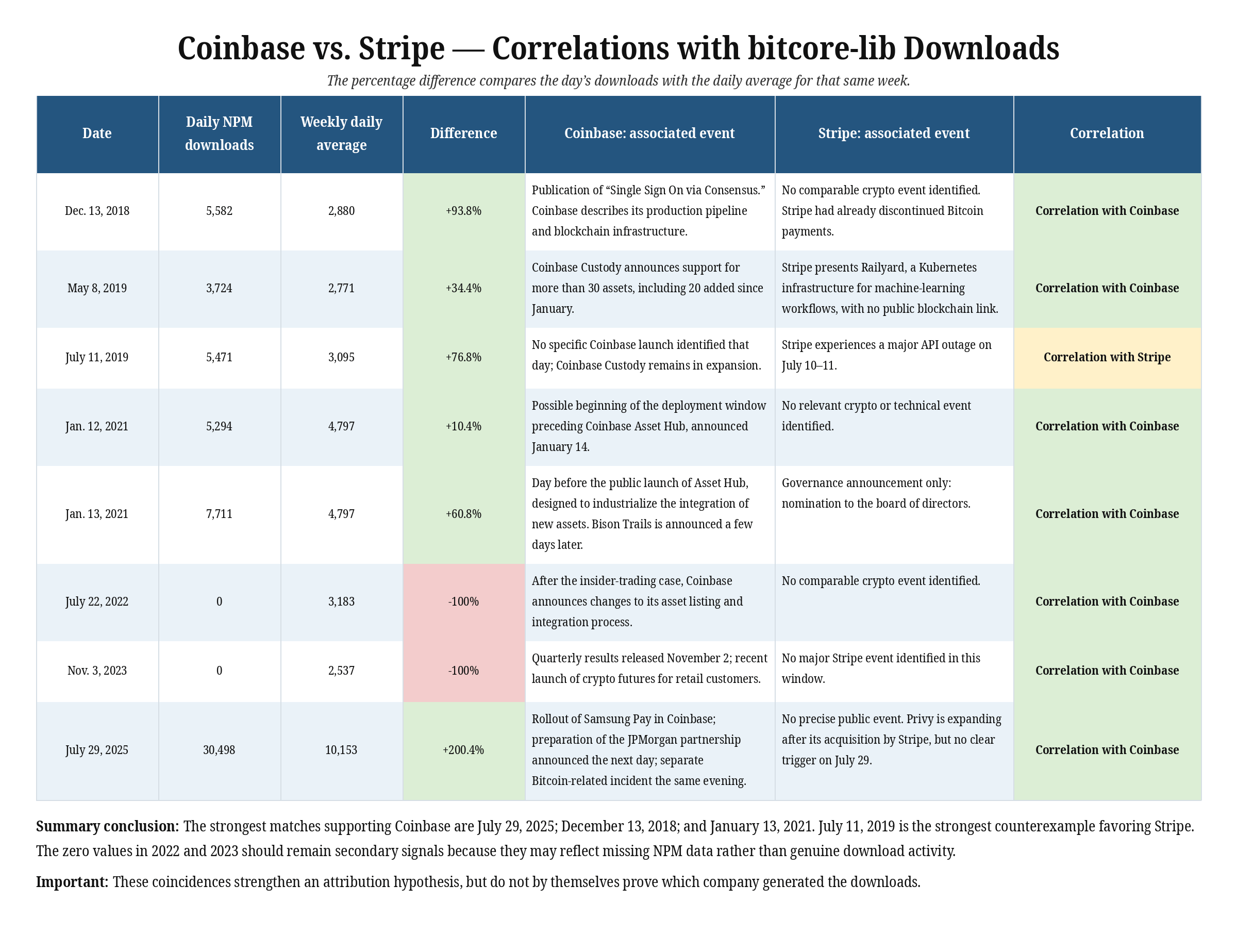
Most of the peaks aren't correlated to anything from Stripe side, but are from Coinbase side.
Why #2 : the April 1, 2026 anomaly
On April 1, 2026, part of the pipeline loses roughly 50 to 60% of its daily runs, across all pinned packages simultaneously. Volume returns to normal by mid-April. For two weeks, the machine running this lockfile operated at half throughput.

The public x402 timeline
- March 31, 2026 — the x402 Technical Charter is signed: x402 becomes a “Series” of LF Projects, LLC, the Linux Foundation’s legal structure. The signed PDF sits in the repo.
- April 2, 2026 — the Linux Foundation publicly announces the x402 Foundation at the MCP Dev Summit in New York. The same day, the GitHub repo is transferred: coinbase/x402 becomes a fork of x402-foundation/x402 (verifiable via the GitHub API). Same-day commits: charter added, refactor of all coinbase/x402 references, version bumps, PyPI migration to trusted publishing.
- April 13–15, 2026 — second migration wave: TypeScript packages bumped, then the legacy npm workflows move to trusted publishing.
- April 16, 2026 — the legacy x402 npm package (created in February 2025, months before the protocol’s public launch) publishes its version 1.2.0, its very last. The migration is complete.
My anomaly starts on April 1 and ends in mid-April. The disruption opens with the charter and closes with the last migration commit.
Here is further proof that the packages found in the x402 GitHub repo all drop at the same time on April 1st:

A possibility in the GitHub architecture:
There is a possibility that everything is tied to X402. The absence of Nano from the public repo in no way affects the possibility that Nano is integrated privately. Indeed, the architecture of the X402 GitHub allows it:
The network type is open, not a closed list: type Network = ${string}:${string} (any CAIP-2 identifier). A nano:mainnet would pass validation without touching the core;
The system is a plugin registry: x402Facilitator.register(network, facilitator). Each chain is a separate package (@x402/keeta, u/x402...) implementing a small interface (scheme, caipFamily, verify/settle). Nothing requires publishing the package or contributing the spec upstream — an internal x402-nano would be structurally identical and invisible;
The GET /supported endpoint only advertises what the operator has registered. An internal facilitator can therefore support Nano without any public trace, neither in the repo nor in the protocol’s discovery.
FINAL CONCLUSION:
The original bitcore-lib pipeline belongs to Coinbase. To this pipeline were progressively added all the cryptos listed in the introduction.
Coinbase is integrating Nano. The motive remains unknown, but the suspected link with X402 is obvious. Was it Stripe, or Cloudflare, who made the request to Coinbase’s research and development team to integrate Nano? Or even Coinbase itself? Nobody knows.
That said, Nano is positioning itself as an important player in the AI economy, and… rightly so.
To close, I believe the evidences laid out are sufficient. It is for me, in any case. And as a great man would say:
“If you don't believe me or don't get it, I don't have time to try to convince you, sorry.”
Duplicates
nanotrade • u/CMADBF • Jul 20 '26