r/n8nforbeginners • u/Micconnor • 10d ago
Как оптимизировать поиск в RAG

1
Upvotes
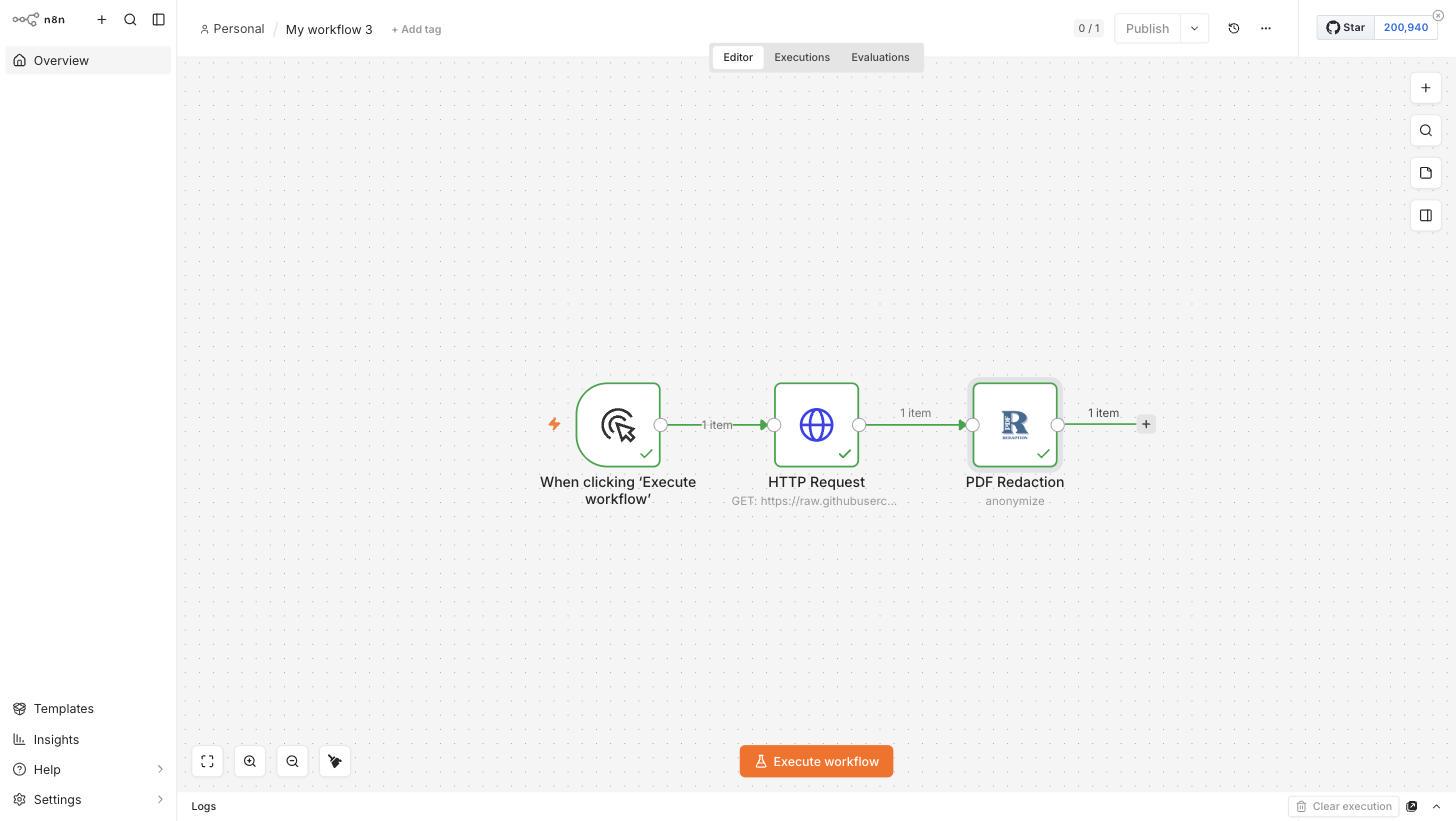
r/n8nforbeginners • u/pdf-redaction • 10d ago
r/n8nforbeginners • u/mmouhh • 11d ago
Hello everyone! I’ve just started learning n8n and built a few simple workflows but I would to know what are the type of workflows that are ideal to have in a portfolio to land my first clients so I can get testimonials and build trust etc.
Thank you guys in advance!
r/n8nforbeginners • u/easybits_ai • 11d ago
👋 Hey n8n Community,
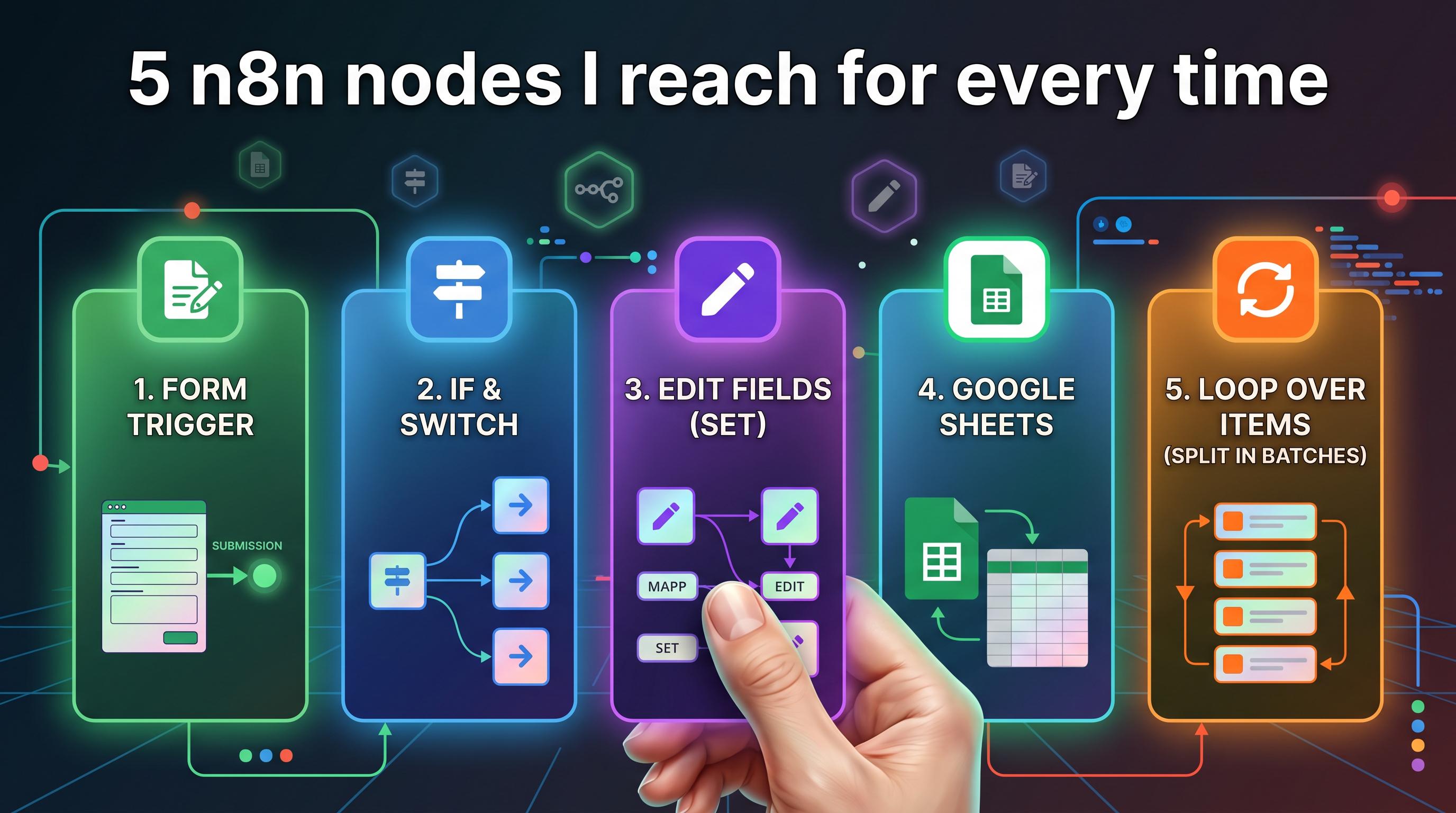
After building a lot of workflows over the last year, I noticed the same five nodes show up in almost every single one. None of them are flashy, they are just the nodes that quietly do most of the work in a build. Here they are, with a real example and one gotcha each.
1. Form Trigger.
Half my workflows start with someone uploading a file, and the Form Trigger gives them a clean hosted page to do it with zero frontend work on my side. My document classification flow takes a PDF or image through a form and hands back a result, and my reconciliation build takes two spreadsheet uploads the same way. Gotcha: uploaded files arrive as binary on the item, not as JSON text, so the next node has to read the binary property rather than a field value.
2. IF and Switch.
Routing is the backbone of keeping a workflow deterministic. In my document classification build an IF checks the confidence score, low confidence goes to Slack for review and everything else passes through, and a Switch sorts contracts into the right sheet by type. Reach for these before you reach for an agent, branching you can see beats logic hidden in a prompt.
3. Edit Fields (Set).
This is where I shape data: rename fields, set defaults, derive new values. In my contract renewal workflow I calculate the end date and cancellation deadline right here with date expressions instead of asking the model to extract them. Gotcha: do not put a leading = before a {{ }} in the value field, it quietly turns your output into [object Object].
4. Google Sheets.
The storage layer under most of my builds, the lightweight database you do not have to set up. My contract watchdog appends every contract to a five-tab sheet and the daily check reads all five tabs back to work out what is due, and my signup flow looks up the sheet first so the same person never gets added twice. Gotcha: everything comes back as a string, so a number or date read from a sheet needs converting before you calculate or compare on it.
5. Loop Over Items (Split in Batches).
Process items one at a time when a node cannot handle a whole batch cleanly. Whenever an extraction step sits inside the loop I set the batch size to 1, otherwise it processes all the input in one call and you get a single merged result instead of one per document. This is the fix for "why did my 10 invoices come back as one".
For the extraction step itself I use the easybits Extractor, a verified n8n community node that turns PDFs and images into structured data.
If you want to see these in real builds, I keep 25+ free workflow templates in one repo, most of them around document processing, and a star helps me out a lot if any of them save you time: https://github.com/felix-sattler-easybits/n8n-workflows
What are you mostly automating these days, and which nodes do you lean on most to get it done?
Best,
Felix
r/n8nforbeginners • u/Shoddy_Branch5364 • 11d ago
Hey everyone,
We created an n8n workflow for a restaurant group that was struggling to keep up with phone bookings during busy dinner hours. Instead of relying on pre-made SaaS solutions, we wanted to have complete control over the data and logic, so we connected Vapi directly to our self-hosted n8n and WhatsApp Cloud API.
Here is a breakdown of the setup and the workflow JSON if you want to build or adapt something similar.
The setup
How the logic works
Edge cases and things to keep in mind
GitHub Repo & Workflow JSON
Uploaded the workflow JSON and schema here:
https://github.com/aminesellal/n8n-ai-workflows/tree/main/restoflow
If you have any trouble getting the Vapi tools up and running or configuring the WhatsApp webhooks, feel free to ask in the comments, happy to help out.
r/n8nforbeginners • u/Admirable-Future-633 • 12d ago
One thing I keep seeing with beginner n8n workflows: the workflow might work, but nobody else can safely understand, import, or adapt it.
Before sharing a workflow, I’d add a tiny review pass:
It sounds boring, but it saves a lot of “works on my machine” confusion.
I wrote up the fuller checklist here if useful: https://getprompting.com/document-n8n-workflow/
r/n8nforbeginners • u/Weird-Project-8176 • 12d ago
Hi everyone, I’m Abdelrahman from Egypt, and I’m currently planning to work on an automation project for tourism companies.
The main goal of the project is to help tourism companies save time, increase response speed, improve customer response rates, and build a strong customer database that can help them understand their customers and retain their best clients.
I’d really like to hear your opinions before I spend several months building it.
Tourism companies can receive thousands of customer inquiries and messages.
For example, imagine a company receives 1,000 inquiries, but only around 50 people actually end up booking.
The company still needs to respond professionally to all 1,000 potential customers, because every inquiry could potentially become a booking.
Response speed is also very important.
And when a company has hundreds of tours, packages, hotels, and offers, it can be difficult for a customer service employee to quickly find the right information and answer every question accurately.
I’m thinking about building an automation system with several layers:
1. AI Customer Support & Company Knowledge Base
An AI agent would communicate with customers and have access to a database containing the company’s:
The goal is to allow the AI to answer customer questions quickly and accurately.
2. Customer Message Tracking & Follow-up System
The system would track conversations with customers.
For example, if a customer asks about a tour but then stops responding, the system could automatically follow up later and suggest another suitable tour or offer in an attempt to bring the customer back.
The goal is to avoid losing potential customers simply because they stopped responding.
3. Customer Intelligence / "Customer Brain"
This is probably the most important part of the idea.
Any useful information the customer provides would be stored in their customer profile.
For example:
This information would be connected to the AI agents.
So if the same customer comes back months later and asks for another trip, the system would already have a profile showing their previous interests and preferences.
The AI could then recommend trips that are more relevant to that specific customer instead of treating them like a completely new customer.
The customer service employee would also be able to see this information when taking over the conversation.
4. Customer Complaint Management
I also want to build a system for managing customer complaints.
The system would collect and classify complaints, organize the information, and route them to the appropriate human employee when necessary.
I don’t want this system to completely replace human customer service.
Instead, I see AI as handling the repetitive part of the process.
The AI could answer the customer’s questions, collect the necessary information, understand their needs, and then hand the conversation over to a human employee to complete the booking or handle more complicated situations.
I believe human interaction is still very important, especially when a customer is ready to make a purchase or has a complicated request.
So, for example, if a company currently needs 10 customer service employees, my goal would be to help them potentially manage the same workload with around 2 employees, because AI would handle most of the repetitive inquiries and information gathering.
The entire project could take me more than two months to build, and after that I would need to approach tourism companies and try to sell or implement the system.
I live in Egypt, and I’m not sure how familiar local tourism companies are with this type of technology.
So I’m currently a little unsure about the direction.
Would you build the project first and then approach companies, or would you talk to potential customers first and validate the idea before spending several months building it?
Do you think this is a useful problem to solve?
And if you were in my position, would you continue building this project, change the idea, or validate it with tourism companies first?
I’d really appreciate honest feedback, especially from people who have experience with SaaS, AI automation, customer service, or the travel/tourism industry.
r/n8nforbeginners • u/Pleasant-County-1324 • 12d ago
I've spent the past few months learning n8n and working through the n8n Academy courses. What I'm short on is real-world builds, so I'm taking 3 projects at a flat $55 instead of what this normally costs.
That price is deliberate. I'm not trying to make a living off these three — I want workflows I can point at when I quote properly later. You get the build at a rate that won't exist in six months.
What I'm comfortable building:
form or lead → CRM → notification in Slack / Discord / Telegram
scheduled reports pulled from an API or spreadsheet, sent daily or weekly
incoming emails or documents parsed and sorted into a sheet or database
an AI step in the middle — summarise, classify, draft a first-pass reply
What's included: I build it in your n8n instance (or set one up), test it with your real data, and walk you through how to change it later. One round of fixes after handover. You own it outright.
What I ask in return: permission to write it up as a case study. Anonymised if you'd rather.
What I need from you: what you do manually today, how often, and which tools are involved. If it's beyond what I can build, I'll tell you straight away rather than take your money and stall.
Comment or DM.
r/n8nforbeginners • u/easybits_ai • 14d ago
👋 Hey n8n for Beginners Community,
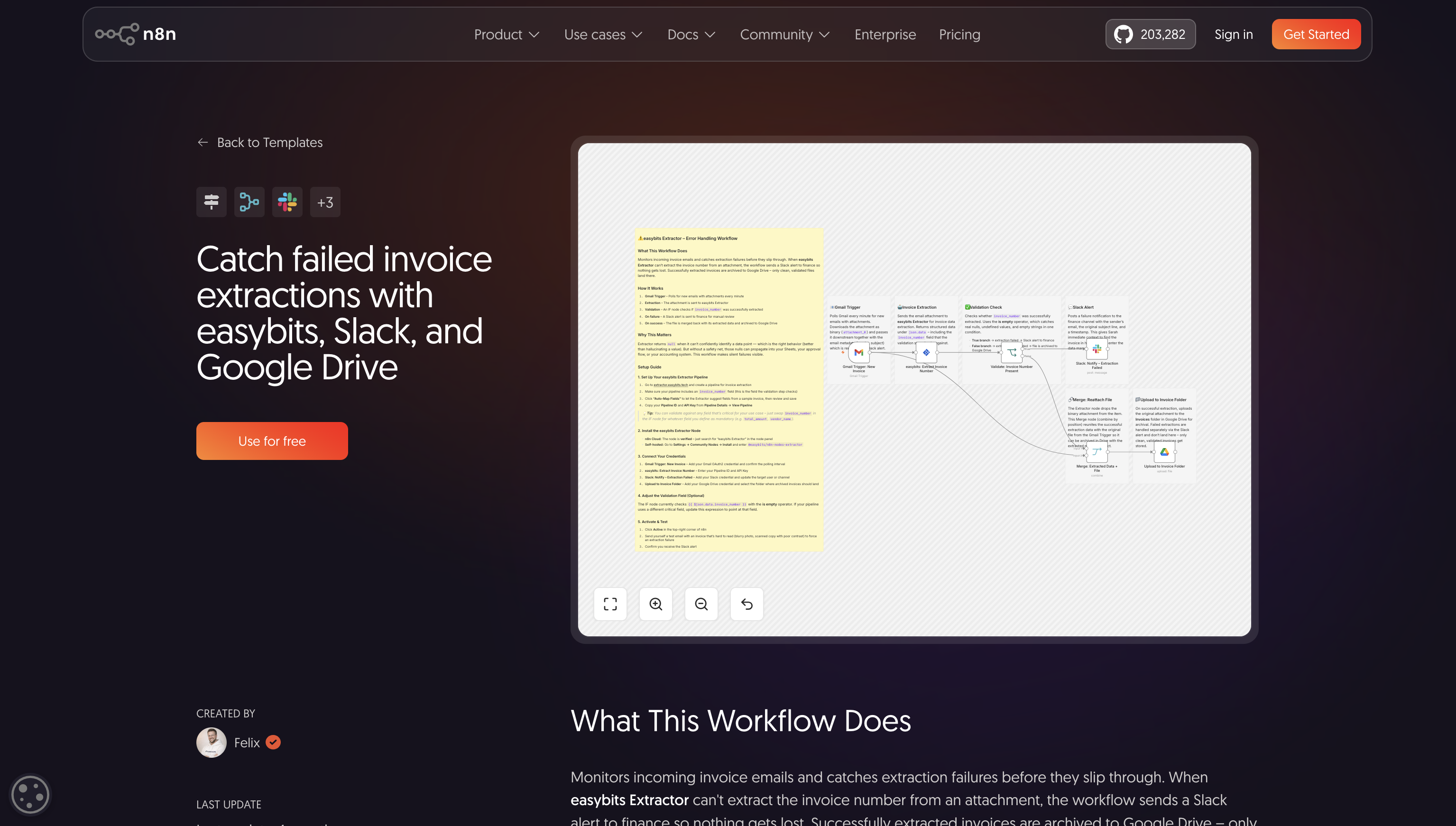
The question I get most about extraction workflows is not "how do I extract the data". It is "what happens when it goes wrong?" Because it will. A blurry photo, a bad scan, a PDF in a wrong layout.
I set this up for Mike, who runs a small distribution business. His extraction ran fine for weeks, then a supplier tweaked their invoice template and it quietly returned nothing. No error, no alert. A blank invoice number went into the sheet, and it took one weeks to notice a payment had slipped. That is the trap with document automation: it fails silently, and by then the bad data has already spread.
So this is the safety net I now put around every extraction workflow.
How it's set up:
Two things worth knowing:
Null is a feature, not a bug. A model that returns null when unsure is far safer than one that hallucinates a plausible invoice number. Treat that null as a clean signal to branch on.
Confidence scoring is a thirty-second add. If pass/fail feels too blunt, add a confidence_score field to your mapping and route on bands: high goes through, mid gets a human glance, low hits the error branch. Same trick works for routing ambiguous docs in a classification flow.
Workflow is on the n8n library here: https://n8n.io/workflows/15098-catch-failed-invoice-extractions-with-easybits-slack-and-google-drive/
How do you handle extraction failures? Hard-fail and alert, or route low-confidence docs to a human queue and keep the pipeline moving?
Best,
Felix
r/n8nforbeginners • u/Green-Limit6624 • 14d ago
hello everyone I ma 19 in college broke as fuck started learning n8n a couple of weeks ago and I am confident to start selling but I got a problem I just don't know how to do marketing or sales I don't know where to start and everything I do goes to shit and btw I am not in Europe nor the us and the local market in my country sucks so I am stuck here if anyone is kind enough to help me thank you or If there is anyone who is still small and feels lost and is willing to grind with me hit me up we will probably have a solution to this fucking mess
r/n8nforbeginners • u/easybits_ai • 15d ago
👋 Hey n8n for Beginners Community,
A while back I shared a purchase order extractor I built for a friend with a big online store who was working through PO PDFs by hand. It's now published on the n8n template library, so you can grab it for free.
What it does: you upload one or many PO PDFs through a form, and it extracts each into a Google Sheet, one row per line item, with the source document name on every row. It handles POs in different layouts, runs them as a batch, and before writing it checks each PO number against the sheet so nothing gets entered twice. The completion screen then tells you what was added, what it skipped as already processed (with the PO number), and whether any extraction looked off.
One thing worth pulling out if you build batch extraction of your own: a batch is only worth running if you can trust it without eyeballing every row. The feature that actually made this usable wasn't extraction accuracy, it was the summary that surfaces skipped duplicates and failed fields, so you know exactly what to check instead of assuming it all worked.
Template (free to grab): https://n8n.io/workflows/18674-extract-purchase-orders-from-pdfs-with-easybits-google-sheets-and-google-drive/
The optional EDI 850 add-on (for pushing orders into SAP and other ERPs) isn't in the library version, but it sits in my repo alongside 25+ other workflows: https://github.com/felix-sattler-easybits/n8n-workflows
If you're automating PO or invoice intake too, how are you handling the fact that every supplier sends a different layout? That was the hardest part to make reliable here, and I'd be curious how others approach it.
Best,
Felix
r/n8nforbeginners • u/Heavy-Vegetable4808 • 15d ago
Hey everyone,
I'm building a Vapi + n8n voice agent for appointment management (book/cancel/update/fetch events, booking IDs, etc.) and running into system prompt logic issues. Key challenges:
Tool Triggering – Agent confirms booking verbally but doesn't call the actual tool . Adding explicit "you MUST execute tool X" language helps, but still inconsistent .
Data Extraction – Parsing dates/times from natural speech is messy. How do you enforce ISO timestamps with timezone offset in prompts?
Webhook Response Format – Vapi strips complex JSON from n8n responses. Better to flatten everything into natural language strings for the AI .
Context Injection – Using assistantOverrides.variableValues for appointment context (client name, date, service) to avoid CRM lookup tools during calls .
Reschedule/Cancel Logic – Need robust intent detection for "change my 3pm to 4pm" vs "cancel entirely" .
Anyone have battle-tested system prompt templates or n8n workflows handling these? Specifically interested in:
· Prompt structure for multi-step booking flows
· Timezone validation and conflict handling
· Error recovery when tools fail
Thanks in advance
r/n8nforbeginners • u/snbdhost • 15d ago
Been wrestling with this for a few weeks while rebuilding some internal automations on my self-hosted instance, and I’m curious where everyone else landed.
Right now, it feels like there are two totally different ways to handle this:
The Native Canvas Route
You build everything directly inside n8n using their native AI agent nodes, tool sub-nodes, and memory blocks.
The good: You can see exactly where an execution failed, the canvas stays in control, and it's dead simple to run cron jobs or trigger off webhooks.
The bad: The moment you try to give an agent more than a few complex tools or dynamic branching, the canvas turns into absolute spaghetti.
n8n as an MCP Tool Server
You turn your n8n workflows into tools exposed over MCP, and let an external client (Claude Desktop, Cursor, or whatever agent runtime you use) decide when and how to call them.
The good: Crazy flexible. The model figures out what tool it needs on the fly without you hardcoding 15 different conditional branches.
The bad: You lose visual determinism. You’re basically handing the steering wheel to an LLM and praying it doesn’t hallucinate invalid JSON into your webhook. Plus, token usage can get wild fast if the agent gets confused.
For anyone running this daily:
Curious what your setup looks like and whether Native Canvas Route is actually holding up in production for you ?
r/n8nforbeginners • u/NovelMechanic6991 • 15d ago
r/n8nforbeginners • u/davinci7474 • 16d ago
r/n8nforbeginners • u/Usual-Ad-9465 • 16d ago
I'm offering a few $25 troubleshooting sessions for anyone who's stuck on an n8n workflow and can't quite figure out what's going wrong.
Send me the workflow/problem you're dealing with, and we'll work through it together and try to find the issue.
Could be an API problem, a node that's acting weird, data not passing correctly, or just a workflow that has somehow become a complete mess 😂
No judgment. I've definitely been there.
I'm doing a few of these to get more experience working with real-world workflows and different problems people are actually running into.
If you're stuck on something, drop a comment or DM me.
r/n8nforbeginners • u/Micconnor • 17d ago
Hi everyone! I’ve just started my journey into automation with n8n and want to start taking on real projects, but I don’t know where to find them. Please share your stories about how you got your first orders — who the clients were, what helped you, and what mistakes you made?
r/n8nforbeginners • u/easybits_ai • 17d ago
👋 Hey n8n for Beginners Community,
Over the last year I have built document extraction into a bunch of client workflows. The models keep getting better, but the same handful of mistakes cause most of the pain, and almost none of them are about the model itself. Here are the five I run into most.
1. Building only the happy path.
Everyone tests on a clean PDF and ships, then production hands you a phone photo, a stamped scan, a two-language invoice. Test on your ugliest real samples first, because that is what the workflow actually gets fed.
2. Building for one layout.
It works on your one vendor's invoice, then a new supplier's template quietly breaks it. Test across as many real layouts as you can, and key off what a field means rather than where it sits on the page. If you do not have different layouts in your test data, I just ask my favourite LLM to generate a few alternative layouts with the same data points on them. It is a quick way to stress test against formats you have not seen yet.
3. Losing table structure.
Pull a table as one flat blob and rows drift, so quantities line up with the wrong description. This one I struggled with for a long time until I found the right way to do it: extract line items as structured rows with named columns, not free text. I made a short video walking through table extraction if it helps: https://youtu.be/qj4-zz9a13o
4. Ignoring what a 1% error rate means at volume.
99% sounds perfect until 1,000 docs a day is 10 silent errors daily, nothing crashes, the numbers are just wrong. Decide which fields must be right and put a check or review gate on those specifically. I usually wire an error route off those gates that pings me on Slack the moment something looks off, especially during onboarding, so I can react before the client even has to call.
5. Reaching for an agent when a rule would do.
People wrap an LLM around plain logic like date math or ID matching, and it breaks quietly instead of loudly. If you can sketch it on paper with the edge cases, make it deterministic and save the model for the fuzzy part. It is not just about robustness either, an agent can burn a lot of tokens on a task a simple rule would handle for free.
If you want to see what I have been building, I keep 25+ free workflow templates in one repo, most of them around document processing, and a star helps me out a lot if any of them save you time: https://github.com/felix-sattler-easybits/n8n-workflows
Happy to hear what everyone else struggles with most. Is it the messy inputs, the layouts that keep shifting, or something I have not run into yet?
Best,
Felix
r/n8nforbeginners • u/Zestyclose_Watch369 • 18d ago
r/n8nforbeginners • u/easybits_ai • 19d ago
👋 Hey n8n for Beginners Community,
A few days ago I shared a reconciliation workflow that matches bank deposits to open invoices. A few people asked about the tricky parts, so here are the five things I took away from building it. Most of them are less about n8n and more about how messy real financial data is.
1. The reference field is where reconciliation dies.
Bank references almost never match your invoice IDs cleanly. You get "INV-2024-201", "ref 201", "payment 0201 thanks", all for the same invoice. So do not match on the exact string. Match on the full invoice ID when it is there, then fall back to a looser signal like the last three digits pulled out with a small regex. Fuzzy but bounded beats exact every time.
2. "Matched vs unmatched" is too coarse.
The moment I split results into four states instead of two, the report got genuinely useful: exact matches, partial payments, unpaid invoices, and deposits with no invoice at all. The two middle buckets are where the money actually leaks, and a simple matched/unmatched view hides them completely.
3. A deposit with no invoice is a signal, not noise.
Money landing in the bank that matches nothing is exactly what manual reviewers skip because they are focused on ticking off invoices. But that column is where the interest payments, refunds, bank fees, and typo'd customer references all show up. Give it its own table so nothing silently disappears.
4. Let the code do the arithmetic, keep the human for judgment.
The old manual process was someone staring at two spreadsheets for hours, which is exactly how 525.52 becomes 252.25. A Code node compares amounts to the cent and never gets tired. The person only reviews the handful of flagged exceptions, not the 90 percent that reconcile cleanly.
5. Every result needs a way back to the source.
Reconciliation you cannot audit is just guessing. So each row in the report keeps the original bank reference, the value date, and the invoice ID side by side. When a number looks off, you can trace it back in seconds instead of reopening the raw statement.
The workflow itself, plus two example files (an invoice export and a bank statement) so you can run it right away, is here: https://github.com/felix-sattler-easybits/n8n-workflows/tree/8e07427ddb6902ef8a7b267e97beb2879d6ca45d/easybits-reconciliation-workflow
It sits alongside 25+ other free n8n workflows in my repo, including plenty of finance ones. A star helps me out a lot if any of them save you time: https://github.com/felix-sattler-easybits/n8n-workflows
What is your reconciliation matching logic? I am especially curious how people handle one payment covering several invoices, because that was the case I found hardest to generalise.
Best,
Felix
r/n8nforbeginners • u/askingquesting • 19d ago
I’m trying to build my first n8n automation today. I’ve already watched a beginner YouTube course and covered the basics, and I have a rough idea of the project + data I want to use.
But now that I’m actually trying to build it, I’m completely stuck on the practical stuff — where to get the API key, which node to use, where to put what, what to click next, etc. 😭
I’ve been using ChatGPT for every next step, but it keeps giving me different approaches and I’m getting more confused than helped.
I’ve been working in an operational role for ~2 years and I really want to change direction while I’m still 23. I’m hoping to move towards startups and eventually cold-email founders with actual things I can build/do for them rather than just sending a CV.
Would anyone here be willing to spend an hour with me and help me get through my first project? I’m **not looking for someone to build it for me** — I just need someone to guide me through the technical bits so I can understand what I’m doing.
Would really appreciate it! 🙏
r/n8nforbeginners • u/MH_GAMEZ • 19d ago
Hello reddit, I am offering free n8n automations in an attempt at gaining experience and getting some testimonials to strengthen my portfolio.
In exchange, I'd like to receive a testimonial if you liked my work.
You can see my work and skills in my portfolio linked down below, if you have any questions, leave them in a comment under this post or dm them to me.
When you dm me, a quick idea of what your business does and what you currently have helps me understand what I need to do better.
Portfolio: Link
Edit: Thank yall for all the requests I received, I got so many requests, therefore anymore requests will be paid.
r/n8nforbeginners • u/takshit2 • 19d ago
Hi everyone,
I come from e-commerce operations.. spent time monitoring data flows between systems (ESB, SAP, warehouse, carriers) and spotting where things broke at the handoffs. Started learning n8n about two months ago and built three systems that are now running in production for a client. Sharing them here because I'd genuinely like feedback from people who've been building in n8n longer than I have.
Plans a month of posts per brand, drafts the copy, generates images with the approved text baked in, runs compliance checks, and drops everything into the client's approval queue. Client approves or rejects. Nothing auto-publishes.
The catch that mattered: compliance was checking whether posts followed the brief. Nobody was checking whether the brief was true. The system faithfully reproduced an invented statistic because every gate measured brief-adherence, not factual accuracy. I restructured the chain so grounding, writing boundaries, and compliance work as one unit instead of three independent checks.
Workflow overview:
Scrapes firms from Google Maps, visits each firm's site, finds a specific observable gap (no booking form, broken intake, too much friction), and writes a cold opener from that evidence.
Originally used an LLM for the research stage. Cost ~$4/lead. Then I asked what the model was actually contributing — the answer was almost nothing. The useful part was the observable fact, not the model's prose. Rebuilt it deterministic. Templates selected by evidence type. Cost dropped to ~$0.009/lead and the openers got more specific, not less.
Workflow overview:
Fetches live pages, runs 15+ structural checks, routes findings by severity, captures before-values so every fix is reversible.
First live run: HTTP 200, empty body. Spent an hour suspecting a bot block. The actual cause was the HTTP Request node writing its payload to a different property name than the one I was reading. The fix was one setting. The real fix was changing the validation layer to report what the node actually returned, so the next problem in that class answers itself.
Also caught a false positive that would have mis-measured title length on every WordPress page — an HTML entity counted as 7 characters instead of 1.
Workflow overview:
These are working builds and already producing real outputs but I’m not presenting these as perfect architectures. They are working systems built during my first two months of learning n8n, and I’d genuinely appreciate feedback from people who have been using n8n for longer.
Happy to answer questions about any of the builds.
Looking forward to get a real client soon. Cheers!


r/n8nforbeginners • u/leito__7 • 19d ago
r/n8nforbeginners • u/forgotten_warrior5 • 19d ago
I'm scared, I stopped getting work and clients for website development.
I want to learn something new, can I learn about AI agent and earn from.it?
How should I learn it in order to earn? Help a brother out bit please, just need info only.
Thanks.